battery HONDA FIT 2010 2.G Owner's Manual
[x] Cancel search | Manufacturer: HONDA, Model Year: 2010, Model line: FIT, Model: HONDA FIT 2010 2.GPages: 351, PDF Size: 5.67 MB
Page 315 of 351
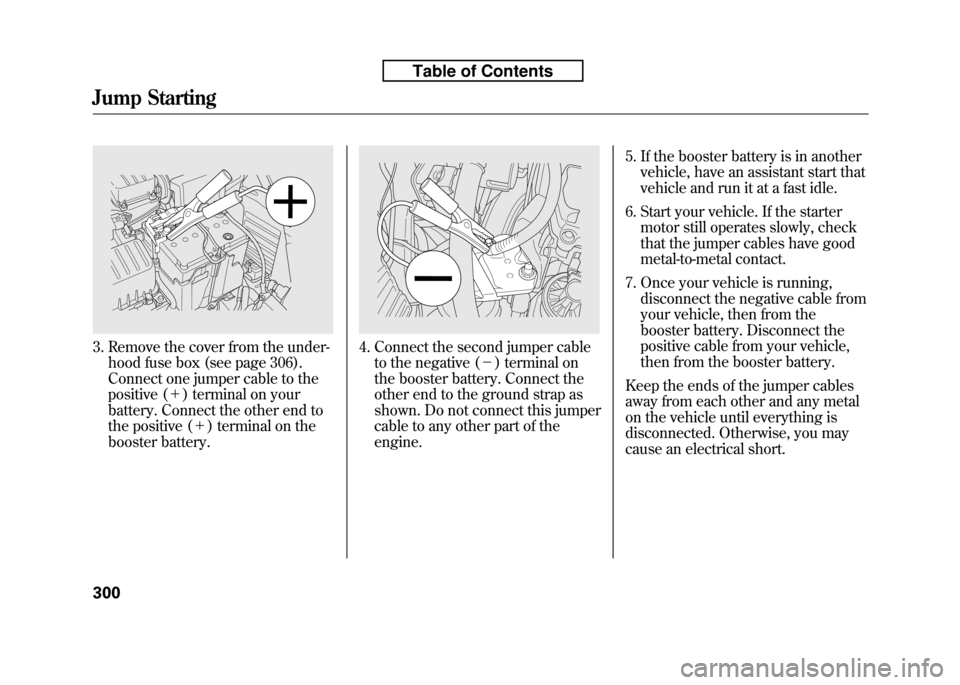
3. Remove the cover from the under-hood fuse box (see page 306).
Connect one jumper cable to the
positive ( +) terminal on your
battery. Connect the other end to
the positive ( +) terminal on the
booster battery.4. Connect the second jumper cable to the negative ( -) terminal on
the booster battery. Connect the
other end to the ground strap as
shown. Do not connect this jumper
cable to any other part of theengine. 5. If the booster battery is in another
vehicle, have an assistant start that
vehicle and run it at a fast idle.
6. Start your vehicle. If the starter motor still operates slowly, check
that the jumper cables have good
metal-to-metal contact.
7. Once your vehicle is running, disconnect the negative cable from
your vehicle, then from the
booster battery. Disconnect the
positive cable from your vehicle,
then from the booster battery.
Keep the ends of the jumper cables
away from each other and any metal
on the vehicle until everything is
disconnected. Otherwise, you may
cause an electrical short.
Jump Starting
300
Table of Contents
Page 318 of 351
Low Oil Pressure Indicator
This indicator should never
come on when the engine is
running. If it starts flashing or stays
on, the oil pressure has dropped very
low or lost pressure. Serious engine
damage is possible, and you should
take immediate action.
Running the engine with low oil
pressure can cause serious mechanical
damage almost immediately. Turn off
the engine as soon as you can safely get
the vehicle stopped. 1. Safely pull off the road, and shut
off the engine. Turn on the hazard
warning lights.
2. Let the vehicle sit for a minute. Open the hood, and check the oil
level (see page 201). An engine
very low on oil can lose pressure
during cornering and other drivingmaneuvers.
3. If necessary, add oil to bring the level back to the full mark on the
dipstick (see page 253).
4. Start the engine, and watch the oil pressure indicator. If it does not go
out within 10 seconds, turn off the
engine. There is a mechanical
problem that needs to be repaired
before you can continue driving(see Emergency Towing on page
311). Charging System Indicator
If the charging system
indicator comes on brightly
when the engine is running, the
battery is not being charged.
Immediately turn off all electrical
accessories. Try not to use other
electrically operated controls such as
the power windows. Keep the engine
running; starting the engine will
discharge the battery rapidly.
Go to a service station or garage
where you can get technicalassistance.
Low Oil Pressure Indicator, Charging System Indicator
303
Taking Care of the Unexpected
Table of Contents
Page 319 of 351
If this indicator comes on
while driving, it means one
of the engine's emissions control
systems may have a problem. Even
though you may feel no difference in
your vehicle's performance, it can
reduce your fuel economy and cause
increased emissions. Continued
operation may cause serious damage.
If you have recently refueled your
vehicle, the indicator coming on
could be due to a loose or missing
fuel fill cap. You will also see a‘‘ CHECK FUEL CAP ’’message on
the information display. Tighten the
cap until it clicks at least once.
Tightening the cap will not turn the
indicator off immediately; it can take
several days of normal driving. If the indicator comes on repeatedly,
even though it may go off as you
continue driving, have your vehicle
checked by a dealer as soon aspossible.
If you keep driving with the malfunction
indicator lamp on, you can damage
your vehicle's emissions controls and
engine. Those repairs may not be
covered by your vehicle's warranties.
If your vehicle has an automatic
transmission, the malfunction
indicator lamp may also come on
with the
‘‘D ’’indicator. Readiness Codes
Your vehicle has certain
‘‘readiness
codes ’’that are part of the on-board
diagnostics for the emissions
systems. In some states, part of the
emissions testing is to make sure
these codes are set. If they are not
set, the test cannot be completed.
If the battery in your vehicle has
been disconnected or gone dead,
these codes are erased. It can take
several days of driving under various
conditions to set the codes again.
To check if they are set, turn the
ignition switch to the ON (II)
position, without starting the engine.
The malfunction indicator lamp will
come on for 20 seconds. If it then
goes off, the readiness codes are set.
If it blinks five times, the readiness
codes are not set. If possible, do not
take your vehicle for an emissions
test until the readiness codes are set.
Refer to Emissions Testing for
more information (see page 329).
Malfunction Indicator Lamp
304
Table of Contents
Page 321 of 351
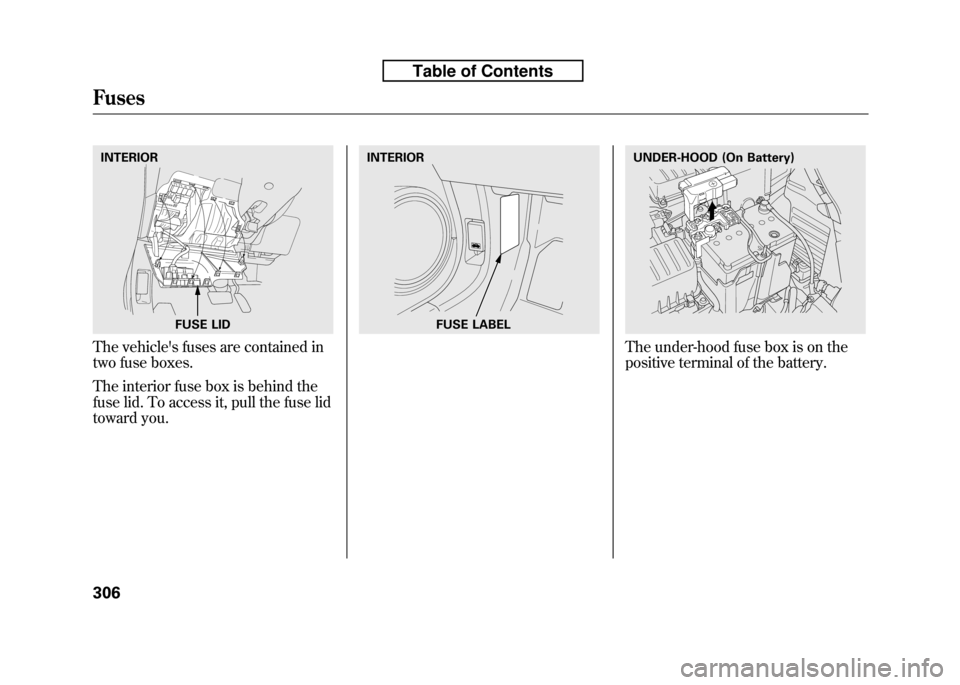
The vehicle's fuses are contained in
two fuse boxes.
The interior fuse box is behind the
fuse lid. To access it, pull the fuse lid
toward you.The under-hood fuse box is on the
positive terminal of the battery.
INTERIORFUSE LID
FUSE LABEL
INTERIOR
UNDER-HOOD (On Battery)
Fuses
306
Table of Contents
Page 325 of 351
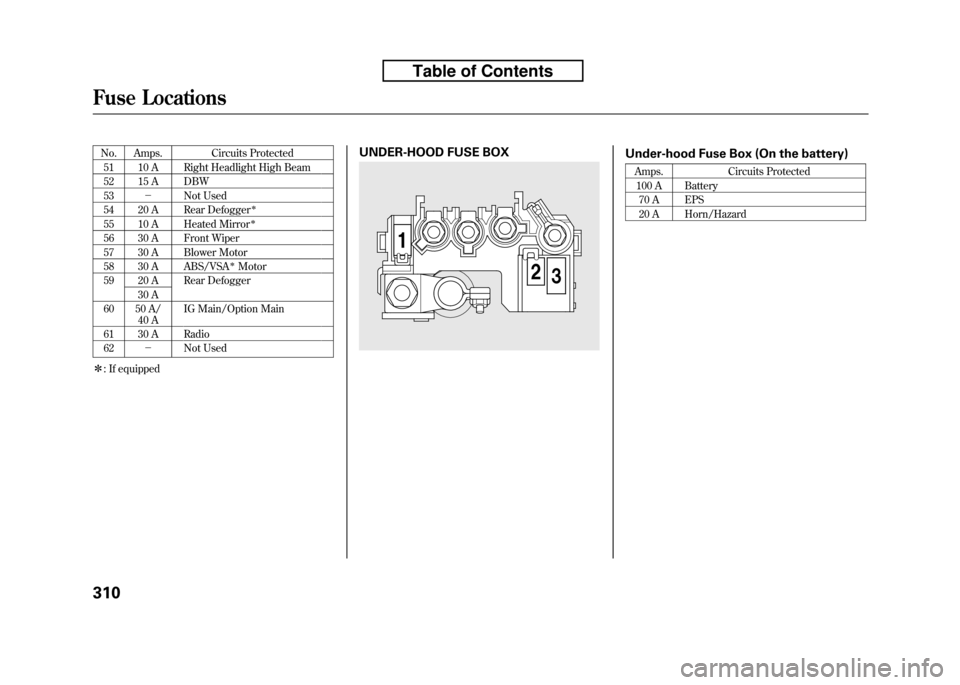
No. Amps. Circuits Protected51 10 A Right Headlight High Beam
52 15 A DBW53 - Not Used
54 20 A Rear Defogger
ꭧ
55 10 A Heated Mirrorꭧ
56 30 A Front Wiper
57 30 A Blower Motor
58 30 A ABS/VSA
ꭧMotor
59 20 A Rear Defogger
30 A
60 50 A/ 40 A IG Main/Option Main
61 30 A Radio62 - Not Used
ꭧ : If equipped UNDER-HOOD FUSE BOX
Under-hood Fuse Box (On the battery)
Amps. Circuits Protected100 A Battery 70 A EPS
20 A Horn/Hazard
Fuse Locations
310
Table of Contents
Page 335 of 351

BatteryCapacity 12 V -32 AH/5 HR
12 V -34 AH/5 HR
12 V -40 AH/20 HR
Fuses Interior See page 309 or the fuse label attached to the dashboard.
Under-hood See page 310 or the fuse box cover.
Alignment Toe-in Front 0.0 in (0 mm)
Rear 0.10 in (2.5 mm)
Camber Front 0° Rear -1°
Caster Front 3°20' Tires
Size Front/Rear 175/65R15 84Sꭧ 1
185/55R16 83Hꭧ2
Spare T125/70D15 95Mꭧ3
T135/80D15 99Mꭧ4
Pressure Front/Rear 32 psi (220 kPa, 2.2 kgf/cm2)ꭧ1
33 psi (230 kPa, 2.3 kgf/cm2)ꭧ2
Spare 60 psi (420 kPa, 4.2 kgf/cm2)
ꭧ 1: All models except Sport
ꭧ 2: Sport model
ꭧ 3: On models without VSA system and all Canadian models with
manual transmission
ꭧ 4: On models with VSA system
Specifications
320
Table of Contents
Page 344 of 351

Testing of Readiness Codes
If you take your vehicle for an
emissions test shortly after the
battery has been disconnected or
gone dead, it may not pass the test.
This is because of certain‘‘readiness
codes ’’that must be set in the on-
board diagnostics for the emissions
systems. These codes are erased
when the battery is disconnected,
and set again only after several days
of driving under a variety ofconditions. If the testing facility determines that
the readiness codes are not set, you
will be requested to return at a later
date to complete the test. If you must
get the vehicle retested within the
next two or three days, you can
condition the vehicle for retesting by
doing the following.
1. Make sure the gas tank is nearly,
but not completely, full (around 3/4).
2. Make sure the vehicle has been parked with the engine off for 6
hours or more.
3. Make sure the ambient temperature is between 40° and95°F. 4. Without touching the accelerator
pedal, start the engine, and let it
idle for 20 seconds.
5. Keep the vehicle in Park (automatic transmission) or
neutral (manual transmission).
Increase the engine speed to 2,000
rpm, and hold it there until the
temperature gauge rises to at least
1/4 of the scale (about 3 minutes).
6. Without touching the accelerator pedal, let the engine idle for 20seconds.
CONTINUED
Emissions Testing
329
Technical Information
Table of Contents
Page 348 of 351

U.S. Owners
Your new vehicle is covered by thesewarranties:
New Vehicle Limited Warranty-
covers your new vehicle, except for
the battery, emissions control
systems, and accessories against
defects in materials andworkmanship.
Emissions Control Systems Defects Warranty and Emissions
Performance Warranty
- these two
warranties cover your vehicle's
emissions control systems. Time,
mileage, and coverage are
conditional. Please read your
warranty booklet for exactinformation.
Original Equipment Battery Limited Warranty
- this warranty gives up to
100% credit toward a replacementbattery.
Seat Belt Limited Warranty- a seat
belt that fails to function properly is
covered by a limited warranty. Please
read your warranty booklet fordetails.
Rust Perforation Limited Warranty-
all exterior body panels are covered
for rust-through from the inside for
the specified time period with no
mileage limit.
Accessory Limited Warranty-
Honda accessories are covered
under this warranty. Time and
mileage limits depend on the type of
accessory and other factors. Please
read your warranty booklet fordetails.
Replacement Parts Limited Warranty
- covers all Honda replacement
parts against defects in materials andworkmanship.
Replacement Battery Limited
Warranty
- provides prorated
coverage for a replacement battery
purchased from your dealer.
Replacement Muffler Lifetime Limited Warranty
- provides
coverage for as long as the purchaser
of the muffler owns the vehicle.
Restrictions and exclusions apply to
all these warranties. Please read the
2010 Honda warranty information
booklet that came with your vehicle
for precise information on warranty
coverages. Your vehicle's original
tires are covered by their
manufacturer. Tire warranty
information is in a separate booklet.
Canadian Owners
Please refer to the 2010 warranty
manual that came with your vehicle.
Warranty Coverages
333
Warranty and Customer Relations
Table of Contents