tow HONDA FIT 2010 2.G Owner's Guide
[x] Cancel search | Manufacturer: HONDA, Model Year: 2010, Model line: FIT, Model: HONDA FIT 2010 2.GPages: 351, PDF Size: 5.67 MB
Page 322 of 351
Checking and Replacing Fuses
If something electrical in your
vehicle stops working, check for a
blown fuse first. Determine from the
chart on pages 309 and 310, or the
diagram on the fuse label, which fuse
or fuses control that device. Check
those fuses first, but check all the
fuses before deciding that a blown
fuse is the cause. Replace any blown
fuses, and check if the device works.
1. Turn the ignition switch to theLOCK (0) position. Make sure the
headlights and all other
accessories are off.
2. On the under-hood fuse box, remove the cover from the fuse
box. On the interior fuse box, pull
the fuse lid toward you.
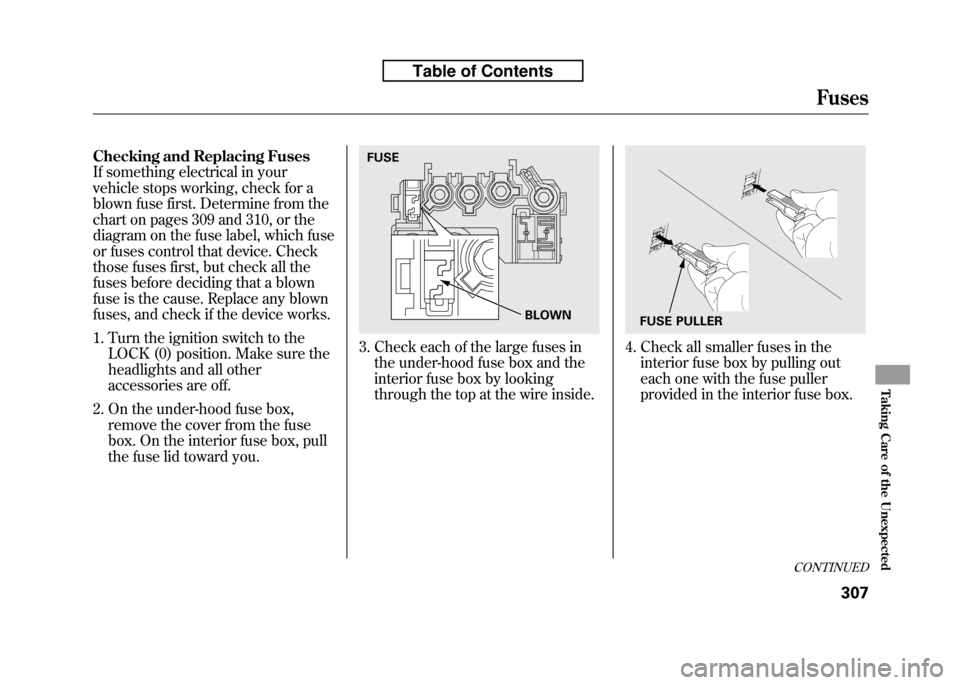
3. Check each of the large fuses inthe under-hood fuse box and the
interior fuse box by looking
through the top at the wire inside.4. Check all smaller fuses in theinterior fuse box by pulling out
each one with the fuse puller
provided in the interior fuse box.
FUSE
BLOWN
FUSE PULLER
CONTINUED
Fuses
307
Taking Care of the Unexpected
Table of Contents
Page 326 of 351
If your vehicle needs to be towed,
call a professional towing service or
organization. Never tow your vehicle
with just a rope or chain. It is verydangerous.
There are two ways to tow your vehicle:
Flat-bed Equipment-The operator
loads your vehicle on the back of atruck. This is the best way to
transport your vehicle.
Wheel-lift Equipment- The tow
truck uses two pivoting arms that go
under the front tires and lift them off
the ground. The rear tires remain on
the ground. This is an acceptable
way to tow your vehicle. If, due to damage, your vehicle must
be towed with the front wheels on
the ground, do this:
Manual transmission:
●
Release the parking brake.
● Shift the transmission to neutral.
● Leave the ignition switch in the
ACCESSORY (I) position so the
steering wheel does not lock.
Automatic transmission:
●Release the parking brake.
● Start the engine.
● Shift to D position and hold for 5
seconds, then to N. Let the engine
run for 3 minutes, then turn it off.
● Turn off the engine.
● Leave the ignition switch in the
ACCESSORY (I) position so the
steering wheel does not lock.
Improper towing preparation will
damage the transmission. Follow the
above procedure exactly. If you cannot
shift the transmission or start the
engine (automatic transmission), your
vehicle must be transported with the
front wheels off the ground.
With the front wheels on the ground,
it is best to tow the vehicle no farther
than 50 miles (80 km), and keep the
speed below 35 mph (55 km/h).
CONTINUED
Emergency Towing
311
Taking Care of the Unexpected
Table of Contents
Page 327 of 351
Trying to lift or tow your vehicle by the
bumpers will cause serious damage.
The bumpers are not designed to
support the vehicle's weight.
The steering system can be damaged if
the steering wheel is locked. Leave the
ignition switch in the ACCESSORY (I)
position, and make sure the steering
wheel turns freely before you begin towing.If Your Vehicle Gets Stuck
If your vehicle gets stuck in sand,
mud, or snow, call a towing service to
pull it out (see page 311).
For very short distances, such as
freeing the vehicle, you can use the
detachable towing hook that mounts
on the anchor in the front bumper.
To use the towing hook:
1. Take the towing hook and the
extension out of the tool kit in the
cargo area.
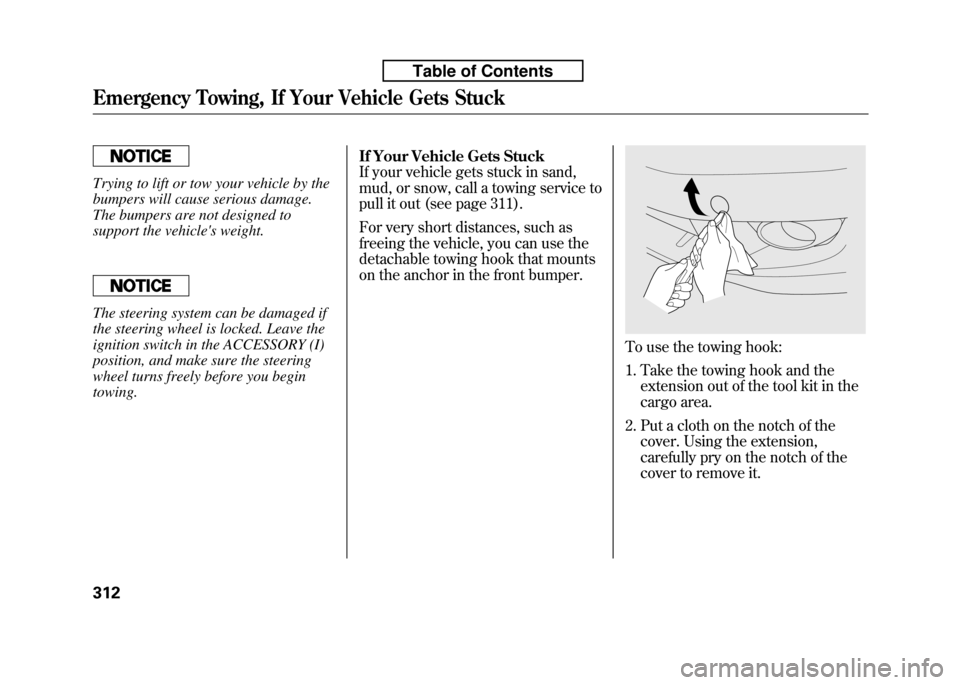
2. Put a cloth on the notch of the cover. Using the extension,
carefully pry on the notch of the
cover to remove it.
Emergency Towing, If Your Vehicle Gets Stuck
312
Table of Contents
Page 328 of 351
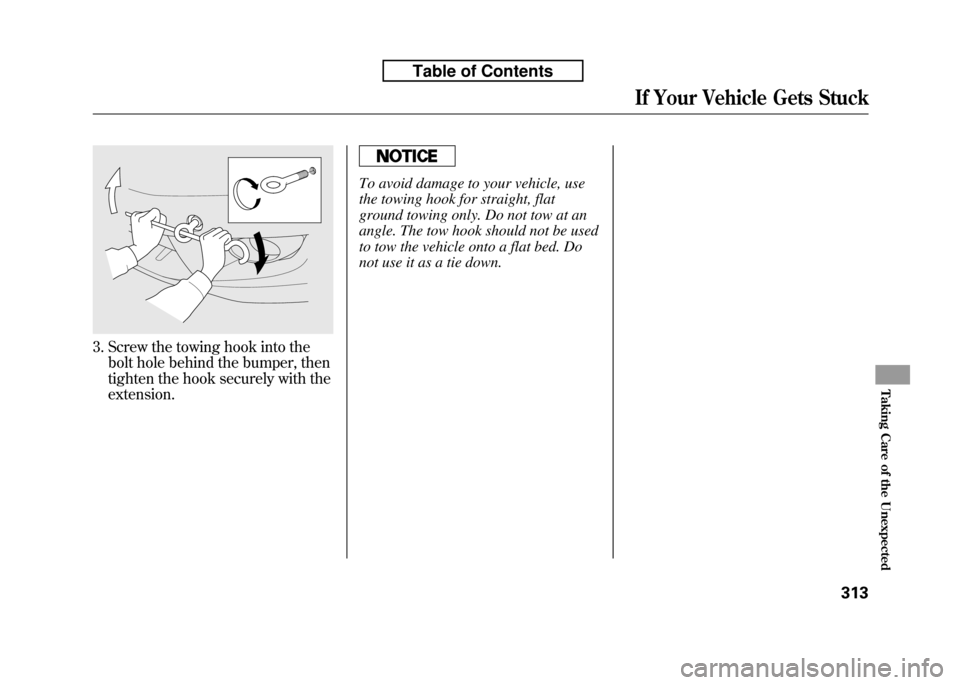
3. Screw the towing hook into thebolt hole behind the bumper, then
tighten the hook securely with theextension.
To avoid damage to your vehicle, use
the towing hook for straight, flat
ground towing only. Do not tow at an
angle. The tow hook should not be used
to tow the vehicle onto a flat bed. Do
not use it as a tie down.
If Your Vehicle Gets Stuck
313
Taking Care of the Unexpected
Table of Contents
Page 348 of 351

U.S. Owners
Your new vehicle is covered by thesewarranties:
New Vehicle Limited Warranty-
covers your new vehicle, except for
the battery, emissions control
systems, and accessories against
defects in materials andworkmanship.
Emissions Control Systems Defects Warranty and Emissions
Performance Warranty
- these two
warranties cover your vehicle's
emissions control systems. Time,
mileage, and coverage are
conditional. Please read your
warranty booklet for exactinformation.
Original Equipment Battery Limited Warranty
- this warranty gives up to
100% credit toward a replacementbattery.
Seat Belt Limited Warranty- a seat
belt that fails to function properly is
covered by a limited warranty. Please
read your warranty booklet fordetails.
Rust Perforation Limited Warranty-
all exterior body panels are covered
for rust-through from the inside for
the specified time period with no
mileage limit.
Accessory Limited Warranty-
Honda accessories are covered
under this warranty. Time and
mileage limits depend on the type of
accessory and other factors. Please
read your warranty booklet fordetails.
Replacement Parts Limited Warranty
- covers all Honda replacement
parts against defects in materials andworkmanship.
Replacement Battery Limited
Warranty
- provides prorated
coverage for a replacement battery
purchased from your dealer.
Replacement Muffler Lifetime Limited Warranty
- provides
coverage for as long as the purchaser
of the muffler owns the vehicle.
Restrictions and exclusions apply to
all these warranties. Please read the
2010 Honda warranty information
booklet that came with your vehicle
for precise information on warranty
coverages. Your vehicle's original
tires are covered by their
manufacturer. Tire warranty
information is in a separate booklet.
Canadian Owners
Please refer to the 2010 warranty
manual that came with your vehicle.
Warranty Coverages
333
Warranty and Customer Relations
Table of Contents