maintenance HONDA FIT 2010 2.G Service Manual
[x] Cancel search | Manufacturer: HONDA, Model Year: 2010, Model line: FIT, Model: HONDA FIT 2010 2.GPages: 351, PDF Size: 5.67 MB
Page 284 of 351
Check the condition of the wiper
blades at least every six months.
Replace them if you find signs of
cracking in the rubber, areas that are
getting hard, or if they leave streaks
and unwiped areas when used.
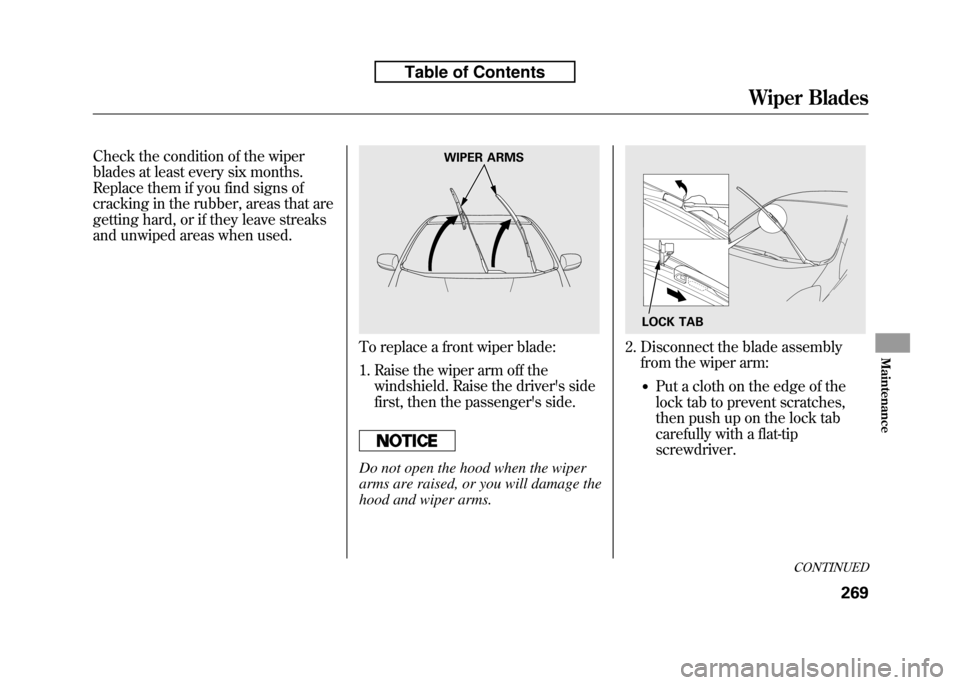
To replace a front wiper blade:
1. Raise the wiper arm off thewindshield. Raise the driver's side
first, then the passenger's side.
Do not open the hood when the wiper
arms are raised, or you will damage the
hood and wiper arms.
2. Disconnect the blade assemblyfrom the wiper arm:
● Put a cloth on the edge of the
lock tab to prevent scratches,
then push up on the lock tab
carefully with a flat-tipscrewdriver.
WIPER ARMS
LOCK TAB
CONTINUED
Wiper Blades
269
Maintenance
Table of Contents
Page 286 of 351
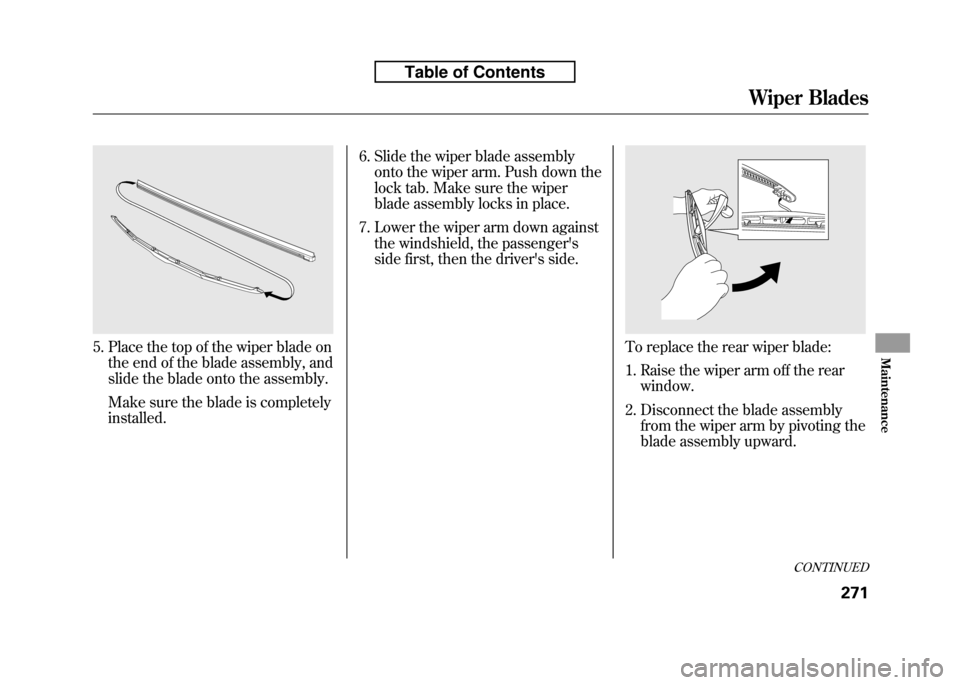
5. Place the top of the wiper blade onthe end of the blade assembly, and
slide the blade onto the assembly.
Make sure the blade is completely installed. 6. Slide the wiper blade assembly
onto the wiper arm. Push down the
lock tab. Make sure the wiper
blade assembly locks in place.
7. Lower the wiper arm down against the windshield, the passenger's
side first, then the driver's side.To replace the rear wiper blade:
1. Raise the wiper arm off the rearwindow.
2. Disconnect the blade assembly from the wiper arm by pivoting the
blade assembly upward.
CONTINUED
Wiper Blades
271
Maintenance
Table of Contents
Page 288 of 351

To safely operate your vehicle, your
tires must be the proper type and
size, in good condition with adequate
tread, and correctly inflated.
The following pages give more
detailed information on how to take
care of your tires and what to do
when they need to be replaced.
Using tires that are excessively
worn or improperly inflated can
cause a crash in which you can
be seriously hurt or killed.
Follow all instructions in this
owner's manual regarding tire
inflation and maintenance.Inflation Guidelines
Keeping the tires properly inflated
provides the best combination of
handling, tread life, and ridingcomfort.
● Underinflated tires wear unevenly,
adversely affect handling and fuel
economy, and are more likely to
fail from being overheated.
● Overinflated tires can make your
vehicle ride more harshly, are
more prone to damage from road
hazards, and wear unevenly.
The tire pressure monitoring system(TPMS)
ꭧwarns you when a tire
pressure is low. See page 235 for
more information. ꭧ : If equipped Even though your vehicle is
equipped with TPMS, we
recommend that you visually check
your tires every day. If you think a
tire might be low, check it
immediately with a tire gauge.
Use a gauge to measure the air
pressure in each tire at least once a
month. Even tires that are in good
condition may lose 1 to 2 psi (10 to
20 kPa, 0.1 to 0.2 kgf/cm
2) per
month. Remember to check the
spare tire (if equipped) at the sametime.
Check the air pressures when the
tires are cold. This means the vehicle
has been parked for at least 3 hours,
or driven less than 1 mile (1.6 km).
Add or release air, if needed, to
match the recommended cold tirepressures.
CONTINUED
Tires
273
Maintenance
Table of Contents
Page 290 of 351
Tire Inspection
Every time you check inflation, you
should also examine the tires for
damage, foreign objects, and wear.
You should look for:● Bumps or bulges in the tread or
side of the tire. Replace the tire if
you find either of these conditions.
● Cuts, splits, or cracks in the side of
the tire. Replace the tire if you can
see fabric or cord.
● Excessive tread wear.
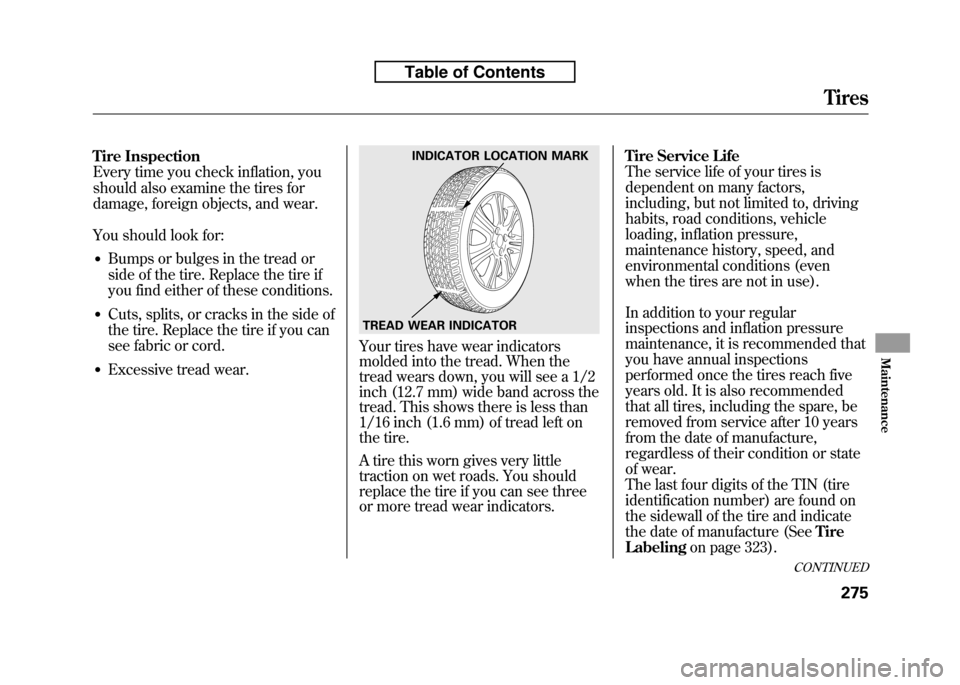
Your tires have wear indicators
molded into the tread. When the
tread wears down, you will see a 1/2
inch (12.7 mm) wide band across the
tread. This shows there is less than
1/16 inch (1.6 mm) of tread left on
the tire.
A tire this worn gives very little
traction on wet roads. You should
replace the tire if you can see three
or more tread wear indicators. Tire Service Life
The service life of your tires is
dependent on many factors,
including, but not limited to, driving
habits, road conditions, vehicle
loading, inflation pressure,
maintenance history, speed, and
environmental conditions (even
when the tires are not in use).
In addition to your regular
inspections and inflation pressure
maintenance, it is recommended that
you have annual inspections
performed once the tires reach five
years old. It is also recommended
that all tires, including the spare, be
removed from service after 10 years
from the date of manufacture,
regardless of their condition or state
of wear.
The last four digits of the TIN (tire
identification number) are found on
the sidewall of the tire and indicate
the date of manufacture (See
Tire
Labeling on page 323).
INDICATOR LOCATION MARK
TREAD WEAR INDICATOR
CONTINUED
Tires
275
Maintenance
Table of Contents
Page 291 of 351
Tire Maintenance
In addition to proper inflation, correct
wheel alignment helps to decrease
tire wear. If you find a tire is worn
unevenly, have your dealer check the
wheel alignment.
Have your dealer check the tires if
you feel a consistent vibration while
driving. A tire should always be
rebalanced if it is removed from the
wheel. When you have new tires
installed, make sure they are
balanced. This increases riding
comfort and tire life. For best results,
have the installer perform a dynamicbalance.
On vehicles with aluminum wheels,
improper wheel weights can damage
your vehicle's aluminum wheels. Use
only Honda wheel weights forbalancing.Tire Rotation
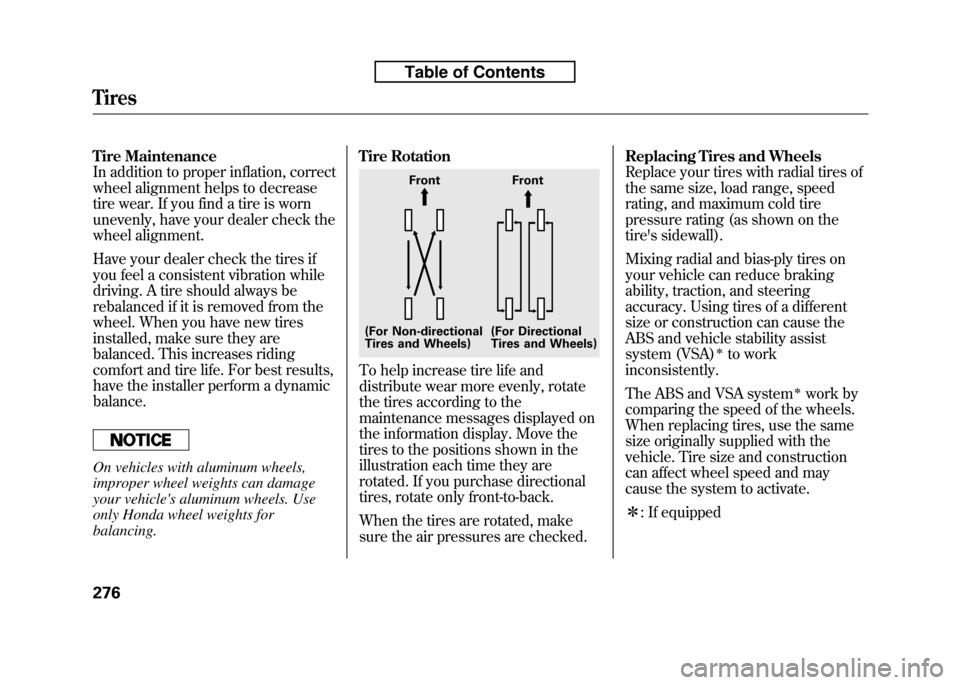
To help increase tire life and
distribute wear more evenly, rotate
the tires according to the
maintenance messages displayed on
the information display. Move the
tires to the positions shown in the
illustration each time they are
rotated. If you purchase directional
tires, rotate only front-to-back.
When the tires are rotated, make
sure the air pressures are checked.Replacing Tires and Wheels
Replace your tires with radial tires of
the same size, load range, speed
rating, and maximum cold tire
pressure rating (as shown on the
tire's sidewall).
Mixing radial and bias-ply tires on
your vehicle can reduce braking
ability, traction, and steering
accuracy. Using tires of a different
size or construction can cause the
ABS and vehicle stability assist
system (VSA)
ꭧto work
inconsistently.
The ABS and VSA system
ꭧwork by
comparing the speed of the wheels.
When replacing tires, use the same
size originally supplied with the
vehicle. Tire size and construction
can affect wheel speed and may
cause the system to activate. ꭧ : If equipped
Front Front
(For Non-directional
Tires and Wheels) (For Directional
Tires and Wheels)
Tires
276
Table of Contents
Page 292 of 351

It is best to replace all four tires at
the same time. If that is not possible
or necessary, replace the two front
tires or two rear tires as a pair.
Replacing just one tire can seriously
affect your vehicle's handling.
If you ever replace a wheel, make
sure that the wheel's specifications
match those of the original wheels.
Also be sure you use only TPMS
specific wheels (if equipped). If you
do not, the tire pressure monitoring
system will not work.
Replacement wheels are available at
your dealer.
Installing improper tires on your
vehicle can affect handling and
stability. This can cause a crash
in which you can be seriously
hurt or killed.
Always use the size and type of
tires recommended in this
owner's manual.Wheel and Tire SpecificationsWheels:All models except Sport
15 x 5 1/2J
Sport model
16 x 6J
Tires:
All models except Sport
175/65R15 84S
Sport model
185/55R16 83H
See page 321 for DOT tire quality
grading information, and page 323
for tire size and labeling information.
CONTINUED
Tires
277
Maintenance
Table of Contents
Page 294 of 351
Wheels
Clean the wheels as you would the
rest of the exterior. Wash them with
the same solution, and rinse themthoroughly.
If equipped
Aluminum alloy wheels have a
protective clear-coat that keeps the
aluminum from corroding and
tarnishing. Cleaning the wheels with
harsh chemicals (including some
commercial wheel cleaners) or a stiff
brush can damage the clear-coat. To
clean the wheels, use a mild
detergent and a soft brush or sponge.Checking the Battery
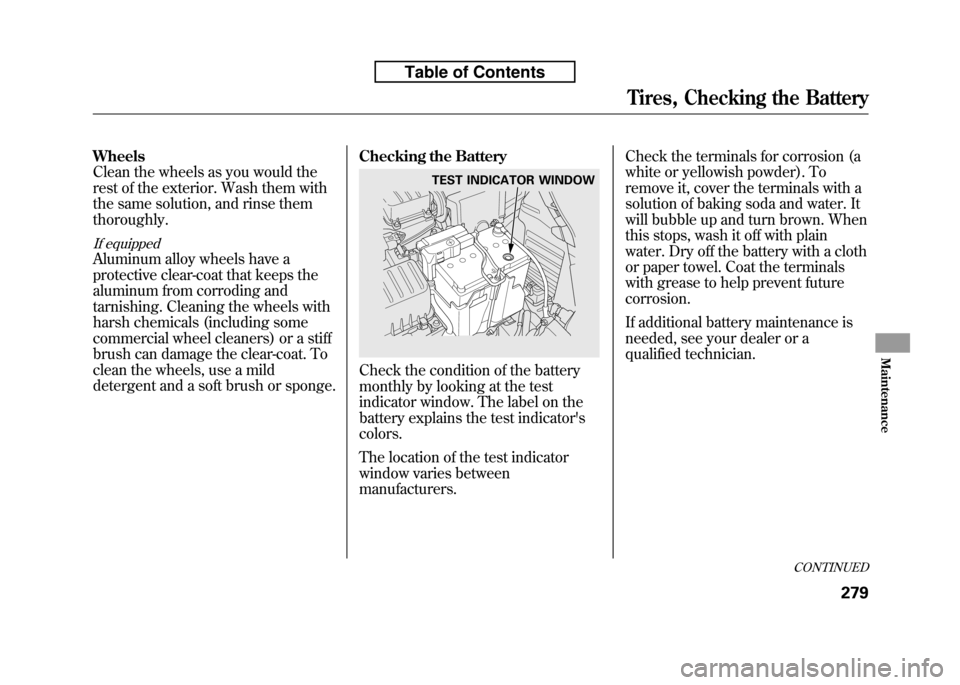
Check the condition of the battery
monthly by looking at the test
indicator window. The label on the
battery explains the test indicator'scolors.
The location of the test indicator
window varies between
manufacturers.Check the terminals for corrosion (a
white or yellowish powder). To
remove it, cover the terminals with a
solution of baking soda and water. It
will bubble up and turn brown. When
this stops, wash it off with plain
water. Dry off the battery with a cloth
or paper towel. Coat the terminals
with grease to help prevent futurecorrosion.
If additional battery maintenance is
needed, see your dealer or a
qualified technician.
TEST INDICATOR WINDOW
CONTINUED
Tires, Checking the Battery
279
Maintenance
Table of Contents
Page 295 of 351

WARNING:Battery posts,
terminals, and related accessories
contain lead and lead compounds.
Wash your hands after handling.
If you need to connect the battery to
a charger, disconnect both cables to
prevent damaging your vehicle's
electrical system. Always disconnect
the negative ( -) cable first, and
reconnect it last.
On vehicles without navigation system
If your vehicle's battery is
disconnected, or goes dead, the time
setting is lost. To reset the time, see
page 192.
If your vehicle's battery is
disconnected, or goes dead, the
audio system may disable itself. The
next time you turn on the radio, you
will see ‘‘ENTER CODE ’’in the
frequency display. Use the preset
buttons to enter the code (see page191).
The battery gives off explosive
hydrogen gas during normaloperation.
A spark or flame can cause the
battery to explode with enough
force to kill or seriously hurtyou.
Wear protective clothing and a
face shield, or have a skilled
technician do the batterymaintenance.
On vehicles with navigation system
The navigation system will also
disable itself. The next time you turn
on the ignition switch, the system
will require you to enter ‘‘ENTER
CODE ’’before it can be used. Refer
to the navigation system manual.
Checking the Battery
280
Table of Contents
Page 296 of 351

If you need to park your vehicle for
an extended period (more than 1
month), there are several things you
should do to prepare it for storage.
Proper preparation helps prevent
deterioration and makes it easier to
get your vehicle back on the road. If
possible, store your vehicle indoors.● Fill the fuel tank.
● Wash and dry the exteriorcompletely.
● Clean the interior. Make sure the
carpeting, floor mats, etc., are
completely dry.
● Leave the parking brake off. Put
the transmission in reverse
(manual) or Park (automatic).
● Block the rear wheels. ●
If the vehicle is to be stored for a
longer period, it should be
supported on jackstands so the
tires are off the ground.
● Leave one window open slightly (if
the vehicle is being storedindoors).
● Disconnect the battery.
● Support the front and rear wiper
blade arms with a folded towel or
rag so they do not touch thewindshield.
● To minimize sticking, apply a
silicone spray lubricant to all door
and tailgate seals. Also, apply a
vehicle body wax to the painted
surfaces that mate with the door
and tailgate seals. ●
Cover the vehicle with a‘‘breathable ’’cover, one made from
a porous material such as cotton.
Non-porous materials, such as
plastic sheeting, trap moisture,
which can damage the paint.
● If possible, periodically run the
engine until it reaches full
operating temperature (the cooling
fans cycle on and off twice).
Preferably, do this once a month.
Vehicle Storage
281
Maintenance
Table of Contents
Page 340 of 351

Driving on a significantly under-
inflated tire causes the tire to
overheat and can lead to tire failure.
Under-inflation also reduces fuel
efficiency and tire tread life, and may
affect the vehicle's handling and
stopping ability.
Please note that the TPMS is not a
substitute for proper tire
maintenance, and it is the driver's
responsibility to maintain correct tire
pressure, even if under-inflation has
not reached the level to trigger
illumination of the TPMS low tire
pressure telltale.Your vehicle has also been equipped
with a TPMS malfunction indicator to
indicate when the system is not
operating properly. The TPMS
malfunction indicator is provided by
a separate telltale, which displays thesymbol
‘‘TPMS ’’when illuminated.
When the malfunction indicator isilluminated,
the system may not be able to detect
or signal low tire pressure asintended.
TPMS malfunctions may occur for a
variety of reasons, including the
installation of replacement or
alternate tires or wheels on the
vehicle that prevent the TPMS from
functioning properly. Always check the TPMS malfunction
telltale after replacing one or more
tires or wheels on your vehicle to
ensure that the replacement or
alternate tires and wheels allow the
TPMS to continue to functionproperly.
Tire Pressure Monitoring System (TPMS)
-Required Federal Explanation
325
Technical Information
Table of Contents