instrument panel HONDA FIT 2010 2.G Owners Manual
[x] Cancel search | Manufacturer: HONDA, Model Year: 2010, Model line: FIT, Model: HONDA FIT 2010 2.GPages: 351, PDF Size: 5.67 MB
Page 5 of 351

Manual Transmission..............217
Glove Box .................................. 105
Gross Vehicle Weight Rating (GVWR) ................................. 210
H
Halogen Headlight Bulbs ...........262
Hazard Warning Flashers ............76
Headlights ............................. 74, 75
Aiming .................................... 262
Daytime Running Lights (Canada only) ..................................... 75
High Beam Indicator ................65
High Beams, Turning on ..........74
Lights On Indicator ..................64
Low Beams, Turning on ...........74
Reminder Chime .................74, 75
Replacing Halogen Bulbs ........262
Turning on ............................... 74
Head Restraints ............................ 94
Heated Mirror ............................ 102
Heating and Cooling ..................110
High Altitude, Starting at ............216
High Beam Lever .........................75High-Low Beam Switch
................74
Hood, Opening and Closing
the .......................................... 200
Horn ........................................ 4, 72
Hydraulic Clutch ........................261
I
Identification Number, Vehicle ................................... 316
Ignition Keys ......................................... 78
Switch ...................................... 80
Timing Control System ...........327
Immobilizer System .....................79
Important Safety Precautions .........6
Indicators, Instrument Panel ........59
ABS (Anti-lock Brake) .......62, 231
Brake (Parking and Brake
System) ......................... 60, 305
Charging System ..............60, 303
Check Fuel Cap .......................70
Cruise Control .......................... 65
Cruise Main ............................. 65
Door and Tailgate Open ...........62DRL (Daytime Running
Lights) ..................................
65
Electric Power Steering ............62
Fog Lights ................................ 64
High Beam ............................... 65
High Temperature ...................63
Key (Immobilizer System) .......66
Lights On ................................. 64
Low Fuel .................................. 62
Low Oil Pressure ..............60, 303
Low Temperature .....................63
Low Tire Pressure .............64, 235
Maintenance Minder .........66, 245
Malfunction Indicator Lamp ............................. 60, 304
Passenger Airbag Off ...............31
Seat Belt Reminder .............18, 60
Security System .......................66
Side Airbag Off ....................31, 61
SRS ..................................... 30, 61
TPMS ................................ 64, 236
Turn Signal and Hazard
Warning ............................... 63
VSA Off .................................... 67
VSA System ............................. 67
CONTINUED
Index
V
INDEX
Page 6 of 351

Washer Level........................... 65
Infant Restraint ............................
39
Infant Seats ..................................
39
Tether Anchorage Point ...........
47
Inflation, Proper Tire ..................
273
Recommended Pressures .......
274
Inside Mirror .............................
101
Inspection, Tire ..........................
275
Installing a Child Seat ..................
42
Instant Fuel Economy ..................
70
Instrument Panel ..........................
59
Instrument Panel Brightness .......
76
Instruments and Controls .............
57
Interior Lights ............................
107
Ceiling Light ...........................
107
Introduction ...................................
i
iPod
®................................... 129, 170
iPod®Error Messages .........135, 176
J
Jacking up the Vehicle ...............285
Jack, Tire ...................................
285
Jump Starting .............................
299K
Keys
............................................. 78
L
Label, Certification .....................316
Lane Change, Signaling ...............
74
Lap/Shoulder Belt .................
14, 19
LATCH Anchorage System ..........
43
Lights Bulb Replacement ...................
262
Indicator ...................................
59
Interior ....................................
107
Parking ....................................
74
Turn Signal ..............................
74
Load Limit ..................................
209
LOCK (Ignition Key Position) ......
80
Locks
Anti-theft Steering Column .......
80
Childproof Door .......................
82
Fuel Fill Door ..........................
199
Lockout Prevention ..................
82
Power Door ..............................
81
Tailgate ....................................
88Low Coolant Level
......................
202
Lower Anchors .............................
43
Lower Glove Box ........................
105
Low Fuel Indicator .......................
62
Low Oil Pressure Indicator ...........................
60, 303
Lubricant Specifications Chart ...
319
Luggage, Storing (cargo) ...........
208
M
Maintenance .............................. 243
Main Items and Sub Items ......
248
Minder ....................................
245
Minder Indicator ......................
66
Owner's Maintenance
Checks ................................
250
Safety ......................................
244
Schedule .................................
251
Malfunction Indicator Lamp ................................
60, 304
Manual Transmission .................
217
Checking Fluid Level ..............
260
Shifting ...................................
217
Manual Transmission Fluid .......
260
Index
VI
Page 13 of 351

Congratulations! Your selection of a 2010 Honda Fit was a wise investment. It
will give you years of driving pleasure.
One of the best ways to enhance the enjoyment of your new vehicle is to read
this manual. In it, you will learn how to operate its driving controls and
convenience items. Afterwards, keep this owner's manual in your vehicle so
you can refer to it at any time.
Several warranties protect your new vehicle. Read the warranty booklet
thoroughly so you understand the coverages and are aware of your rights
and responsibilities.
Maintaining your vehicle according to the maintenance minder shown in the
instrument panel helps to keep your driving trouble-free while it preserves
your investment. When your vehicle needs maintenance, keep in mind that
your dealer's staff is specially trained in servicing the many systems unique
to your vehicle. Your dealer is dedicated to your satisfaction and will be
pleased to answer any questions and concerns.As you read this manual, you will find
information that is preceded by a
symbol. This information is
intended to help you avoid damage to
your vehicle, other property, or theenvironment.
Introduction
i
Page 18 of 351

Contents
A convenient reference to the
sections in this manual.
Your Vehicle at a Glance
A quick reference to the main
controls in your vehicle.
Driver and Passenger Safety
Important information about the
proper use and care of your vehicle's
seat belts, an overview of the
supplemental restraint system, and
valuable information on how to
protect children with child restraints.
Instruments and Controls
Explains the purpose of each
instrument panel indicator and
gauge, and how to use the controls
on the dashboard and steeringcolumn. Features
How to operate the heating and air
conditioning system, the audio
system, and other conveniencefeatures.Before Driving
What gasoline to use, how to break-
in your new vehicle, and how to load
luggage and other cargo. Driving
The proper way to start the engine,
shift the transmission, and park. Maintenance
The maintenance minder shows you
when you need to take your vehicle
to the dealer for maintenance
service. There is also a list of things
to check and instructions on how to
check them.
Taking Care of the Unexpected
This section covers several problems
motorists sometimes experience, and
details how to handle them.
Technical Information
ID numbers, dimensions, capacities,
and technical information.
Warranty and Customer Relations
(U.S. and Canada only)
A summary of the warranties
covering your new vehicle, and how
to contact us for any reason. Refer to
your warranty manual for detailedinformation. Index
Service Information Summary
A summary of the information you
need when you pull up to the fuelpump.
Overview of Contents
2
Page 19 of 351
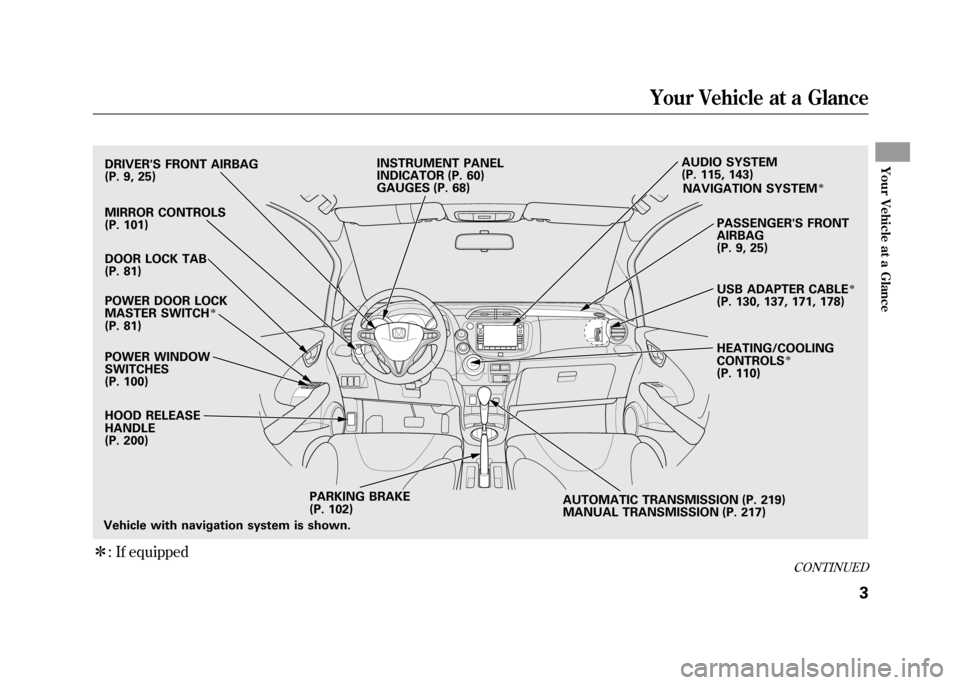
ꭧ: If equipped
Vehicle with navigation system is shown.DRIVER'S FRONT AIRBAG
(P. 9, 25)
MIRROR CONTROLS
(P. 101)
DOOR LOCK TAB
(P. 81)
POWER DOOR LOCK
MASTER SWITCH
ꭧ
(P. 81)
POWER WINDOW SWITCHES
(P. 100)
HOOD RELEASE
HANDLE
(P. 200)
INSTRUMENT PANEL
INDICATOR (P. 60)
GAUGES (P. 68)
AUDIO SYSTEM
(P. 115, 143)
PASSENGER'S FRONT
AIRBAG
(P. 9, 25)
USB ADAPTER CABLE
ꭧ
(P. 130, 137, 171, 178)
HEATING/COOLING
CONTROLS
ꭧ
(P. 110)
PARKING BRAKE
(P. 102) AUTOMATIC TRANSMISSION (P. 219)
MANUAL TRANSMISSION (P. 217)NAVIGATION SYSTEM
ꭧ
CONTINUED
Your Vehicle at a Glance
3
Your Vehicle at a Glance
Page 20 of 351
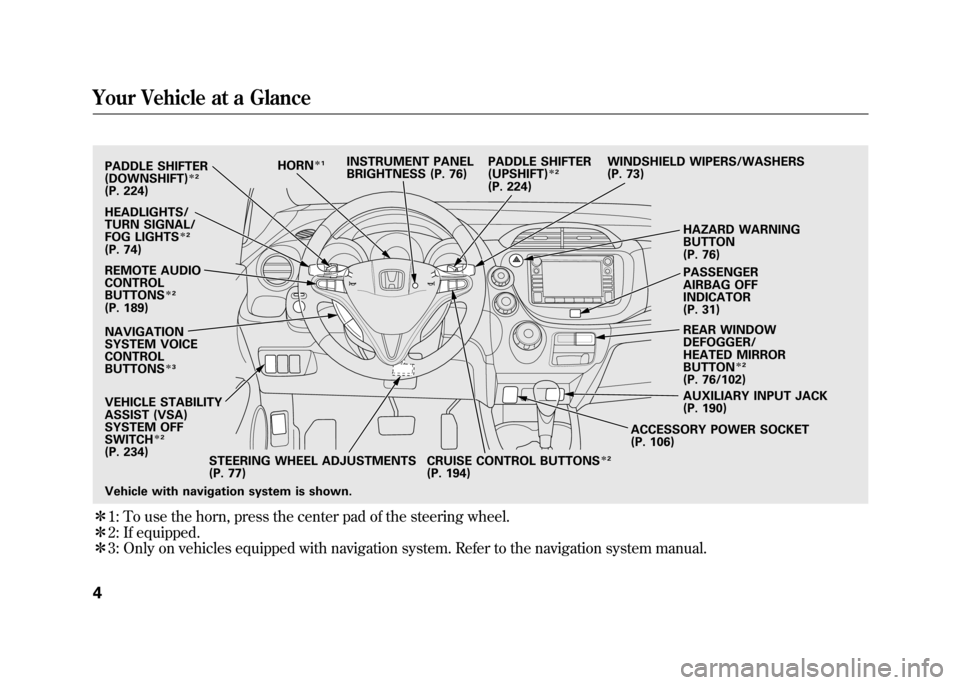
ꭧ1: To use the horn, press the center pad of the steering wheel.
ꭧ 2: If equipped.
ꭧ 3: Only on vehicles equipped with navigation system. Refer to the navigation system manual.
Vehicle with navigation system is shown.
PADDLE SHIFTER
(DOWNSHIFT)
ꭧ
2
(P. 224)
HEADLIGHTS/
TURN SIGNAL/
FOG LIGHTS
ꭧ2
(P. 74)
REMOTE AUDIO
CONTROL BUTTONS
ꭧ2
(P. 189)
NAVIGATION
SYSTEM VOICE
CONTROL BUTTONS
ꭧ3
VEHICLE STABILITY
ASSIST (VSA)
SYSTEM OFF SWITCH
ꭧ2
(P. 234)
STEERING WHEEL ADJUSTMENTS
(P. 77) CRUISE CONTROL BUTTONSꭧ
2
(P. 194)
HORN
ꭧ
1PADDLE SHIFTER(UPSHIFT)ꭧ2
(P. 224)
INSTRUMENT PANEL
BRIGHTNESS (P. 76)
HAZARD WARNINGBUTTON
(P. 76)
WINDSHIELD WIPERS/WASHERS
(P. 73)
PASSENGER
AIRBAG OFF INDICATOR
(P. 31)
REAR WINDOW DEFOGGER/
HEATED MIRROR BUTTON
ꭧ2
(P. 76/102)
AUXILIARY INPUT JACK
(P. 190)
ACCESSORY POWER SOCKET
(P. 106)
Your Vehicle at a Glance
4
Page 24 of 351

Seat Belts
Your vehicle is equipped with seat
belts in all seating positions.
Your seat belt system also includes
an indicator on the instrument panel
and a beeper to remind you and your
passengers to fasten your seat belts.
Why Wear Seat Belts
Seat belts are the single most
effective safety device for adults and
larger children. (Infants and smaller
children must be properly restrained
in child seats.)
Not wearing a seat belt properly
increases the chance of serious
injury or death in a crash, even
though your vehicle has airbags.
In addition, most states and all
Canadian provinces and territories
require you to wear seat belts.
Not wearing a seat belt properly
increases the chance of serious
injury or death in a crash, even
though your vehicle hasairbags.
Be sure you and your
passengers always wear seat
belts and wear them properly.
When properly worn, seat belts: ● Keep you connected to the vehicle
so you can take advantage of the
vehicle's built-in safety features.
● Help protect you in almost every
type of crash, including:- frontal impacts
- side impacts
- rear impacts
- rollovers ●
Help keep you from being thrown
against the inside of the vehicle
and against other occupants.
● Keep you from being thrown out of
the vehicle.
● Help keep you in a good position
should the airbags ever deploy. A
good position reduces the risk of
injury from an inflating airbag and
allows you to get the best
advantage from the airbag.
Of course, seat belts cannot
completely protect you in every
crash. But in most cases, seat belts
can reduce your risk of seriousinjury.
What You Should Do:
Always wear your seat belt, and
make sure you wear it properly.
Your Vehicle's Safety Features
8
Table of Contents
Page 27 of 351
Introduction
The following pages provide
instructions on how to properly
protect the driver, adult passengers,
and teenage children who are large
enough and mature enough to drive
or ride in the front.
See pages 34-38 for important
guidelines on how to properly protect
infants, small children, and larger
children who ride in your vehicle.
1. Close and Lock the Doors
After everyone has entered the
vehicle, be sure the doors and the
tailgate are closed and locked.Your vehicle has a door and
tailgate open indicator on
the instrument panel to indicate
when any door or the tailgate is not
tightly closed.
Locking the doors reduces the
chance of someone being thrown out
of the vehicle during a crash, and it
helps prevent passengers from
accidentally opening a door and
falling out.
Locking the doors and the tailgate
also helps prevent an outsider from
unexpectedly opening a door or the
tailgate when you come to a stop.
See page 81 for how to lock the
doors, and page 62 for how the door
and tailgate open indicator works.
Some models have the auto door
locking/unlocking feature. For more
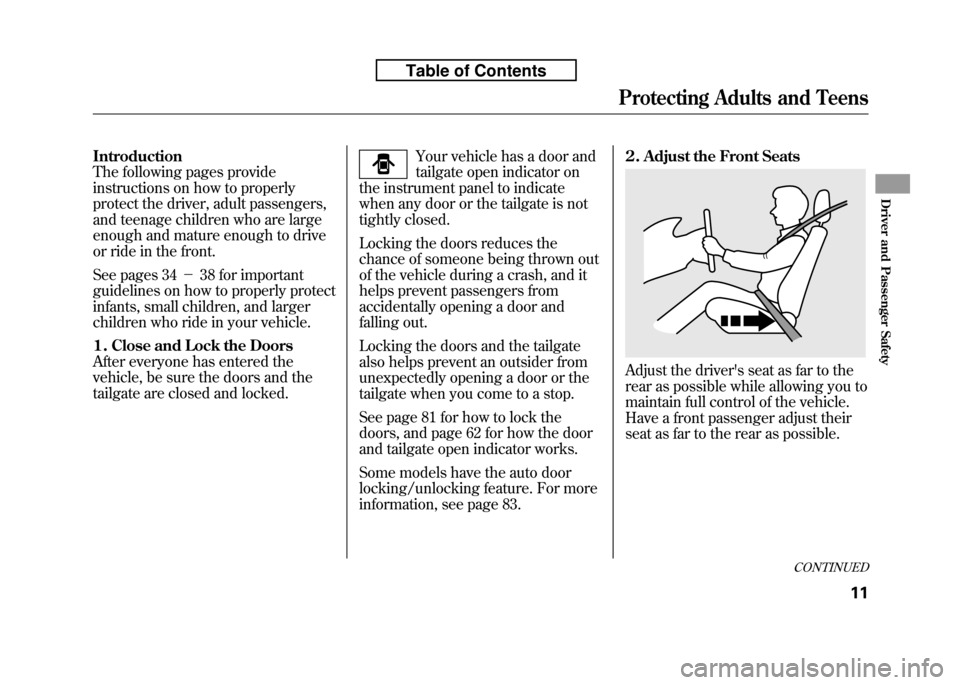
information, see page 83. 2. Adjust the Front Seats
Adjust the driver's seat as far to the
rear as possible while allowing you to
maintain full control of the vehicle.
Have a front passenger adjust their
seat as far to the rear as possible.
CONTINUED
Protecting Adults and Teens
11
Driver and Passenger Safety
Table of Contents
Page 34 of 351

Seat Belt System Components
Your seat belt system includes lap/
shoulder belts in all seating positions.
The front seat belts are also equipped
with automatic seat belt tensioners.
This system uses the same sensors as
the front airbags to monitor whether
the front seat belts are latched or
unlatched, and how much weight is on
the front passenger's seat (see page27).
The seat belt system includes
an indicator on the instrument
panel and a beeper to remind you and
your passengers to fasten your seatbelts.
This system monitors the front seat
belts. If you turn the ignition switch to
the ON (II) position before your seat
belt is fastened, the beeper will sound
and the indicator will flash. If your seat
belt is not fastened before the beeper
stops, the indicator will stop flashing
but remain on. If a front passenger does not fasten
their seat belt, the indicator will
come on about 6 seconds after the
ignition switch is turned to the ON
(II) position.
If either the driver or a front
passenger does not fasten their seat
belt while driving, the beeper will
sound and the indicator will flash
again at regular intervals.
When no one is sitting in the front
passenger's seat, or a child or small
adult is riding there, the indicator
should not come on and the beeper
should not sound.
If the indicator comes on or the
beeper sounds when the driver's seat
belt is latched and there is no front
seat passenger and no items on the
front seat, something may be
interfering with the monitoring
system. Look for and remove:
● Any items under the front
passenger's seat.
● Any object(s) hanging on the seat
or in the seat-back pocket.
● Any object(s) touching the rear of
the seat-back.
If no obstructions are found, have
your vehicle checked by a dealer.
Additional Information About Your Seat Belts
18
Table of Contents
Page 40 of 351

●Automatic front seat belt
tensioners (see page 20).
● Sensors that can detect a moderate
to severe front impact or sideimpact.
● Sensors that can detect whether a
child is in the passenger's side
airbag path and signal the control
unit to turn the airbag off (see
page 29).
● Sensors that can detect whether
the driver's seat belt and the front
passenger's seat belt are latched or
unlatched (see page 18).
● A driver's seat position sensor that
monitors the distance of the seat
from the front airbag. If the seat is
too far forward, the airbag will
inflate with less force (see page27). ●
Weight sensors that monitor the
weight on the front passenger's
seat. If the weight is about 65 lbs
(29 kg) or less (the weight of an
infant or small child), the
passenger's front airbag will be
turned off (see page 27).
● A sophisticated electronic system
that continually monitors and
records information about the
sensors, the control unit, the
airbag activators, the seat belt
tensioners, and driver and front
passenger seat belt use when the
ignition switch is in the ON (II)position.
● An indicator on the instrument
panel that alerts you to a possible
problem with your airbags,
sensors, or seat belt tensioners
(see page 30). ●
An indicator on the instrument
panel that alerts you that the
passenger's side airbag has been
turned off (see page 31).
● An indicator on the dashboard that
alerts you that the passenger's
front airbag has been turned off
(see page 31).
● Emergency backup power in case
your vehicle's electrical system is
disconnected in a crash.
Additional Information About Your Airbags
24
Table of Contents