interior HONDA FIT 2010 2.G Owners Manual
[x] Cancel search | Manufacturer: HONDA, Model Year: 2010, Model line: FIT, Model: HONDA FIT 2010 2.GPages: 351, PDF Size: 5.67 MB
Page 4 of 351

EngineAdding Engine Coolant ...........256
Coolant Temperature Indicator ............................... 63
If it Won't Start ........................297
Malfunction Indicator Lamp ............................. 60, 304
Oil Life Indicator .....................245
Oil Pressure Indicator .......60, 303
Oil, What Kind to Use .............253
Overheating ............................ 301
Specifications .......................... 318
Speed Limiter ..................218, 222
Starting ................................... 216
Engine Coolant .......................... 256
Engine Number .........................317
Ethanol in Gasoline ....................198
Evaporative Emissions Controls .................................. 326
Exhaust Emissions Controls ......327
Exhaust Fumes ............................ 53
Expectant Mothers, Use of Seat
Belts by .................................... 16F
Fan, Interior
............................... 111
Features ..................................... 109
Filters Dust and Pollen .......................268
Oil ........................................... 254
Flashers, Hazard Warning ...........76
Flat Tire, Changing a .................285
Floor Mats ................................. 267
Fluids
Automatic Transmission .........259
Brake ...................................... 261
Clutch ..................................... 261
Location .................................. 252
Manual Transmission ..............260
Windshield Washer .................258
FM/AM Radio Reception ...........184
Four-way Flashers ........................76
Front Airbags ........................... 9, 25
Front Seat Adjusting .................................. 93
Fuel ............................................ 198
Check Fuel Cap Indicator .........70
Economy ................................. 203Fill Door and Cap
....................
199
Gauge ...................................... 70
Low Fuel Indicator ...................62
Octane Requirement ...............198
Reserve Indicator .....................62
Tank, Filling the ......................199
Fuel Economy ............................ 203
Fuses, Checking the ..................307
G
Gas Mileage, Improving .............204
Gasoline ..................................... 198
Low Fuel Indicator ...................62
Octane Requirement ...............198
Tank, Refueling .......................199
Gas Station Procedures ..............199
Gauges
Fuel .......................................... 70
Odometer ................................. 70
Speedometer ............................ 68
Tachometer .............................. 68
Gearshift Lever Positions Automatic Transmission ...............219, 220
Index
IV
Page 6 of 351
Washer Level........................... 65
Infant Restraint ............................
39
Infant Seats ..................................
39
Tether Anchorage Point ...........
47
Inflation, Proper Tire ..................
273
Recommended Pressures .......
274
Inside Mirror .............................
101
Inspection, Tire ..........................
275
Installing a Child Seat ..................
42
Instant Fuel Economy ..................
70
Instrument Panel ..........................
59
Instrument Panel Brightness .......
76
Instruments and Controls .............
57
Interior Lights ............................
107
Ceiling Light ...........................
107
Introduction ...................................
i
iPod
®................................... 129, 170
iPod®Error Messages .........135, 176
J
Jacking up the Vehicle ...............285
Jack, Tire ...................................
285
Jump Starting .............................
299K
Keys
............................................. 78
L
Label, Certification .....................316
Lane Change, Signaling ...............
74
Lap/Shoulder Belt .................
14, 19
LATCH Anchorage System ..........
43
Lights Bulb Replacement ...................
262
Indicator ...................................
59
Interior ....................................
107
Parking ....................................
74
Turn Signal ..............................
74
Load Limit ..................................
209
LOCK (Ignition Key Position) ......
80
Locks
Anti-theft Steering Column .......
80
Childproof Door .......................
82
Fuel Fill Door ..........................
199
Lockout Prevention ..................
82
Power Door ..............................
81
Tailgate ....................................
88Low Coolant Level
......................
202
Lower Anchors .............................
43
Lower Glove Box ........................
105
Low Fuel Indicator .......................
62
Low Oil Pressure Indicator ...........................
60, 303
Lubricant Specifications Chart ...
319
Luggage, Storing (cargo) ...........
208
M
Maintenance .............................. 243
Main Items and Sub Items ......
248
Minder ....................................
245
Minder Indicator ......................
66
Owner's Maintenance
Checks ................................
250
Safety ......................................
244
Schedule .................................
251
Malfunction Indicator Lamp ................................
60, 304
Manual Transmission .................
217
Checking Fluid Level ..............
260
Shifting ...................................
217
Manual Transmission Fluid .......
260
Index
VI
Page 32 of 351
In addition, an occupant who is out of
position in the front seat can be
seriously or fatally injured in a crash
by striking interior parts of the
vehicle or being struck by an
inflating front airbag.
Sitting improperly or out of
position can result in serious
injury or death in a crash.
Always sit upright, well back in
the seat, with your feet on thefloor.Advice for Pregnant Women
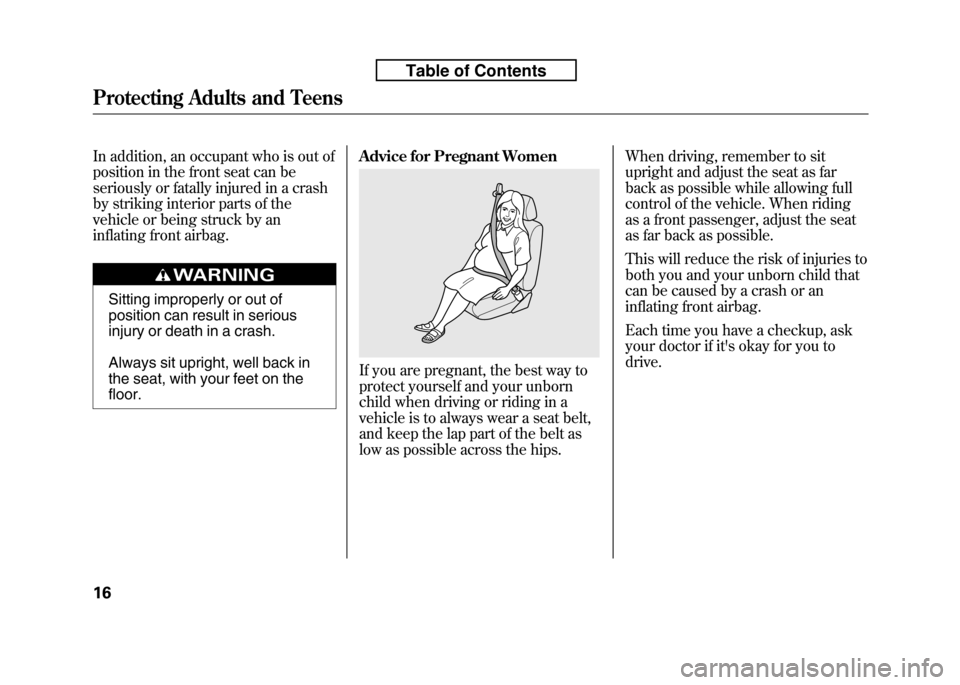
If you are pregnant, the best way to
protect yourself and your unborn
child when driving or riding in a
vehicle is to always wear a seat belt,
and keep the lap part of the belt as
low as possible across the hips. When driving, remember to sit
upright and adjust the seat as far
back as possible while allowing full
control of the vehicle. When riding
as a front passenger, adjust the seat
as far back as possible.
This will reduce the risk of injuries to
both you and your unborn child that
can be caused by a crash or an
inflating front airbag.
Each time you have a checkup, ask
your doctor if it's okay for you todrive.
Protecting Adults and Teens
16
Table of Contents
Page 51 of 351
All Children Should Sit in a Back Seat
According to accident statistics,
children of all ages and sizes are
safer when they are restrained in a
back seat.
The National Highway Traffic Safety
Administration and Transport
Canada recommend that all children
aged 12 and under be properly
restrained in a back seat. Some
states have laws restricting where
children may ride.
Children who ride in back are less
likely to be injured by striking
interior vehicle parts during a
collision or hard braking. Also,
children cannot be injured by an
inflating front airbag when they ride
in the back.The Passenger's Front Airbag Can
Pose Serious Risks
Front airbags have been designed to
help protect adults in a moderate to
severe frontal collision. To do this,
the passenger's front airbag is quite
large, and it can inflate with enough
force to cause very serious injuries.
Even though your vehicle has an
advanced front airbag system that
automatically turns the passenger's
front airbag off under certain
circumstances (see page 31), please
follow these guidelines:
Infants
Never put a rear-facing child seat inthe front seat of a vehicle equipped
with a passenger's front airbag.
If the
airbag inflates, it can hit the back of
the child seat with enough force to
kill or very seriously injure an infant.
Small Children
Placing a forward-facing child seat inthe front seat of a vehicle equippedwith a passenger's front airbag can be
hazardous.
If the vehicle seat is too
far forward, or the child's head is
thrown forward during a collision, an
inflating front airbag can strike the
child with enough force to kill or
very seriously injure a small child.
Larger Children
Children who have outgrown childseats are also at risk of being injuredor killed by an inflating passenger's
front airbag.
Whenever possible,
larger children should sit in the back
seat, on a booster seat if needed, and
be properly restrained with a seat
belt (see page 49 for important
information about protecting largerchildren).
CONTINUED
Protecting Children -General Guidelines
35
Driver and Passenger Safety
Table of Contents
Page 69 of 351
Your vehicle's exhaust contains
carbon monoxide gas. Carbon
monoxide should not enter the
vehicle in normal driving if you
maintain your vehicle properly and
follow the information on this page.
Have the exhaust system inspected
for leaks whenever:● The vehicle is raised for an oilchange.
● You notice a change in the sound
of the exhaust.
● The vehicle was in a collision that
may have damaged the underside.
Carbon monoxide gas is toxic.
Breathing it can cause
unconsciousness and even killyou.
Avoid any enclosed areas or
activities that expose you to
carbon monoxide.
High levels of carbon monoxide can
collect rapidly in enclosed areas,
such as a garage. Do not run the
engine with the garage door closed.
Even with the door open, run the
engine only long enough to move the
vehicle out of the garage. With the tailgate open, airflow can
pull exhaust gas into your vehicle's
interior and create a hazardous
condition. If you must drive with the
tailgate open, open all the windows
and set the heating and cooling
system as shown below.
If you must sit in your parked vehicle
with the engine running, even in an
unconfined area, adjust the heating
and cooling system as follows:
1. Select the fresh air mode.
2. Select the
mode.
3. Turn the fan on high speed.
4. Set the temperature control to a comfortable setting.
Carbon Monoxide Hazard
53
Driver and Passenger Safety
Table of Contents
Page 73 of 351
This section gives information about
the controls and displays that
contribute to the daily operation of
your vehicle. All the essential
controls are within easy reach.Control Locations..........................
58
Instrument Panel ..........................
59
Instrument Panel Indicators ..........
60
Gauges ..........................................
68
Trip Meter ................................
69
Instant Fuel Economy ...............
70
Average Fuel Economy .............
70
Odometer ..................................
70
Fuel Gauge ...............................
70
Check Fuel Cap Indicator .........
70
Maintenance Minder ................
71
Controls Near the Steering
Wheel .......................................
72
Windshield Wipers and Washers ................................
73
Windshield Wipers ...................
73
Rear Window Wiper and
Washer .................................
73
Turn Signal and Headlights ..........
74
Headlights ....................................
75
Instrument Panel Brightness ........
76
Hazard Warning Button ................
76
Rear Window Defogger .................
76
Steering Wheel Adjustments .........
77Keys and Locks
............................. 78
Immobilizer System ......................
79
Ignition Switch ..............................
80
Door Locks ...................................
81
Power Door Locks ....................
81
Childproof Door Locks ..............
82
Auto Door Locking/ Unlocking .............................
83
Auto Door Locking ...................
83
Auto Door Unlocking ................
85
Tailgate .........................................
88
Remote Transmitter ......................
90
Seats .............................................
93
Power Windows ..........................
100
Mirrors .......................................
101
Parking Brake .............................
102
Interior Convenience Items .........
104
Lower Glove Box ....................
105
Upper Glove Box .....................
105
Beverage Holders ...................
106
Seat Under Box .......................
106
Accessory Power Socket .........
106
Sun Visor ................................
106
Interior Lights .............................
107
Instruments and Controls
57
Instruments and Controls
Page 90 of 351
4. Hold past OFF to turn the rearwindow wiper on and to spray the
rear window washer. The rear
window wiper makes one more
sweep after you release the switch.
When you shift the transmission to
the reverse position with the front
windshield wiper activated, the rear
wiper operates automatically even if
the rear wiper switch is off.
The rear window washer uses the
same fluid reservoir as the
windshield washer. Turn Signal and Headlights
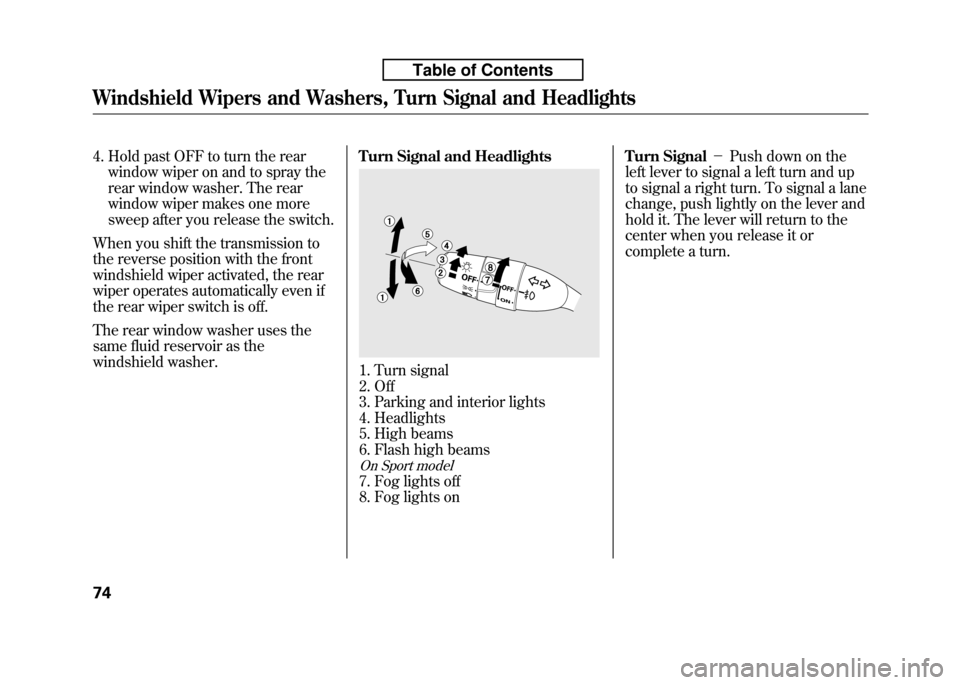
1. Turn signal
2. Off
3. Parking and interior lights
4. Headlights
5. High beams
6. Flash high beams
On Sport model
7. Fog lights off
8. Fog lights onTurn Signal
-Push down on the
left lever to signal a left turn and up
to signal a right turn. To signal a lane
change, push lightly on the lever and
hold it. The lever will return to the
center when you release it or
complete a turn.
Windshield Wipers and Washers, Turn Signal and Headlights
74
Table of Contents
Page 105 of 351

To close the tailgate, hold the tailgate
handle, lower the tailgate, then press
down on the back edge.
Keep the tailgate closed at all times
while driving to avoid damaging the
tailgate and to prevent exhaust gas
from getting into the interior. See
Carbon Monoxide Hazardon page
53. Unlocking the Tailgate
On Sport model and Canadian LX model
If the power door lock system cannot
unlock the tailgate, unlock itmanually.
Place a cloth on the edge of the cover
to prevent scratches, then use a
small flat-tip screwdriver to remove
the cover on the back of the tailgate.
Push the release lever to the right as shown.
If you need to unlock the tailgate
manually, it means there is a
problem with the tailgate. Have the
vehicle checked by your dealer.
TAILGATE HANDLE
Lock
Unlock
Tailgate
89
Instruments and Controls
Table of Contents
Page 120 of 351
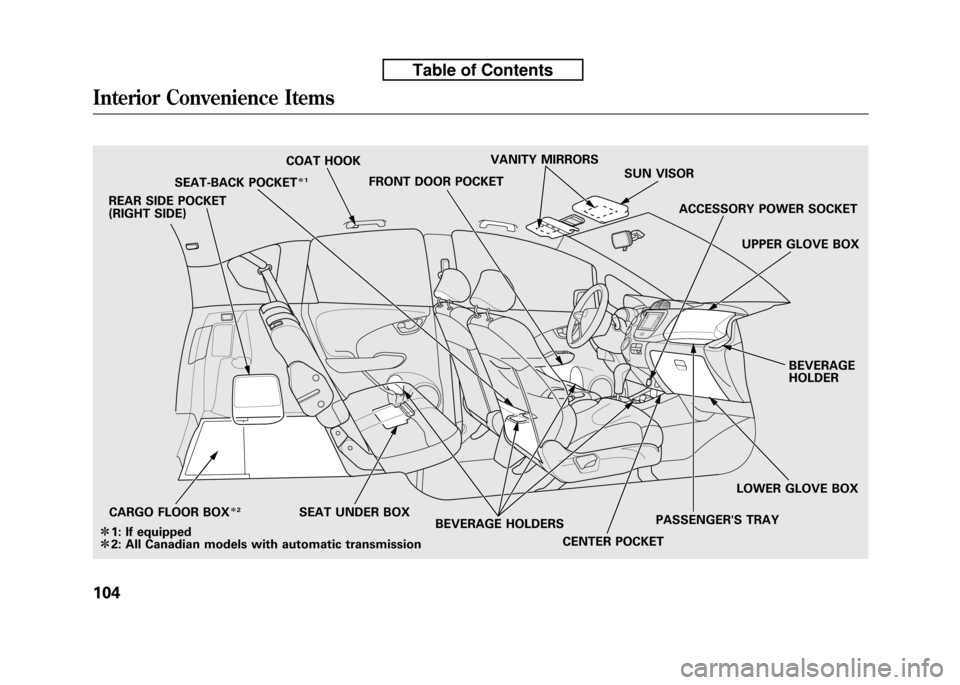
SEAT-BACK POCKETꭧ1
COAT HOOK
FRONT DOOR POCKET VANITY MIRRORS
SUN VISOR
SEAT UNDER BOX CENTER POCKETPASSENGER'S TRAYUPPER GLOVE BOX
ACCESSORY POWER SOCKET
BEVERAGE HOLDER
REAR SIDE POCKET
(RIGHT SIDE)
LOWER GLOVE BOX
BEVERAGE HOLDERS
CARGO FLOOR BOX
ꭧ
2
ꭧ 1: If equipped
ꭧ 2: All Canadian models with automatic transmission
Interior Convenience Items
104
Table of Contents
Page 121 of 351
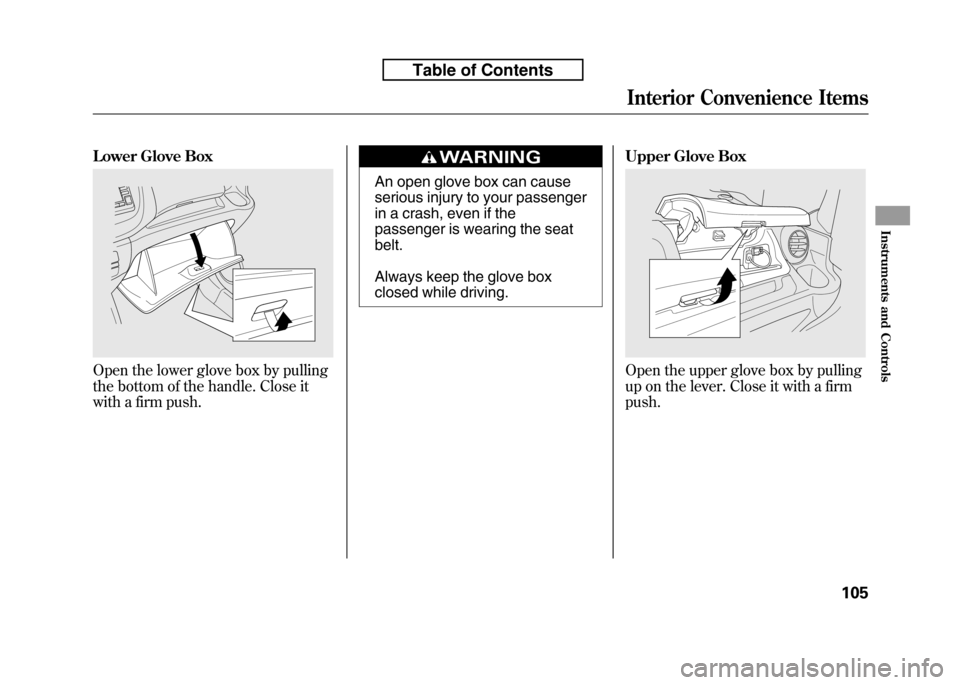
Lower Glove Box
Open the lower glove box by pulling
the bottom of the handle. Close it
with a firm push.
An open glove box can cause
serious injury to your passenger
in a crash, even if the
passenger is wearing the seatbelt.
Always keep the glove box
closed while driving.Upper Glove Box
Open the upper glove box by pulling
up on the lever. Close it with a firmpush.
Interior Convenience Items
105
Instruments and Controls
Table of Contents