wheel HONDA FIT 2011 2.G Owner's Guide
[x] Cancel search | Manufacturer: HONDA, Model Year: 2011, Model line: FIT, Model: HONDA FIT 2011 2.GPages: 356, PDF Size: 6.08 MB
Page 287 of 356
If you need to park your vehicle for
an extended period (more than 1
month), there are several things you
should do to prepare it for storage.
Proper preparation helps prevent
deterioration and makes it easier to
get your vehicle back on the road. If
possible, store your vehicle indoors. Fill the fuel tank.
Wash and dry the exteriorcompletely.
Clean the interior. Make sure the
carpeting, floor mats, etc., are
completely dry.
Leave the parking brake off. Put
the transmission in reverse
(manual) or Park (automatic).
Block the rear wheels.
If the vehicle is to be stored for a
longer period, it should be
supported on jackstands so the
tires are off the ground.
Leave one window open slightly (if
the vehicle is being storedindoors).
Disconnect the battery.
Support the front and rear wiper
blade arms with a folded towel or
rag so they do not touch thewindshield.
To minimize sticking, apply a
silicone spray lubricant to all door
and tailgate seals. Also, apply a
vehicle body wax to the painted
surfaces that mate with the door
and tailgate seals.
Cover the vehicle with a‘‘breathable ’’cover, one made from
a porous material such as cotton.
Non-porous materials, such as
plastic sheeting, trap moisture,
which can damage the paint.
If possible, periodically run the
engine until it reaches full
operating temperature (the cooling
fans cycle on and off twice).
Preferably, do this once a month.
Vehicle Storage
283
Maintenance
Main MenuTable of Contents
Page 290 of 356
Except all Canadian models withautomatic transmission
Use the compact spare tire as a
temporary replacement only. Get
your regular tire repaired or
replaced, and put it back on your
vehicle as soon as you can.
Check the inflation pressure of the
compact spare tire every time you
check the other tires. It should be
inflated to:
60 psi (420 kPa, 4.2 kgf/cm
2) Follow these precautions:
Never exceed 50 mph (80 km/h).
This tire gives a harsher ride and
less traction on some road
surfaces. Use greater caution while driving.
Do not mount tire chains on the
compact spare tire.
Do not use your compact spare tire
on another vehicle unless it is the
same make and model.
On vehicles with the TPMS
system, the low tire pressure
indicator comes on and stays on
after you replace the flat tire with
the compact spare tire. After
several miles (kilometers) driving
with the compact spare tire, the
TPMS indicator comes on and the
low tire pressure indicator goesoff.Replace the tire when you can see
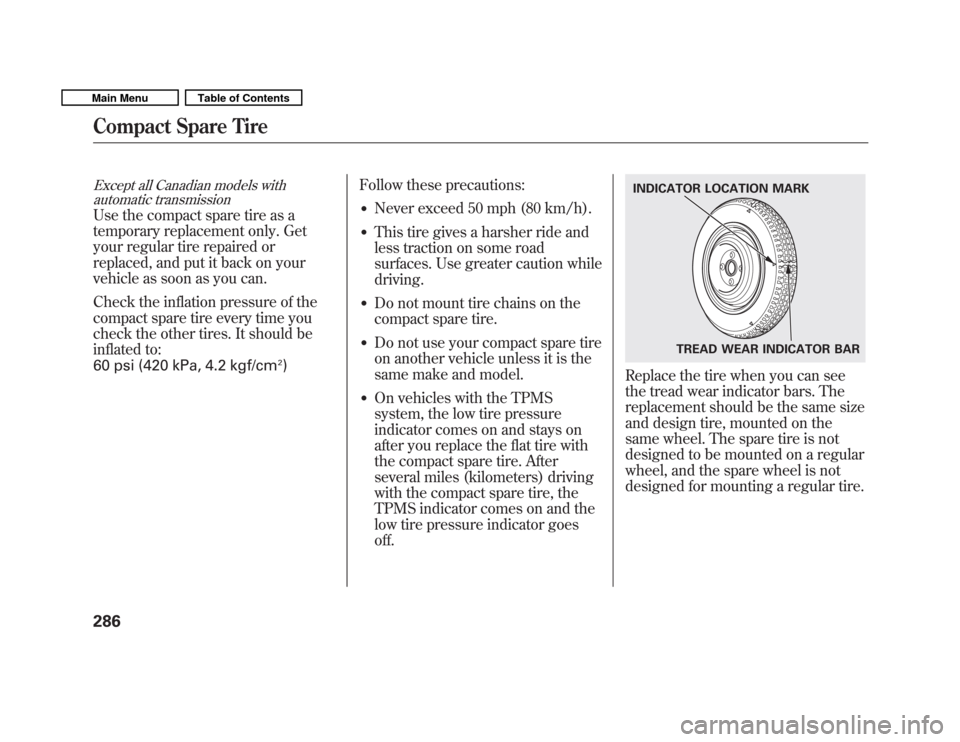
the tread wear indicator bars. The
replacement should be the same size
and design tire, mounted on the
same wheel. The spare tire is not
designed to be mounted on a regular
wheel, and the spare wheel is not
designed for mounting a regular tire.
INDICATOR LOCATION MARK
TREAD WEAR INDICATOR BAR
Compact Spare Tire
286
Main MenuTable of Contents
Page 292 of 356
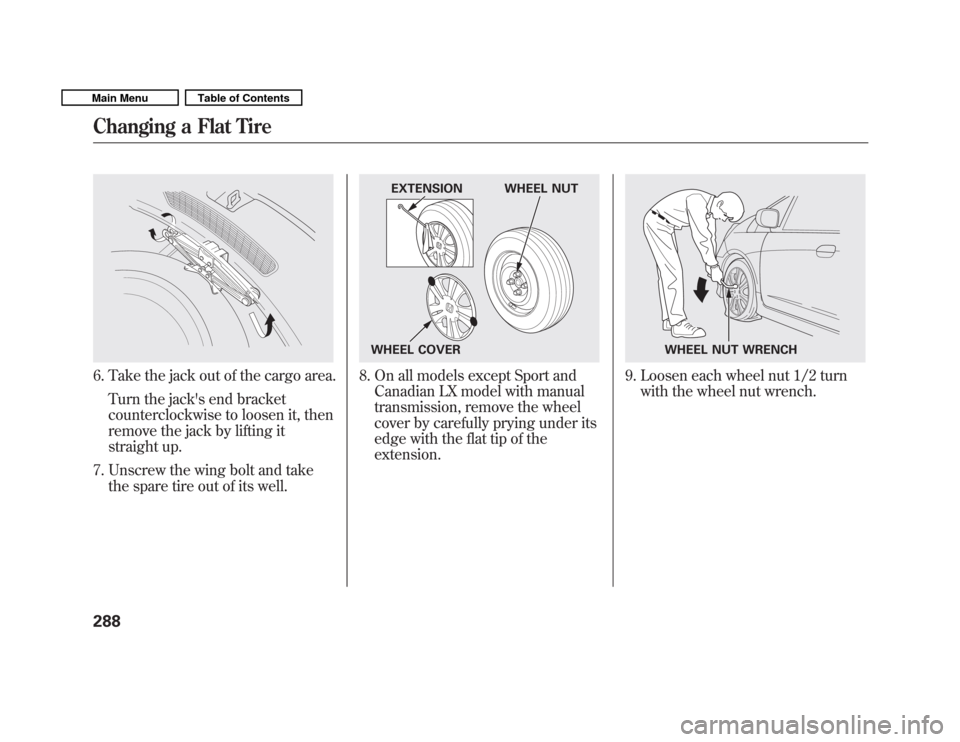
6. Take the jack out of the cargo area.Turn the jack's end bracket
counterclockwise to loosen it, then
remove the jack by lifting it
straight up.
7. Unscrew the wing bolt and take the spare tire out of its well.8. On all models except Sport andCanadian LX model with manual
transmission, remove the wheel
cover by carefully prying under its
edge with the flat tip of theextension.9. Loosen each wheel nut 1/2 turnwith the wheel nut wrench.
EXTENSION WHEEL NUT
WHEEL COVER
WHEEL NUT WRENCH
Changing a Flat Tire
288
Main MenuTable of Contents
Page 293 of 356
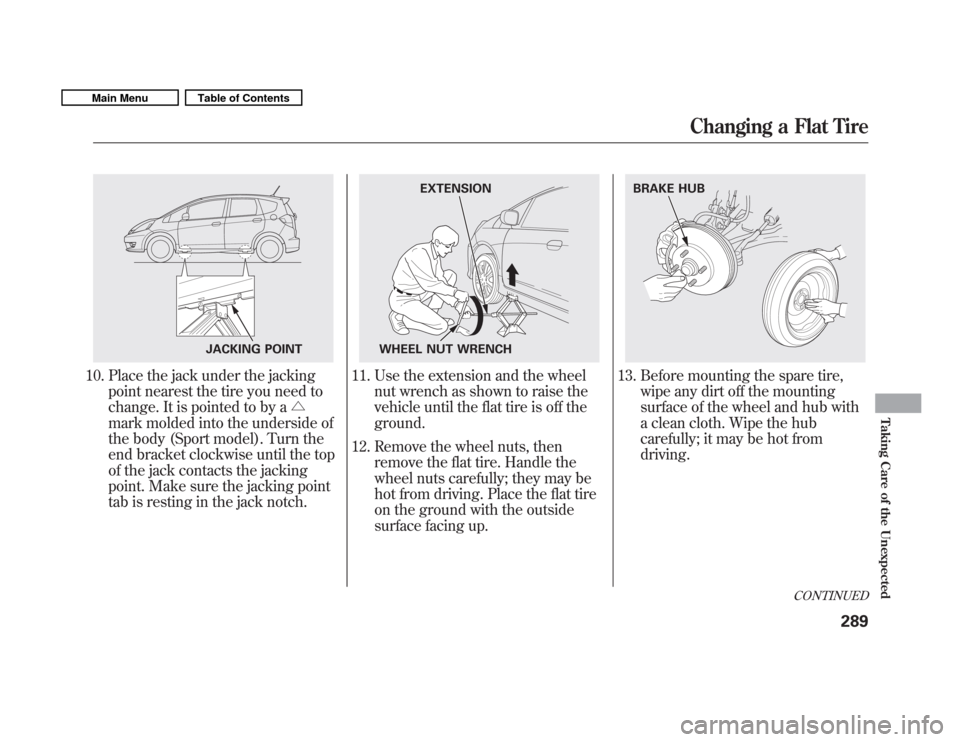
10. Place the jack under the jackingpoint nearest the tire you need to
change. It is pointed to by a
mark molded into the underside of
the body (Sport model). Turn the
end bracket clockwise until the top
of the jack contacts the jacking
point. Make sure the jacking point
tab is resting in the jack notch.11. Use the extension and the wheel nut wrench as shown to raise the
vehicle until the flat tire is off theground.
12. Remove the wheel nuts, then remove the flat tire. Handle the
wheel nuts carefully; they may be
hot from driving. Place the flat tire
on the ground with the outside
surface facing up.13. Before mounting the spare tire, wipe any dirt off the mounting
surface of the wheel and hub with
a clean cloth. Wipe the hub
carefully; it may be hot fromdriving.
JACKING POINT
EXTENSION
WHEEL NUT WRENCHBRAKE HUB
CONTINUED
Changing a Flat Tire
289
Taking Care of the Unexpected
Main MenuTable of Contents
Page 294 of 356
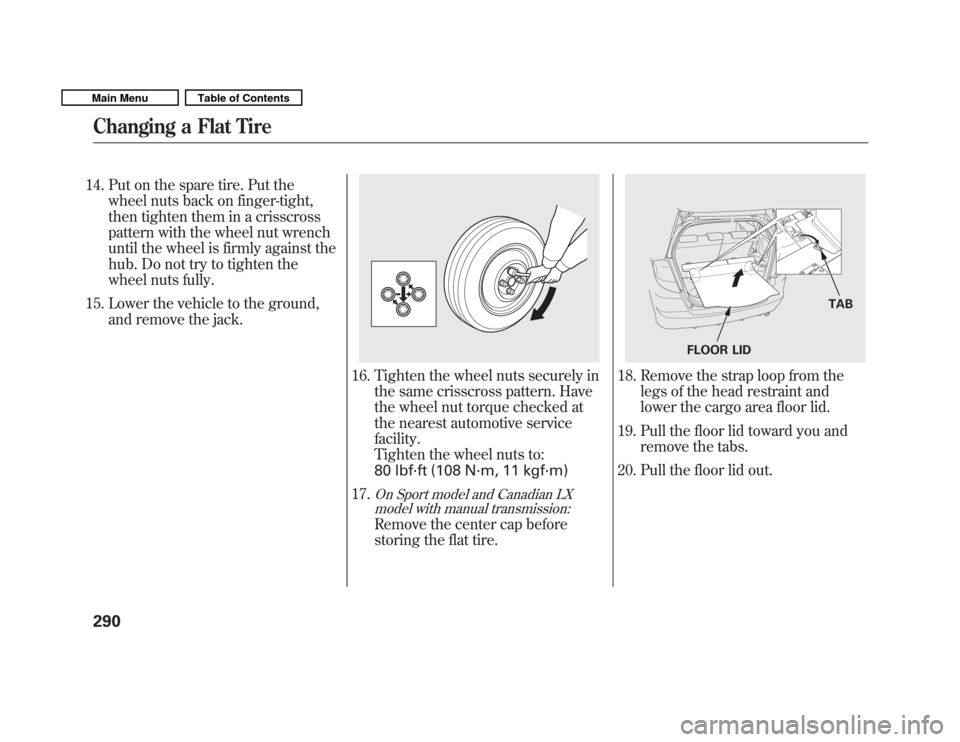
14. Put on the spare tire. Put thewheel nuts back on finger-tight,
then tighten them in a crisscross
pattern with the wheel nut wrench
until the wheel is firmly against the
hub. Do not try to tighten the
wheel nuts fully.
15. Lower the vehicle to the ground, and remove the jack.
16. Tighten the wheel nuts securely in
the same crisscross pattern. Have
the wheel nut torque checked at
the nearest automotive servicefacility.
Tighten the wheel nuts to:
80 lbf·ft (108 N·m, 11 kgf·m)
17.
On Sport model and Canadian LX model with manual transmission:
Remove the center cap before
storing the flat tire.
18. Remove the strap loop from the
legs of the head restraint and
lower the cargo area floor lid.
19. Pull the floor lid toward you and remove the tabs.
20. Pull the floor lid out.
TAB
FLOOR LID
Changing a Flat Tire
290
Main MenuTable of Contents
Page 295 of 356
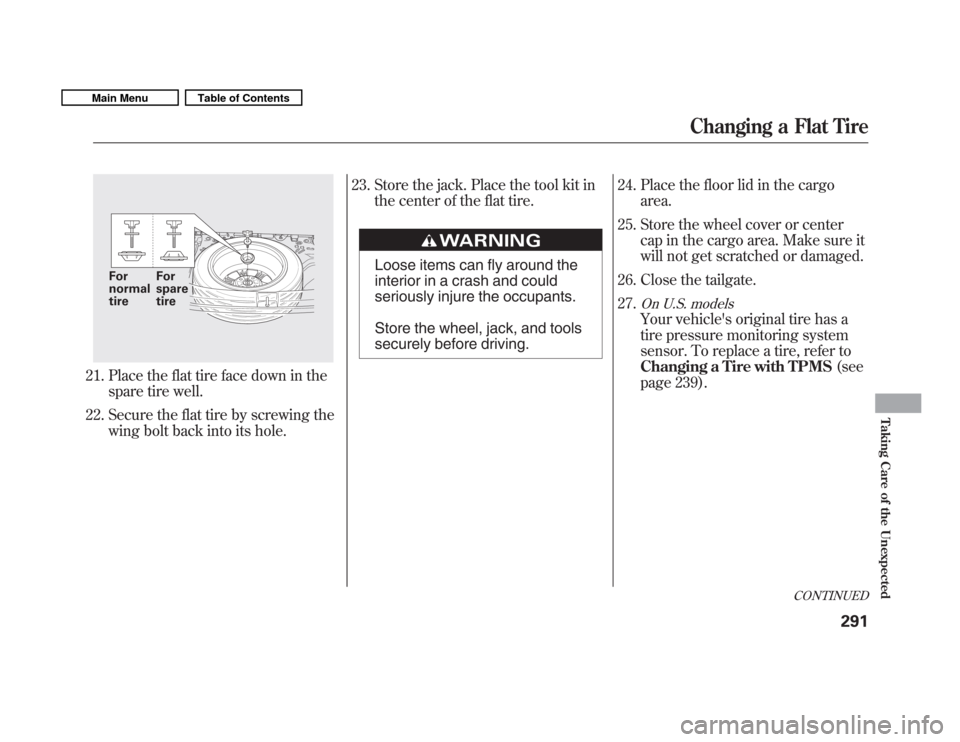
21. Place the flat tire face down in thespare tire well.
22. Secure the flat tire by screwing the wing bolt back into its hole. 23. Store the jack. Place the tool kit in
the center of the flat tire.
Loose items can fly around the
interior in a crash and could
seriously injure the occupants.
Store the wheel, jack, and tools
securely before driving. 24. Place the floor lid in the cargo
area.
25. Store the wheel cover or center cap in the cargo area. Make sure it
will not get scratched or damaged.
26. Close the tailgate. 27.
On U.S. models
Your vehicle's original tire has a
tire pressure monitoring system
sensor. To replace a tire, refer to
Changing a Tire with TPMS (see
page 239).
For normal tire For spare tire
CONTINUED
Changing a Flat Tire
291
Taking Care of the Unexpected
Main MenuTable of Contents
Page 296 of 356
Installing a wheel cover
All models except Sport and CanadianLX model with manual transmission
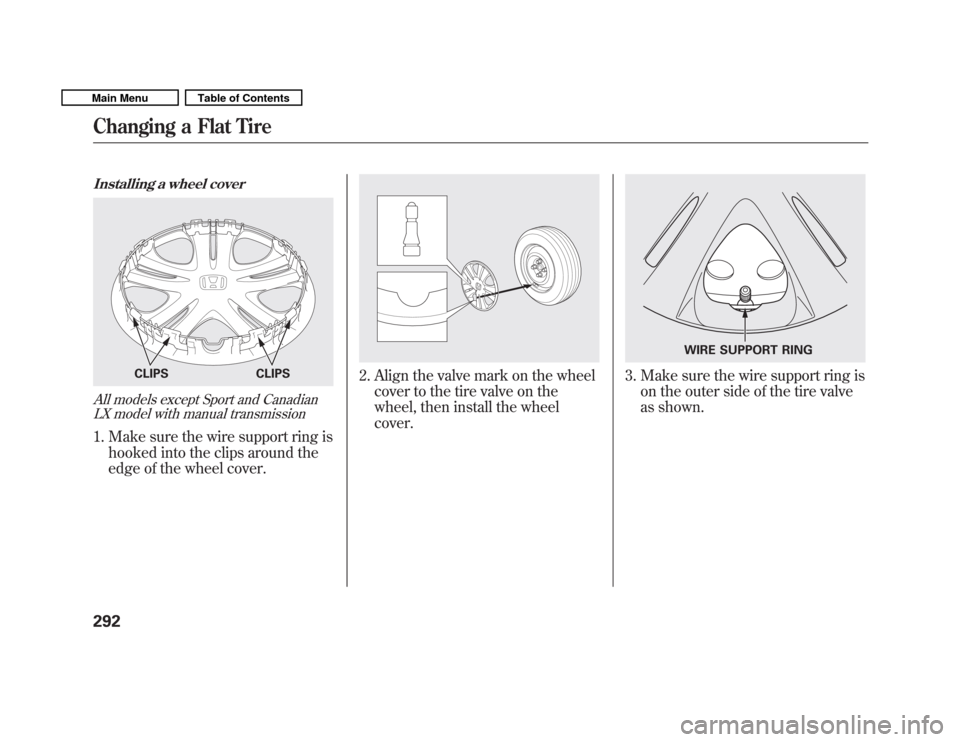
1. Make sure the wire support ring is
hooked into the clips around the
edge of the wheel cover.
2. Align the valve mark on the wheelcover to the tire valve on the
wheel, then install the wheelcover.3. Make sure the wire support ring ison the outer side of the tire valve
as shown.CLIPS CLIPS
WIRE SUPPORT RING
Changing a Flat Tire
292
Main MenuTable of Contents
Page 297 of 356
How to Use the Tire Repair Kit
All Canadian models with automatictransmission
To reduce weight, your vehicle is
equipped with a tire repair kit instead
of a spare tire. This kit will allow you
to temporarily repair a flat tire under
the following conditions:
Only one tire is flat.
The puncture is smaller than
3/16ths of an inch (4 mm).
The puncture is located within the tread.
The wheel rim is not damaged.
The tire bead is seated.
When making a temporary repair,
carefully follow all instructions in this
owner's manual and in the
instructions that came with the kit. If you have a flat tire while driving,
park the vehicle on a level surface in
a safe place, put the transmission in
Park (P), set the parking brake, and
turn the hazard lights on.
Thoroughly examine the tire for a
puncture or other damage.
If a puncture is wider than 3/16ths of
an inch (4 mm), or is located in the
tire sidewall, do not attempt to repair
the tire. Have your vehicle towed to a
Honda service center. In Canada or
the continental U.S.A. simply call 1-
800-465-PLUS (7587) for Honda Plus
Roadside Assistance.
If the damage is smaller than 3/16ths
of an inch (4 mm) and within the tire
tread, proceed with the followinginstructions.
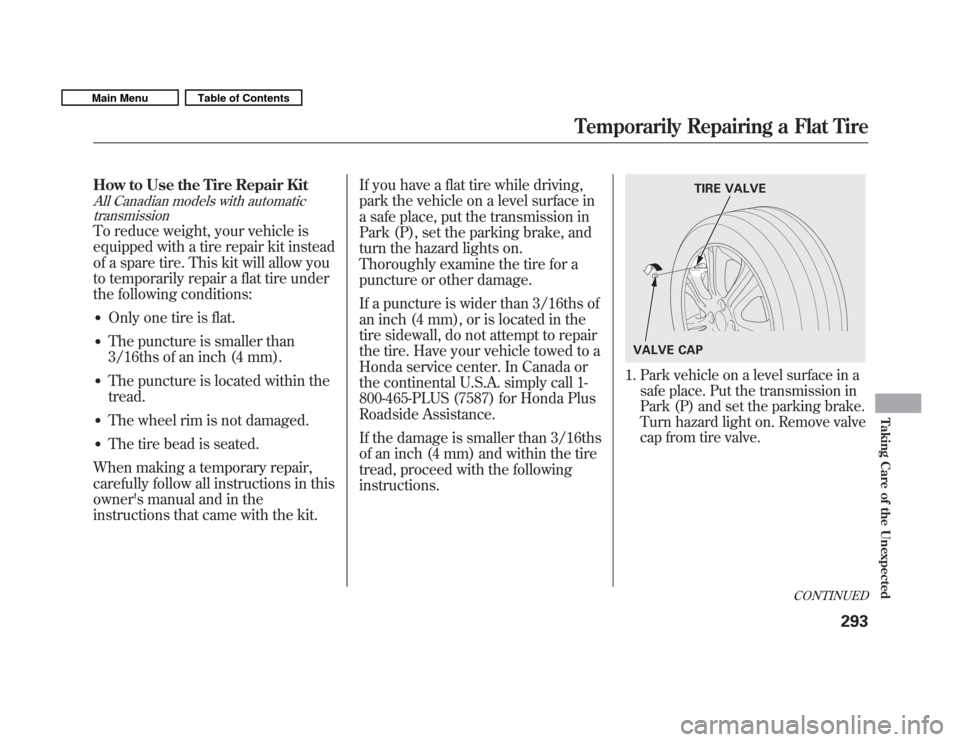
1. Park vehicle on a level surface in a
safe place. Put the transmission in
Park (P) and set the parking brake.
Turn hazard light on. Remove valve
cap from tire valve.
TIRE VALVE
VALVE CAP
CONTINUED
Temporarily Repairing a Flat Tire
293
Taking Care of the Unexpected
Main MenuTable of Contents
Page 298 of 356
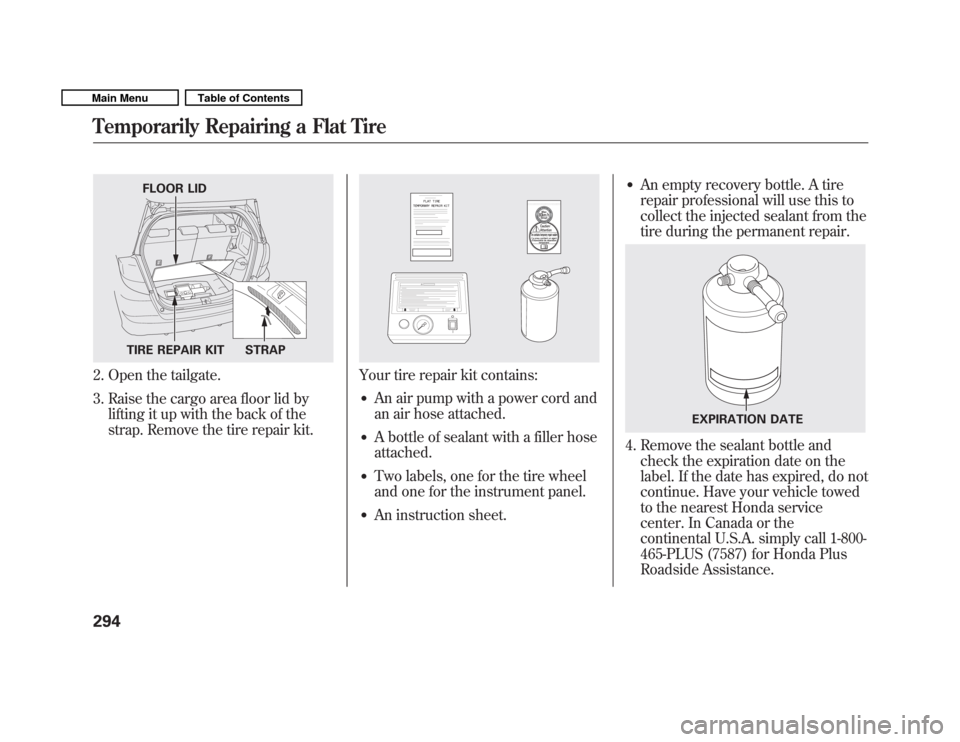
2. Open the tailgate.
3. Raise the cargo area floor lid bylifting it up with the back of the
strap. Remove the tire repair kit.Your tire repair kit contains:
An air pump with a power cord and
an air hose attached.
A bottle of sealant with a filler hose attached.
Two labels, one for the tire wheel
and one for the instrument panel.
An instruction sheet.
An empty recovery bottle. A tire
repair professional will use this to
collect the injected sealant from the
tire during the permanent repair.
4. Remove the sealant bottle and
check the expiration date on the
label. If the date has expired, do not
continue. Have your vehicle towed
to the nearest Honda service
center. In Canada or the
continental U.S.A. simply call 1-800-
465-PLUS (7587) for Honda Plus
Roadside Assistance.
FLOOR LID
TIRE REPAIR KIT STRAP
EXPIRATION DATE
Temporarily Repairing a Flat Tire
294
Main MenuTable of Contents
Page 301 of 356
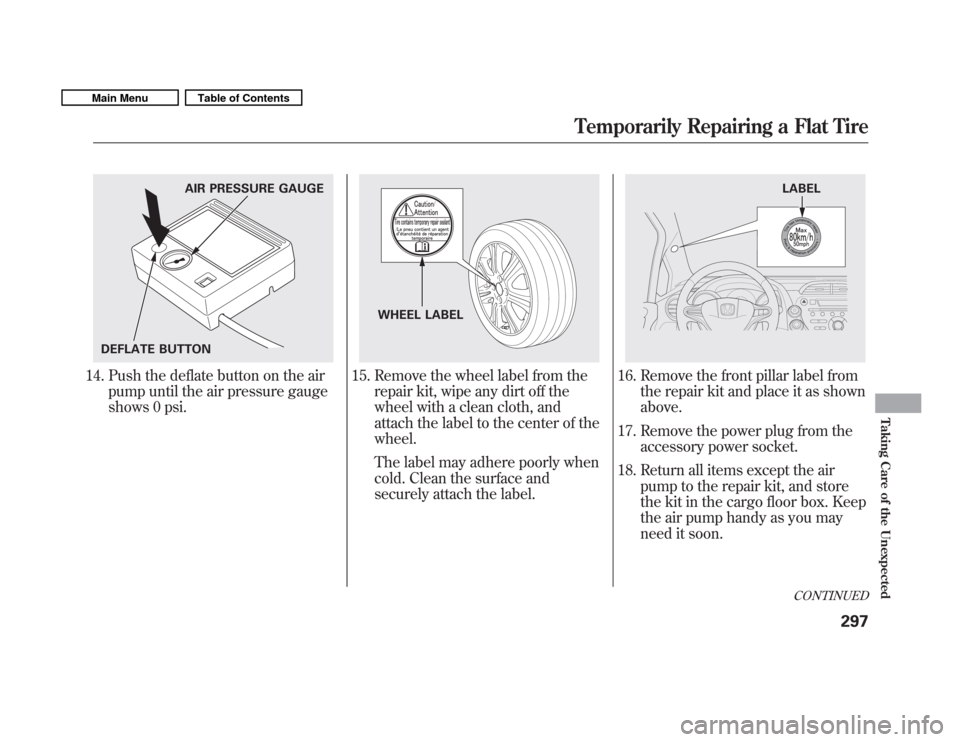
14. Push the deflate button on the airpump until the air pressure gauge
shows 0 psi.15. Remove the wheel label from the repair kit, wipe any dirt off the
wheel with a clean cloth, and
attach the label to the center of thewheel.
The label may adhere poorly when
cold. Clean the surface and
securely attach the label.16. Remove the front pillar label from the repair kit and place it as shown above.
17. Remove the power plug from the accessory power socket.
18. Return all items except the air pump to the repair kit, and store
the kit in the cargo floor box. Keep
the air pump handy as you may
need it soon.
AIR PRESSURE GAUGE
DEFLATE BUTTON
WHEEL LABEL
LABEL
CONTINUED
Temporarily Repairing a Flat Tire
297
Taking Care of the Unexpected
Main MenuTable of Contents