tow HONDA FIT 2013 3.G Owner's Manual
[x] Cancel search | Manufacturer: HONDA, Model Year: 2013, Model line: FIT, Model: HONDA FIT 2013 3.GPages: 286, PDF Size: 9.38 MB
Page 239 of 286
238
Handling the Unexpected
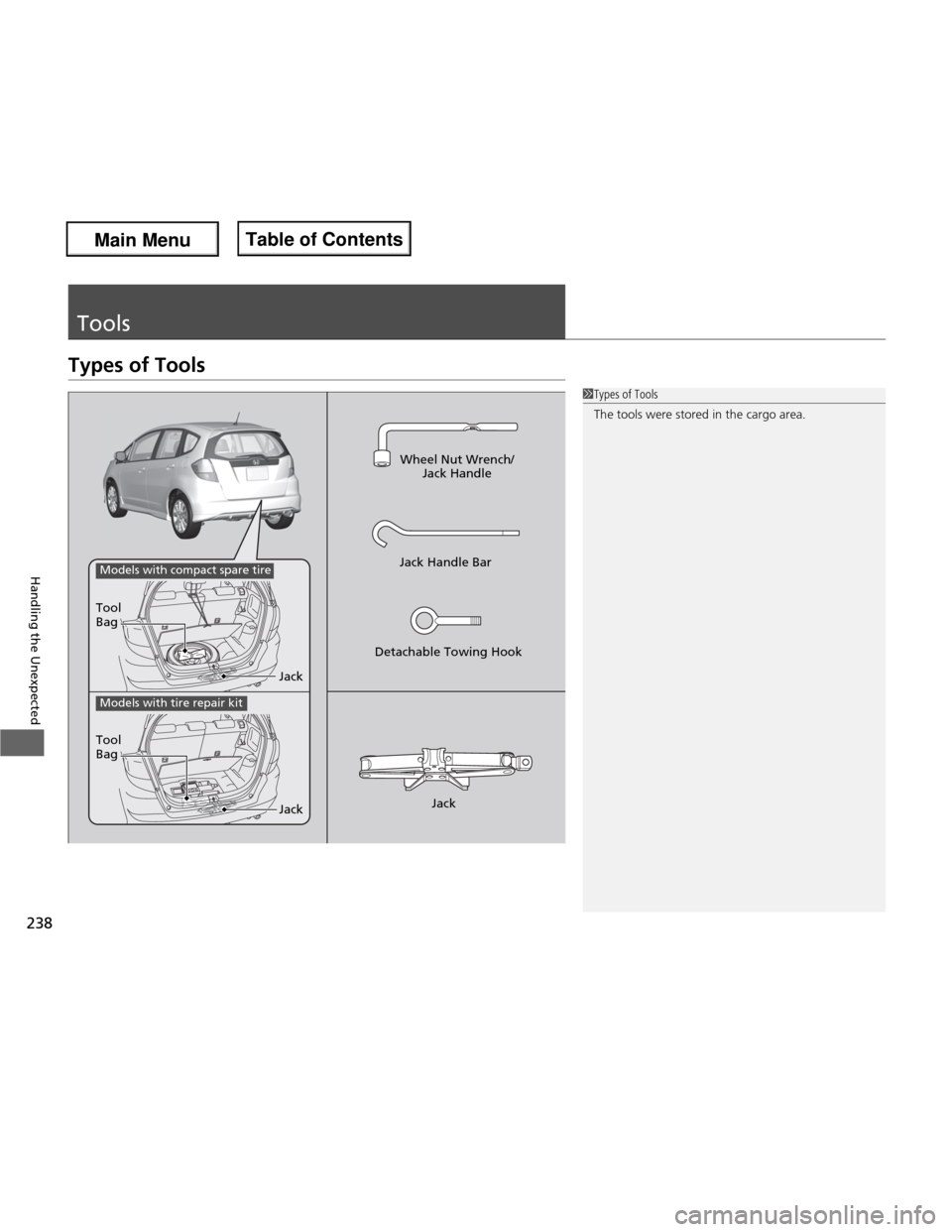
Tools
Types of Tools
1Types of Tools
The tools were stored in the cargo area.
Wheel Nut Wrench/Jack Handle
Jack
Jack Handle Bar
Detachable Towing Hook
Tool Bag Jack
Tool Bag Jack
Models with compact spare tire
Models with tire repair kit
Main Menu
Main MenuTable of Contents
Page 246 of 286
245
uuIf a Tire Goes FlatuTemporarily Repairing a Flat Tire
Continued
Handling the Unexpected
Temporarily Repairing a Flat Tire
If the tire has a large cut or is otherwise severely damaged, you will need to have the
vehicle towed. If the tire only has a small puncture, from a nail for instance, you can
use the tire repair kit so that you can drive to the nearest service station for a more
permanent repair.
If a tire goes flat while driving, grasp the steering wheel firmly, and brake gradually
to reduce speed. Then stop in a safe place. 1.Park the vehicle on firm, level, and non-slippery ground.
2. Put the shift lever in
(P .
3. Set the parking brake.
4. Turn on the hazard warning lights and turn the ignition switch to LOCK
(0 .
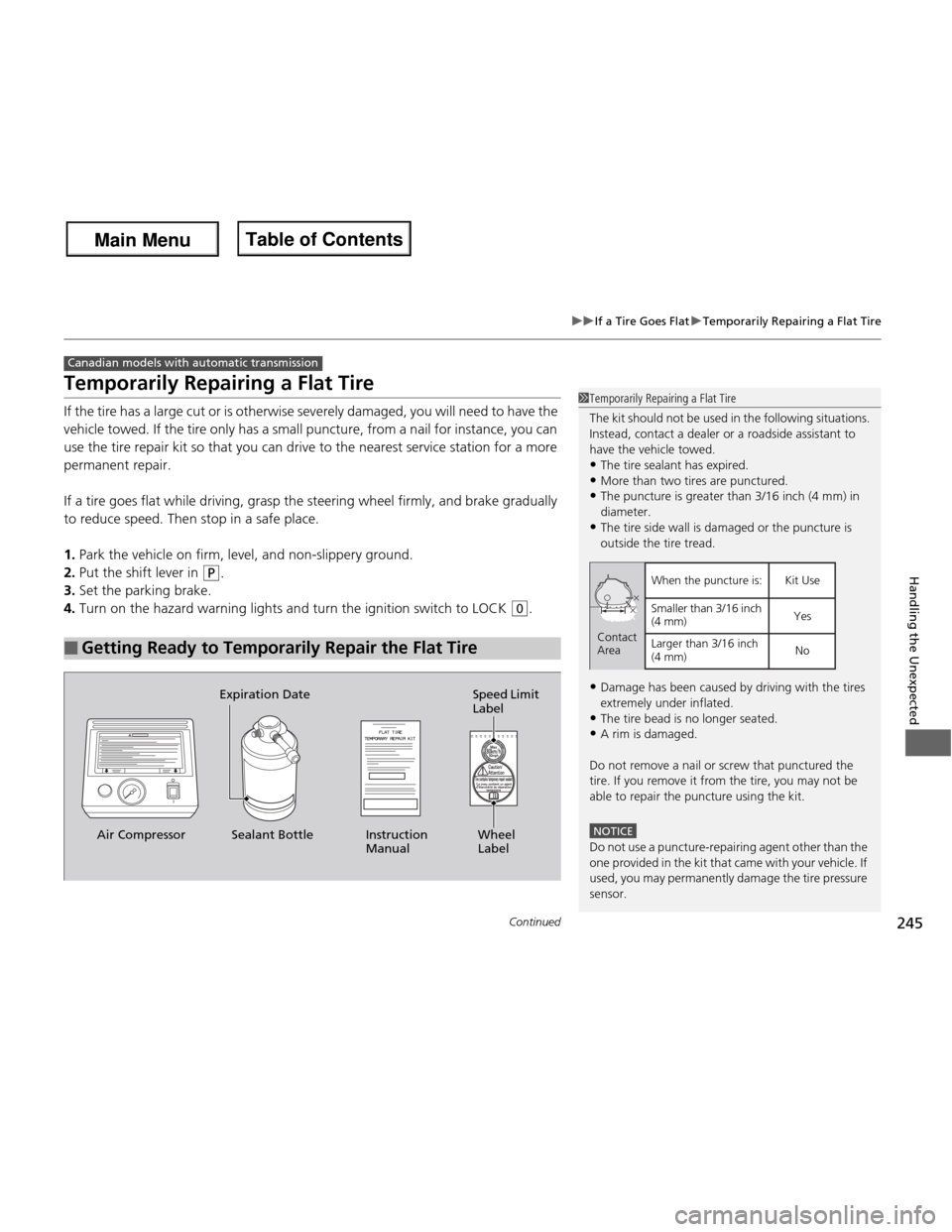
■Getting Ready to Temporarily Repair the Flat Tire
Canadian models with automatic transmission
1Temporarily Repairing a Flat Tire
The kit should not be used in the following situations.
Instead, contact a dealer or a roadside assistant to
have the vehicle towed.
• The tire sealant has expired.
• More than two tires are punctured.
• The puncture is greater than 3/16 inch (4 mm) in diameter.
• The tire side wall is damaged or the puncture is
outside the tire tread.
• Damage has been caused by driving with the tires
extremely under inflated.
• The tire bead is no longer seated.
• A rim is damaged.
Do not remove a nail or screw that punctured the
tire. If you remove it from the tire, you may not be
able to repair the puncture using the kit.
NOTICE
Do not use a puncture-repairing agent other than the
one provided in the ki t that came with your vehicle. If
used, you may permanently damage the tire pressure
sensor.
When the puncture is:
Smaller than 3/16 inch
(4 mm)
Larger than 3/16 inch
(4 mm) Kit Use
YesNo
Contact
Area
Instruction Manual
Air Compressor
Wheel
Label
Sealant Bottle
Expiration Date
Speed Limit Label
Main Menu
Main MenuTable of Contents
Page 249 of 286
uuIf a Tire Goes FlatuTemporarily Repairing a Flat Tire
248
Handling the Unexpected
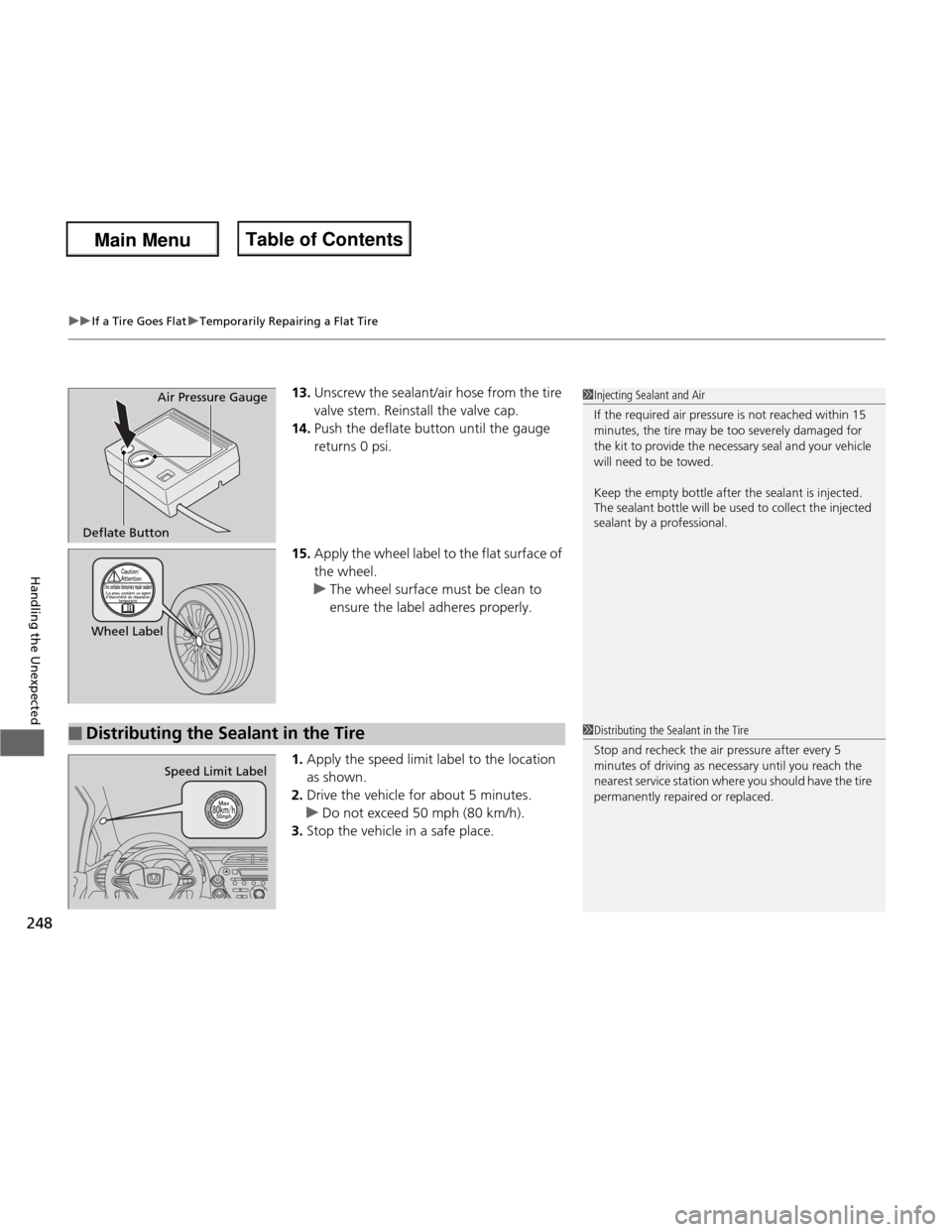
13. Unscrew the sealant/air hose from the tire
valve stem. Reinstall the valve cap.
14. Push the deflate button until the gauge returns 0 psi.
15. Apply the wheel label to the flat surface of
the wheel.
uThe wheel surface must be clean to
ensure the label adheres properly.
1. Apply the speed limit label to the location as shown.
2. Drive the vehicle for about 5 minutes.
uDo not exceed 50 mph (80 km/h).
3. Stop the vehicle in a safe place.
Air Pressure Gauge
Deflate Button
Wheel Label
■Distributing the Sealant in the Tire
1Injecting Sealant and Air
If the required air pressure is not reached within 15
minutes, the tire may be too severely damaged for
the kit to provide the necessary seal and your vehicle will need to be towed.
Keep the empty bottle after the sealant is injected.
The sealant bottle will be used to collect the injected
sealant by a professional.
1Distributing the Sealant in the Tire
Stop and recheck the air pressure after every 5
minutes of driving as necessary until you reach the
nearest service station where you should have the tire
permanently repaired or replaced.
Speed Limit Label
Main Menu
Main MenuTable of Contents
Page 250 of 286
249
uuIf a Tire Goes FlatuTemporarily Repairing a Flat Tire
Handling the Unexpected
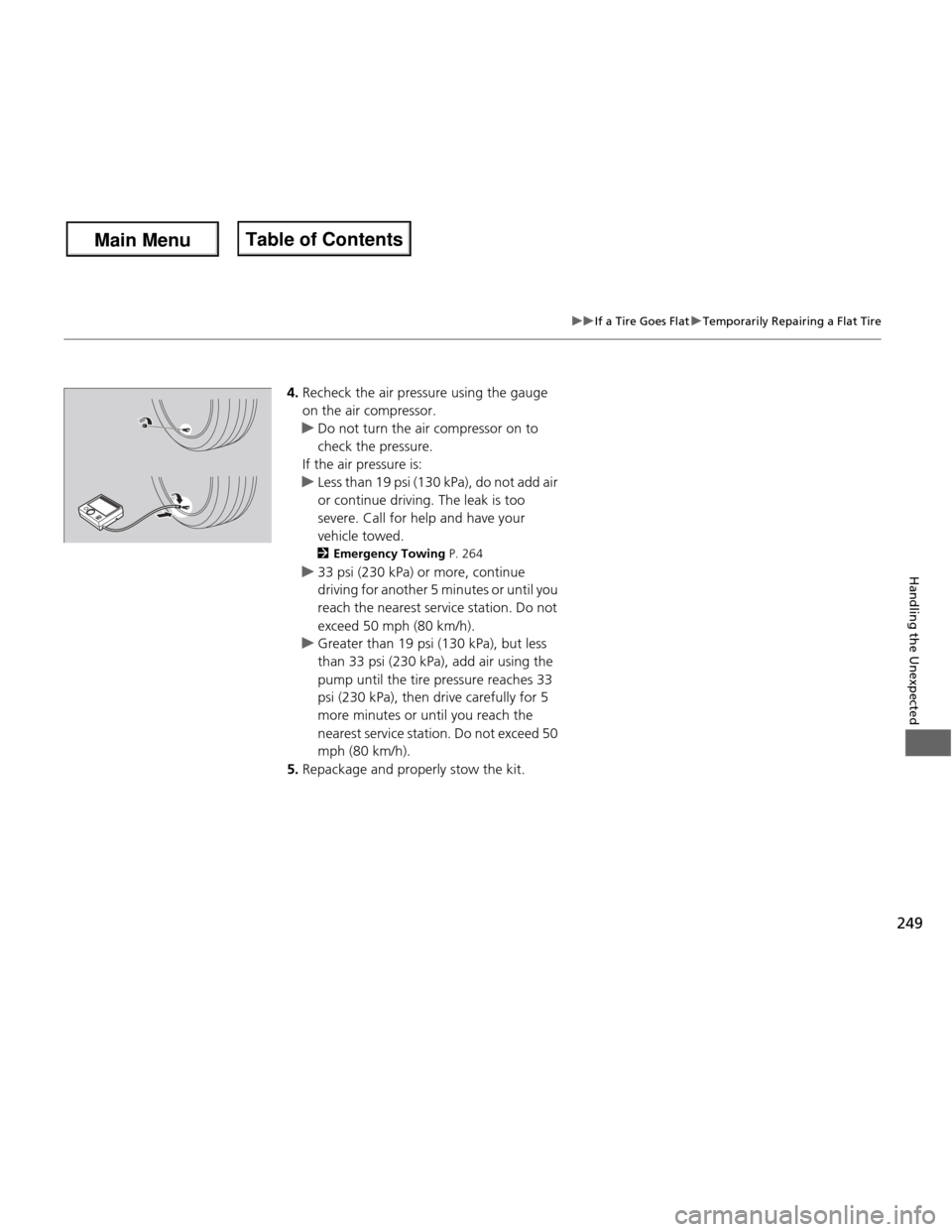
4.Recheck the air pressure using the gauge
on the air compressor.
uDo not turn the air compressor on to
check the pressure.
If the air pressure is:
uLess than 19 psi (130 kPa), do not add air
or continue driving. The leak is too
severe. Call for help and have your
vehicle towed.
2 Emergency Towing P. 264
u33 psi (230 kPa) or more, continue
driving for another 5 minutes or until you
reach the nearest service station. Do not
exceed 50 mph (80 km/h).
uGreater than 19 psi (130 kPa), but less
than 33 psi (230 kPa), add air using the
pump until the tire pressure reaches 33
psi (230 kPa), then drive carefully for 5
more minutes or until you reach the
nearest service station. Do not exceed 50
mph (80 km/h).
5. Repackage and properly stow the kit.
Main Menu
Main MenuTable of Contents
Page 251 of 286
250
Handling the Unexpected
Engine Does Not Start
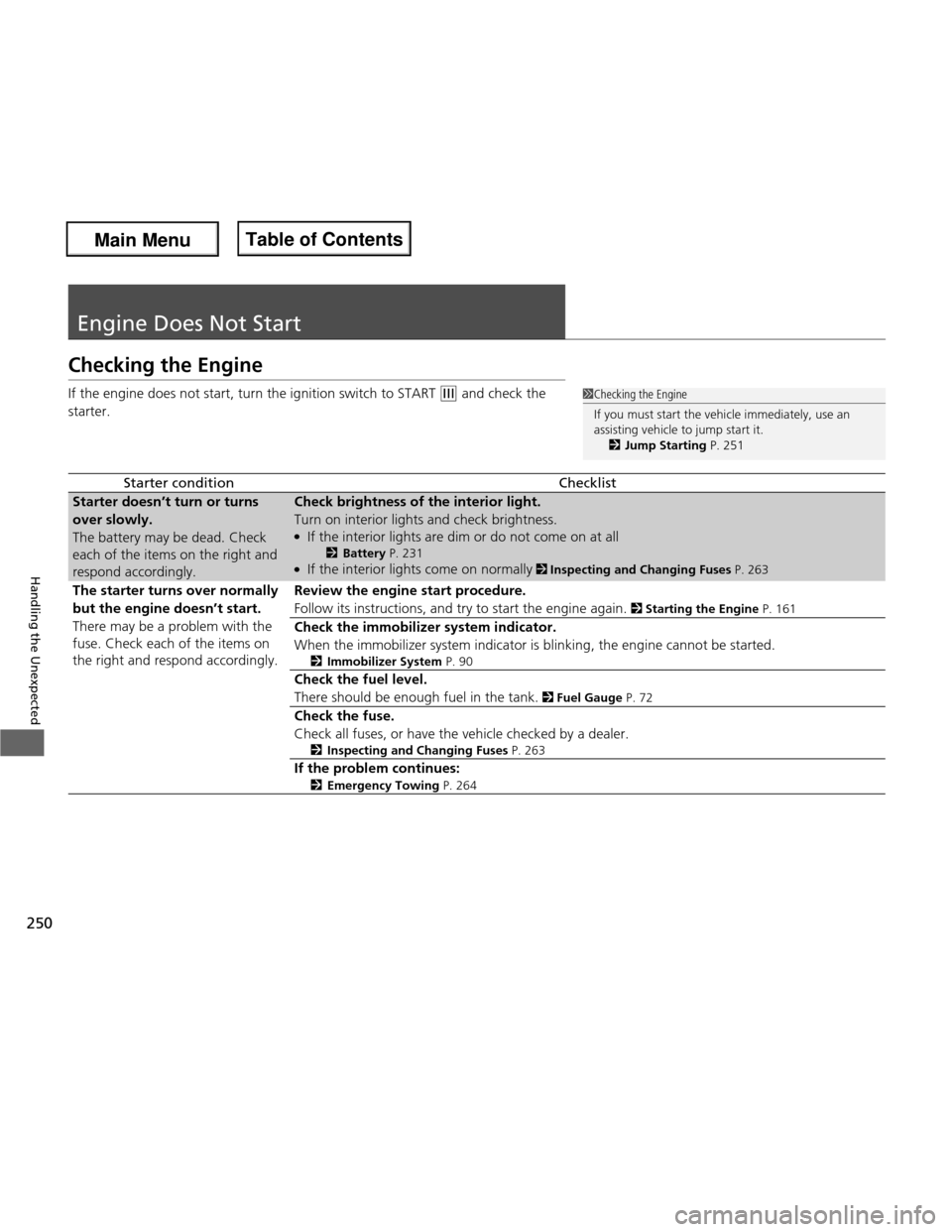
Checking the Engine
If the engine does not start, turn the ignition switch to START
(e and check the
starter.
Starter conditionChecklist
Starter doesn’t turn or turns over slowly.
The battery may be dead. Check
each of the items on the right and
respond accordingly.Check brightness of the interior light.
Turn on interior lights and check brightness. ● If the interior lights are dim or do not come on at all
2Battery P. 231
● If the interior lights come on normally 2 Inspecting and Changing Fuses P. 263
The starter turns over normally
but the engine doesn’t start.
There may be a problem with the
fuse. Check each of the items on
the right and respond accordingly.Review the engine start procedure.
Follow its instructions, and try to start the engine again. 2 Starting the Engine P. 161
Check the immobilizer system indicator.
When the immobilizer system indicator is blinking, the engine cannot be started.
2Immobilizer System P. 90
Check the fuel level. There should be enough fuel in the tank. 2 Fuel Gauge P. 72
Check the fuse.
Check all fuses, or have the vehicle checked by a dealer.
2Inspecting and Changing Fuses P. 263
If the problem continues:
2 Emergency Towing P. 264
1Checking the Engine
If you must start the vehicle immediately, use an assisting vehicle to jump start it.
2 Jump Starting P. 251
Main Menu
Main MenuTable of Contents
Page 262 of 286
261
uuFusesuFuse Locations
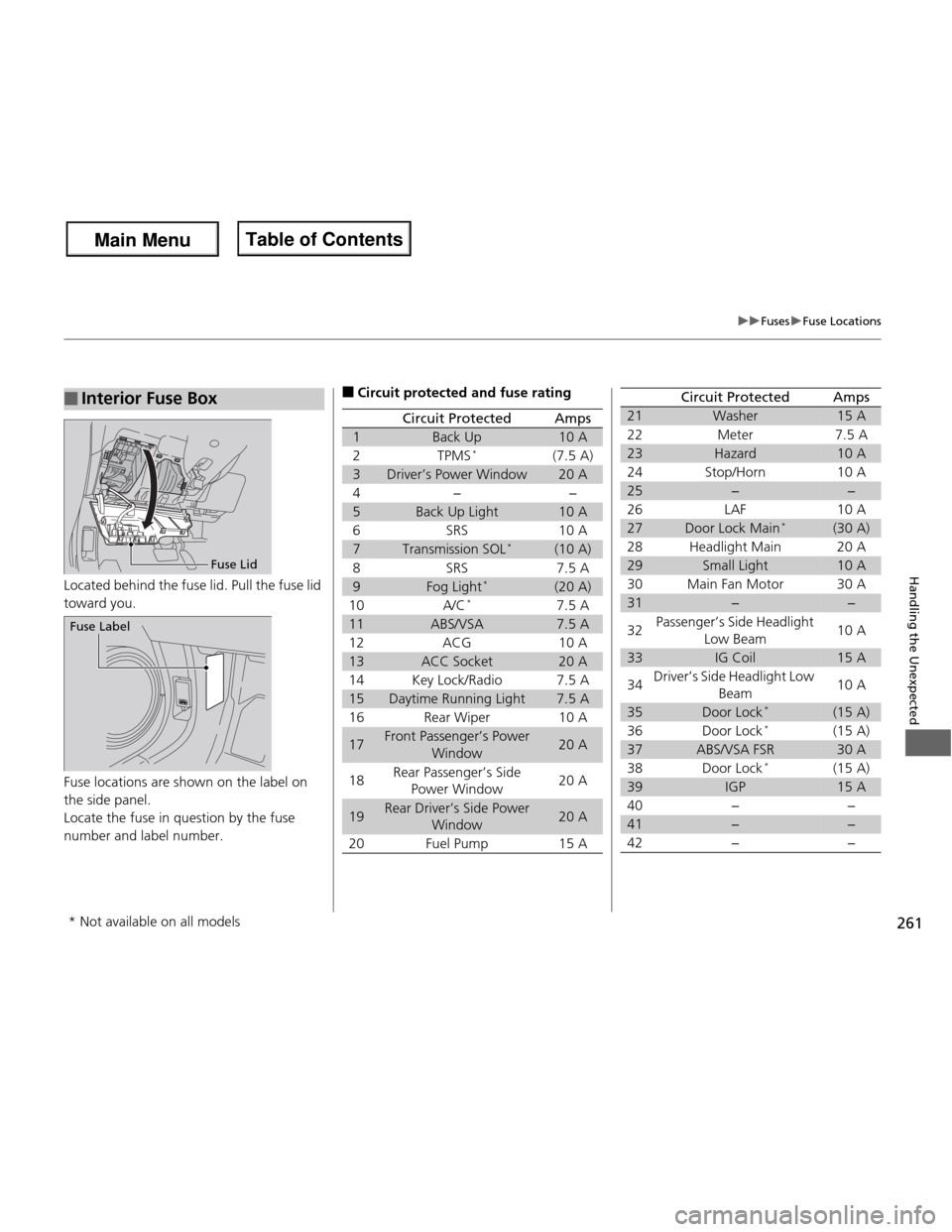
Handling the UnexpectedLocated behind the fuse lid. Pull the fuse lid toward you.
Fuse locations are shown on the label on
the side panel.
Locate the fuse in question by the fuse
number and label number.
■Interior Fuse Box
Fuse Lid
Fuse Label
■Circuit protected and fuse rating
Circuit ProtectedAmps
1Back Up10 A
2TPMS*(7.5 A)
3Driver’s Power Window20 A
4−−
5Back Up Light10 A
6SRS10 A
7Transmission SOL *(10 A)
8SRS7.5 A
9Fog Light*(20 A)
10A/C*7.5 A
11ABS/VSA7.5 A
12ACG10 A
13ACC Socket20 A
14Key Lock/Radio7.5 A
15Daytime Running Light7.5 A
16Rear Wiper10 A
17Front Passenger’s Power
Window20 A
18Rear Passenger’s Side Power Window20 A
19Rear Driver’s Side Power Window20 A
20Fuel Pump15 A
21Washer15 A
22Meter7.5 A
23Hazard10 A
24Stop/Horn10 A
25−−
26LAF10 A
27Door Lock Main *(30 A)
28Headlight Main20 A
29Small Light10 A
30Main Fan Motor30 A
31−−
32Passenger’s Side Headlight
Low Beam10 A
33IG Coil15 A
34Driver’s Side Headlight Low Beam10 A
35Door Lock*(15 A)
36Door Lock
*(15 A)
37ABS/VSA FSR30 A
38Door Lock*(15 A)
39IGP15 A
40−−
41−−
42−−
Circuit ProtectedAmps
* Not available on all models
Main Menu
Main MenuTable of Contents
Page 265 of 286
264
Handling the Unexpected
Emergency Towing
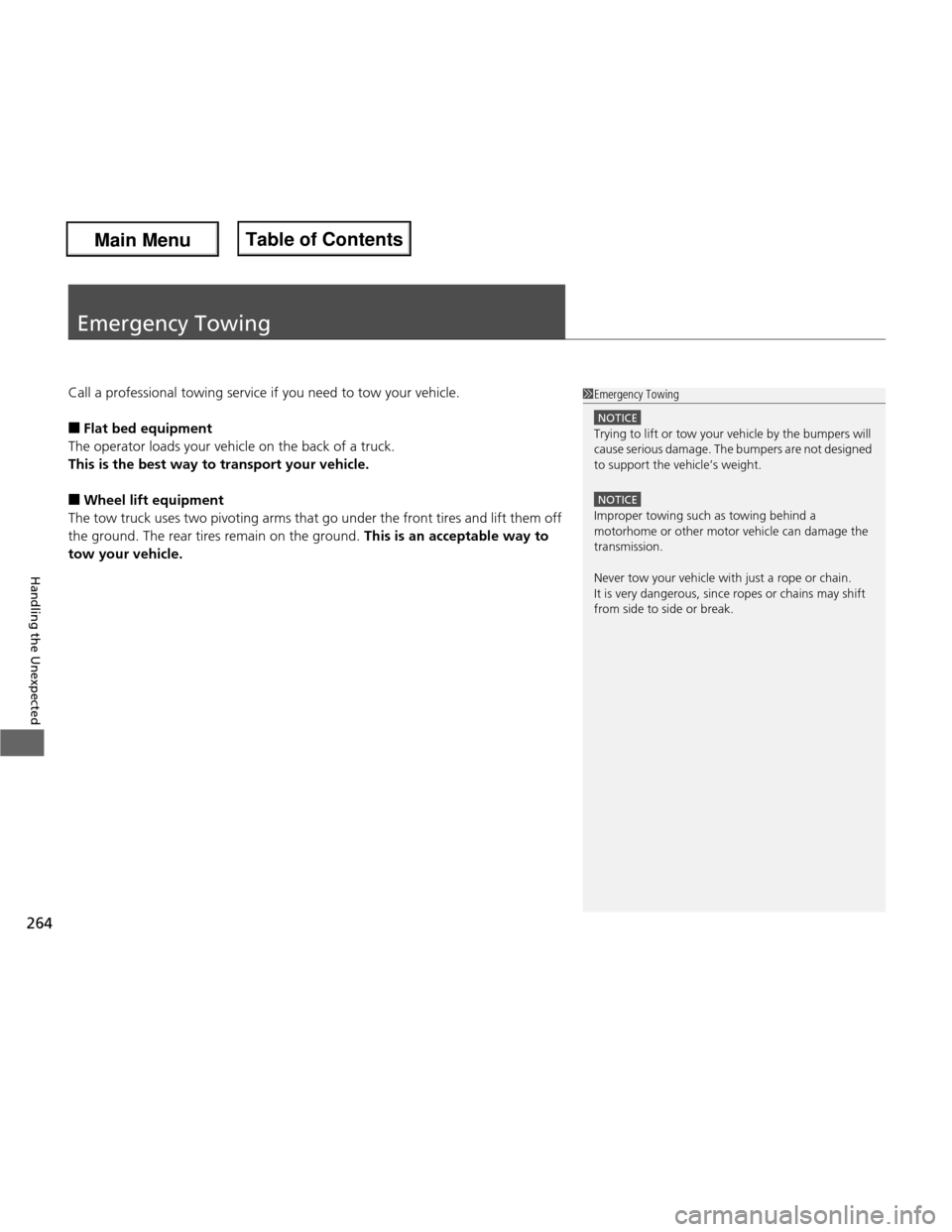
Call a professional towing service if you need to tow your vehicle. ■Flat bed equipment
The operator loads your vehicle on the back of a truck.
This is the best way to transport your vehicle. ■ Wheel lift equipment
The tow truck uses two pivoting arms that go under the front tires and lift them off
the ground. The rear tires remain on the ground. This is an acceptable way to
tow your vehicle.1Emergency Towing
NOTICE
Trying to lift or tow your vehicle by the bumpers will
cause serious damage. The bumpers are not designed
to support the vehicle’s weight.
NOTICE
Improper towing such as towing behind a
motorhome or other motor vehicle can damage the
transmission.
Never tow your vehicle with just a rope or chain.
It is very dangerous, since ropes or chains may shift from side to side or break.
Main Menu
Main MenuTable of Contents
Page 266 of 286
Continued265
uuEmergency Towingu
Handling the Unexpected
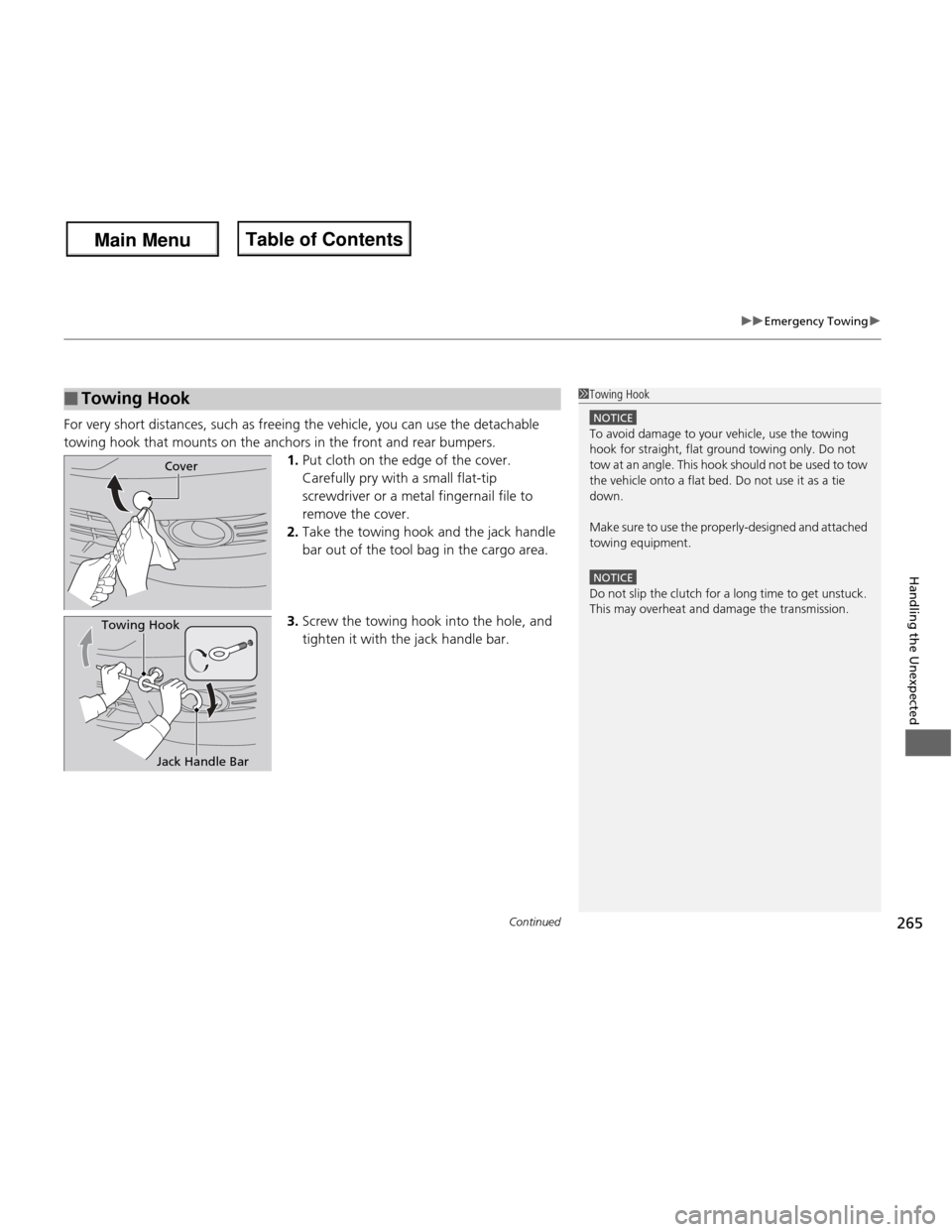
For very short distances, such as freeing the vehicle, you can use the detachable
towing hook that mounts on the anchors in the front and rear bumpers.
1.Put cloth on the edge of the cover.
Carefully pry with a small flat-tip
screwdriver or a metal fingernail file to remove the cover.
2. Take the towing hook and the jack handle
bar out of the tool bag in the cargo area.
3. Screw the towing hook into the hole, and
tighten it with the jack handle bar.
■Towing Hook1Towing Hook
NOTICE
To avoid damage to your vehicle, use the towing hook for straight, flat ground towing only. Do not
tow at an angle. This hook should not be used to tow
the vehicle onto a flat bed. Do not use it as a tie down.
Make sure to use the properly-designed and attached
towing equipment.
NOTICE
Do not slip the clutch for a long time to get unstuck.
This may overheat and damage the transmission.
Cover
Towing Hook
Jack Handle Bar
Main Menu
Main MenuTable of Contents
Page 267 of 286
uuEmergency Towingu
266
Handling the Unexpected
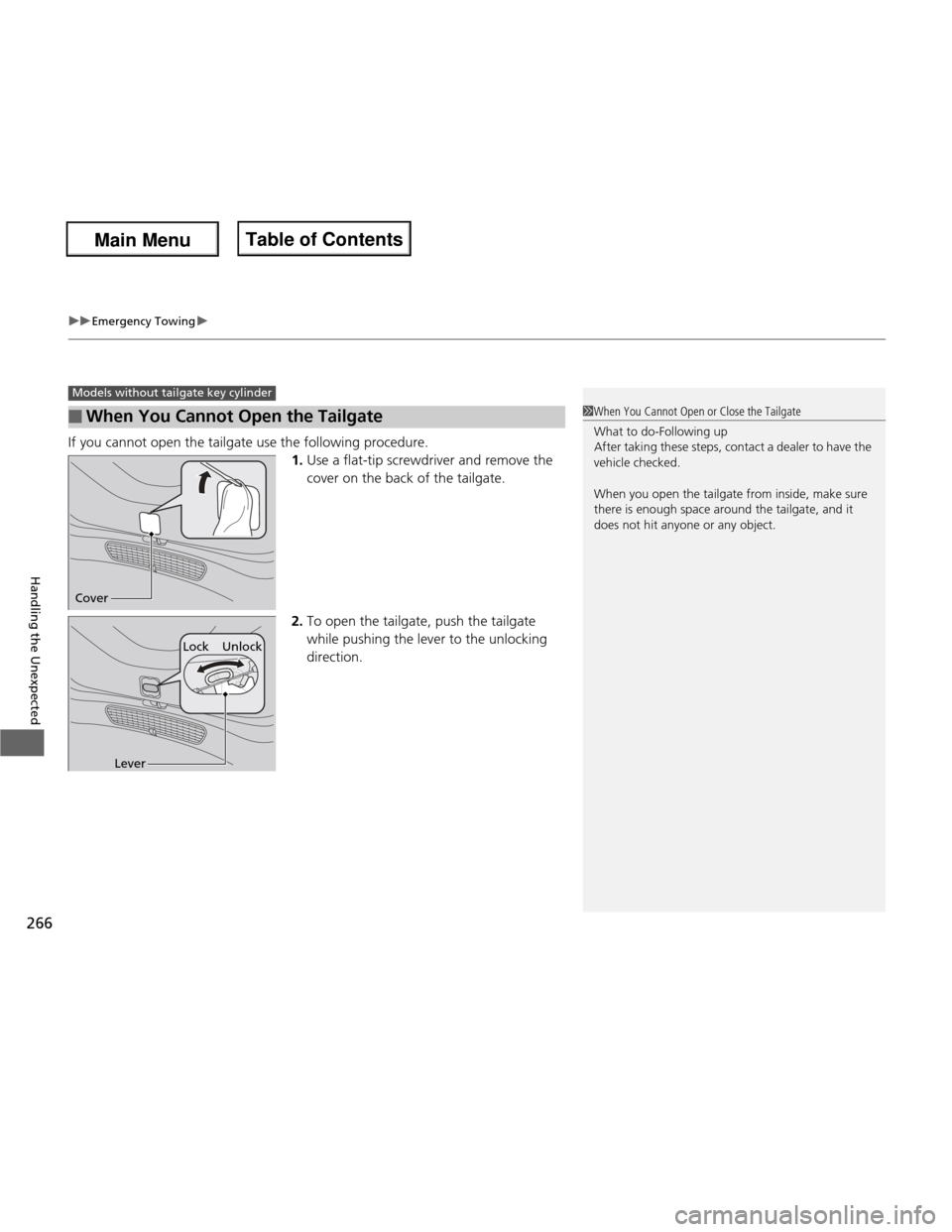
If you cannot open the tailgate use the following procedure.1.Use a flat-tip screwdriver and remove the
cover on the back of the tailgate.
2. To open the tailgate, push the tailgate
while pushing the lever to the unlocking
direction.
■When You Cannot Open the Tailgate
Models without tailgate key cylinder
1When You Cannot Open or Close the Tailgate
What to do-Following up
After taking these steps, contact a dealer to have the
vehicle checked.
When you open the tailgate from inside, make sure
there is enough space around the tailgate, and it
does not hit anyone or any object.
Cover
Lever
Lock Unlock
Main Menu
Main MenuTable of Contents
Page 286 of 286

285
Index
Summer .................................................. 230
Tire Chains.............................................. 230
Wear Indicators....................................... 227
Winter .................................................... 230
Tools ......................................................... 238
Towing a Trailer ....................................... 159
Towing Your Vehicle Emergency .............................................. 264
TPMS (Tire Pressure Monitoring System) .......... 178
Indicator ........................................... 69, 259
Transmission ............................. 165, 167, 171
Automatic............................................... 164
Fluid ............................................... 208, 209
Manual ................................................... 171
Number .................................................. 270
Sequential Shift Mode............................. 169
Shift Position Indicator .............. 65, 166, 168
Trip Meter .................................................. 73
Troubleshooting ...................................... 237
Blown Fuse ..................................... 260, 261
Brake Pedal Vibrates ................................. 17
Buzzer Sounds When Opening Door ......... 18
Emergency Towing ................................. 264
Engine Won’t Start ................................. 250
Noise When Braking ................................. 18
Overheating ............................................ 254
Puncture/Flat Tire ............................ 239, 245
Rear Door Won’t Open ....................... 17, 83
Select Lever Won’t Move ........................ 253
Warning Indicators.................................... 64 Turn Signals
................................................ 95
Indicators (Instrument Panel) ...................... 70
U
Unlocking the Doors ............................ 79, 82
USB Adapter Cable ........................... 122, 123
USB Flash Drives ........................................ 139
V
Vanity Mirrors ............................................... 5
Vehicle Identification Number (VIN) ....... 270
Vehicle Stability Assist (VSA ®).................. 176
Off Button ............................................... 177
Off Indicator .............................................. 68
System Indicator ........................................ 68
Viscosity (Oil) .................................... 201, 269
VSA ® (Vehicle Stability Assist) .................. 176
W
Warning Indicator On/Blinking ............... 256
Warning Labels ........................................... 62
Warranties (Warranty Manual provided
separately) ............................................... 275
Watts ......................................................... 268
Wear Indicators (Tire) ............................... 227
Wheel Nut Wrench (Jack Handle) ... 238, 242
Window Washers ........................................ 97
Adding/Refilling Fluid ............................... 211
Switch ....................................................... 97 Windshield
.................................................. 97
Cleaning ................................................. 236
Defrosting/Defogging .............................. 120
Washer Fluid ........................................... 211
Wiper Blades ........................................... 218
Wipers and Washers.................................. 97
Winter Tires .............................................. 230
Snow Tires .............................................. 230
Tire Chains .............................................. 230
Wipers and Washers ................................... 97
Checking and Replacing Wiper
Blades ........................................... 218, 220
WMA ................................................. 129, 133
Worn Tires ................................................ 222
Main Menu
Main Menu