lock HONDA FIT 2016 3.G Quick Guide
[x] Cancel search | Manufacturer: HONDA, Model Year: 2016, Model line: FIT, Model: HONDA FIT 2016 3.GPages: 75, PDF Size: 5.39 MB
Page 22 of 75
36 || 37
V
EHICLE CONTROLS
VEHICLE CONTROLS
Exterior Lights
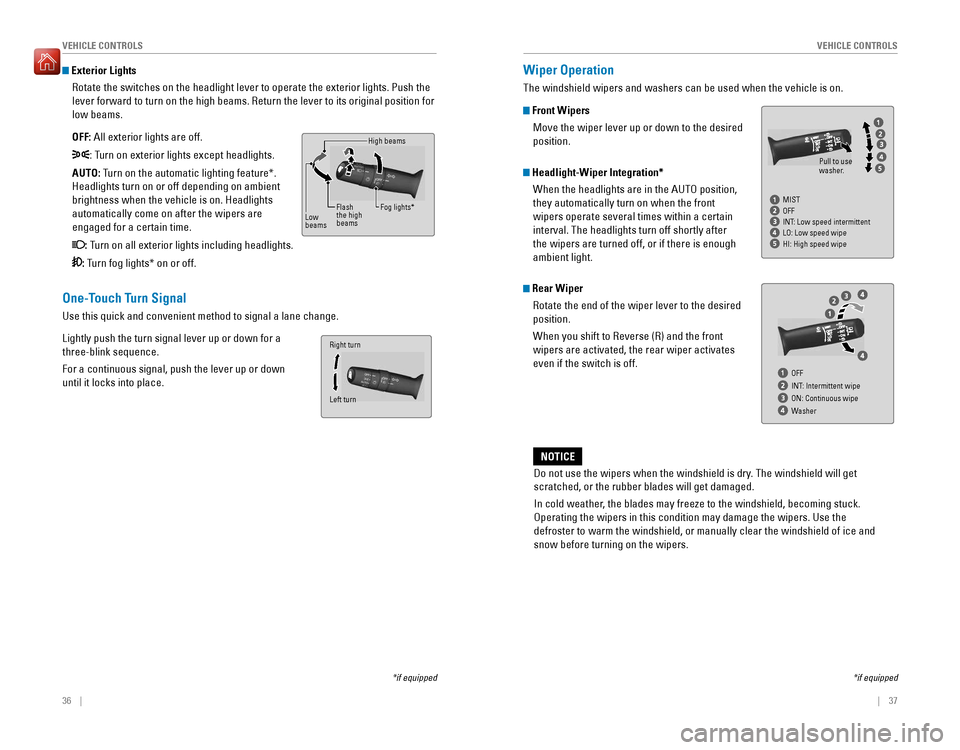
Rotate the switches on the headlight lever to operate the exterior lights. Push the
lever forward to turn on the high beams. Return the lever to its original position for low beams. OFF: All exterior lights are off.
: Turn on exterior lights except headlights.
AUTO: Turn on the automatic lighting feature*.
Headlights turn on or off depending on ambient brightness when the vehicle is on. Headlights automatically come on after the wipers are engaged for a certain time.
: Turn on all exterior lights including headlights.
: Turn fog lights* on or off.
*if equipped
One-Touch Turn Signal
Use this quick and convenient method to signal a lane change. Lightly push the turn signal lever up or down for a three-blink sequence. For a continuous signal, push the lever up or down until it locks into place.
Left turn
Right turn
High beams
Low beams Flash the high beams
Fog lights*
Wiper Operation
The windshield wipers and washers can be used when the vehicle is on.
Front Wipers
Move the wiper lever up or down to the desired position.
Headlight-Wiper Integration*
When the headlights are in the AUTO position, they automatically turn on when the front wipers operate several times within a certain interval. The headlights turn off shortly after the wipers are turned off, or if there is enough
ambient light.
Rear Wiper
Rotate the end of the wiper lever to the desired position. When you shift to Reverse (R) and the front wipers are activated, the rear wiper activates even if the switch is off.
Do not use the wipers when the windshield is dry. The windshield will get scratched, or the rubber blades will get damaged.
In cold weather, the blades may freeze to the windshield, becoming stuck. Operating the wipers in this condition may damage the wipers. Use the
defroster to warm the windshield, or manually clear the windshield of ice and snow before turning on the wipers.
NOTICE
*if equipped
Pull to use
washer.
MIST OFF
INT: Low speed intermittent LO: Low speed wipe HI: High speed wipe
OFF
INT: Intermittent wipeON: Continuous wipe
Washer
Page 23 of 75
38 || 39
V
EHICLE CONTROLS
VEHICLE CONTROLS
Reclining the seat-back too far can result in serious injury or death in a crash. Adjust the seat-back to an upright position, and sit well back in the seat.
WARNING
Adjusting the Seats
Make seat adjustments before driving to ensure the best comfort and safety.
Adjusting the Front Seats
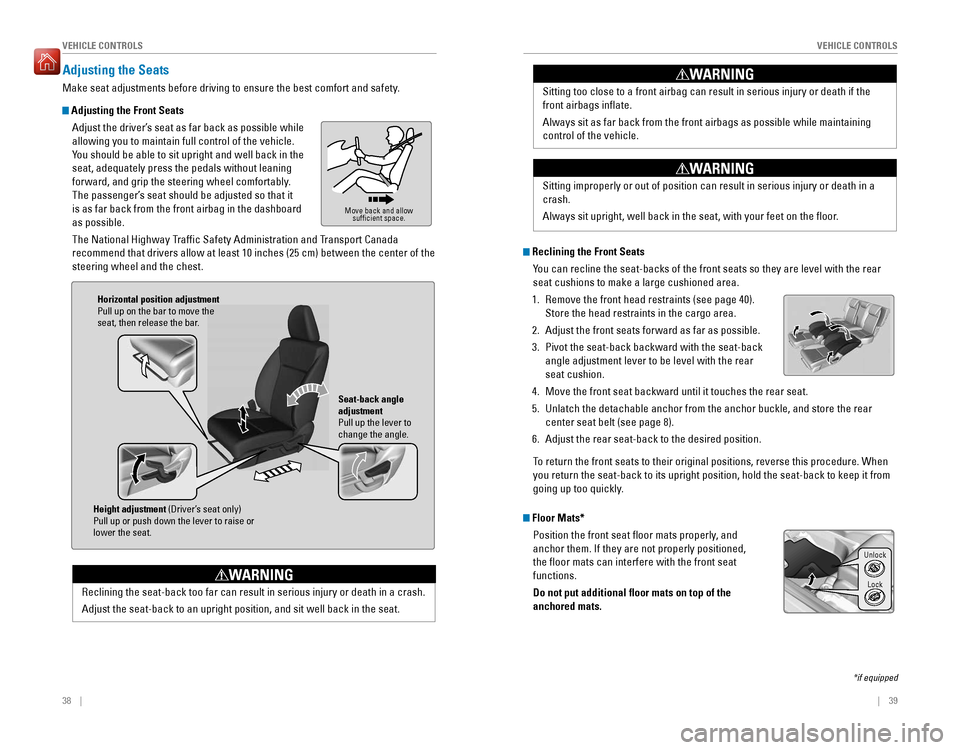
Adjust the driver’s seat as far back as possible while allowing you to maintain full control of the vehicle.
You should be able to sit upright and well back in the seat, adequately press the pedals without leaning
forward, and grip the steering wheel comfortably.
The passenger’s seat should be adjusted so that it is as far back from the front airbag in the dashboard as possible.
The National Highway Trafc Safety Administration and Transport Canada
recommend that drivers allow at least 10 inches (25 cm) between the center of the steering wheel and the chest.
Move back and allow
sufcient space.
Height adjustment (Driver’s seat only)
Pull up or push down the lever to raise or lower the seat. Seat-back angle adjustment
Pull up the lever to change the angle.
Horizontal position adjustment
Pull up on the bar to move the
seat, then release the bar. Sitting improperly or out of position can result in serious injury or death in a crash.
Always sit upright, well back in the seat, with your feet on the loor.
WARNING
Floor Mats*
Position the front seat oor mats properly, and
anchor them. If they are not properly positioned, the oor mats can interfere with the front seat functions. Do not put additional oor mats on top of the anchored mats.
Unlock
Lock
Sitting too close to a front airbag can result in serious injury or death if the front airbags inlate. Always sit as far back from the front airbags as possible while maintaining control of the vehicle.
WARNING
Reclining the Front Seats
You can recline the seat-backs of the front seats so they are level with the rear seat cushions to make a large cushioned area.
1. Remove the front head restraints (see page 40). Store the head restraints in the cargo area.
2. Adjust the front seats forward as far as possible.
3. Pivot the seat-back backward with the seat-back angle adjustment lever to be level with the rear seat cushion.
4. Move the front seat backward until it touches the rear seat.
5. Unlatch the detachable anchor from the anchor buckle, and store the rear center seat belt (see page 8).
6. Adjust the rear seat-back to the desired position.
To return the front seats to their original positions, reverse this procedure. When you return the seat-back to its upright position, hold the seat-back to keep it from
going up too quickly.
*if equipped
Page 24 of 75
40 || 41
V
EHICLE CONTROLS
VEHICLE CONTROLS
Improperly positioning head restraints reduces their effectiveness and increases the likelihood of serious injury in a crash.
Make sure head restraints are in place and positioned properly before driving.
WARNING
Failure to reinstall, or correctly reinstall, the head restraints can result in severe injury during a crash. Always replace the head restraints before driving.
WARNING
Adjusting the Head Restraints
Your vehicle is equipped with head restraints in all seating positions. Head
restraints are most effective for protection against whiplash and other rear-impact crash injuries.
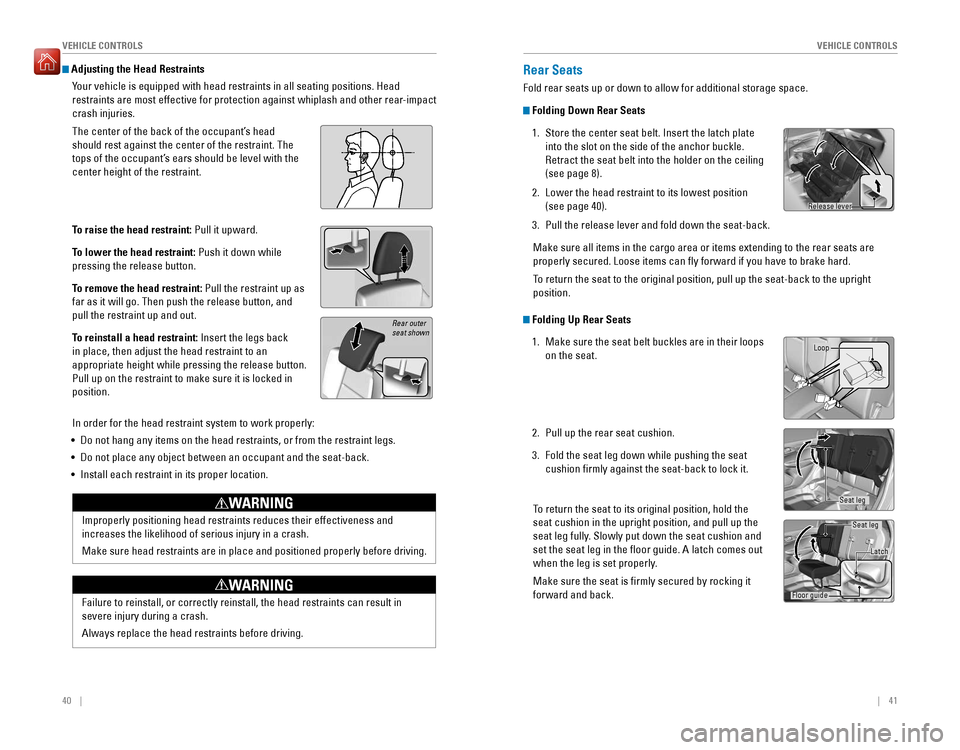
The center of the back of the occupant’s head should rest against the center of the restraint. The
tops of the occupant’s ears should be level with the center height of the restraint.
To raise the head restraint: Pull it upward.
To lower the head restraint: Push it down while
pressing the release button.
To remove the head restraint: Pull the restraint up as
far as it will go. Then push the release button, and pull the restraint up and out.
To reinstall a head restraint: Insert the legs back
in place, then adjust the head restraint to an appropriate height while pressing the release button. Pull up on the restraint to make sure it is locked in position. In order for the head restraint system to work properly:
• Do not hang any items on the head restraints, or from the restraint legs.
• Do not place any object between an occupant and the seat-back.
• Install each restraint in its proper location.
Rear outer seat shown
Rear Seats
Fold rear seats up or down to allow for additional storage space.
Folding Down Rear Seats
1. Store the center seat belt. Insert the latch plate into the slot on the side of the anchor buckle. Retract the seat belt into the holder on the ceiling (see page 8).
2. Lower the head restraint to its lowest position (see page 40).
3. Pull the release lever and fold down the seat-back.
Make sure all items in the cargo area or items extending to the rear seats are properly secured. Loose items can ly forward if you have to brake hard.
To return the seat to the original position, pull up the seat-back to the upright position.
Folding Up Rear Seats
1. Make sure the seat belt buckles are in their loops on the seat.
2. Pull up the rear seat cushion.
3. Fold the seat leg down while pushing the seat cushion irmly against the seat-back to lock it.
To return the seat to its original position, hold the seat cushion in the upright position, and pull up the
seat leg fully. Slowly put down the seat cushion and set the seat leg in the oor guide. A latch comes out
when the leg is set properly. Make sure the seat is irmly secured by rocking it forward and back.
Release lever
Loop
Seat leg
Seat leg Latch
Floor guide
Page 25 of 75
42 || 43
V
EHICLE CONTROLS
VEHICLE CONTROLS
Adjusting the Mirrors
Adjust the angle of the mirrors for the best visibility when you are sitting in the correct driving position.
Rearview Mirror with Day/Night Positions
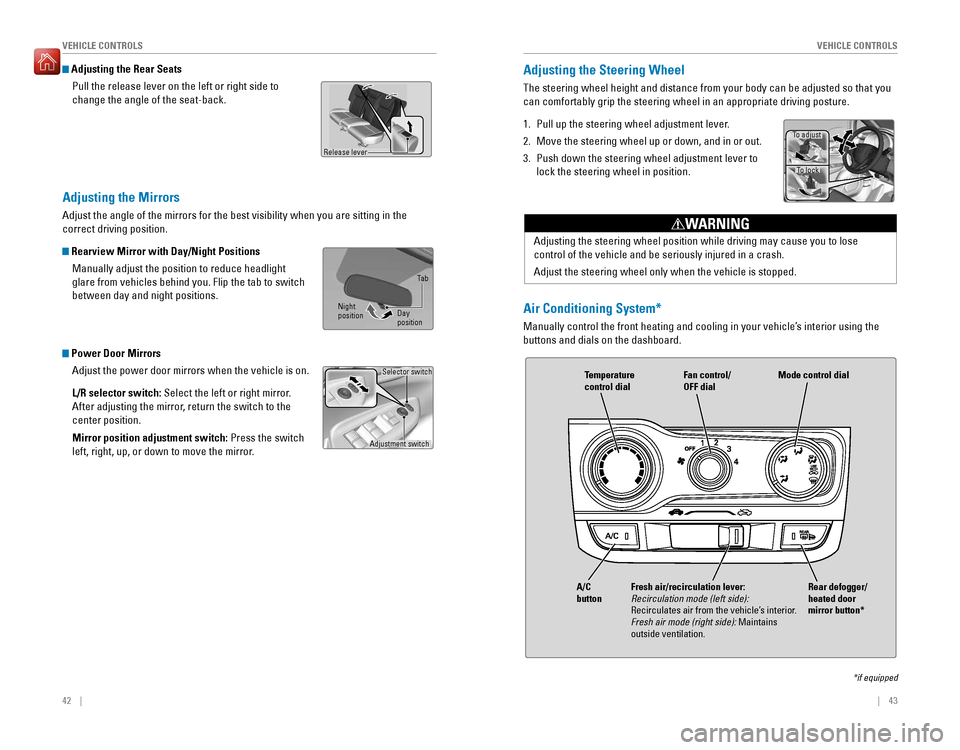
Manually adjust the position to reduce headlight
glare from vehicles behind you. Flip the tab to switch between day and night positions.
Power Door Mirrors
Adjust the power door mirrors when the vehicle is on. L/R selector switch: Select the left or right mirror.
After adjusting the mirror, return the switch to the center position. Mirror position adjustment switch: Press the switch
left, right, up, or down to move the mirror.
Adjustment switch Selector switch
Adjusting the Rear Seats
Pull the release lever on the left or right side to
change the angle of the seat-back.
Release lever
Adjusting the Steering Wheel
The steering wheel height and distance from your body can be adjusted so that you can comfortably grip the steering wheel in an appropriate driving posture.
1. Pull up the steering wheel adjustment lever.
2. Move the steering wheel up or down, and in or out.
3. Push down the steering wheel adjustment lever to lock the steering wheel in position.
Adjusting the steering wheel position while driving may cause you to lose control of the vehicle and be seriously injured in a crash. Adjust the steering wheel only when the vehicle is stopped.
WARNING
To adjust To lock
Night position Ta b
DaypositionAir Conditioning System*
Manually control the front heating and cooling in your vehicle’s interior using the buttons and dials on the dashboard.
Fan control/ OFF dial
A/C button Temperature control dial
Fresh air/recirculation lever:
Recirculation mode (left side):
Recirculates air from the vehicle’s interior.
Fresh air mode (right side): Maintains
outside ventilation. Rear defogger/heated door mirror button*Mode control dial
*if equipped
Page 26 of 75
44 || 45
V
EHICLE CONTROLS
VEHICLE CONTROLS
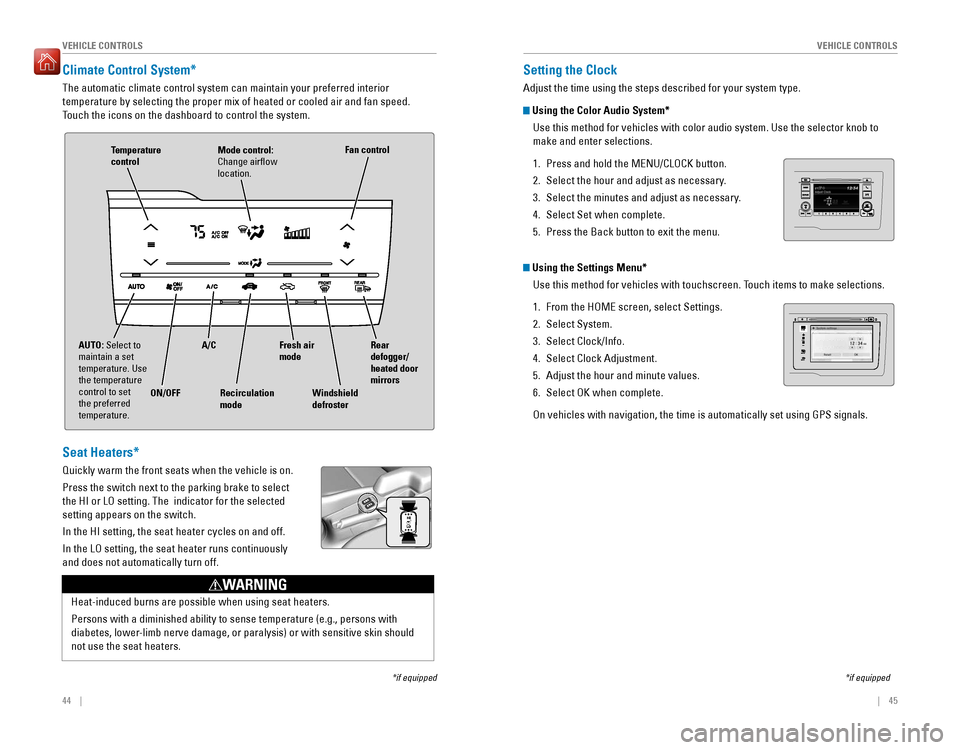
Climate Control System*
The automatic climate control system can maintain your preferred interior temperature by selecting the proper mix of heated or cooled air and fan speed.
Touch the icons on the dashboard to control the system.
*if equipped
AUTO: Select to
maintain a set temperature. Use the temperature control to set the preferred temperature. ON/OFFA/C
Recirculation mode Rear defogger/heated door mirrors
Windshield defroster
Fan control
Mode control: Change airow location.Temperature control
Fresh air mode
Seat Heaters*
Quickly warm the front seats when the vehicle is on. Press the switch next to the parking brake to select the HI or LO setting. The indicator for the selected setting appears on the switch. In the HI setting, the seat heater cycles on and off.In the LO setting, the seat heater runs continuously and does not automatically turn off.
Heat-induced burns are possible when using seat heaters.
Persons with a diminished ability to sense temperature (e.g., persons with
diabetes, lower-limb nerve damage, or paralysis) or with sensitive skin should not use the seat heaters.
WARNING
Setting the Clock
Adjust the time using the steps described for your system type.
Using the Color Audio System*
Use this method for vehicles with color audio system. Use the selector knob to make and enter selections. 1.
Press and hold the MENU/CLOCK button.
2. Select the hour and adjust as necessary.
3. Select the minutes and adjust as necessary.
4. Select Set when complete.5. Press the Back button to exit the menu.
Using the Settings Menu*
Use this method for vehicles with touchscreen. Touch items to make selections.
1. From the HOME screen, select Settings.
2. Select System. 3. Select Clock/Info.
4. Select Clock Adjustment.
5. Adjust the hour and minute values.
6. Select OK when complete.
On vehicles with navigation, the time is automatically set using GPS signals.
*if equipped
VO L
HOME
MENU BA CK
Page 27 of 75
46 || 47
AUDIO AND CONNECTIVITY
V EHICLE CONTROLS
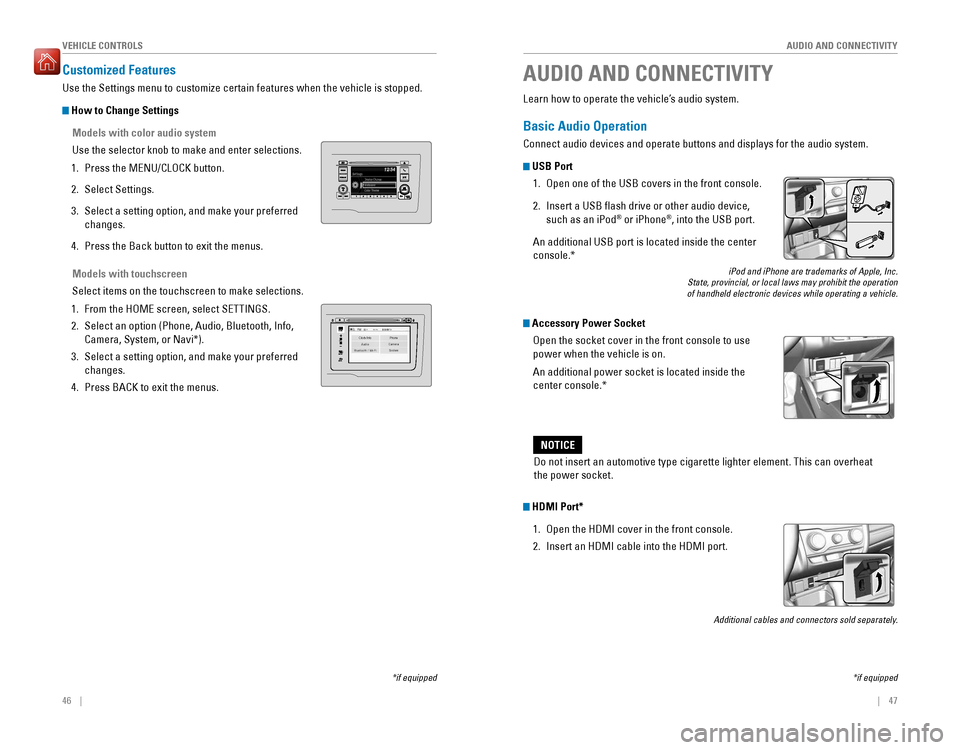
Models with touchscreen
Select items on the touchscreen to make selections.
1. From the HOME screen, select SETTINGS.
2. Select an option (Phone, Audio, Bluetooth, Info, Camera, System, or Navi*).
3. Select a setting option, and make your preferred changes.
4. Press BACK to exit the menus.
Customized Features
Use the Settings menu to customize certain features when the vehicle is stopped.
How to Change Settings
Models with color audio system
Use the selector knob to make and enter selections.
1. Press the MENU/CLOCK button.
2. Select Settings.
3. Select a setting option, and make your preferred changes.
4. Press the Back button to exit the menus.
VOL
HOME
MENU BA CKClock/Info Phone
Learn how to operate the vehicle’s audio system.
Basic Audio Operation
Connect audio devices and operate buttons and displays for the audio system.
USB Port
1. Open one of the USB covers in the front console. 2. Insert a USB lash drive or other audio device, such as an iPod ®
or iPhone ®
, into the USB port.
An additional USB port is located inside the center console.* iPod and iPhone are trademarks of Apple, Inc.
State, provincial, or local laws may prohibit the operation
of handheld electronic devices while operating a vehicle.
Accessory Power Socket
Open the socket cover in the front console to use power when the vehicle is on. An additional power socket is located inside the
center console.*
AUDIO AND CONNECTIVITY
*if equipped
Do not insert an automotive type cigarette lighter element. This can overheat the power socket.
NOTICE
HDMI Port*
1. Open the HDMI cover in the front console.
2. Insert an HDMI cable into the HDMI port.
Additional cables and connectors sold separately.
*if equipped
Page 29 of 75
50 || 51
AUDIO AND CONNECTIVITY
AUDIO AND CONNECTIVITY
Models with color audio system
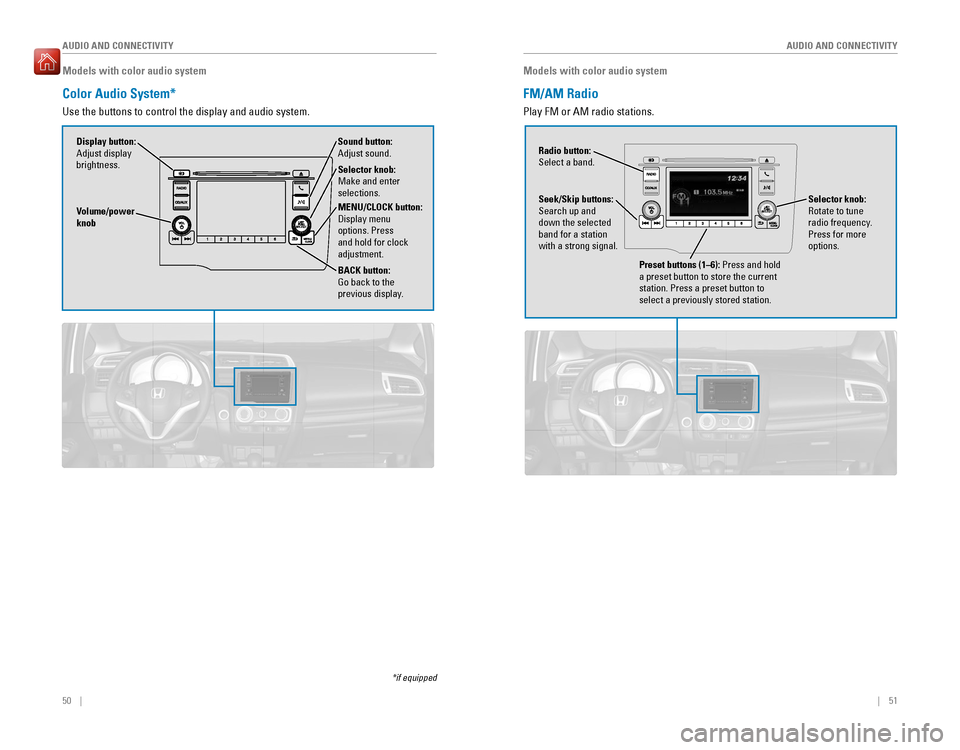
Color Audio System*
Use the buttons to control the display and audio system.
Selector knob:
Make and enter selections.
Volume/power knob MENU/CLOCK button:
Display menu options. Press and hold for clock adjustment. BACK button:
Go back to the
previous display.
Display button:
Adjust display brightness. Sound button:
Adjust sound.
Models with color audio system
FM/AM Radio
Play FM or AM radio stations.
Radio button:
Select a band.
Preset buttons (1–6): Press and hold
a preset button to store the current station. Press a preset button to select a previously stored station.
Seek/Skip buttons:
Search up and down the selected
band for a station with a strong signal. Selector knob:
Rotate to tune
radio frequency. Press for more options.
*if equipped
Page 45 of 75
82 || 83
DRIVING
NAVIGATION
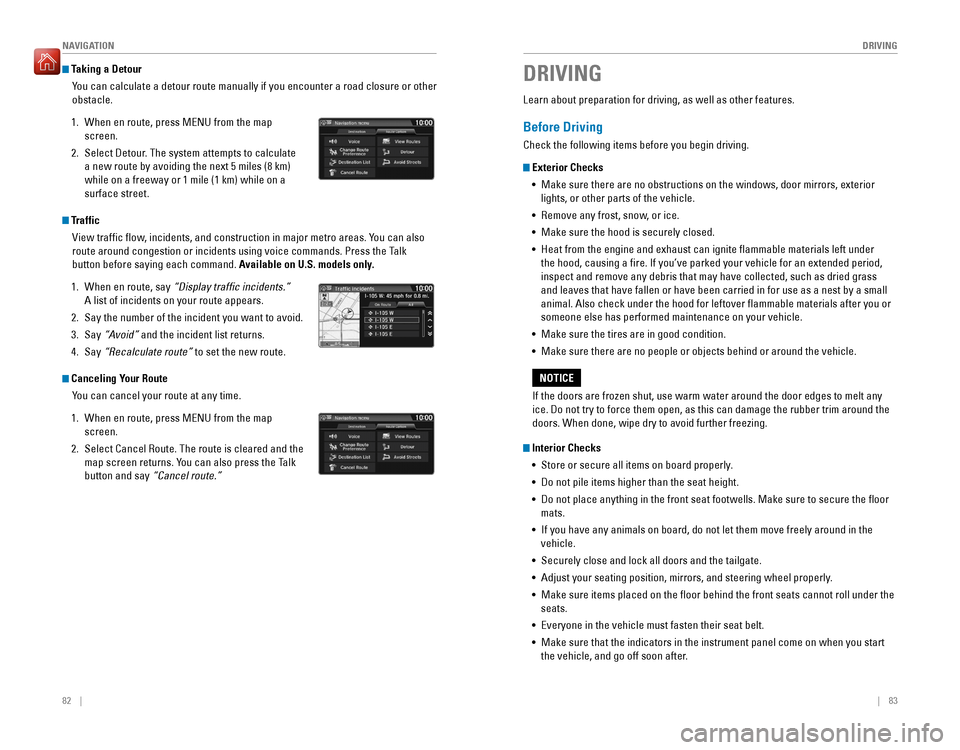
Taking a Detour
You can calculate a detour route manually if you encounter a road closure or other obstacle.
1. When en route, press MENU from the map screen.
2. Select Detour. The system attempts to calculate a new route by avoiding the next 5 miles (8 km) while on a freeway or 1 mile (1 km) while on a surface street.
Traffic
View trafc ow, incidents, and construction in major metro areas. You can also
route around congestion or incidents using voice commands. Press the Talk
button before saying each command. Available on U.S. models only.
1. When en route, say “Display trafic incidents.”
A list of incidents on your route appears.
2. Say the number of the incident you want to avoid.
3. Say “Avoid” and the incident list returns.
4. Say “Recalculate route” to set the new route.
Canceling Your Route
You can cancel your route at any time.
1. When en route, press MENU from the map screen.
2. Select Cancel Route. The route is cleared and the map screen returns. You can also press the Talk button and say “Cancel route.”
Learn about preparation for driving, as well as other features.
Before Driving
Check the following items before you begin driving.
Exterior Checks
•
Make sure there are no obstructions on the windows, door mirrors, exterior
lights, or other parts of the vehicle.
• Remove any frost, snow, or ice.
• Make sure the hood is securely closed.
• Heat from the engine and exhaust can ignite lammable materials left under
the hood, causing a ire. If you’ve parked your vehicle for an extended period,
inspect and remove any debris that may have collected, such as dried grass and leaves that have fallen or have been carried in for use as a nest by a small animal. Also check under the hood for leftover lammable materials after you or someone else has performed maintenance on your vehicle.
• Make sure the tires are in good condition.
• Make sure there are no people or objects behind or around the vehicle.
Interior Checks
• Store or secure all items on board properly.
• Do not pile items higher than the seat height.
• Do not place anything in the front seat footwells. Make sure to secure the loor mats.
• If you have any animals on board, do not let them move freely around in the
vehicle.
• Securely close and lock all doors and the tailgate.
• Adjust your seating position, mirrors, and steering wheel properly.
• Make sure items placed on the loor behind the front seats cannot roll under the
seats.
• Everyone in the vehicle must fasten their seat belt.
• Make sure that the indicators in the instrument panel come on when you start
the vehicle, and go off soon after.
DRIVING
If the doors are frozen shut, use warm water around the door edges to melt any ice. Do not try to force them open, as this can damage the rubber trim around the doors. When done, wipe dry to avoid further freezing.
NOTICE
Page 47 of 75
86 || 87
DRIVING
DRIVING
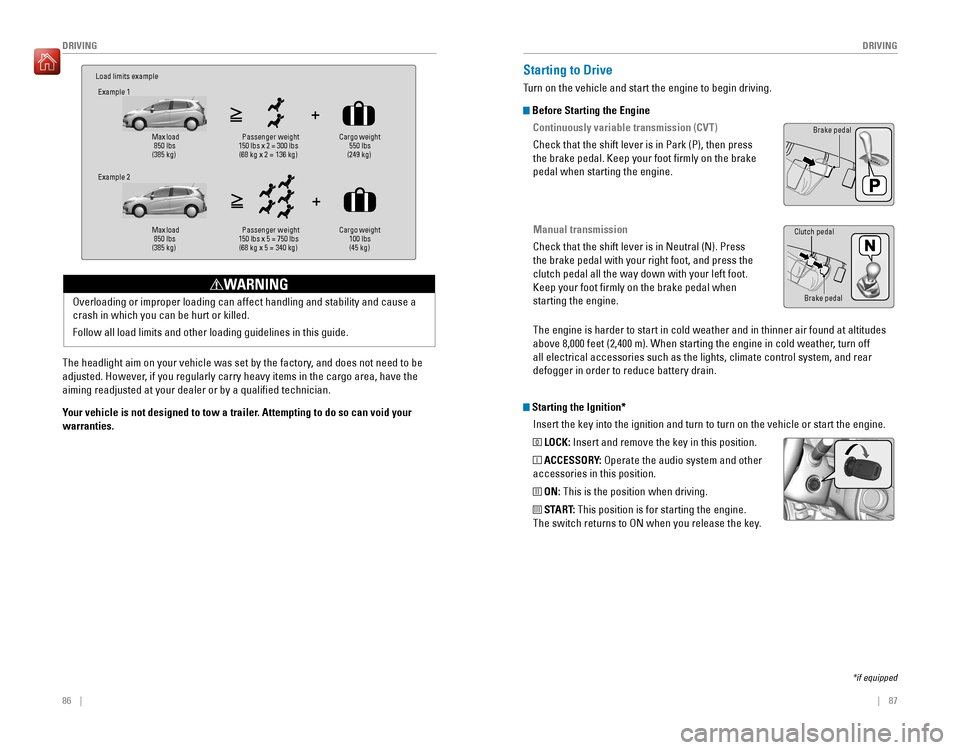
Load limits example
Example 1
Max load
850 lbs
(385 kg) Pass
enger weight
150 lbs x 2 = 300 lbs (68 kg x 2 = 136 kg) Cargo weight
550 lbs
(249 kg)
Example 2
Max load
850 lbs
(385 kg) Pa
ssenger w eight
150 lbs x 5 = 750 lbs
(68 kg x 5 = 340 kg) Cargo weight
100 lbs (45 kg)
The headlight aim on your vehicle was set by the factory, and does not need to be
adjusted. However, if you regularly carry heavy items in the cargo area, have the aiming readjusted at your dealer or by a qualiied technician.
Your vehicle is not designed to tow a trailer. Attempting to do so can void your warranties. Overloading or improper loading can affect handling and stability and cause a crash in which you can be hurt or killed. Follow all load limits and other loading guidelines in this guide.
WARNING
Starting the Ignition*
Insert the key into the ignition and turn to turn on the vehicle or start the engine.
0
LOCK: Insert and remove the key in this position.
I
ACCESSORY: Operate the audio system and other
accessories in this position.
II
ON: This is the position when driving.
III
START: This position is for starting the engine.
The switch returns to ON when you release the key.
Starting to Drive
Turn on the vehicle and start the engine to begin driving.
Before Starting the Engine
Continuously variable transmission (CVT)
Check that the shift lever is in Park (P), then press
the brake pedal. Keep your foot irmly on the brake pedal when starting the engine.
Manual transmission
Check that the shift lever is in Neutral (N). Press the brake pedal with your right foot, and press the clutch pedal all the way down with your left foot. Keep your foot irmly on the brake pedal when starting the engine.
Brake pedal
The engine is harder to start in cold weather and in thinner air found at altitudes
above 8,000 feet (2,400 m). When starting the engine in cold weather, turn off
all electrical accessories such as the lights, climate control system, and rear defogger in order to reduce battery drain.
*if equipped
Brake pedal
Clutch pedal
Page 49 of 75
90 || 91
DRIVING
DRIVING
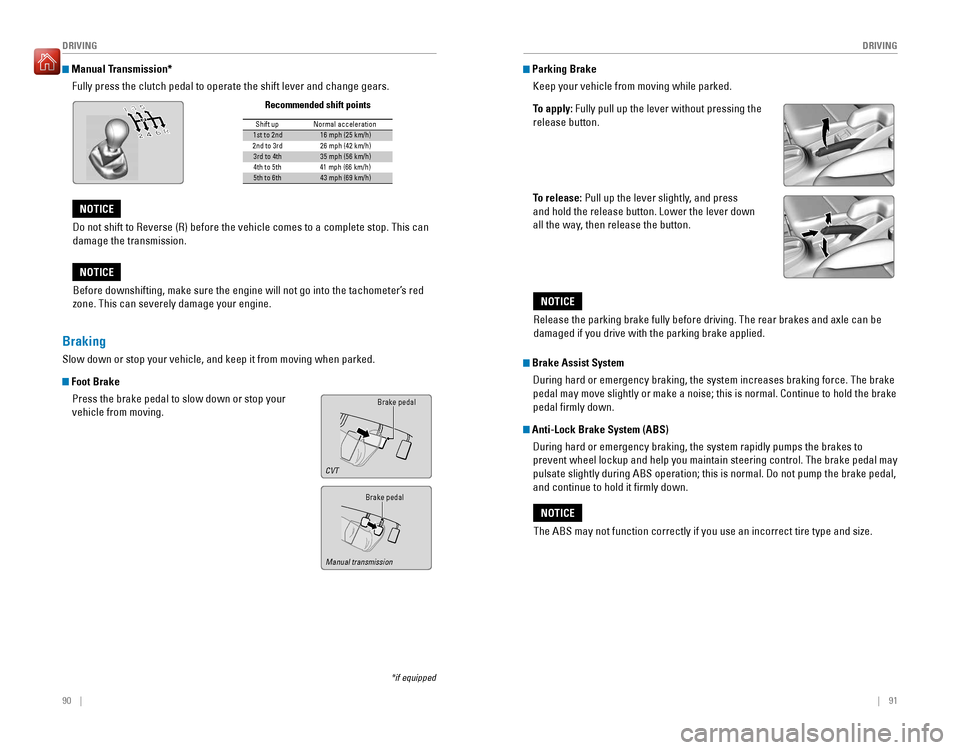
Manual Transmission*
Fully press the clutch pedal to operate the shift lever and change gears.
Do not shift to Reverse (R) before the vehicle comes to a complete stop. This can damage the transmission.
NOTICE
Before downshifting, make sure the engine will not go into the tachometer’s red
zone. This can severely damage your engine.
NOTICE
Shift up Normal acceleratio n1st to 2n d16 mph (25 km/h)
2nd to 3rd 26 mph (42 km/h)
3rd to 4th35 mph (56 km/h)
4th to 5th 41 mph (66 km/h)
5th to 6th43 mph (69 km/h)
Recommended shift points
*if equipped
Braking
Slow down or stop your vehicle, and keep it from moving when parked.
Foot Brake
Press the brake pedal to slow down or stop your vehicle from moving.Brake pedal
Brake pedal
CVT
Manual transmission
Parking Brake
Keep your vehicle from moving while parked.
To apply: Fully pull up the lever without pressing the
release button.
To release: Pull up the lever slightly, and press
and hold the release button. Lower the lever down
all the way, then release the button.
The ABS may not function correctly if you use an incorrect tire type and size.
NOTICE
Brake Assist System
During hard or emergency braking, the system increases braking force. The brake
pedal may move slightly or make a noise; this is normal. Continue to hold the brake pedal rmly down.
Anti-Lock Brake System (ABS)
During hard or emergency braking, the system rapidly pumps the brakes to
prevent wheel lockup and help you maintain steering control. The brake pedal may
pulsate slightly during ABS operation; this is normal. Do not pump the brake pedal, and continue to hold it rmly down.
Release the parking brake fully before driving. The rear brakes and axle can be damaged if you drive with the parking brake applied.
NOTICE