Brake light HONDA FIT 2017 3.G Owner's Manual
[x] Cancel search | Manufacturer: HONDA, Model Year: 2017, Model line: FIT, Model: HONDA FIT 2017 3.GPages: 465, PDF Size: 26.52 MB
Page 364 of 465
363
Maintenance
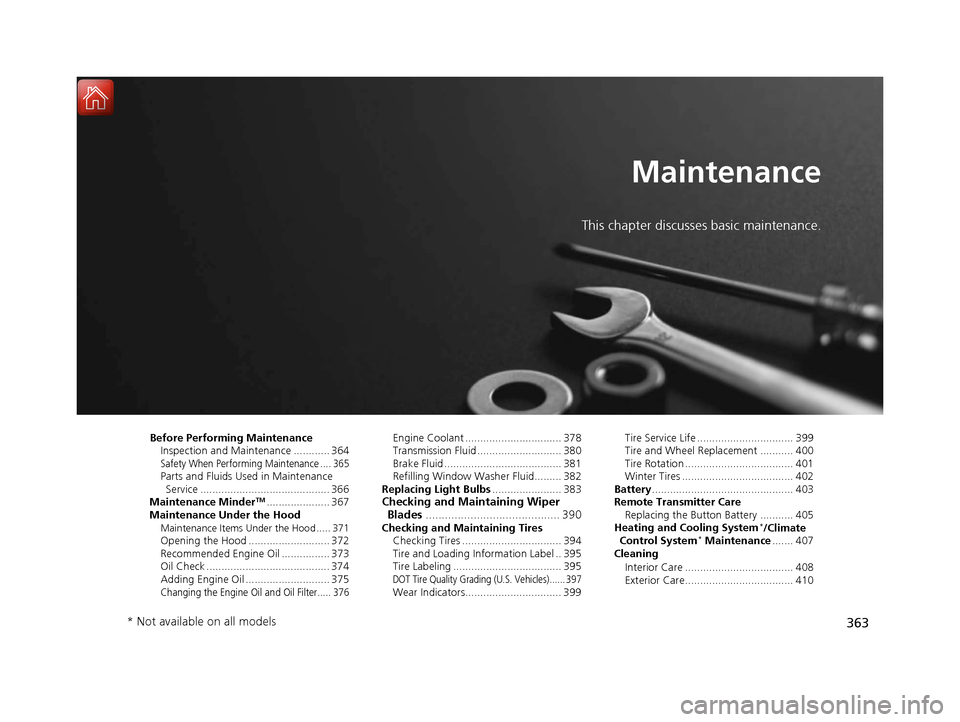
This chapter discusses basic maintenance.
Before Performing MaintenanceInspection and Maintenance ............ 364
Safety When Performing Maintenance .... 365Parts and Fluids Used in Maintenance Service ........................................... 366
Maintenance Minder
TM..................... 367
Maintenance Under the Hood
Maintenance Items Under the Hood ..... 371Opening the Hood ........................... 372
Recommended Engine Oil ................ 373
Oil Check ......................................... 374
Adding Engine Oil ............................ 375
Changing the Engine Oil and Oil Filter..... 376
Engine Coolant ................................ 378
Transmission Fluid ............................ 380
Brake Fluid ....................................... 381
Refilling Window Wa sher Fluid......... 382
Replacing Light Bulbs ....................... 383
Checking and Maintaining Wiper
Blades .......................................... 390
Checking and Maintaining Tires
Checking Tires ................................. 394
Tire and Loading Information Label .. 395
Tire Labeling .................................... 395
DOT Tire Quality Grading (U.S. Vehicles) ...... 397Wear Indicators................................ 399 Tire Service Life ................................ 399
Tire and Wheel Replacement ........... 400
Tire Rotation .................................... 401
Winter Tires ..................................... 402
Battery ............................................... 403
Remote Transmitter Care
Replacing the Button Battery ........... 405
Heating and Cooling System
*/Climate
Control System* Maintenance ....... 407
Cleaning
Interior Care .................................... 408
Exterior Care.................................... 410
* Not available on all models
17 FIT -31T5A6200.book 363 ページ 2016年5月27日 金曜日 午後6時33分
Page 365 of 465
364
Maintenance
Before Performing Maintenance
Inspection and Maintenance
For your safety, perform all listed inspections and maintenance to keep your vehicle
in good condition. If you become aware of any abnormality (noise, smell, insufficient
brake fluid, oil residue on the ground, etc.), have your vehicle inspected by a dealer.
(Note, however, that service at a dealer is not mandatory to keep your warranties in
effect.)
■Daily inspections
Perform inspections before long distance tri ps, when washing the vehicle, or when
refueling.
■Periodic inspections
• Check the brake fluid level monthly.
2 Brake Fluid P. 381
•Check the tire pressure monthly. Examin e the tread for wear and foreign objects.
2Checking and Maintaining Tires P. 394
•Check the operation of the exterior lights monthly.
2 Replacing Light Bulbs P. 383
•Check the condition of the wiper bl ades at least every six months.
2Checking and Maintaining Wiper Blades P. 390
■Types of Inspection and Maintenance
1Inspection and Maintenance
Maintenance, replacement, or repair of
emissions control devices and systems may be
done by any automotive repair establishment or
individuals using parts that are “certified” to
EPA standards.
According to state and fede ral regulations, failure to
perform maintenance on the maintenance main
items marked with # will not void your emissions
warranties. However, all maintenance services should
be performed in accordan ce with the intervals
indicated by the information display.
2 Maintenance Service Items P. 369
If you want to perform complex maintenance tasks
that require more skills a nd tools, you can purchase a
subscription to the Service Express website at
www.techinfo.honda.com .
2 Authorized Manuals P. 451
If you want to perform ma intenance yourself, make
sure that you have the necessary tools and skills first.
After performing ma intenance, update the records in
the separate maintenance booklet.
U.S. models
17 FIT -31T5A6200.book 364 ページ 2016年5月27日 金曜日 午後6時33分
Page 373 of 465
372
uuMaintenance Under the Hood uOpening the Hood
Maintenance
Opening the Hood
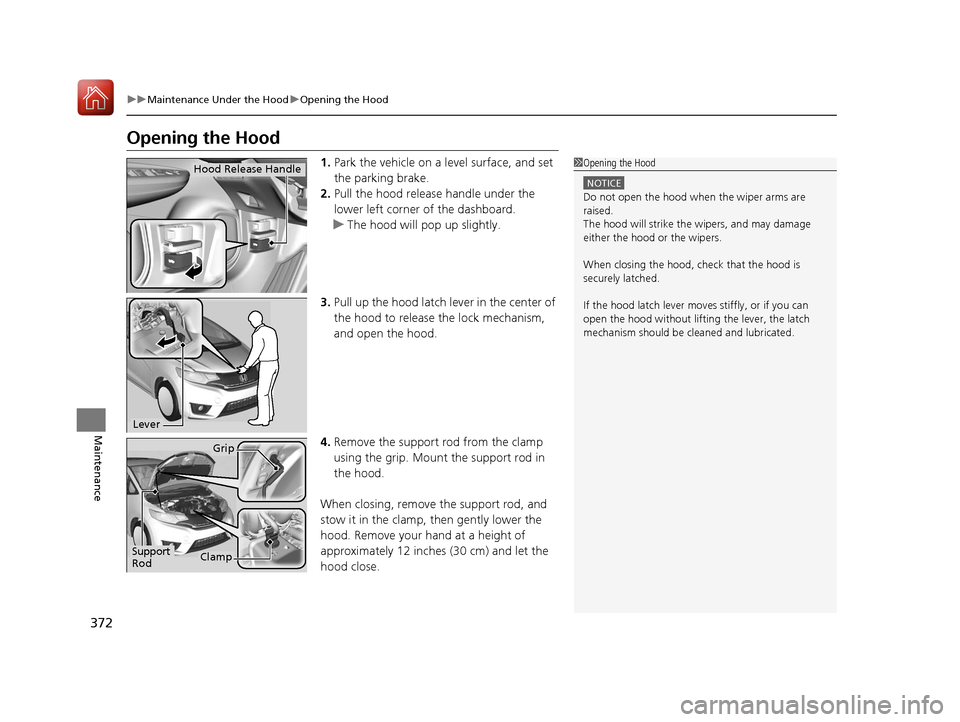
1. Park the vehicle on a level surface, and set
the parking brake.
2. Pull the hood release handle under the
lower left corner of the dashboard.
u The hood will pop up slightly.
3. Pull up the hood latch lever in the center of
the hood to release the lock mechanism,
and open the hood.
4. Remove the support rod from the clamp
using the grip. Mount the support rod in
the hood.
When closing, remove the support rod, and
stow it in the clamp, then gently lower the
hood. Remove your hand at a height of
approximately 12 inches (30 cm) and let the
hood close.1 Opening the Hood
NOTICE
Do not open the hood when the wiper arms are
raised.
The hood will strike the wipers, and may damage
either the hood or the wipers.
When closing the hood, check that the hood is
securely latched.
If the hood latch lever moves stiffly, or if you can
open the hood without lifti ng the lever, the latch
mechanism should be cleaned and lubricated.
Hood Release Handle
Lever
Support
Rod
Grip
Clamp
17 FIT -31T5A6200.book 372 ページ 2016年5月27日 金曜日 午後6時33分
Page 389 of 465
388
uuReplacing Light Bulbs uBrake/Tail/Rear Side Marker Lights
Maintenance
Brake/Tail/Rear Side Marker Lights
Brake/tail/rear side marker lights are LED type. Have an authorized Honda dealer
inspect and replace the light assembly.
High-Mount Brake Light
High-mount brake light is LED type. Have an authorized Honda dealer inspect and
replace the light assembly.
17 FIT -31T5A6200.book 388 ページ 2016年5月27日 金曜日 午後6時33分
Page 413 of 465
412
uuCleaning uExterior Care
Maintenance
The inside lenses of exterior lights (head lights, brake lights etc.) may fog temporarily
if you have driven in the rain, or after the vehicle has been run through a car wash.
Dew condensation also may build up inside the lenses when there is a significant
enough difference between the ambient and inside lens temperatures (similar to
vehicle windows fogging up in rainy conditions). These conditions are natural
processes, not structural design problems in the exterior lights.
Lens design characteristics may result in mo isture developing on the light lens frame
surfaces. This also is not a malfunction.
However, if you see large amounts water ac cumulation, or large water drop building
up inside the lenses, have your vehicle inspected by a dealer.
■Fogged Exterior Light Lens
17 FIT -31T5A6200.book 412 ページ 2016年5月27日 金曜日 午後6時33分
Page 416 of 465
415Continued
Handling the Unexpected
If a Tire Goes Flat
Changing a Flat Tire
If a tire goes flat while driving, grasp the steering wheel firmly, and brake gradually
to reduce speed. Then, stop in a safe plac e. Replace the flat tire with a compact
spare tire. Go to a dealer as soon as possib le to have the full-size tire repaired or
replaced.
1. Park the vehicle on firm, level, and non-slippery surface an d apply the parking
brake.
2. Move the shift lever to
(P.
2. Move the shift lever to
(R.
3. Turn on the hazard warning lights an d turn the ignition switch to LOCK
(0*1.
*1 : Models with the smart entry system have an ENGINE START/STOP button instead of an ignition switch.
1Changing a Flat Tire
Periodically check the tire pressure of the compact
spare. It should be set to the specified pressure.
Specified Pressure: 60 psi (420 kPa, 4.2 kgf/cm
2)
When driving with the compact spare tire, keep the
vehicle speed under 50 mph (80 km/h). Replace with
a full-size tire as soon as possible.
The compact spare tire and wheel in your vehicle are
specifically for this model.
Do not use them with another vehicle.
Do not use another type of compact spare tire or
wheel with your vehicle.
Do not mount tire chains on a compact spare tire.
If a chain-mounted front tire goes flat, remove one of
the full-size rear tires and replace it with the compact
spare tire. Remove the flat front tire and replace it
with the full-size tire that was removed from the rear.
Mount the tire chains on the front tire.
Continuously variable transmission models
Manual transmission models
All models
17 FIT -31T5A6200.book 415 ページ 2016年5月27日 金曜日 午後6時33分
Page 432 of 465
431
uuIndicator, Comin g On/BlinkinguIf the Brake System Indicator (Red) Comes On
Handling the Unexpected
If the Brake System Indicator (Red) Comes On
■Reasons for the indicator to come on
• The brake fluid is low.
• There is a malfunction in the brake system.
■What to do when the indicator comes on while driving
Press the brake pedal lightly to check pedal pressure.
• If normal, check the brake fluid level the next time you stop.
• If abnormal, take immediate acti on. If necessary, downshift the
transmission to slow the vehicle using engine braking.
If the Electric Power Steeri ng (EPS) System Indicator
Comes On
■Reasons for the indicator to come on
• Comes on when there is a problem with EPS system.
• If you depress the accelerator pedal repeatedly to increase the engine
speed while the engine is idling, the indicator comes on, and
sometimes the steering wheel becomes harder to operate.
■What to do when th e indicator comes on
Stop the vehicle in a safe place and restart the engine.
If the indicator comes on and stays on, immediately have your vehicle
inspected by a dealer.
1 If the Brake System Indicator (Red) Comes On
Have your vehicle re paired immediately.
It is dangerous to drive with low brake fluid. If there
is no resistance from the brake pedal, stop
immediately in a safe plac e. If necessary downshift
the gears.
If the brake system indicator and ABS indicator come
on simultaneously, the elec tronic brake distribution
system is not working. Th is can result in vehicle
instability under sudden braking.
Have your vehicle inspecte d by a dealer immediately.U.S.
Canada
17 FIT -31T5A6200.book 431 ページ 2016年5月27日 金曜日 午後6時33分
Page 434 of 465
433Continued
Handling the Unexpected
Fuses
Fuse Locations
If any electrical devices are not working,
turn the ignition switch to LOCK
(0*1 and
check to see if any appl icable fuse is blown.
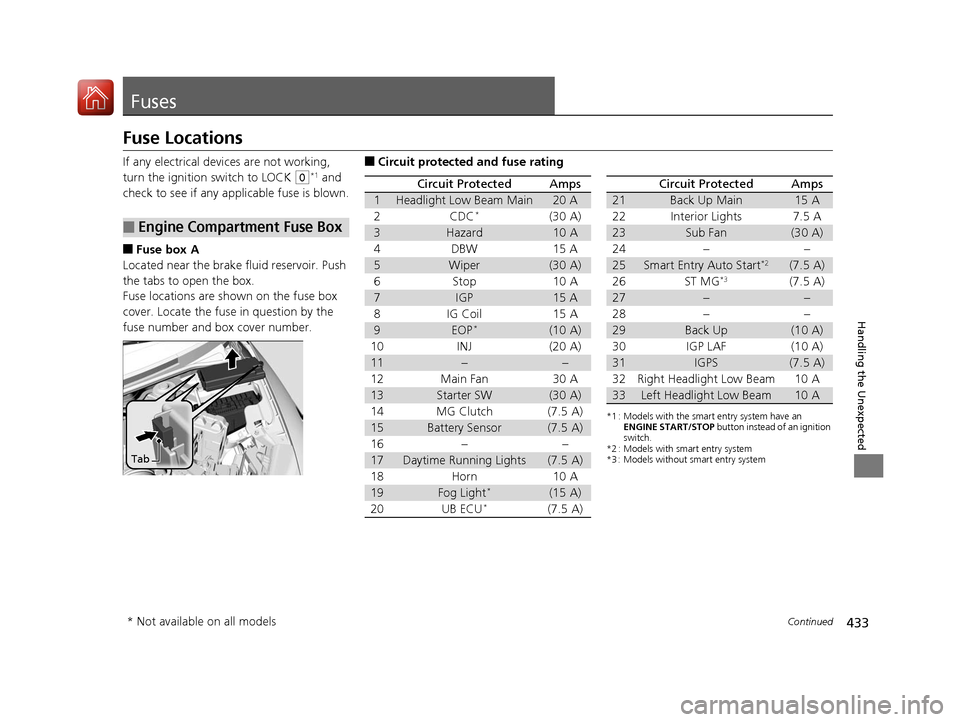
■Fuse box A
Located near the brake fluid reservoir. Push
the tabs to open the box.
Fuse locations are shown on the fuse box
cover. Locate the fuse in question by the
fuse number and box cover number.
■Engine Compartment Fuse Box
Tab
■Circuit protected and fuse rating
Circuit ProtectedAmps
1Headlight Low Beam Main20 A
2CDC*(30 A)
3Hazard10 A
4DBW15 A
5Wiper(30 A)
6Stop10 A
7IGP15 A
8IG Coil15 A
9EOP*(10 A)
10INJ(20 A)
11––
12Main Fan30 A
13Starter SW(30 A)
14MG Clutch(7.5 A)
15Battery Sensor(7.5 A)
16––
17Daytime Running Lights(7.5 A)
18Horn10 A
19Fog Light*(15 A)
20UB ECU*(7.5 A)
*1 : Models with the smart entry system have an ENGINE START/STOP button instead of an ignition
switch.
*2 : Models with smart entry system
*3 : Models without smart entry system
Circuit ProtectedAmps
21Back Up Main15 A
22Interior Lights7.5 A
23Sub Fan(30 A)
24––
25Smart Entry Auto Start*2(7.5 A)
26ST MG*3(7.5 A)
27––
28––
29Back Up(10 A)
30IGP LAF(10 A)
31IGPS(7.5 A)
32Right Headlight Low Beam10 A
33Left Headlight Low Beam10 A
* Not available on all models
17 FIT -31T5A6200.book 433 ページ 2016年5月27日 金曜日 午後6時33分
Page 443 of 465
442
Information
Specifications
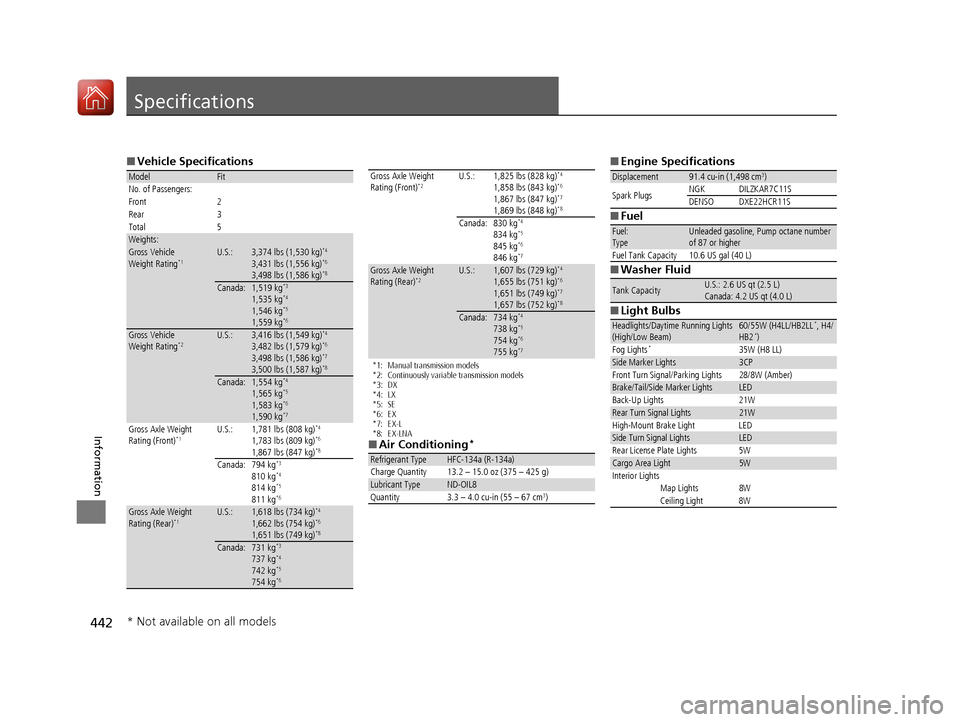
■Vehicle Specifications
ModelFitNo. of Passengers:
Front 2
Rear 3
Total 5
Weights:Gross Vehicle
Weight Rating*1U.S.:3,374 lbs (1,530 kg)*4
3,431 lbs (1,556 kg)*6
3,498 lbs (1,586 kg)*8
Canada:1,519 kg*3
1,535 kg*4
1,546 kg*5
1,559 kg*6
Gross Vehicle
Weight Rating*2U.S.:3,416 lbs (1,549 kg)*4
3,482 lbs (1,579 kg)*6
3,498 lbs (1,586 kg)*7
3,500 lbs (1,587 kg)*8
Canada:1,554 kg*4
1,565 kg*5
1,583 kg*6
1,590 kg*7
Gross Axle Weight
Rating (Front)*1U.S.:1,781 lbs (808 kg)*4
1,783 lbs (809 kg)*6
1,867 lbs (847 kg)*8
Canada:794 kg*3
810 kg*4
814 kg*5
811 kg*6
Gross Axle Weight
Rating (Rear)*1U.S.:1,618 lbs (734 kg)*4
1,662 lbs (754 kg)*6
1,651 lbs (749 kg)*8
Canada:731 kg*3
737 kg*4
742 kg*5
754 kg*6
*1: Manual transmission models
*2: Continuously variable transmission models
*3: DX
*4: LX
*5: SE
*6: EX
*7: EX-L
*8: EX-LNA
■ Air Conditioning*
Gross Axle Weight
Rating (Front)*2U.S.:1,825 lbs (828 kg)*4
1,858 lbs (843 kg)*6
1,867 lbs (847 kg)*7
1,869 lbs (848 kg)*8
Canada:830 kg*4
834 kg*5
845 kg*6
846 kg*7
Gross Axle Weight
Rating (Rear)*2U.S.:1,607 lbs (729 kg)*4
1,655 lbs (751 kg)*6
1,651 lbs (749 kg)*7
1,657 lbs (752 kg)*8
Canada:734 kg*4
738 kg*5
754 kg*6
755 kg*7
Refrigerant Type HFC-134a (R-134a)
Charge Quantity 13.2 – 15.0 oz (375 – 425 g)
Lubricant TypeND-OIL8
Quantity 3.3 – 4.0 cu-in (55 – 67 cm3)
■ Engine Specifications
■ Fuel
■ Washer Fluid
■ Light Bulbs
Displacement91.4 cu-in (1,498 cm3)
Spark Plugs NGK DILZKAR7C11S
DENSODXE22HCR11S
Fuel:
TypeUnleaded gasoline, Pump octane number
of 87 or higher
Fuel Tank Capacity 10.6 US gal (40 L)
Tank CapacityU.S.: 2.6 US qt (2.5 L)
Canada: 4.2 US qt (4.0 L)
Headlights/Daytime Running Lights
(High/Low Beam)60/55W (H4LL/HB2LL*, H4/
HB2*)
Fog Lights*35W (H8 LL)Side Marker Lights3CP
Front Turn Signal/Parking Lights 28/8W (Amber)
Brake/Tail/Side Marker LightsLED
Back-Up Lights 21W
Rear Turn Signal Lights21W
High-Mount Brake Light LED
Side Turn Signal LightsLED
Rear License Plate Lights 5W
Cargo Area Light5W
Interior Lights
Map Lights8W
Ceiling Light 8W
* Not available on all models
17 FIT -31T5A6200.book 442 ページ 2016年5月27日 金曜日 午後6時33分
Page 449 of 465
448
uuEmissions Testing uTesting of Readiness Codes
Information
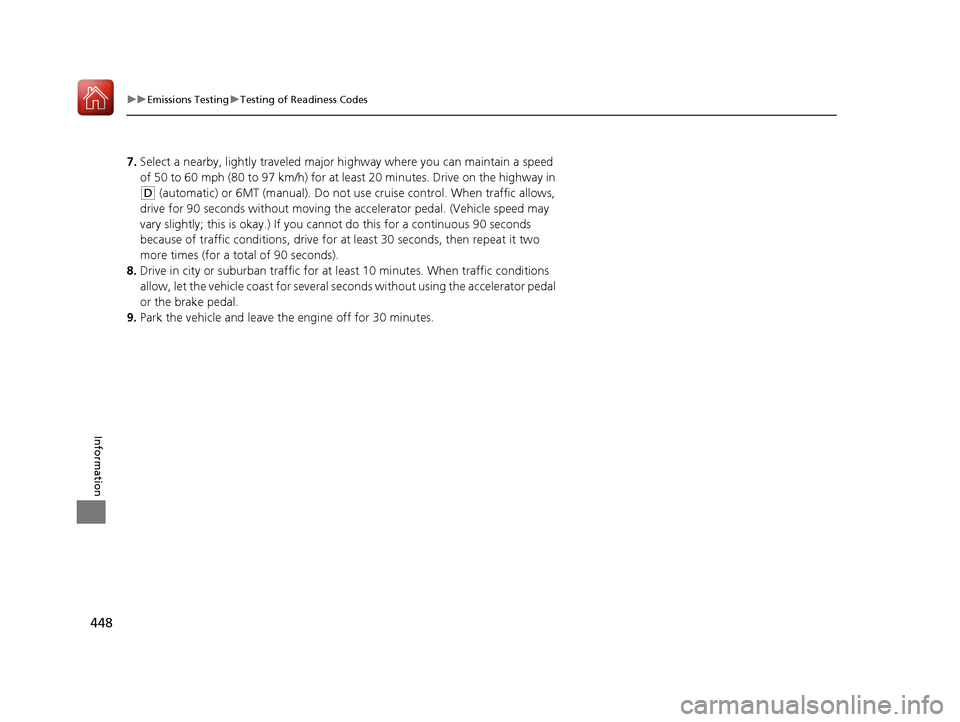
7. Select a nearby, lightly traveled major hi ghway where you can maintain a speed
of 50 to 60 mph (80 to 97 km/h) for at least 20 minutes. Drive on the highway in
(D (automatic) or 6MT (manual). Do not use cruise control. When traffic allows,
drive for 90 seconds without moving the accelerator pedal. (Vehicle speed may
vary slightly; this is okay.) If you cannot do this for a continuous 90 seconds
because of traffic conditions, drive for at least 30 seconds, then repeat it two
more times (for a total of 90 seconds).
8. Drive in city or suburban traffic for at le ast 10 minutes. When traffic conditions
allow, let the vehicle coast for several se conds without using the accelerator pedal
or the brake pedal.
9. Park the vehicle and leave the engine off for 30 minutes.
17 FIT -31T5A6200.book 448 ページ 2016年5月27日 金曜日 午後6時33分