heating HONDA HR-V 2016 2.G User Guide
[x] Cancel search | Manufacturer: HONDA, Model Year: 2016, Model line: HR-V, Model: HONDA HR-V 2016 2.GPages: 489, PDF Size: 26.59 MB
Page 162 of 489
161Continued
Controls
Heating and Cooling System*
Using Vents, Heating and A/C
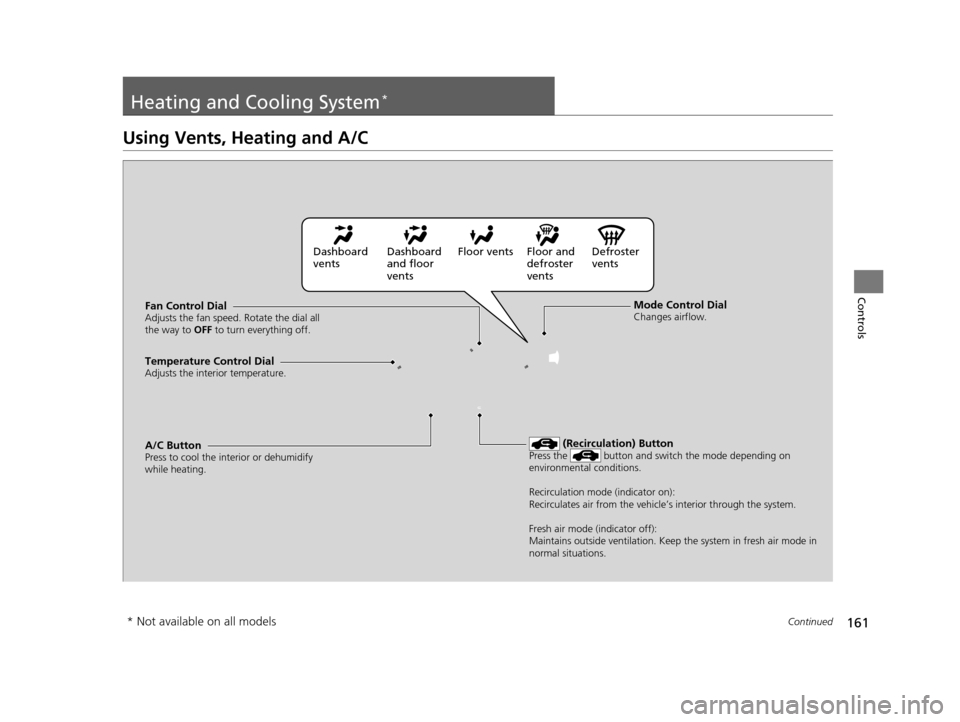
Mode Control DialChanges airflow.Fan Control DialAdjusts the fan speed. Rotate the dial all
the way to OFF to turn everything off.
A/C ButtonPress to cool the interior or dehumidify
while heating.
Temperature Control DialAdjusts the interior temperature.
(Recirculation) ButtonPress the button and switch the mode depending on
environmental conditions.
Recirculation mode (indicator on):
Recirculates air from the vehicle’s interior through the system.
Fresh air mode (indicator off):
Maintains outside ventilation. Keep the system in fresh air mode in
normal situations.
Dashboard
vents Dashboard
and floor
ventsFloor vents Floor and
defroster
ventsDefroster
vents
* Not available on all models
15 HR-V GAS-31T7A6000.book 161 ページ 2015年6月29日 月曜日 午前11時36分
Page 163 of 489
162
uuHeating and Cooling System*uUsing Vents, Heating and A/C
Controls
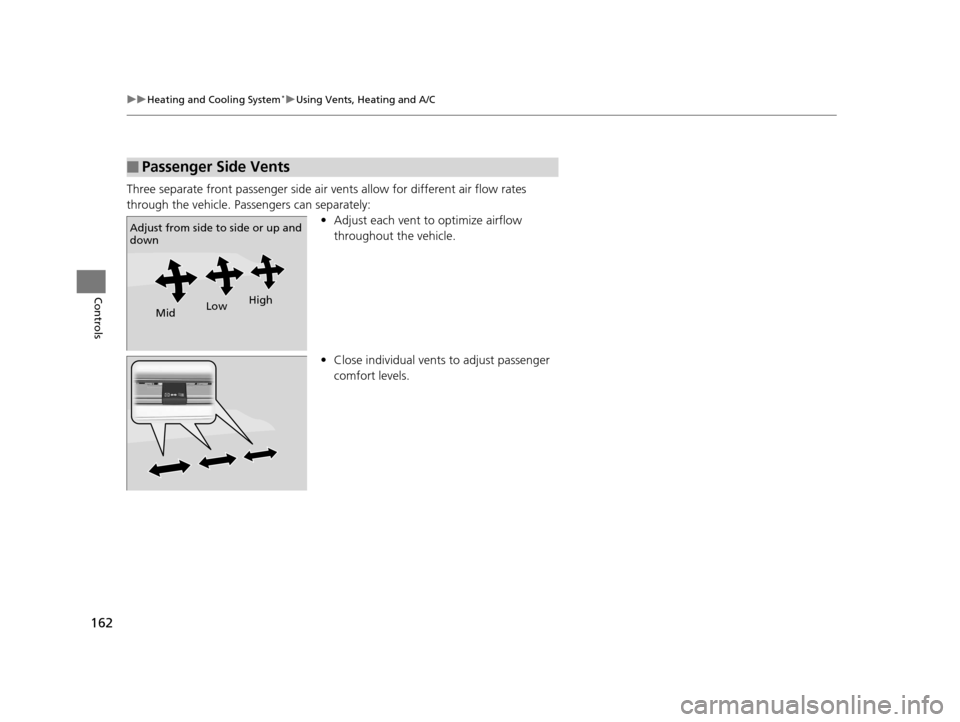
Three separate front passenger side air vents allow for different air flow rates
through the vehicle. Passengers can separately: •Adjust each vent to optimize airflow
throughout the vehicle.
• Close individual vents to adjust passenger
comfort levels.
■Passenger Side Vents
Adjust from side to side or up and
down
MidLowHigh
15 HR-V GAS-31T7A6000.book 162 ページ 2015年6月29日 月曜日 午前11時36分
Page 164 of 489
Continued163
uuHeating and Cooling System*uUsing Vents, Heating and A/C
Controls
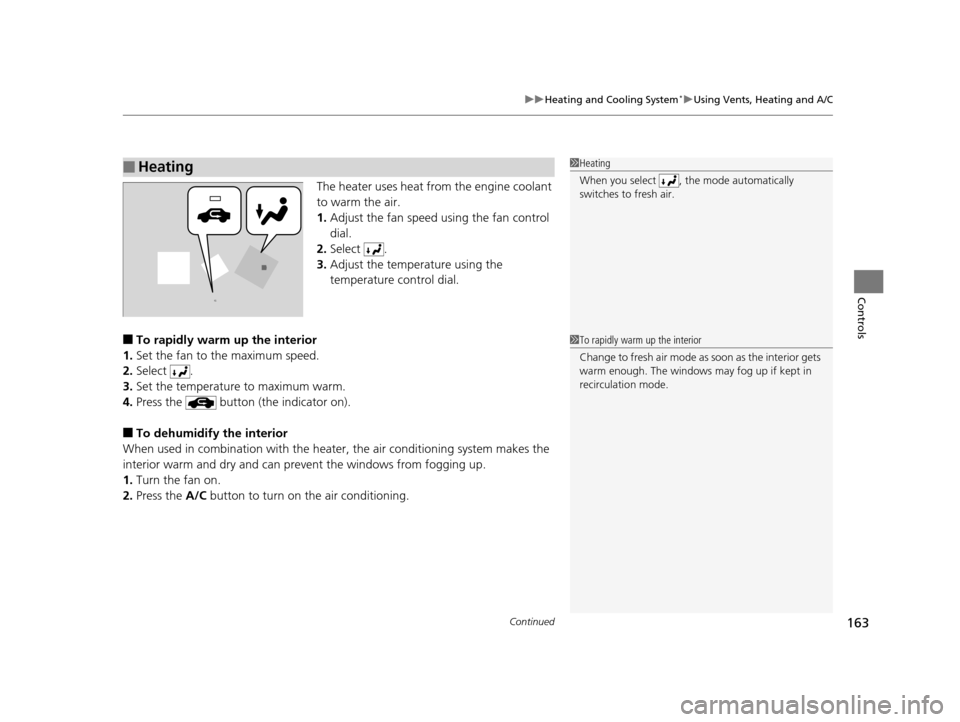
The heater uses heat from the engine coolant
to warm the air.
1. Adjust the fan speed using the fan control
dial.
2. Select .
3. Adjust the temperature using the
temperature control dial.
■To rapidly warm up the interior
1. Set the fan to the maximum speed.
2. Select .
3. Set the temperature to maximum warm.
4. Press the button (the indicator on).
■To dehumidify the interior
When used in combination with the heat er, the air conditioning system makes the
interior warm and dry and can prev ent the windows from fogging up.
1. Turn the fan on.
2. Press the A/C button to turn on the air conditioning.
■Heating1Heating
When you select , the mode automatically
switches to fresh air.
1To rapidly warm up the interior
Change to fresh air mode as soon as the interior gets
warm enough. The windows may fog up if kept in
recirculation mode.
15 HR-V GAS-31T7A6000.book 163 ページ 2015年6月29日 月曜日 午前11時36分
Page 165 of 489
uuHeating and Cooling System*uUsing Vents, Heating and A/C
164
Controls
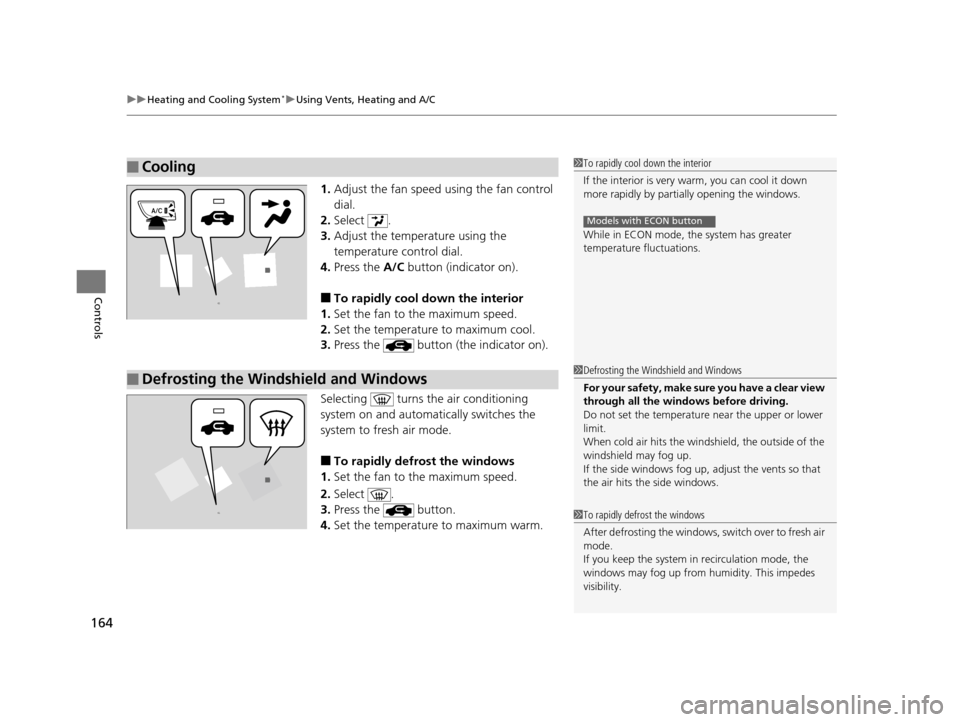
1. Adjust the fan speed using the fan control
dial.
2. Select .
3. Adjust the temperature using the
temperature control dial.
4. Press the A/C button (indicator on).
■To rapidly cool down the interior
1. Set the fan to the maximum speed.
2. Set the temperature to maximum cool.
3. Press the button (the indicator on).
Selecting turns th e air conditioning
system on and automa tically switches the
system to fresh air mode.
■To rapidly defrost the windows
1. Set the fan to the maximum speed.
2. Select .
3. Press the button.
4. Set the temperature to maximum warm.
■Cooling1To rapidly cool down the interior
If the interior is very warm, you can cool it down
more rapidly by parti ally opening the windows.
While in ECON mode, the system has greater
temperature fluctuations.
Models with ECON button
■Defrosting the Windshield and Windows1 Defrosting the Windshield and Windows
For your safety, make sure you have a clear view
through all the windows before driving.
Do not set the temperatur e near the upper or lower
limit.
When cold air hits the windshield, the outside of the
windshield may fog up.
If the side windows fog up, adjust the vents so that
the air hits th e side windows.
1To rapidly defrost the windows
After defrosting the windows, switch over to fresh air
mode.
If you keep the system in recirculation mode, the
windows may fog up from humidity. This impedes
visibility.
15 HR-V GAS-31T7A6000.book 164 ページ 2015年6月29日 月曜日 午前11時36分
Page 326 of 489
325Continued
Driving
When Driving
Starting the Engine
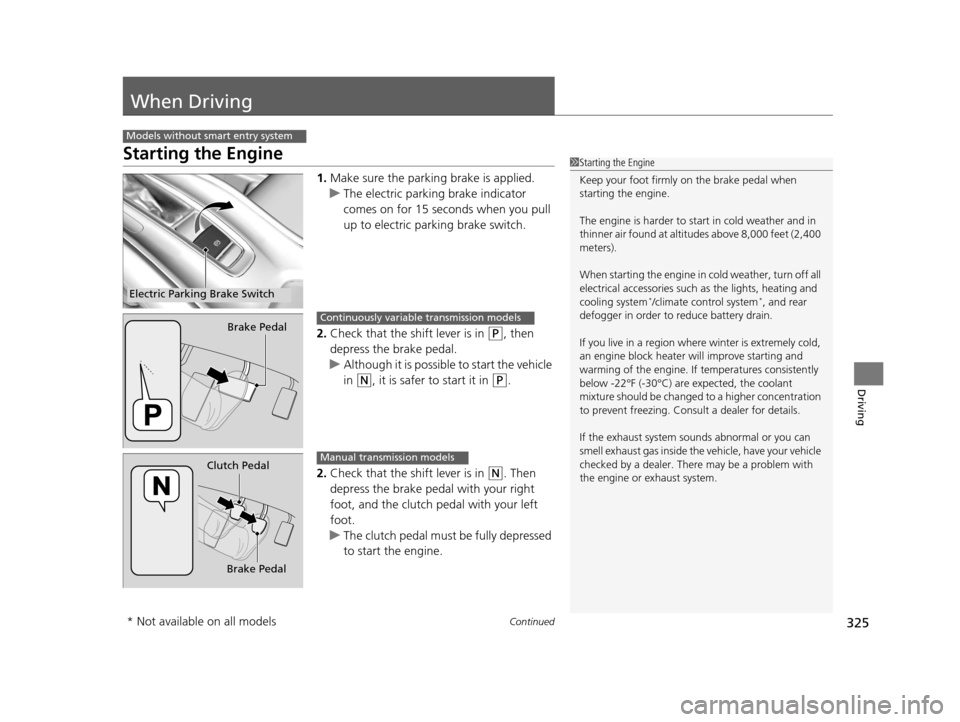
1.Make sure the parkin g brake is applied.
u The electric parking brake indicator
comes on for 15 seconds when you pull
up to electric parking brake switch.
2. Check that the shift lever is in
(P, then
depress the brake pedal.
u Although it is possible to start the vehicle
in
(N, it is safer to start it in (P.
2. Check that the shift lever is in
(N. Then
depress the brake pedal with your right
foot, and the clutch pedal with your left
foot.
u The clutch pedal must be fully depressed
to start the engine.
Models without smart entry system
1Starting the Engine
Keep your foot firmly on the brake pedal when
starting the engine.
The engine is harder to st art in cold weather and in
thinner air found at altitudes above 8,000 feet (2,400
meters).
When starting the engine in cold weather, turn off all
electrical accessories such as the lights, heating and
cooling system
*/climate control system*, and rear
defogger in order to reduce battery drain.
If you live in a region where winter is extremely cold,
an engine block heater will improve starting and
warming of the engine. If temperatures consistently
below -22°F (-30°C) are expected, the coolant
mixture should be changed to a higher concentration
to prevent freezing. Cons ult a dealer for details.
If the exhaust system sounds abnormal or you can
smell exhaust gas inside the vehicle, have your vehicle
checked by a dealer. There may be a problem with
the engine or exhaust system.Electric Parking Brake Switch
Brake PedalContinuously variable transmission models
Brake Pedal
Clutch Pedal
Manual transmission models
* Not available on all models
15 HR-V GAS-31T7A6000.book 325 ページ 2015年6月29日 月曜日 午前11時36分
Page 344 of 489
343
uuWhen Driving uECON Button*
Driving
ECON Button*
The ECON button turns the ECON mode on
and off. The ECON mode helps you improve
your fuel economy by adjusting the
performance of the engine, transmission,
heating and cooling system
*/climate control
system*, and cruise control.
1 ECON Button*
While in ECON mode, the climate control system has
greater temperature fluctuations.
Models with climate control system
* Not available on all models
15 HR-V GAS-31T7A6000.book 343 ページ 2015年6月29日 月曜日 午前11時36分
Page 380 of 489
379
Maintenance
This chapter discusses basic maintenance.
Before Performing MaintenanceInspection and Maintenance ............ 380
Safety When Performing Maintenance .... 381Parts and Fluids Used in Maintenance Service ........................................... 382
Maintenance Minder
TM..................... 383
Maintenance Under the Hood
Maintenance Items Under the Hood ..... 387Opening the Hood ........................... 388
Recommended Engine Oil ................ 389
Oil Check ......................................... 390
Adding Engine Oil ............................ 391
Changing the Engine Oil and Oil Filter..... 392
Engine Coolant ................................ 394
Transmission Fluid ............................ 396
Brake Fluid ....................................... 397
Refilling Window Wa sher Fluid......... 398
Replacing Light Bulbs ....................... 399
Checking and Maintaining Wiper
Blades .......................................... 407
Checking and Maintaining Tires
Checking Tires ................................. 411
Tire and Loading Information Label .. 412
Tire Labeling .................................... 412
DOT Tire Quality Grading (U.S. Vehicles) ...... 414Wear Indicators................................ 416 Tire Service Life ................................ 416
Tire and Wheel Replacement ........... 417
Tire Rotation .................................... 418
Winter Tires ..................................... 419
Battery ............................................... 420
Remote Transmitter Care
Replacing the Button Battery ........... 422
Heating and Cooling System
*/Climate
Control System* Maintenance ....... 424
Cleaning
Interior Care .................................... 425
Exterior Care.................................... 427
* Not available on all models
15 HR-V GAS-31T7A6000.book 379 ページ 2015年6月29日 月曜日 午前11時36分
Page 412 of 489
411
Maintenance
Checking and Maintaining Tires
Checking Tires
To safely operate your vehicle, your tires must be of the proper type and size, in
good condition with adequate tread, and properly inflated.
■Inflation guidelines
Properly inflated tires provid e the best combination of hand ling, tread life, and comfort.
Refer to the driver’s doorjamb label or spec ification’s page for the specified pressure.
Underinflated tires wear unev enly, adversely affect handling and fuel economy, and
are more likely to fail from overheating.
Overinflated tires make your vehicle ride ha rshly, are more prone to road hazards,
and wear unevenly.
Every day before you drive, look at each of the tires. If one looks lower than the
others, check the pressure with a tire gauge.
At least once a month or before long trips , use a gauge to measure the pressure in
all tires, including the spare. Even tires in good condition can lose 1 to 2 psi (10 to
20 kPa, 0.1 to 0.2 kgf/cm
2) per month.
■Inspection guidelines
Every time you check inflation, also examine the tires and valve stems.
Look for:
• Bumps or bulges on the side or in the tread. Replace the tire if you find any cuts,
splits, or cracks in the side of the tire . Replace it if you see fabric or cord.
• Remove any foreign objects and inspect for air leaks.
• Uneven tread wear. Have a deal er check the wheel alignment.
• Excessive tread wear.
2 Wear Indicators P. 416
•Cracks or other damage around valve stem.
1Checking Tires
Measure the air pressure when tires are cold. This
means the vehicle has been parked for at least three
hours, or driven less than 1 mile (1.6 km). If
necessary, add or releas e air until the specified
pressure is reached.
If checked when hot, tire pressure can be as much as
4–6 psi (30–40 kPa, 0.3–0.4 kgf/cm
2) higher than if
checked when cold.
Have a dealer check the tires if you feel a consistent
vibration while driving. Ne w tires and any that have
been removed and reinst alled should be properly
balanced.
Whenever tire pressure is adjusted, you must
calibrate the TPMS.
2 TPMS Calibration P. 359
3WARNING
Using tires that are excessively worn or
improperly inflated can cause a crash in
which you can be seriously hurt or killed.
Follow all instruction s in this owner’s
manual regarding ti re inflation and
maintenance.
U.S. models
15 HR-V GAS-31T7A6000.book 411 ページ 2015年6月29日 月曜日 午前11時36分
Page 425 of 489
424
Maintenance
Heating and Cooling System*/Climate Control System* Maintenance
Dust and Pollen Filter
The heating and cooling system*/climate control system* is equipped with a dust
and pollen filter that collects pollen, dust, and other debris in the air. The
Maintenance Minder
TM messages will let you know when to replace the filter.
We recommend that you replace the dust a nd pollen filter sooner when using your
vehicle in areas with high concentrations of dust.
1 Dust and Pollen Filter
If the airflow from the heating and cooling system
*/
climate control system* deteriorates noticeably, and
the windows fog up easily, the filter may need to be
replaced. Please contact a dealer for replacement.
* Not available on all models
15 HR-V GAS-31T7A6000.book 424 ページ 2015年6月29日 月曜日 午前11時36分
Page 432 of 489
431
Handling the Unexpected
This chapter explains how to handle unexpected troubles.
ToolsTypes of Tools .................................. 432
If a Tire Goes Flat Changing a Flat Tire ......................... 434
Engine Does Not Start Checking the Engine ........................ 443
If the Smart Entry Remote Battery is Weak ....444
Emergency Engine Stop ................... 445
Jump Starting .................................... 446
Shift Lever Does Not Move .............. 448
Overheating How to Handle Overheating ............. 449 Indicator, Coming On/Blinking
If the Low Oil Pressu
re Indicator Comes
On................................................ 451
If the Charging System Indicator Comes
On ................................................. 451
If the Malfunction Indicator Lamp Comes On or Blinks ..................................... 452
If the Brake System Indicator (Red) Comes On...................................................... 453
If the Electric Power Steering (EPS) System Indicator Comes On ....................... 453 If the Electric Parking Brake System
Indicator Comes On ....................... 454
If the Low Tire Pressure/TPMS Indicator Comes On or Blinks ....................... 455
Fuses Fuse Locations ................................. 456
Inspecting and Changing Fuses ........ 460
Emergency Towing ........................... 461
When You Cannot Open the Tailgate..... 462
15 HR-V GAS-31T7A6000.book 431 ページ 2015年6月29日 月曜日 午前11時36分