belt HONDA INSIGHT 2002 1.G User Guide
[x] Cancel search | Manufacturer: HONDA, Model Year: 2002, Model line: INSIGHT, Model: HONDA INSIGHT 2002 1.GPages: 270, PDF Size: 3.62 MB
Page 18 of 270
CONT INUED
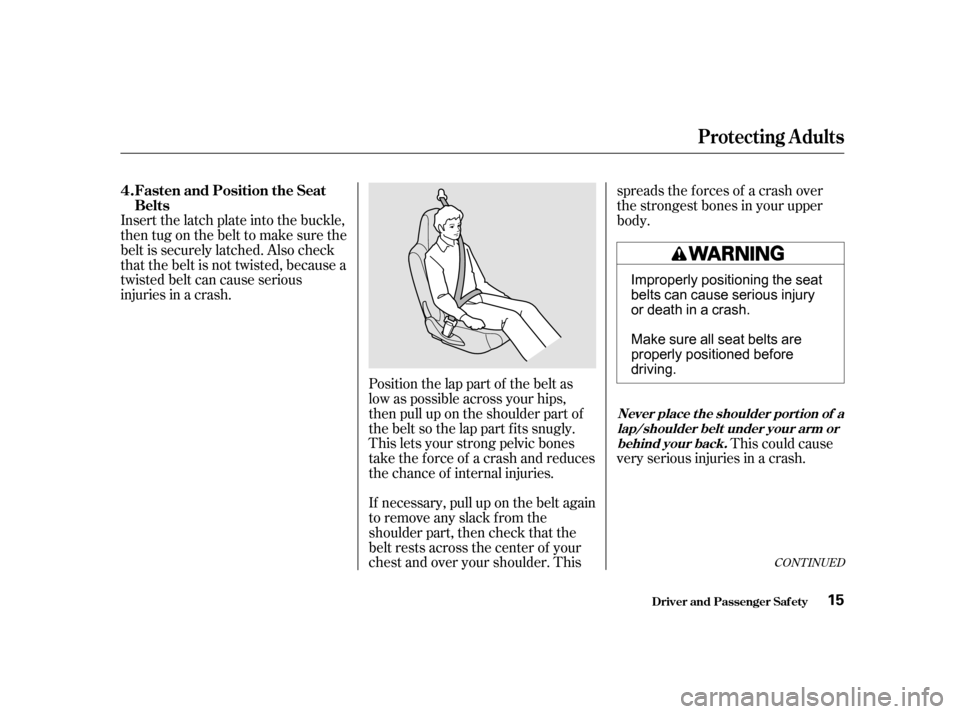
Position the lap part of the belt as
low as possible across your hips,
then pull up on the shoulder part of
the belt so the lap part f its snugly.
This lets your strong pelvic bones
take the force of a crash and reduces
the chance of internal injuries.
Insert the latch plate into the buckle,
then tug on the belt to make sure the
belt is securely latched. Also check
that the belt is not twisted, because a
twisted belt can cause serious
injuries in a crash.
If necessary, pull up on the belt again
to remove any slack from the
shoulder part, then check that the
belt rests across the center of your
chest and over your shoulder. Thisspreads the f orces of a crash over
the strongest bones in your upper
body.
This could cause
very serious injuries in a crash.
Driver and Passenger Saf ety
Protecting Adults
Fasten and Position the Seat
Belts
4.
Never place t he shoulder port ion of a
lap/shoulder belt under your arm orbehind your back.
15
Improperly positioning the seat
belts can cause serious injury
or death in a crash.
Make sure all seat belts are
properly positioned before
driving.
Page 19 of 270

See page f or additional
inf ormation about your seat belt
system and how to take care of your
belts.After occupants have adjusted their
seats and put on seat belts, it is very
important that they continue to sit
upright, well back in their seats, with
their feet on the floor, until the car is
parked and the engine is of f .
Sitting improperly can increase the
chance of injury during a crash. For
example, if an occupant slouches,
lies down, turns sideways, sits
forward, leans forward or sideways,
or puts one or both f eet up, the
chance of injury during a crash is
greatly increased.In addition, an occupant who is out of
position can be seriously or f atally
injured by striking interior parts of
thecar,orbybeingstruckbyan
inf lating airbag.
If a seat belt does not seem to work
as it should, it may not protect the
occupant in a crash.
Anyone using a seat belt that is
not working properly can be
seriously injured or killed. Have your
Honda dealer check the belt as soon
as possible.
34
Driver and Passenger Saf ety
Protecting Adults
Maintain a Proper Sitting
Position
5.
No one should
sit in a seat wit h an inoperat ive seat belt.
16
Page 20 of 270
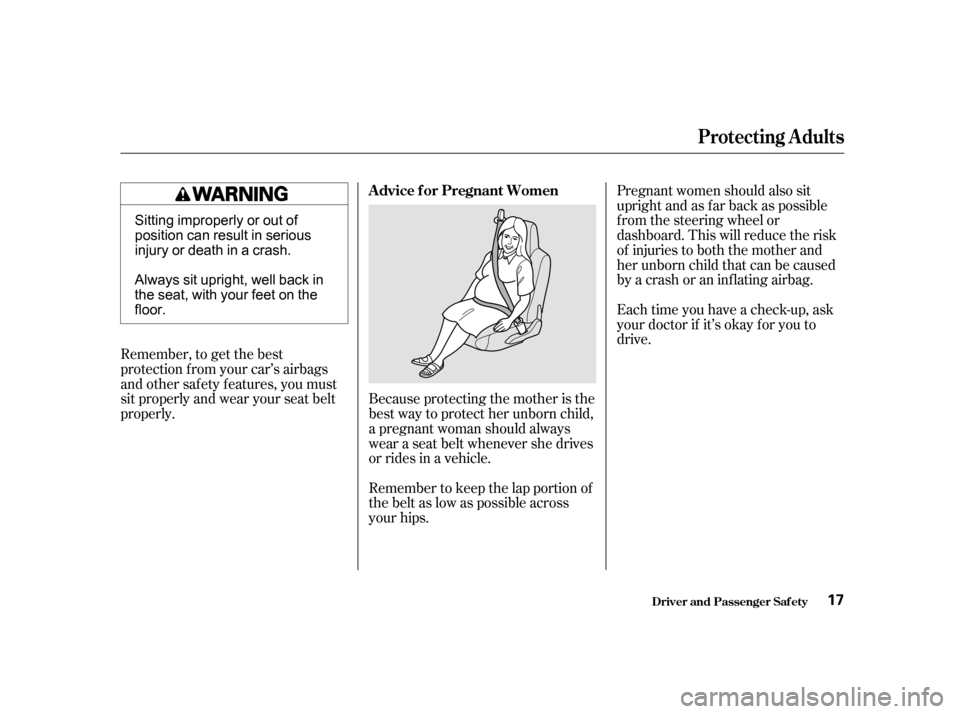
Pregnant women should also sit
upright and as f ar back as possible
f rom the steering wheel or
dashboard. This will reduce the risk
of injuries to both the mother and
her unborn child that can be caused
by a crash or an inf lating airbag.
Each time you have a check-up, ask
your doctor if it’s okay f or you to
drive.
Remember to keep the lap portion of
the belt as low as possible across
your hips.
Remember, to get the best
protection f rom your car’s airbags
and other safety features, you must
sit properly and wear your seat belt
properly.
Because protecting the mother is the
best way to protect her unborn child,
a pregnant woman should always
wear a seat belt whenever she drives
or rides in a vehicle.
Protecting Adults
Advice f or Pregnant Women
Driver and Passenger Saf ety17
Sitting improperly or out of
position can result in serious
injury or death in a crash.
Always sit upright, well back in
the seat, with your feet on the
floor.
Page 21 of 270

Carrying hard or sharp objects on
your lap, or driving with a pipe or
other sharp object in your mouth,
can result in injuries if your
airbags inflate.
If they do, they
could be very seriously injured in a
crash.
Devices intended to improve
occupant comf ort or reposition the
shoulder part of a seat belt can
severely compromise the
protective capability of the seat
belt and increase the chance of
serious injury in a crash. Any object
attached to or placed on the covers
marked ‘‘SRS AIRBAG’’ in the
center of the steering wheel and
on top of the dashboard could
interf ere with the proper operation
of the airbags. Or, if the airbags
inf late, the objects could be
propelled inside the car and hurt
someone. If your
hands or arms are close to the
airbag covers in the center of the
steering wheel and on top of the
dashboard, they could be injured if
the airbags inf late.
Protecting Adults
Driver and Passenger Saf ety
Additional Saf ety PrecautionsDo not place hard or sharp object s
bet ween yourself and an airbag.
T wo people should never use t he
same seat belt .
Do not put any accessories on seatbelts. Do not at t ach or place object s onthe f ront airbag covers. K eep your hands and arms away
f rom t he airbag covers.
18
Page 22 of 270
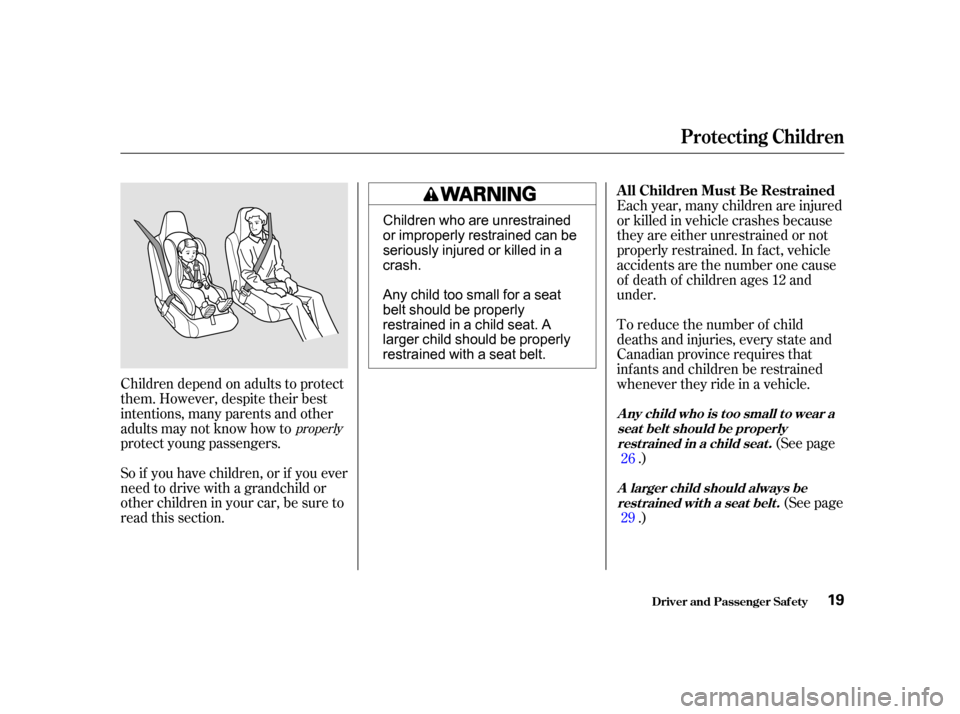
Children depend on adults to protect
them. However, despite their best
intentions, many parents and other
adults may not know how to
protect young passengers.(See page
.)
(See page
.)
So if you have children, or if you ever
need to drive with a grandchild or
otherchildreninyourcar,besureto
read this section. Each year, many children are injured
or killed in vehicle crashes because
they are either unrestrained or not
properly restrained. In f act, vehicle
accidents are the number one cause
of death of children ages 12 and
under.
To reduce the number of child
deaths and injuries, every state and
Canadian province requires that
inf ants and children be restrained
whenever they ride in a vehicle.
29
26
properly
Driver and Passenger Saf ety
Protecting Children
All Children Must Be Restrained
Anychildwhoistoosmalltoweara
seat belt should be properlyrest rained in a child seat .
A larger child should always berest rained wit h a seat belt .
19
Children who are unrestrained
or improperly restrained can be
seriously injured or killed in a
crash.
Any child too small for a seat
belt should be properly
restrained in a child seat. A
larger child should be properly
restrained with a seat belt.
Page 26 of 270
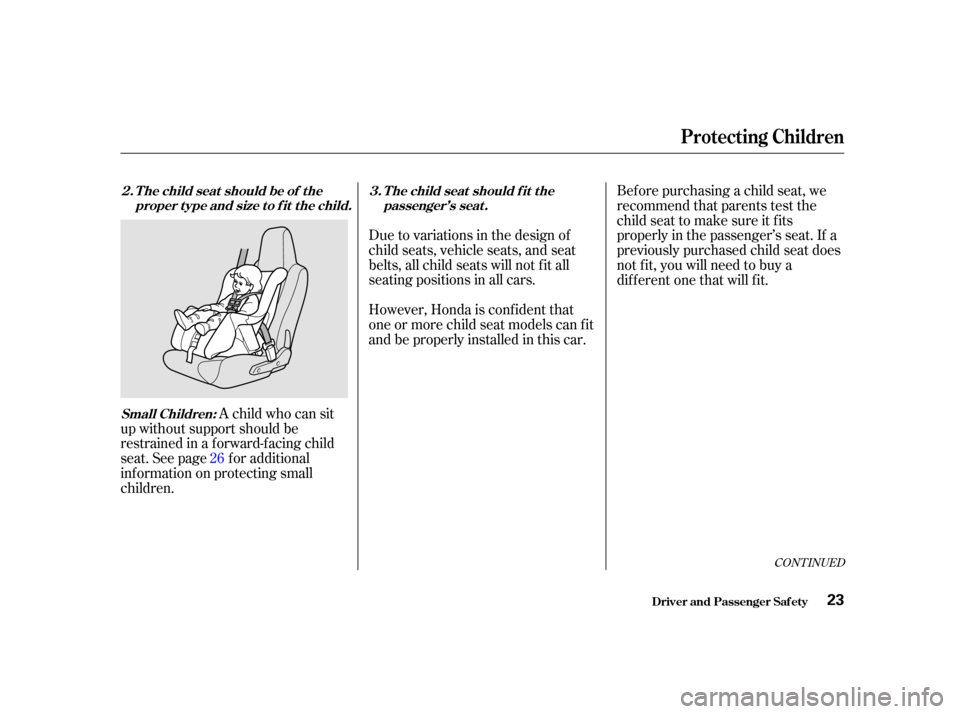
A child who can sit
up without support should be
restrained in a f orward-f acing child
seat. See page f or additional
inf ormation on protecting small
children. Due to variations in the design of
child seats, vehicle seats, and seat
belts, all child seats will not f it all
seating positions in all cars.
Bef ore purchasing a child seat, we
recommend that parents test the
child seat to make sure it f its
properly in the passenger’s seat. If a
previously purchased child seat does
not f it, you will need to buy a
different one that will fit.
However, Honda is conf ident that
one or more child seat models can f it
andbeproperlyinstalledinthiscar.
26
CONT INUED
T he child seat should be of the proper t ype and size t o f it t he child.
Small Children: T he child seat should f it the
passenger’s seat .
2.
3.
Protecting Children
Driver and Passenger Saf ety23
Page 27 of 270
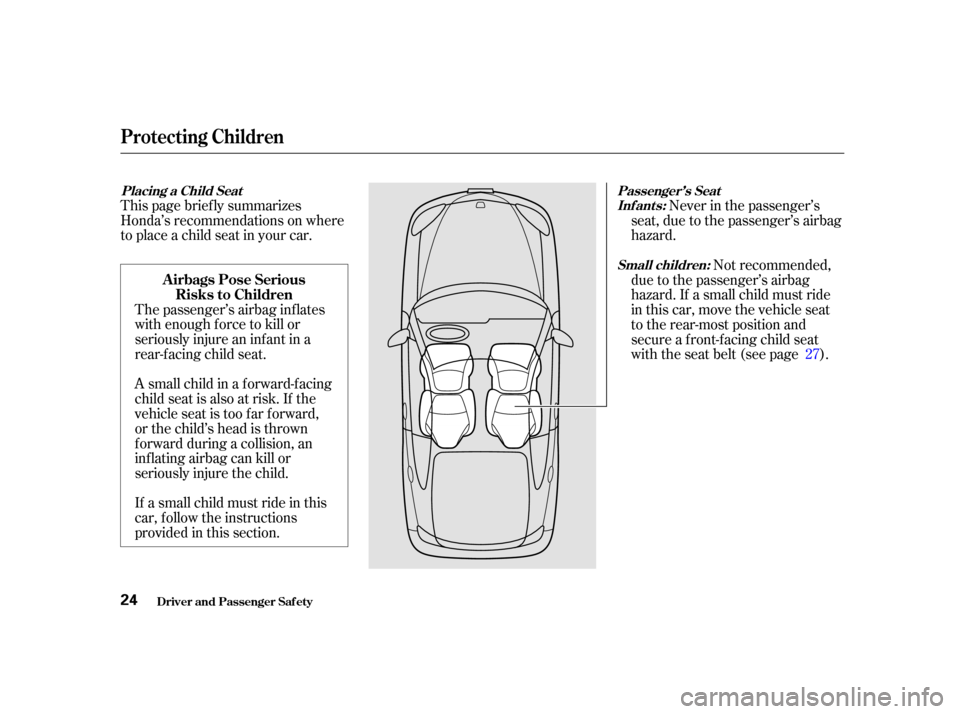
The passenger’s airbag inf lates
with enough f orce to kill or
seriously injure an inf ant in a
rear-facing child seat.
If a small child must ride in this
car, f ollow the instructions
provided in this section. A small child in a f orward-f acing
child seat is also at risk. If the
vehicle seat is too f ar f orward,
or the child’s head is thrown
f orward during a collision, an
inf lating airbag can kill or
seriously injure the child.
This page brief ly summarizes
Honda’s recommendations on where
to place a child seat in your car.
Never in the passenger’s
seat, due to the passenger’s airbag
hazard.
Not recommended,
due to the passenger’s airbag
hazard. If a small child must ride
in this car, move the vehicle seat
to the rear-most position and
secure a f ront-f acing child seat
with the seat belt (see page ). 27
Placing a Child Seat Passenger’s Seat
Inf ant s:
Small children:
Protecting Children
Driver and Passenger Saf ety
Airbags Pose SeriousRisks to Children
24
Page 28 of 270

Af ter selecting a proper child seat,
there are three main steps in
installing the seat:All child seats
must be secured to the car with
the lap part of a lap/shoulder belt.
A child whose seat is not properly
secured to the car can be
endangered in a crash. See page for instructions on how to
secure a f orward-f acing child seat
in this car.
Af ter installing a child
seat, push and pull the seat
f orward and f rom side to side to
verif y that it is secure. To provide security during normal
driving maneuvers as well as during
a collision, we recommend that
parents secure a child seat as f irmly
as possible.
Make sure the child is properly
strappedinthechildseat
according to the child seat maker’s
instructions. A child who is not
properly secured in a child seat
canbethrownoutof theseatina
crash and be seriously injured.
When you are not using a child seat,
either remove it and store it in a saf e
place, or make sure it is properly
secured. An unsecured child seat can
be thrown around the car during a
crash or sudden stop and injure
someone.
However, a child seat does not need
to be ‘‘rock solid.’’ It may be dif f icult
to install a child seat so that it does
not move at all. Some side-to-side or
back-and-f orth movement can be
expected and should not reduce the
child seat’s ef f ectiveness.
27
Protecting Children
Driver and Passenger Saf ety
Secure the child seat to the car
wit h a seat belt .
Inst alling a Child Seat
Make sure t he child seat is f irmlysecured. Secure the child in the child seat.
Storing a Child Seat
1.
2. 3.
25
Page 30 of 270
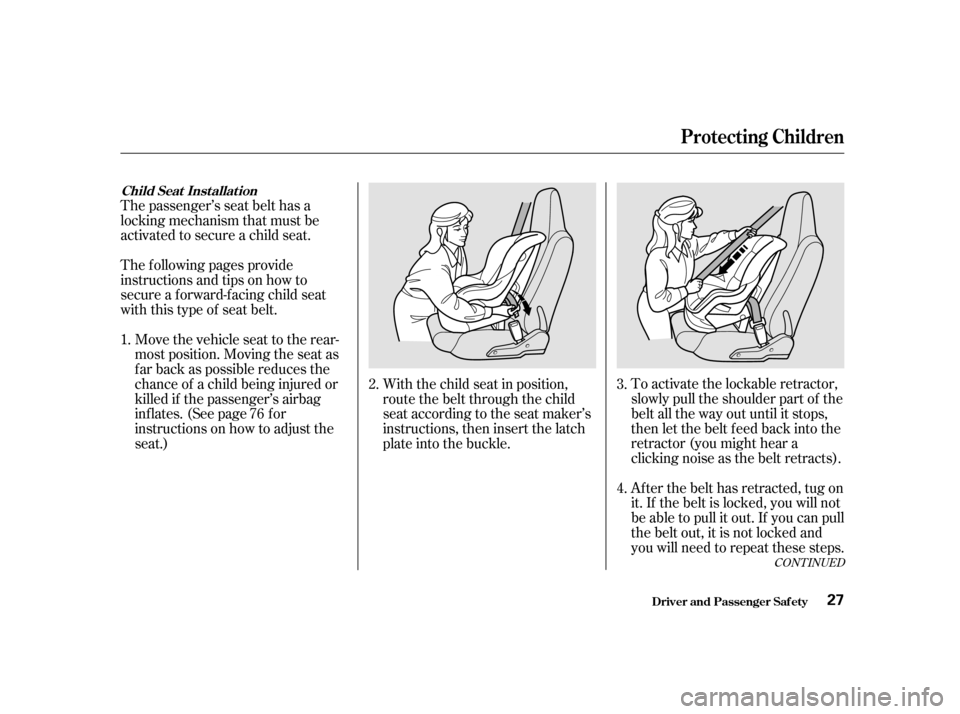
To activate the lockable retractor,
slowly pull the shoulder part of the
belt all the way out until it stops,
then let the belt feed back into the
retractor (you might hear a
clicking noise as the belt retracts).
Af ter the belt has retracted, tug on
it. If the belt is locked, you will not
be able to pull it out. If you can pull
the belt out, it is not locked and
you will need to repeat these steps.
The passenger’s seat belt has a
locking mechanism that must be
activated to secure a child seat.
The f ollowing pages provide
instructions and tips on how to
secure a f orward-f acing child seat
with this type of seat belt.
Move the vehicle seat to the rear-
most position. Moving the seat as
f ar back as possible reduces the
chance of a child being injured or
killed if the passenger’s airbag
inflates. (See page for
instructions on how to adjust the
seat.) With the child seat in position,
route the belt through the child
seat according to the seat maker’s
instructions, then insert the latch
plate into the buckle.
1.
2.3.
4.
76
CONT INUED
Child Seat Inst allat ion
Protecting Children
Driver and Passenger Saf ety27
Page 31 of 270
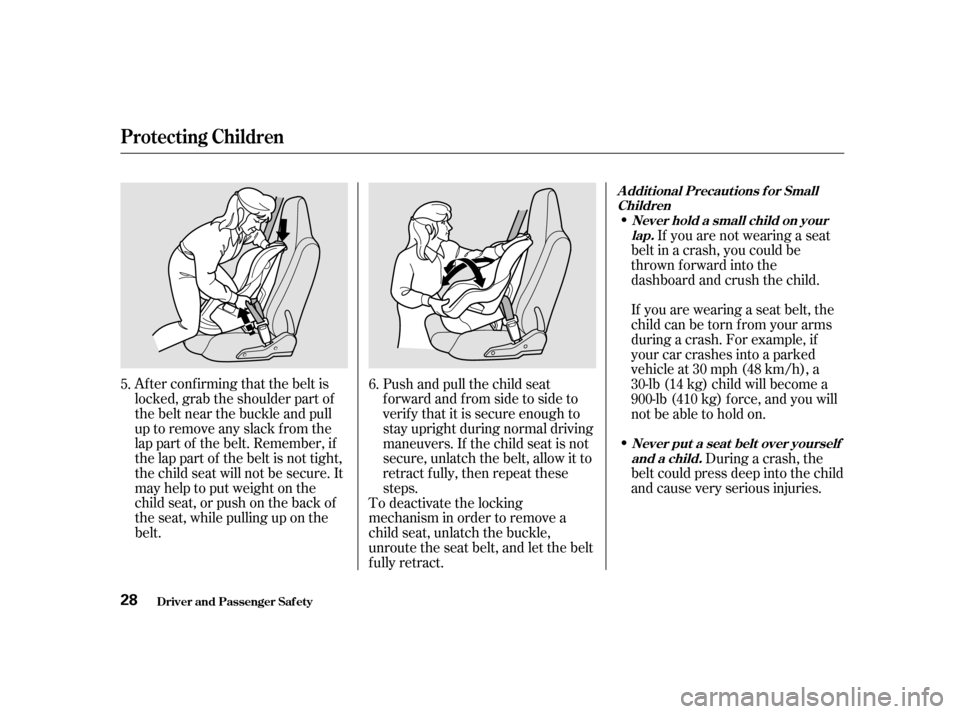
Af ter conf irming that the belt is
locked, grab the shoulder part of
the belt near the buckle and pull
up to remove any slack from the
lap part of the belt. Remember, if
the lap part of the belt is not tight,
the child seat will not be secure. It
mayhelptoputweightonthe
child seat, or push on the back of
the seat, while pulling up on the
belt.Push and pull the child seat
f orward and f rom side to side to
verif y that it is secure enough to
stay upright during normal driving
maneuvers. If the child seat is not
secure, unlatch the belt, allow it to
retract f ully, then repeat these
steps.
To deactivate the locking
mechanism in order to remove a
child seat, unlatch the buckle,
unroute the seat belt, and let the belt
fully retract. If you are not wearing a seat
belt in a crash, you could be
thrown f orward into the
dashboard and crush the child.
During a crash, the
belt could press deep into the child
and cause very serious injuries. If youarewearingaseatbelt,the
child can be torn f rom your arms
during a crash. For example, if
your car crashes into a parked
vehicleat30mph(48km/h),a
30-lb (14 kg) child will become a
900-lb (410 kg) f orce, and you will
notbeabletoholdon.
5.
6.
A ddit ional Precaut ions f or Small
Children Never hold a small child on yourlap.
Never put a seat belt over yourselfand a child.
Protecting Children
Driver and Passenger Saf ety28