gas HONDA INSIGHT 2003 1.G Owners Manual
[x] Cancel search | Manufacturer: HONDA, Model Year: 2003, Model line: INSIGHT, Model: HONDA INSIGHT 2003 1.GPages: 411, PDF Size: 5.22 MB
Page 1 of 411
 to navigate through\
this reference.
For a printed owners manual, click on authorized manuals or go")
2003 Insight Online Reference Owner's Manual
Use these links (and links throughout this manual) to navigate through\
this reference.
For a printed owner's manual, click on authorized manuals or go to www.h\
elminc.com.
Contents
Owner's Identification Form
Introduction
........................................................................\
................................................................. i
A Few Words About Safety ........................................................................\
........................................ .ii
Your Car at a Glance ........................................................................................................................... iv
Driver and Passenger Safety ........................................................................\
...................................... 5
Proper use and care of your car's seat belts, and Supplemental Restraint\
System.
Instruments and Controls ................................................................................................................. 59
Instrument panel indicator and gauge, and how to us e dashboard and steering column controls.
Features ............................. .................................................................. 161
How to operate the climate control system, the audio system, and other c\
onvenience features.
Before Driving .................................................................................................................................. 243
What gasoline to use, how to break -in your new car, and how to load luggage and other cargo.
Driving ........................................................................\
...................................................................... 261
The proper way to start the engine, shift the transmission, and park, pl\
us towing a trailer.
Maintenance ..................................................................................................................................... 297
The Maintenance Schedule shows you when you need to take your car to the\
dealer.
Taking Care of the Unexpected
...................................................................................................... 347
This section covers several problems motorists sometimes experience, and\
how to handle them.
Technical Information ..................................................................................................................... 377
ID numbers, dimensions, capacities, and technical information.
Warranty and Customer Relations (U.S. and Canada) ................................................................393
A summary of the warranties covering your new Honda, and how to contact \
us.
Authorized Manuals (U.S. only) ...................................................................................................... 397
How to order manuals and other technical literature.
Index ........................................................................\
........................................................................\
.... .I
Service Information Summary
A summary of information you need when you pull up to the fuel pump.
Page 60 of 411

Your vehicle’s exhaust contains
carbon monoxide gas. Carbon
monoxide should not enter the
vehicle in normal driving if you
maintain your vehicle properly and
f ollow the inf ormation on this page.High levels of carbon monoxide can
collect rapidly in enclosed areas,
such as a garage. Do not run the
engine with the garage door closed.
Even with the door open, run the
engine only long enough to move the
vehicle out of the garage.
Have the exhaust system inspected
f or leaks whenever:
Select the f resh air mode.
Select the mode.
Set the f an speed to high.
Set the temperature control to a
comfortable setting.
With the hatch open, airflow can pull
exhaust gas into your vehicle’s
interior and create a hazardous
condition. If you must drive with the
hatch open, open all the windows,
and set the climate control system as
shown below.
If you must sit in your parked vehicle
with the engine running, even in an
unconfined area, adjust the climate
control system as f ollows:
The vehicle is raised f or an oil
change.
You notice a change in the sound
of the exhaust.
The vehicle was in a crash that
may have damaged the underside. 1.
2.
3.
4.
Carbon Monoxide Hazard
56
Carbon monoxide gas is toxic.
Breathing it can cause
unconsciousness and even kill
you.
Avoid any enclosed areas or
activities that expose you to
carbon monoxide.
Page 143 of 411
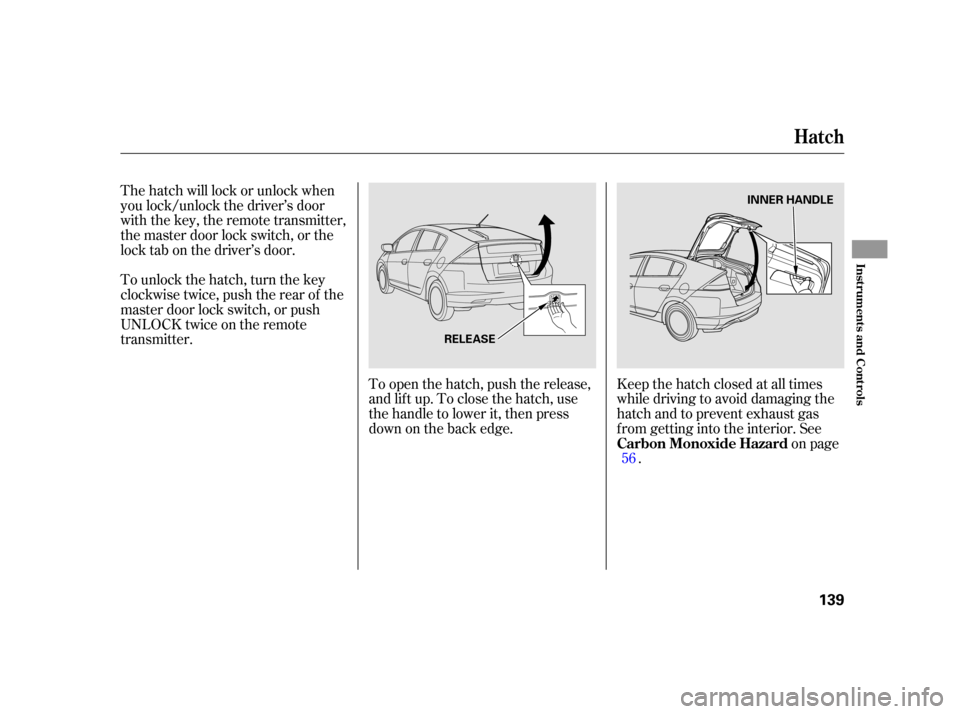
The hatch will lock or unlock when
you lock/unlock the driver’s door
with the key, the remote transmitter,
the master door lock switch, or the
locktabonthedriver’sdoor.
To unlock the hatch, turn the key
clockwise twice, push the rear of the
master door lock switch, or push
UNLOCK twice on the remote
transmitter.Keep the hatch closed at all times
while driving to avoid damaging the
hatch and to prevent exhaust gas
f rom getting into the interior. Seeon page
.
To open the hatch, push the release,
and lif t up. To close the hatch, use
thehandletolowerit,thenpress
down on the back edge.
56
Carbon Monoxide Hazard
Hatch
Inst rument s and Cont rols
139
INNER HANDLE
RELEASE
Page 247 of 411

Bef ore you begin driving your
vehicle, you should know what
gasoline to use and how to check the
levels of important f luids. You also
need to know how to properly store
luggage or packages. The
inf ormation in this section will help
you. If you plan to add any
accessories to your vehicle, please
read the information in this section
first..............................
Break-in Period .244
.................
Fuel Recommendation . 244
.........
Service Station Procedures . 245
....................................
Ref ueling .245
.....
Tighten Fuel Cap Message . 247
OpeningandClosingthe .......................................
Hood .248
...................................
Oil Check .249
.............
Engine Coolant Check . 250
...............................
Fuel Economy .251
...
Accessories and Modif ications . 254
.............................
Carrying Cargo .256
Bef ore Driving
Bef ore Driving
243
Page 248 of 411

Help assure your vehicle’s f uture
reliability and perf ormance by paying
extra attention to how you drive
during the f irst 600 miles (1,000 km).
During this period:Avoid full-throttle starts and rapid
acceleration.
You should also f ollow these
recommendations with an
overhauled or exchanged engine, or
when the brakes are replaced. Your vehicle is designed to operate
on unleaded gasoline with a pump
octane number of 87 or higher. Use
of a lower octane gasoline can cause
a persistent, heavy metallic rapping
noise that can lead to engine damage.
Do not change the oil until the
scheduled maintenance time.
Avoidhardbrakingforthefirst
200 miles (300 km). Use of gasoline with these additives
may adversely af f ect perf ormance,
and cause the malfunction indicator
lamp on your instrument panel to
come on. If this happens, contact
your dealer f or service. Some
gasoline today is blended with
oxygenates such as ethanol. Your
vehicle is designed to operate on
oxygenated gasoline containing up to
10% ethanol by volume. Do not use
gasoline containing methanol. If you
notice any undesirable operating
symptoms, try another service
station or switch to another brand of
gasoline.
Break-in Period
Fuel Recommendation
Break-in Period, Fuel Recommendation
244
T o help prevent harmf ul f uel system
and engine deposits, use high quality
f uel containing detergent and additives.
In addition, in order to maintain good
perf ormance, f uel economy, and
emissions control, we strongly
recommend the use of gasoline that
does NOT contain harmf ul manganese-
based f uel additives such as MMT , if
such gasoline is available.
Page 249 of 411
CONT INUED
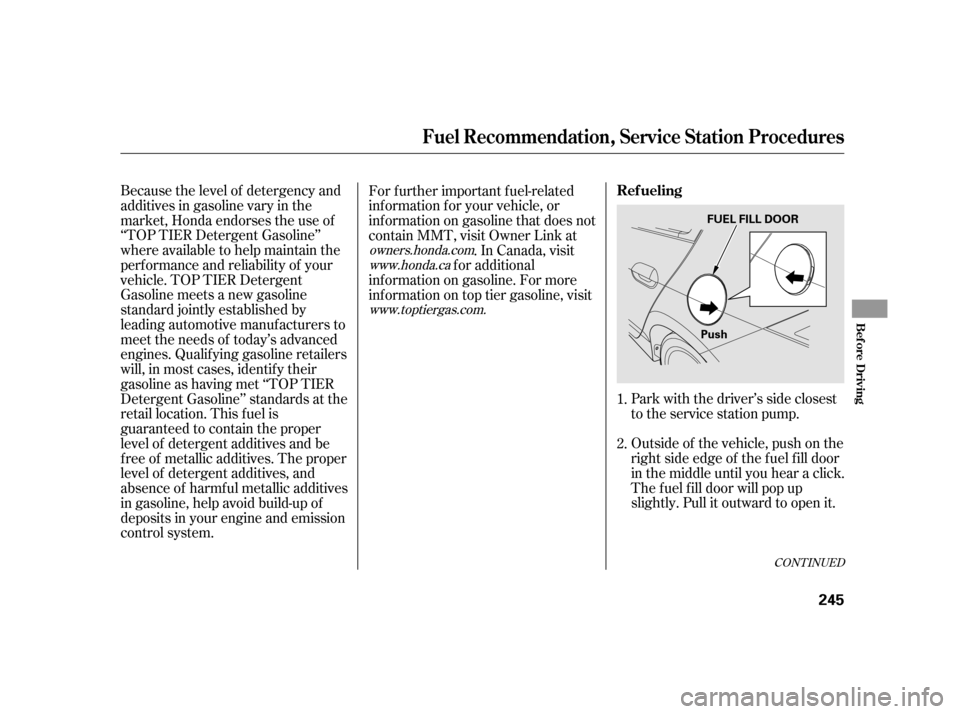
Outside of the vehicle, push on the
right side edge of the f uel f ill door
in the middle until you hear a click.
The f uel f ill door will pop up
slightly. Pull it outward to open it. Park with the driver’s side closest
to the service station pump.
Because the level of detergency and
additives in gasoline vary in the
market, Honda endorses the use of
‘‘TOP TIER Detergent Gasoline’’
where available to help maintain the
perf ormance and reliability of your
vehicle. TOP TIER Detergent
Gasoline meets a new gasoline
standard jointly established by
leading automotive manuf acturers to
meet the needs of today’s advanced
engines. Qualif ying gasoline retailers
will, in most cases, identif y their
gasoline as having met ‘‘TOP TIER
Detergent Gasoline’’ standards at the
retail location. This f uel is
guaranteed to contain the proper
level of detergent additives and be
f ree of metallic additives. The proper
level of detergent additives, and
absence of harmf ul metallic additives
in gasoline, help avoid build-up of
deposits in your engine and emission
control system. For f urther important f uel-related
inf ormation f or your vehicle, or
inf ormation on gasoline that does not
contain MMT, visit Owner Link at
. In Canada, visit
f or additional
inf ormation on gasoline. For more
inf ormation on top tier gasoline, visit
1.
2.
owners.honda.comwww.honda.ca
www.toptiergas.com.
Ref ueling
Fuel Recommendation, Service Station Procedures
Bef ore Driving
245
PushFUEL FILL DOOR
Page 250 of 411
Stop f illing the tank af ter the f uel
nozzle automatically clicks of f . Do
not try to ‘‘top off’’ the tank. This
leaves some room in the f uel tank
for the fuel to expand with
temperature changes.
If thefuelnozzlekeepsclickingoff
even though the tank is not f ull,
there may be a problem with your
vehicle’s fuel vapor recovery
system. The system helps keep
f uel vapor f rom going into the
atmosphere. Try f illing at another
pump. If this does not f ix the
problem, consult your dealer.
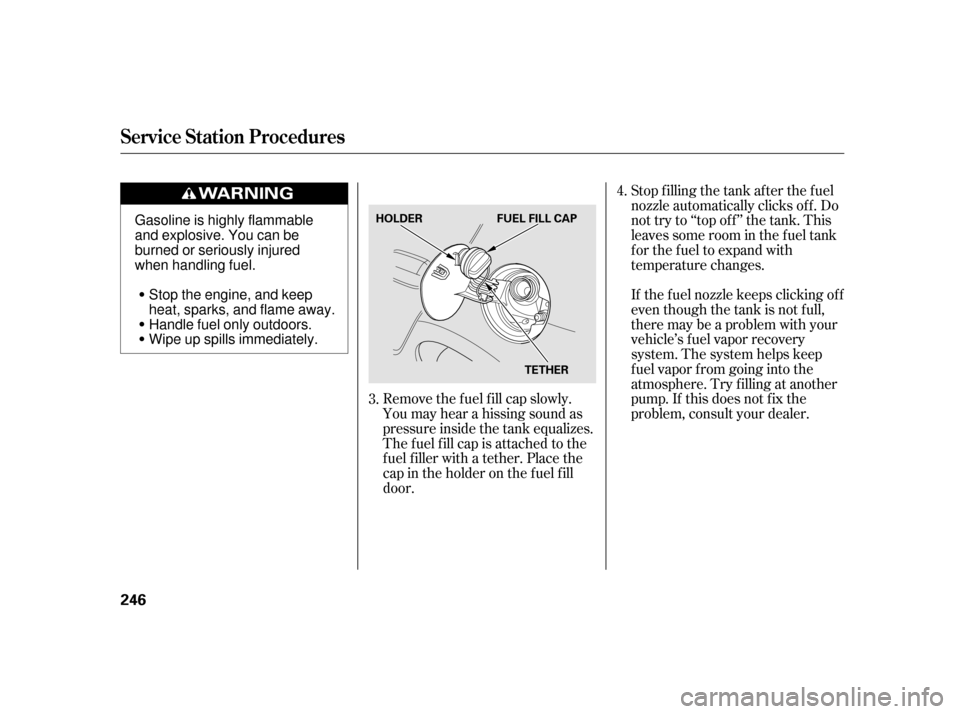
Remove the f uel f ill cap slowly.
You may hear a hissing sound as
pressure inside the tank equalizes.
The fuel fill cap is attached to the
f uel f iller with a tether. Place the
cap in the holder on the f uel f ill
door.
3. 4.
Service Station Procedures
246
TETHER
HOLDER
FUEL FILL CAP
Gasoline is highly flammable
and explosive. You can be
burned or seriously injured
when handling fuel.
Stop the engine, and keep
heat, sparks, and flame away.
Handle fuel only outdoors.
Wipe up spills immediately.
Page 263 of 411

Store or secure all items that could
be thrown around and hurt
someone during a crash.
Be sure items placed on the f loor
behind the f ront seats cannot roll
under the seats and interf ere with
the driver’s ability to operate the
pedals, the operation of the seats,
or the operation of the sensors
under the seats.
Keep the glove box closed while
driving. If it is open, a passenger
could injure their knees during a
crash or sudden stop.Distribute cargo evenly on the
f loor of the hatch, placing the
heaviest items on the bottom and
as far forward as possible.
Trytosecuretheitemswithrope
or cord so they will not shif t while
you are driving.
If you carry large items that
prevent you f rom closing the
hatch, exhaust gas can enter the
passenger area. To avoid the
possibility of
, f ollow the instructions
on page .
If youfoldtherearseatsdown,tie
down items that could be thrown
about the vehicle during a crash or
sudden stop. Keep all cargo below
the bottom of the windows. If it is
higher, it could interf ere with
proper operation of the side
curtain airbags.
Refer to page for folding rear
seats.
Do not stack items higher than the
back of the rear seats. They can
block your view and be thrown
around the vehicle during a crash.
Do not spill any liquids on or
around the IMA battery. Spilled
liquids may damage the IMA
battery. If you accidentally spill
liquids on or around the battery,
ensure that the spill is completely
wiped up at the earliest possible
time. 56
145
Carrying Items in the Passenger
Compartment
Carrying Cargo in the Cargo A rea
carbon monoxide
poisoning
Carrying Cargo
Bef ore Driving
259
Page 302 of 411

To eliminate potential hazards, read
the instructions bef ore you begin,
and make sure you have the tools
and skills required.To clean parts, use a commercially
available degreaser or parts
cleaner, not gasoline.
To reduce the possibility of f ire or
explosion, keep cigarettes, sparks,
and f lames away f rom the battery
and all f uel-related parts. Make sure your vehicle is parked
on level ground, the parking brake
is set, and the engine is of f . Some of the most important saf ety
precautions are given here. However,
we cannot warn you of every
conceivable hazard that can arise in
perf orming maintenance. Only you
can decide whether or not you
should perf orm a given task.Do
not run the engine unless
instructed to do so. Let the
engine and exhaust system cool
down bef ore touching any parts.
Wear eye protection and
protective clothing when working
with the battery or compressed air.
All service items not detailed in this
section should be perf ormed by a
certif ied technician or qualif ied
mechanic.
Be sure there is
adequate ventilation whenever you
operate the engine.
Maintenance Saf ety
Important Saf ety Precautions Injury f rom moving parts. Burns f rom hot parts.
Carbon Monoxide poison f rom
engine exhaust.
Potential Vehicle Hazards
298
Failure to properly follow
maintenance instructions and
precautions can cause you to
be seriously hurt or killed.
Always follow the procedures
and precautions in this owner’s
manual.
Improperly maintaining this
vehicle or failing to correct a
problem before driving can
cause a crash in which you can
be seriously hurt or killed.
Always follow the inspection
and maintenance
recommendations and
schedules in this owner’s
manual.
Page 315 of 411
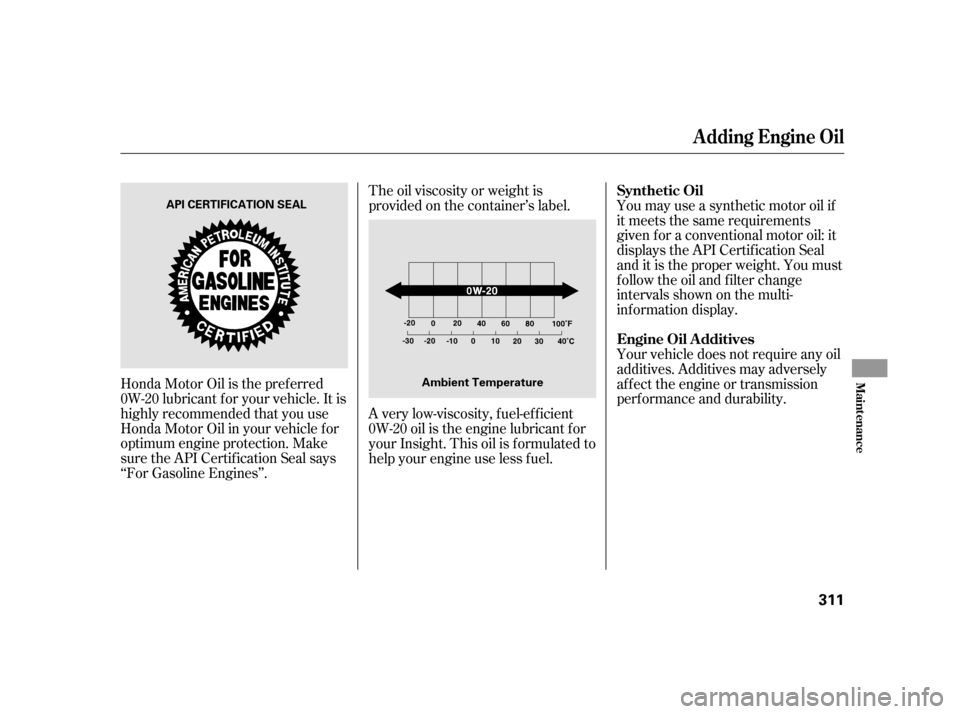
Honda Motor Oil is the pref erred
0W-20 lubricant f or your vehicle. It is
highly recommended that you use
Honda Motor Oil in your vehicle f or
optimum engine protection. Make
sure the API Certif ication Seal says
‘‘For Gasoline Engines’’.The oil viscosity or weight is
provided on the container’s label. You may use a synthetic motor oil if
it meets the same requirements
given f or a conventional motor oil: it
displays the API Certif ication Seal
and it is the proper weight. You must
f ollow the oil and f ilter change
intervals shown on the multi-
inf ormation display.
Your vehicle does not require any oil
additives. Additives may adversely
af f ect the engine or transmission
perf ormance and durability.
A very low-viscosity, f uel-ef f icient
0W-20 oil is the engine lubricant f or
your Insight. This oil is f ormulated to
help your engine use less f uel.
A dding Engine Oil
Synthetic Oil
Engine Oil A dditives
Maint enance
311
API CERTIFICATION SEAL
Ambient Temperature