airbag HONDA INSIGHT 2014 2.G User Guide
[x] Cancel search | Manufacturer: HONDA, Model Year: 2014, Model line: INSIGHT, Model: HONDA INSIGHT 2014 2.GPages: 411, PDF Size: 8.83 MB
Page 22 of 411
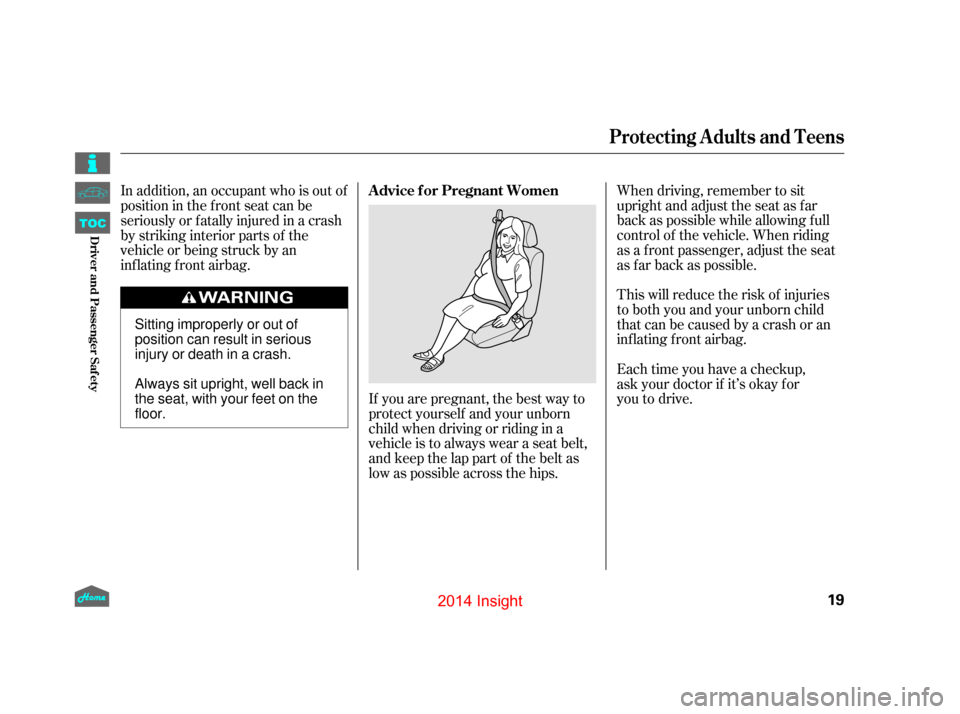
If you are pregnant, the best way to
protect yourself and your unborn
child when driving or riding in a
vehicle is to always wear a seat belt,
and keep the lap part of the belt as
low as possible across the hips.When driving, remember to sit
upright and adjust the seat as f ar
back as possible while allowing f ull
control of the vehicle. When riding
as a f ront passenger, adjust the seat
as far back as possible.
This will reduce the risk of injuries
to both you and your unborn child
that can be caused by a crash or an
inflating front airbag.
Each time you have a checkup,
ask your doctor if it’s okay for
you to drive.
In addition, an occupant who is out of
position in the f ront seat can be
seriously or f atally injured in a crash
by striking interior parts of the
vehicle or being struck by an
inflating front airbag.
Advice f or Pregnant Women
Protecting A dults and Teens
19
Sitting improperly or out of
position can result in serious
injury or death in a crash.
Always sit upright, well back in
the seat, with your feet on the
floor.
12/07/13 16:39:08 31TM8630_024
Driver and Passenger Saf etyTOC
2014 Insight
Page 23 of 411

Carrying hard or sharp
objects on your lap, or driving with
a pipe or other sharp object in
your mouth, can result in injuries
if your f ront airbag inf lates.
If they do, they
could be very seriously injured in a
crash.
Devices intended to improve
occupant comf ort or reposition the
shoulder part of a seat belt can
reduce the protective capability of
the seat belt and increase the
chance of serious injury in a crash. Objects on
the covers marked ‘‘SRS AIRBAG’’
could interf ere with the proper
operation of the airbags or be
propelled inside the vehicle and
hurt someone if the airbags inf late.
If your
hands or arms are close to an
airbag cover, they could be injured
if the airbag inf lates. If a side airbag or a
side curtain airbag inf lates, a cup
holder or other hard object
attached on or near the door could
be propelled inside the vehicle and
hurt someone.
If they do, they
could be very seriously injured in A passenger who is not
wearing a seat belt during a crash
or emergency stop can be thrown
against the inside of the vehicle,
against other occupants, or out of
the vehicle.
Improperly replacing
or covering f ront seat-back covers
can prevent your side airbags f rom
inf lating during a side impact.
Do not place hard or sharp object s
bet ween yourself and a f rontairbag.
T wo people should never use t he
same seat belt .
Do not put any accessories on seatbelts. Do not at t ach or place object s on
the f ront airbag covers.
K eep your hands and arms awayf rom t he airbag covers. Do not at t ach hard object s on or
near a door.
Never let passengers ride in t he cargo area or on t op of a f olded-down back seat . Passengers should not stand up or
change seats while the vehicle ismoving.
Do not cover or replace f ront seat -back covers wit hout consult ingyour dealer.Additional Saf ety Precautions
Protecting A dults and Teens
20
12/07/13 16:39:16 31TM8630_025
Driver and Passenger Saf etyTOC
a crash.
2014 Insight
Page 26 of 411
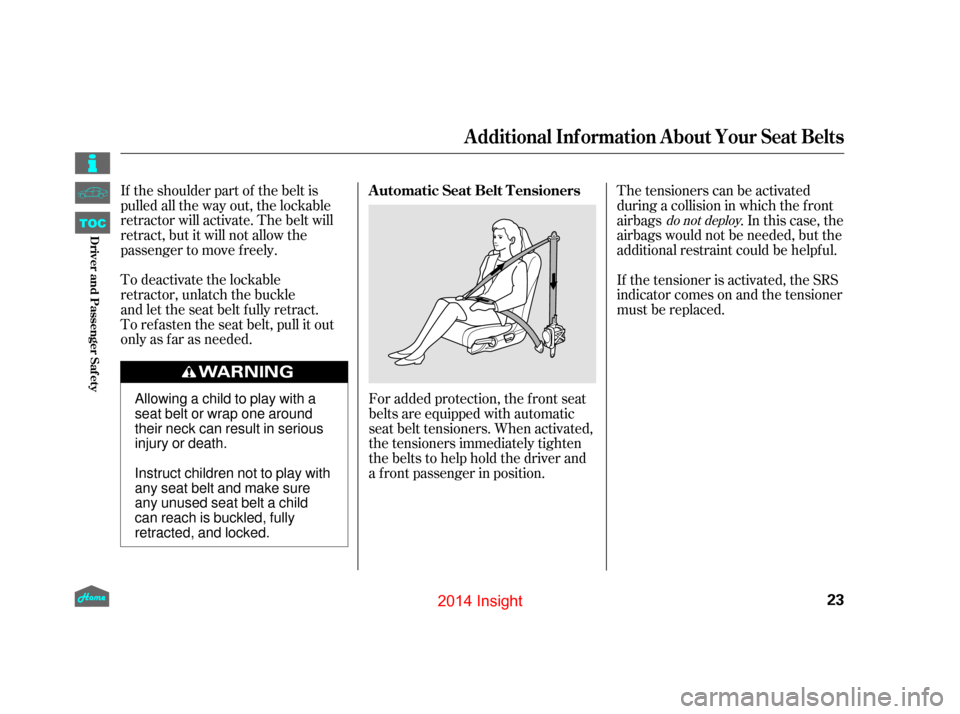
For added protection, the f ront seat
belts are equipped with automatic
seat belt tensioners. When activated,
the tensioners immediately tighten
the belts to help hold the driver and
a f ront passenger in position.
If the shoulder part of the belt is
pulled all the way out, the lockable
retractor will activate. The belt will
retract, but it will not allow the
passenger to move f reely.
To deactivate the lockable
retractor, unlatch the buckle
and let the seat belt fully retract.
To refasten the seat belt, pull it out
only as far as needed.
The tensioners can be activated
during a collision in which the f ront
airbags
. In this case, the
airbags would not be needed, but the
additional restraint could be helpf ul.
If the tensioner is activated, the SRS
indicator comes on and the tensioner
must be replaced.
do not deploy
Additional Inf ormation About Your Seat Belts
A utomatic Seat Belt T ensioners
23
Allowing a child to play with a
seat belt or wrap one around
their neck can result in serious
injury or death.
Instruct children not to play with
any seat belt and make sure
any unused seat belt a child
can reach is buckled, fully
retracted, and locked.
12/07/13 16:39:38 31TM8630_028
Driver and Passenger Saf etyTOC
2014 Insight
Page 28 of 411
CONT INUED
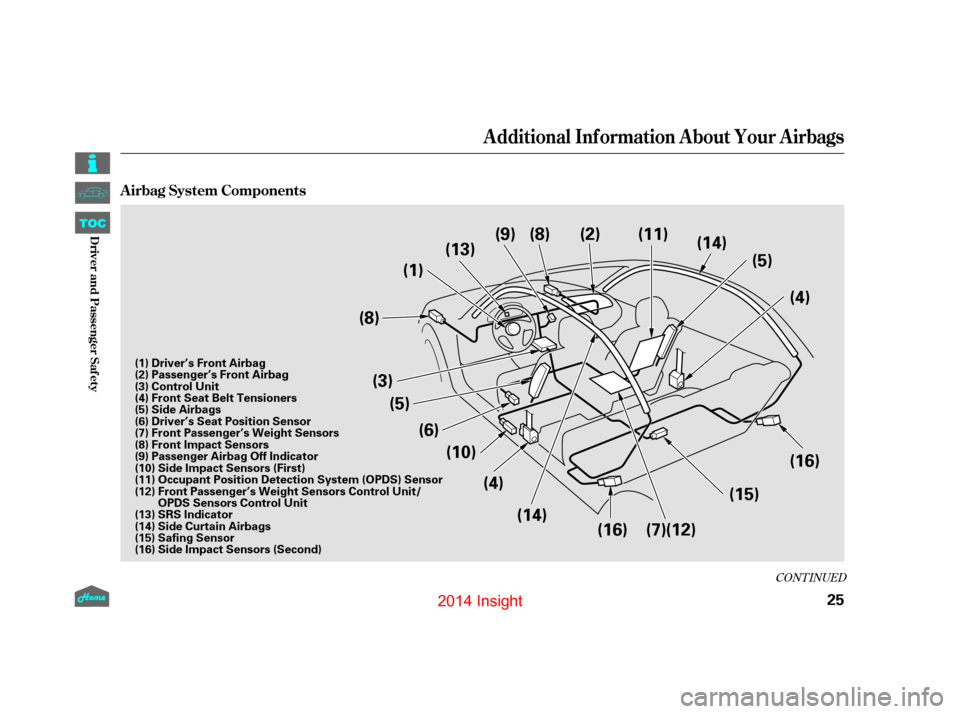
A irbag System Components
Additional Inf ormation About Your Airbags
25
(1)
(3) (5)
(4)
(5)
(6)(10)
(13)
(9) (8)
(14)
(2)
(16) (4)
(15)
(16)
(14)
(8)
(11)
(7)(12)
(1) Driver’s Front Airbag
(2) Passenger’s Front Airbag
(3) Control Unit
(4) Front Seat Belt Tensioners
(5) Side Airbags
(6) Driver’s Seat Position Sensor
(7) Front Passenger’s Weight Sensors
(12) Front Passenger’s Weight Sensors Control Unit/ OPDS Sensors Control Unit
(13) SRS Indicator
(14) Side Curtain Airbags
(15) Safing Sensor
(16) Side Impact Sensors (Second) (8) Front Impact Sensors
(9) Passenger Airbag Off Indicator
(10) Side Impact Sensors (First)
(11) Occupant Position Detection System (OPDS) Sensor
12/07/13 16:39:51 31TM8630_030
Driver and Passenger Saf etyTOC
2014 Insight
Page 29 of 411
Your Airbag System includes:Two SRS (supplemental restraint
system) f ront airbags. The driver’s
airbag is stored in the center of
the steering wheel; the f ront
passenger’sairbagisstoredinthe
dashboard. Both are marked ‘‘SRS
AIRBAG’’ (see page).
Two side airbags, one f or the
driver and one f or a f ront
passenger. The airbags are stored
in the outer edges of the seat-
backs. Both are marked ‘‘SIDE
AIRBAG’’ (see page).
Two side curtain airbags, one for
each side of the vehicle. The
airbags are stored in the ceiling,
above the side windows. The
front and rear pillars are
marked ‘‘SIDE CURTAIN
AIRBAG’’ (see page). Automatic front seat belt
tensioners (see
page).
Sensors that can detect a
moderate to severe front impact or
side impact.
Sensors that can detect whether a
child is in the passenger’s side
airbag path and signal the control
unit to turn the airbag of f (see
page ). Sensors that can detect whether
the driver’s seat belt and the f ront
passenger’s seat belt are latched
or unlatched (see
page).
A driver’s seat position sensor
that monitors the distance of the
seat from the front airbag. If the
seat is too far forward, the
airbag will inflate with less force
(see page ).
28
32
33 23
32 21
30
Additional Inf ormation About Your Airbags
26
12/07/13 16:39:58 31TM8630_031
Driver and Passenger Saf etyTOC
2014 Insight
Page 30 of 411
An indicator on the instrument
panel that alerts you that the
passenger’s side airbag has been
turned of f (seepage).
An indicator on the dashboard that
alerts you that the passenger’s
f ront airbag has been turned of f
(see page ).
Emergency backup power in case
your vehicle’s electrical system is
disconnected in a crash.
Weight sensors that monitor the
weight on the f ront passenger’s
seat. If the weight is about 65
lbs (29 kg) or less (the weight
of an inf ant or small child), the
passenger’s f ront airbag will be
turned of f (see
page). A sophisticated electronic
system that continually monitors
and records information about
the sensors, the control unit, the
airbag activators, the seat belt
tensioners, and driver and front
passenger seat belt use
when the ignition switch is in the
ON (II) position.
An indicator on the instrument
panel that alerts you to a possible
problem with your airbag system
components (see
page). 34
35
34
30
Additional Inf ormation About Your Airbags
27
12/07/13 16:40:04 31TM8630_032
Driver and Passenger Saf etyTOC
2014 Insight
Page 31 of 411
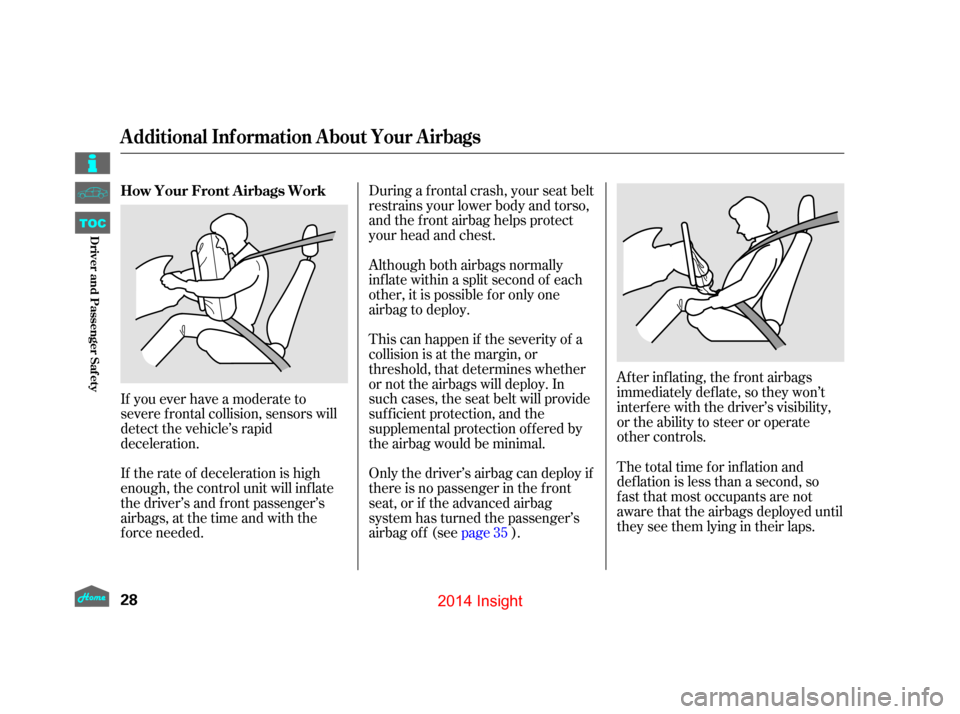
Af ter inf lating, the f ront airbags
immediately def late, so they won’t
interf ere with the driver’s visibility,
or the ability to steer or operate
other controls.
During a f rontal crash, your seat belt
restrains your lower body and torso,
and the f ront airbag helps protect
your head and chest.
Although both airbags normally
inf late within a split second of each
other, it is possible f or only one
airbag to deploy.
This can happen if the severity of a
collision is at the margin, or
threshold, that determines whether
or not the airbags will deploy. In
such cases, the seat belt will provide
suf f icient protection, and the
supplemental protection of f ered by
the airbag would be minimal.
If you ever have a moderate to
severe f rontal collision, sensors will
detect the vehicle’s rapid
deceleration.
If the rate of deceleration is high
enough, the control unit will inf late
the driver’s and f ront passenger’s
airbags, at the time and with the
f orce needed. Only the driver’s airbag can deploy if
there is no passenger in the f ront
seat, or if the advanced airbag
system has turned the passenger’s
airbag off (see
page). The total time for inflation and
def lation is less than a second, so
f ast that most occupants are not
aware that the airbags deployed until
they see them lying in their laps.
35
How Your Front Airbags Work
Additional Inf ormation About Your Airbags
28
12/07/13 16:40:12 31TM8630_033
Driver and Passenger Saf etyTOC
2014 Insight
Page 32 of 411

After a crash, you may see what
looks like smoke. This is actually
powder from the airbag’s surface.
Although the powder is not
harmful, people with respiratory
problems may experience some
temporary discomfort. If
this occurs, get out of the vehicle
as soon as it is safe to do so.Your vehicle is equipped with dual-
stage, multiple-threshold f ront
airbags (SRS). During a f rontal crash
severe enough to cause one or both
f ront airbags to deploy, the airbags
can inf late at dif f erent rates,
depending on the severity of the
crash, whether or not the seat belts
are latched, and/or other factors.
Front airbags are designed to
supplement the seat belts to help
reduce the likelihood of head and
chest injuries in f rontal crashes.
CONT INUED
Additional Inf ormation About Your Airbags
Dual-Stage, Multiple-T hreshold
Front A irbags (SRS)
29
12/07/13 16:40:17 31TM8630_034
Driver and Passenger Saf etyTOC
2014 Insight
Page 33 of 411
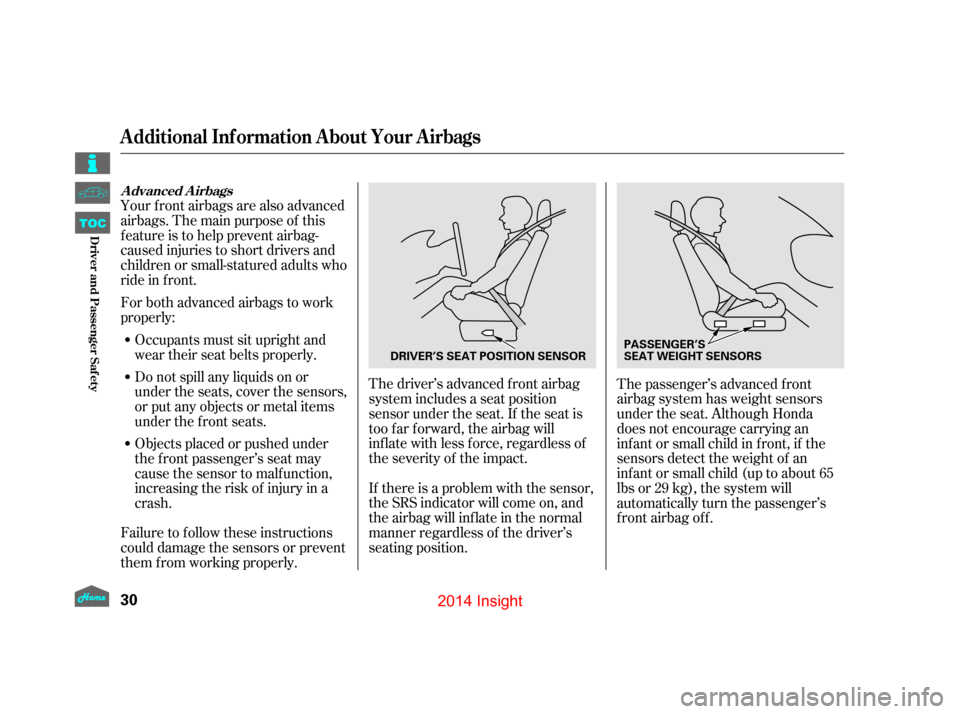
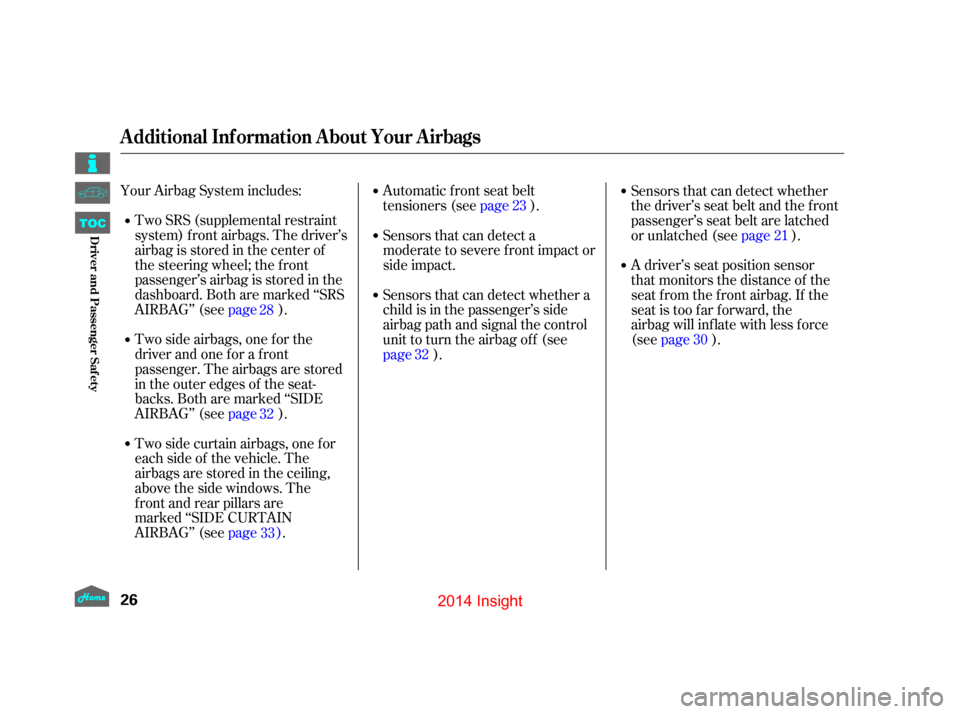
The driver’s advanced front airbag
system includes a seat position
sensor under the seat. If the seat is
too far forward, the airbag will
inf late with less f orce, regardless of
the severity of the impact.
If there is a problem with the sensor,
the SRS indicator will come on, and
the airbag will inf late in the normal
manner regardless of the driver’s
seating position.The passenger’s advanced f ront
airbag system has weight sensors
under the seat. Although Honda
does not encourage carrying an
inf ant or small child in f ront, if the
sensors detect the weight of an
inf ant or small child (up to about 65
lbs or 29 kg), the system will
automatically turn the passenger’s
front airbag off.
Your f ront airbags are also advanced
airbags. The main purpose of this
feature is to help prevent airbag-
caused injuries to short drivers and
children or small-statured adults who
ride in f ront.
For both advanced airbags to work
properly:
Occupants must sit upright and
wear their seat belts properly.
Failure to f ollow these instructions
could damage the sensors or prevent
them f rom working properly. Do not spill any liquids on or
under the seats, cover the sensors,
or put any objects or metal items
under the f ront seats.
Objects placed or pushed under
the f ront passenger’s seat may
cause the sensor to malf unction,
increasing the risk of injury in a
crash.
Advanced Airbags
Additional Inf ormation About Your Airbags
30
PASSENGER’S
SEAT WEIGHT SENSORS
DRIVER’S SEAT POSITION SENSOR
12/07/13 16:40:26 31TM8630_035
Driver and Passenger Saf etyTOC
2014 Insight
Page 34 of 411

Be aware that objects placed on the
passenger’s seat can also cause the
airbag to be turned off.
When the passenger airbag gets
turned of f by the weight sensors, a
‘‘passenger airbag of f ’’ indicator in
the center of the dashboard comes
on (seepage ).
If the weight sensors detect there is
no passenger in the f ront seat, the
airbag is automatically turned off.
However, the passenger airbag of f
indicator in this situation will not
come on. To ensure that the passenger’s
advanced front airbag system will
work properly,
This includes:
A rear passenger pushing or
pulling on the back of the f ront
passenger’s seat.
Moving the f ront seat f orcibly
back against cargo on the seat or
f loor behind it.
Hanging heavy items on the f ront
passenger seat, or placing heavy
items in the seat-back pocket.
Moving the front seat or seat-back
f orcibly back against the f olded
rear seat. Back seat passengers should not
wedge objects or intentionally
f orce their f eet under the f ront
passenger seat.
35
Additional Inf ormation About Your Airbags
do not do anyt hing
t hat would increase or decrease t he weight on the f ront passenger’s seat.
31
12/07/13 16:40:33 31TM8630_036
Driver and Passenger Saf etyTOC
2014 Insight