brake HONDA INTEGRA 1994 4.G Owner's Manual
[x] Cancel search | Manufacturer: HONDA, Model Year: 1994, Model line: INTEGRA, Model: HONDA INTEGRA 1994 4.GPages: 1413, PDF Size: 37.94 MB
Page 413 of 1413
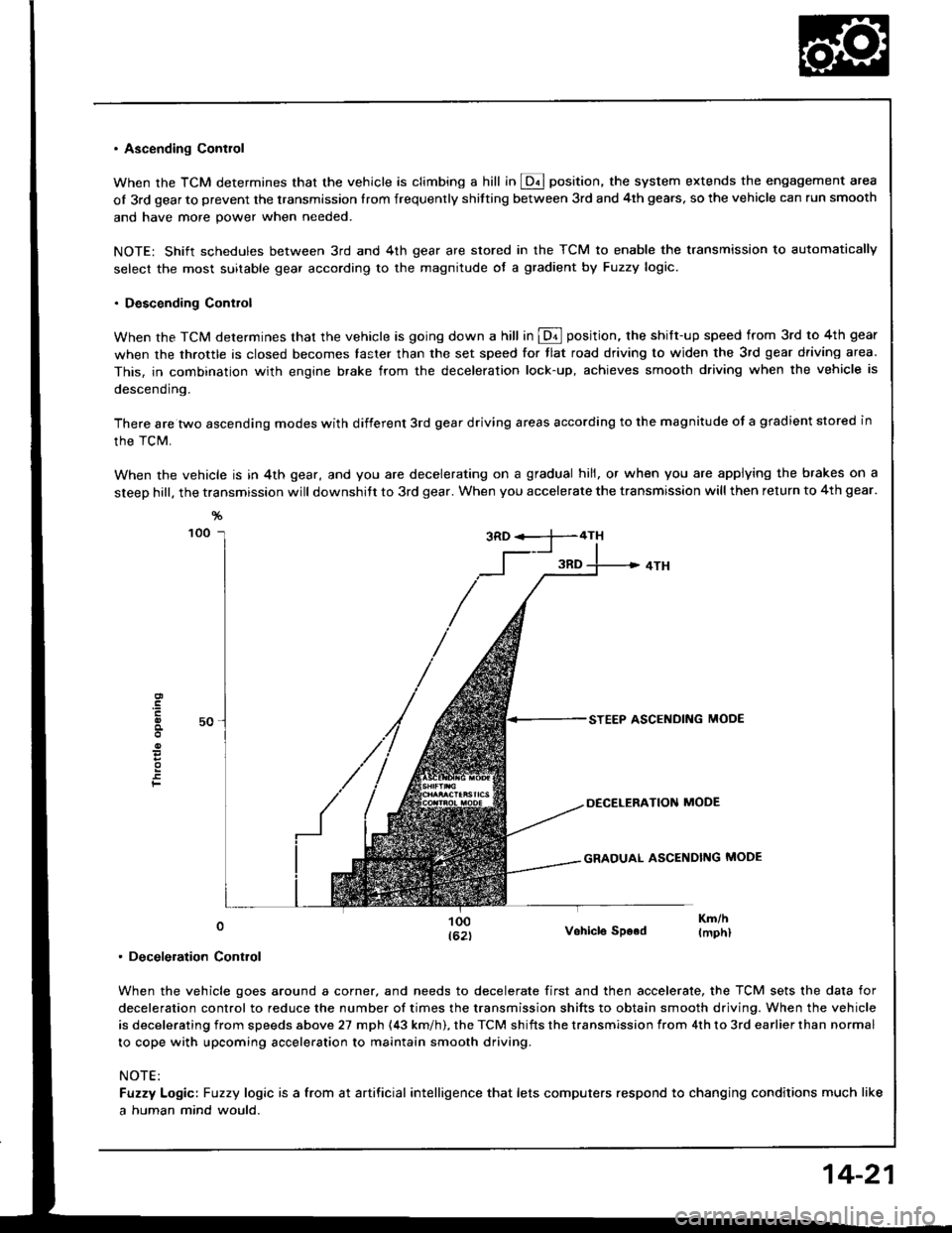
. Ascending Contlol
When the TCM determines that the vehicle is climbing a hill in @ position, the system extends the engagement area
of 3rd gear to prevent the transmission Irom frequenrly shitting between 3rd and 4th gears, so the vehicle can run smooth
and have more power when needed.
NOTE: Shift schedules between 3rd and 4th gear are stored in the TCM to enable the transmission to automatically
select the most suitable gear according to the magnitude of a gradient by Fuzzy logic.
. Descending Control
When the TCM determines that the vehicle is going down a hill in @ position. the shift-up speed from 3rd to 4th gear
when the throttle is closed becomes taster than the set speed for tlat road driving to widen the 3rd gear driving area.
This, in combination with engine brake from the deceleration lock-up, achieves smooth driving when the vehicle is
descending.
There are two ascending modes with different 3rd gear driving areas according to the magnitude of a gradient stored in
the TCM.
When the vehicle is in 4th gear, and you are decelerating on a gradual hill, or when you are applying the brakes on a
steep hill, the transmission will downshitt to 3rd gear. When you accelerate the transmission will then return to 4th gear.
F
0
. Deceleration Control
Vohicle SDood
When the vehicle goes around a corner, and needs to decelerate first and then accelerate, the TCM sets the data for
deceleration control to reduce the number of times the transmission shifts to obtain smooth driving. When the vehicle
is decelerating from speeds above 27 mph (43 km/h). the TCM shifts the transmission from 4th to 3rd earlier than normal
to cope with upcoming acceleration to maintain smooth driving.
NOTE:
Fuzzy Logic: Fuzzy logic is a from at artificial intelligence that lets computers respond to changing conditions much like
a human mind would.
14-21
Page 443 of 1413
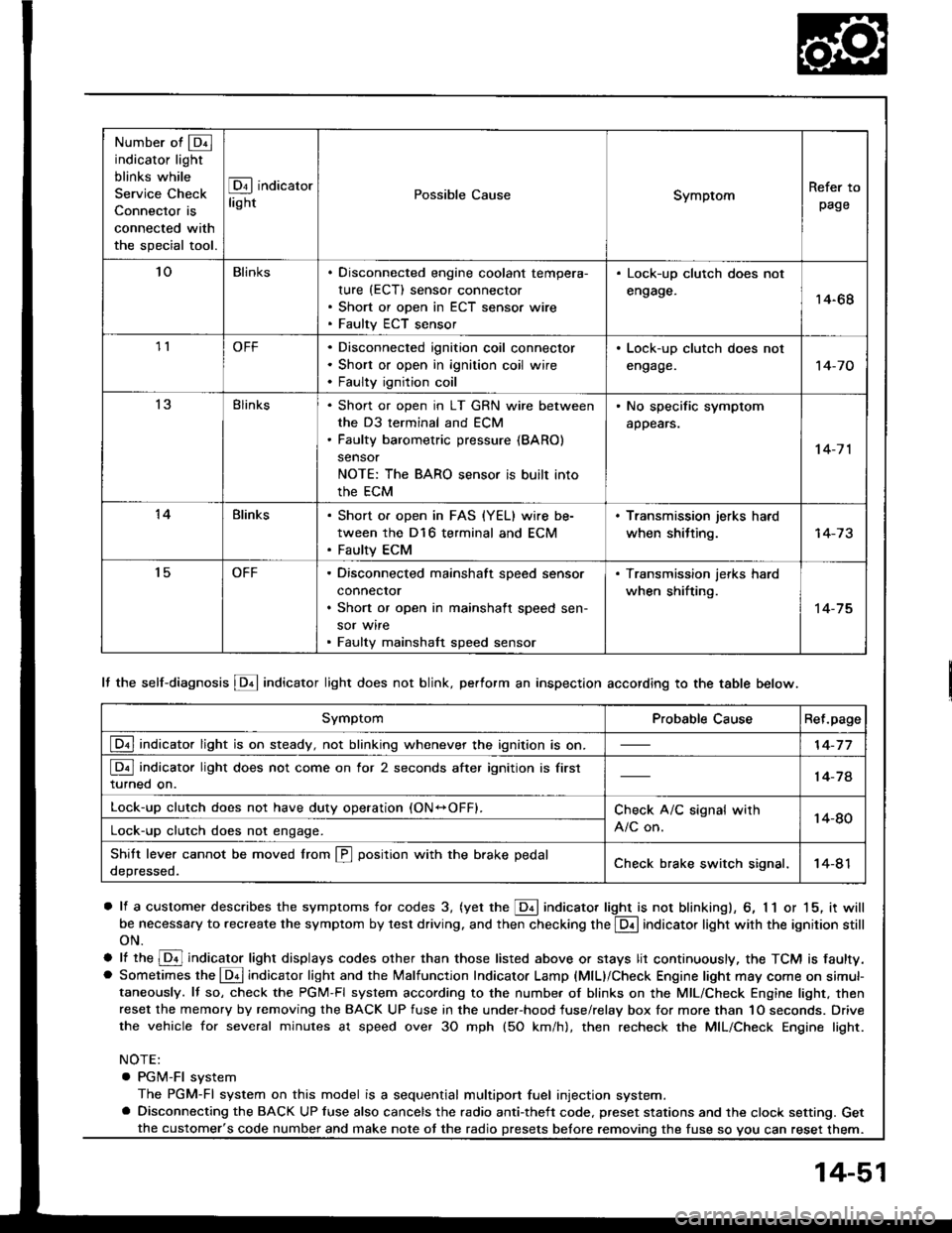
Number of @indicator light
blinks while
Service Check
Connector is
connected with
the special tool.
@ indicator
lightPossible CauseSymptomRefer to
page
'loBlinksDisconnected engine coolant tempera-
rure (ECT) sensor connector
Short or open in ECT sensor wire
Faulty ECT sensor
Lock-up clutch does not
engage.14-68
1lOFFDisconnected ignition coil connector
Short or open in ignition coil wire
Faulty ignition coil
. Lock-up clutch does not
engage.'t 4-7 0
13Blinks. Shon or open in LT GRN wire between
the D3 terminal and ECM. Faulty barometric pressure {BARO)
sensor
NOTE: The BARO sensor is built into
the ECM
. No specific symptom
appears.
14-7 1
14Blinks. Short of open in FAS {YEL} wire be-
tween the D16 terminal and ECM. Faulty ECM
. Transmission jerks hard
when shitting.
't5OFFDisconnected mainshaft speed sensor
connecror
Short or open in mainshaft speed sen-
sor wire
Faulty mainshaft speed sensor
. Transmission jerks hard
when shifting.
14-75
SymptomProbable CauseRet.page
LQ! indicator light is on steady, not blinking whenever the ignition is on.14-77
[Q3] indicator light does not come on for 2 seconds after ignition is first
turned on.14-78
Lock-up clutch does not have duty operation (ON-OFFI.Check A/C signal with
A/C on.14-80Lock-up clutch does not engage.
Shitt leve. cannot be moved lrom @ position with the brake pedal
depressed.Check brake switch signal,14-41
It the self-diagnosis LQ4 indicator light does not blink, perform an inspection according to the table below.
a lf a customer describes the symptoms for codes 3, (yet the LQ! indicator light is not blinkingl, 6, 1 1 or 15, it will
be necessa.y to recreate the symptom by test driving. and then checking the @ indicator light with the ignition still
oN.
e lt ttre @ indicator light displays codes olher than those listed above or stays lit continuously, the TCM is faulty.. Sometimes the Lqd indicator light and the Malfunction Indicator Lamp (MlL)/Check Engine light may come on simul-taneously. lf so, check the PGM-Fl system according to the numbe. of blinks on the MIL/Check Engine light. thenreset the memory by removing the BACK UP fuse in the unde.-hood fuse/relay box for more than 1O seconds. Drive
the vehicle for several minutes at speed over 30 mph (5O km/h), then recheck the MIL/Check Engine light.
NOTE:
. PGM-FI system
The PGM-Fl system on this model is a sequential multiport fuel injection system.a Disconnecting the BACK UP luse also cancels the radio anti-theft code. preset stations and the clock setting. Get
the fuse so vou can reset them.the customer's code number and make note ot the radio
14-51
Page 449 of 1413
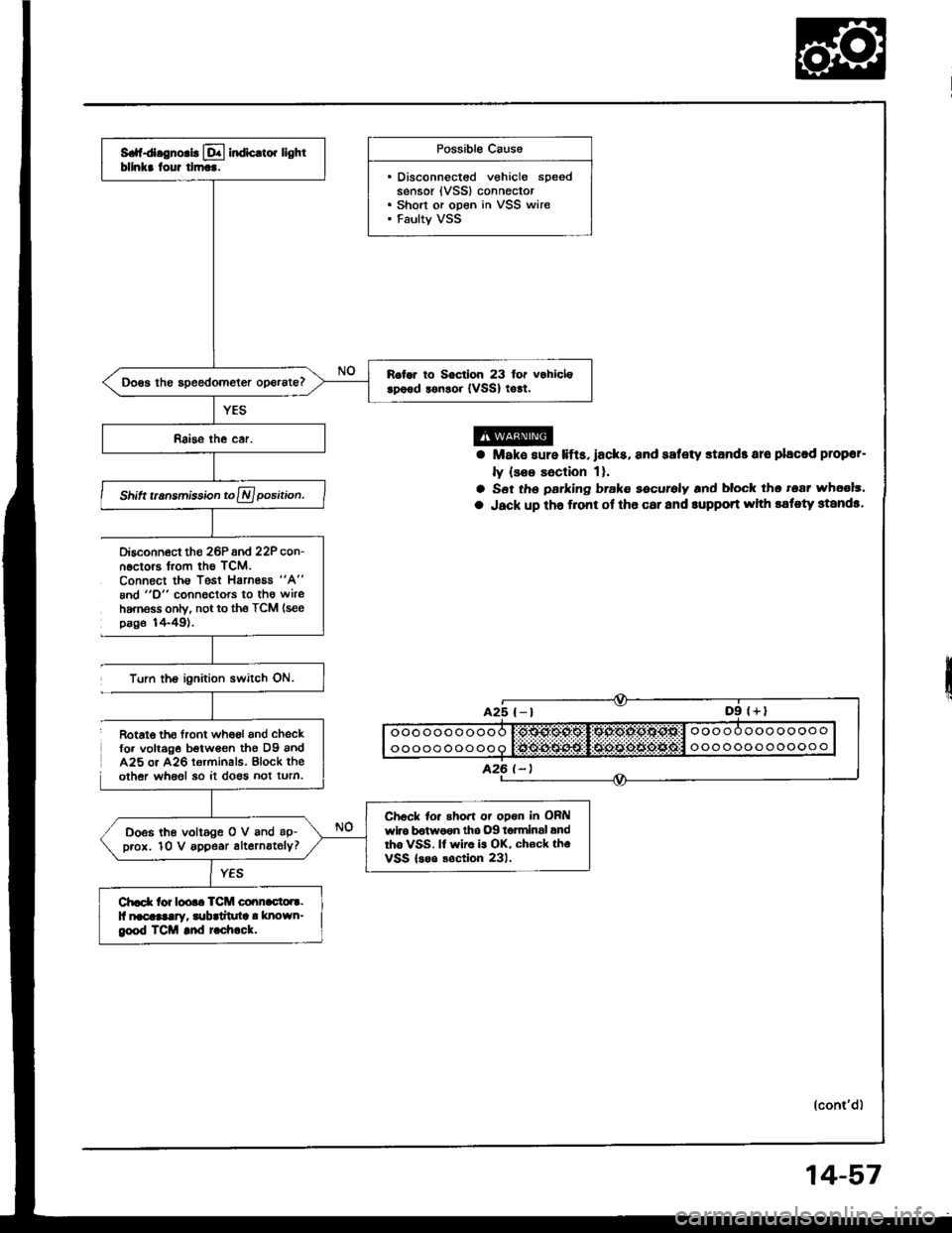
S. d.gno.b lql indic.to. lightbllnkr tour tlm...
R.lor to Soctlon 23 for vohiclerpood lonsoi {vSSl to!t.
Shift t.nsmisiion to A position.
Ch6ck to. shoft or opon in OFilwlro b€twoen tho .)9 t6tminsl andrho VSS. lf wiro is OK, ch€ck thoVSS lsoo soction 231.
Doss lhe voltage O V and ap-p.ox. 10 V appe.r alternately?
Ch.d( tor loo.. TCM co.!n.cto.r.ll nacaaalay, lubrtituta ! known_geod TCM and t chock.
Possible Caus6
. Disconnectsd vehicle speedsensor {VSS} connector. Short or open in VSS wire. Faulty VSS
Disconn6ct the 26Pand 22P con-n.ctors trom th€ TCM.Connect ths Tgst Harnoas "A"
8nd "O" connectors to tho wireharnsss only, not to the TCM (see
page 1+49).
Turn the ignilion switch ON.
a Mak€ sure lifts,lacks, and safety stands aro placod plopor-
ly {see Eaclion 1}.
a S6t th6 parking brake eecurely and block tho tear wh6ol3'
a Jack up tho f.ont ot tho car and rupport whh sstoty standa.
(cont'd)
Rotat€ th€ tront wh6ol and chsckfo. volt6g€ botwean the D9 andA25 o. A26 terminals. Block theother whaol 30 it do€s not turn.
14-57
Page 473 of 1413
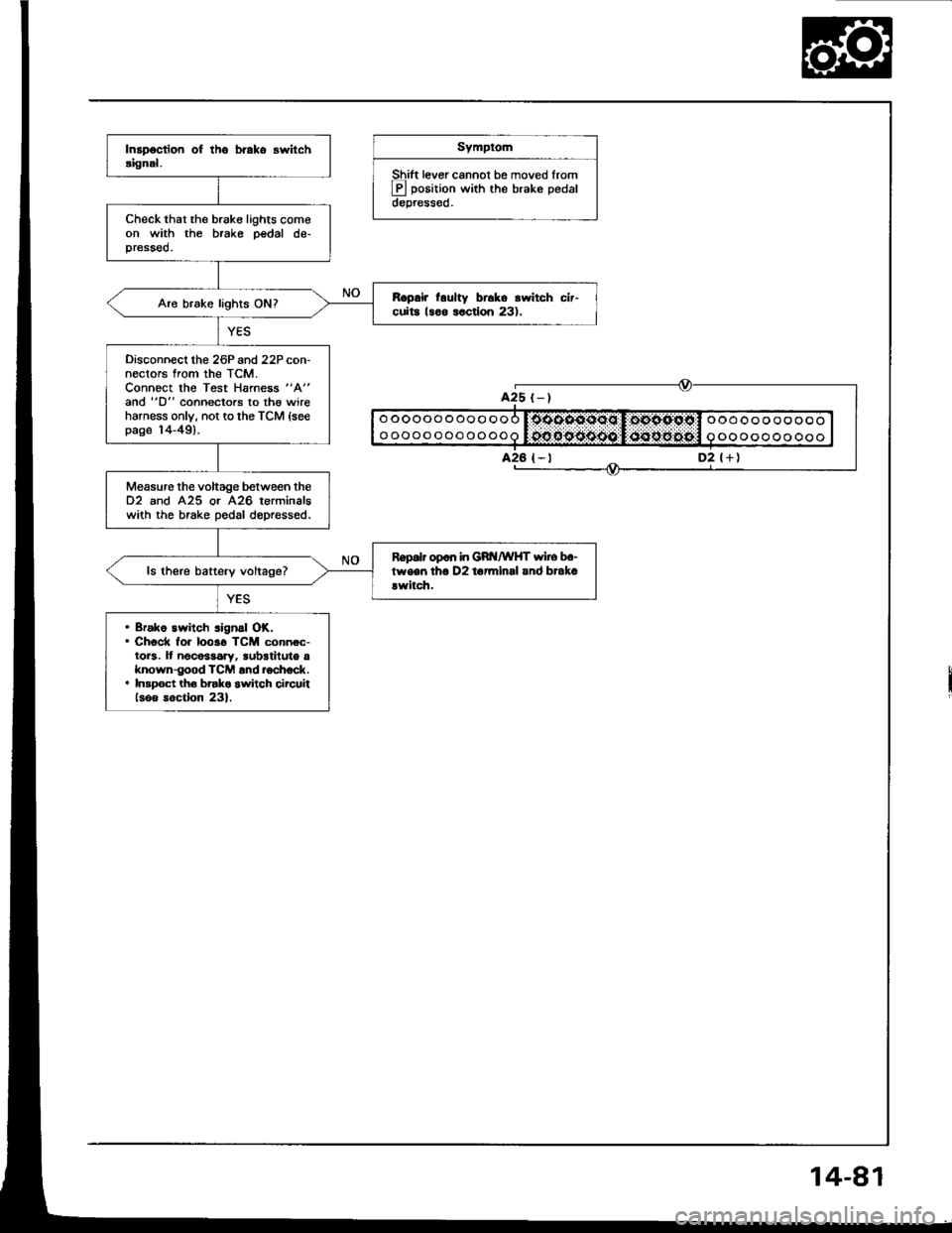
Symptom
Shift lever cannot be moved lrom
E position with the brake pedaldepressed.
Check thar the brake lights comeon with the brake pedal de-pressed.
R.prir l.ulty br6ko rwitch cir-cuita 18o6 lactlon 231.Aro brake lights ON?
Disconnecl lhe 26P and 22P con-nectors from the TCM.Connoct the Test Harness "A"
and "D" coonectors to th€ wireharness only, not to the TCM {seepage 14-49).
Measure the voltage between the02 and 425 or A26 terminalswith the brake pedal dopressed.
Ropalr op6n in GRt{/wHT wiro b.-tween tho D2 to7minsl and brak.!witch.ls there battery voltage?
. Bfako switch signal OK.. Check for 10036 TCM connec-tors. It noco$ary, sub3tiluto aknown-good TCM and ioch6ck.. Insp6ct tho brako switch circuiilsoo soction 23).
oooooooooooo
oooooooooooo
ooooooooooo
oooooooooo
A25 t-)
D2 l+)
Page 480 of 1413
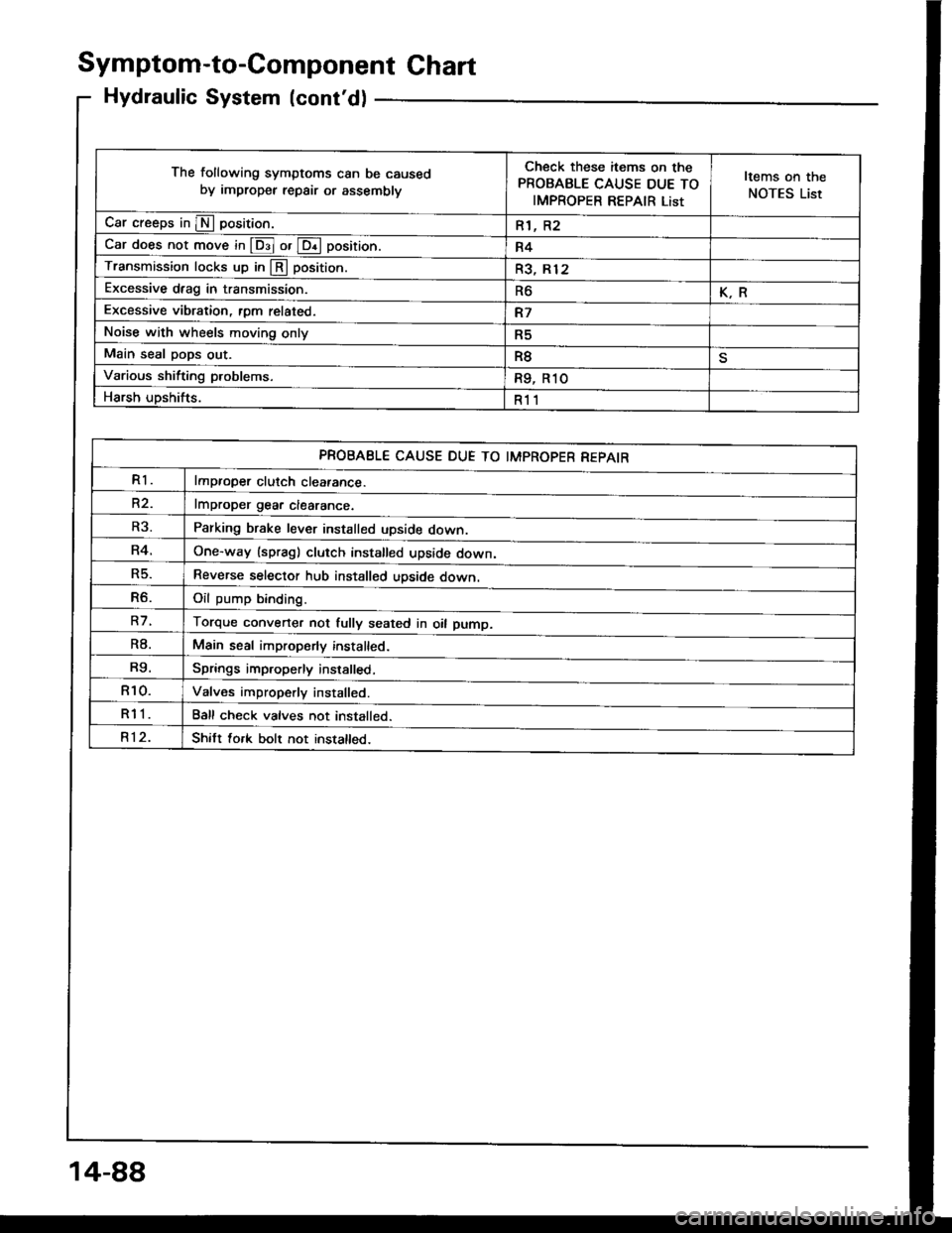
Symptom-to-Component Ghart
Hydraulic System (cont'd)
The following symptoms can be caused
by improper repair or assemblv
Check these items on the
PROBABLE CAUSE DUE TO
IMPROPER REPAIR List
Items on the
NOTES List
Car creeps in E position.R1, R2
Car does not move in @ or @ position.R4
Transmission locks up in @ position.R3, Rl2
Excessive drag in transmission.R6K.R
Excessive vibration, rom related.R7
Noise with wheels moving onlyR5
Main seal pops out.R8
Various shifting problems.R9, R1O
Harsh upshifts.R11
PROBABLE CAUSE DUE TO IMPROPER REPAIR
R1lmproper clutch cleatance.
R2.lmDroDer qear clearance.
Parking brake lever installed upside down.
One-way (spragl clutch installed upside down,
Reverse selector hub installed upside down.
Oil oumo bindind
Torque converter not fully seated in oil pump.
Main seal improperly installed.
Springs improperly installed,
Valves improperly installed.
Ball check valves not installed.
Shitt fork bolt not installed.
R3.
R4.
R5.
R6.
R7.
R8.
R9.
R10.
R11
R12.
14-88
Page 482 of 1413
![HONDA INTEGRA 1994 4.G Owners Manual Road Test
NOTE: Warm up the engine to operating temperature (the cooling fan comes on).
1 Apply parking brake and block th€ wheels. Start the engine, them move the selector lever to E] position whil](/img/13/6067/w960_6067-481.png "HONDA INTEGRA 1994 4.G Owners Manual Road Test
NOTE: Warm up the engine to operating temperature (the cooling fan comes on).
1 Apply parking brake and block th€ wheels. Start the engine, them move the selector lever to E] position whil")
Road Test
NOTE: Warm up the engine to operating temperature (the cooling fan comes on).
1 Apply parking brake and block th€ wheels. Start the engine, them move the selector lever to E] position whiledepressing the brake pedal. Depress the accelerator pedal, and release it suddenly. The engine should not stall,
2. Repeat same test in @ position.
3. Shift the selecto. lever to E position, and chock that the shift points occur at approximate speeds shown. Alsocheck fof abnormal noise and clutch slippage.
NOTE: Throttle position sensor voltage fepresents the throttle opening.
- 1 . Connect the Test Harness between the ECM and connector (see section 1 1).-2. Setthe digital multimeter to check voltage between D1 1{+)terminal and D22 { - ) terminal for the throttle Dosi-tion sensor.
TESTHARI{ESSOTLAJ_PT3OlOA
DIGITAL MULTIMETERCommarcially avsilablo o.KS-AHM-32-OO3
011 {+oooooooooooooooooooooooooooooooooooooooooooooooooooooooooooooooooooooooooooo
14-90
Page 483 of 1413
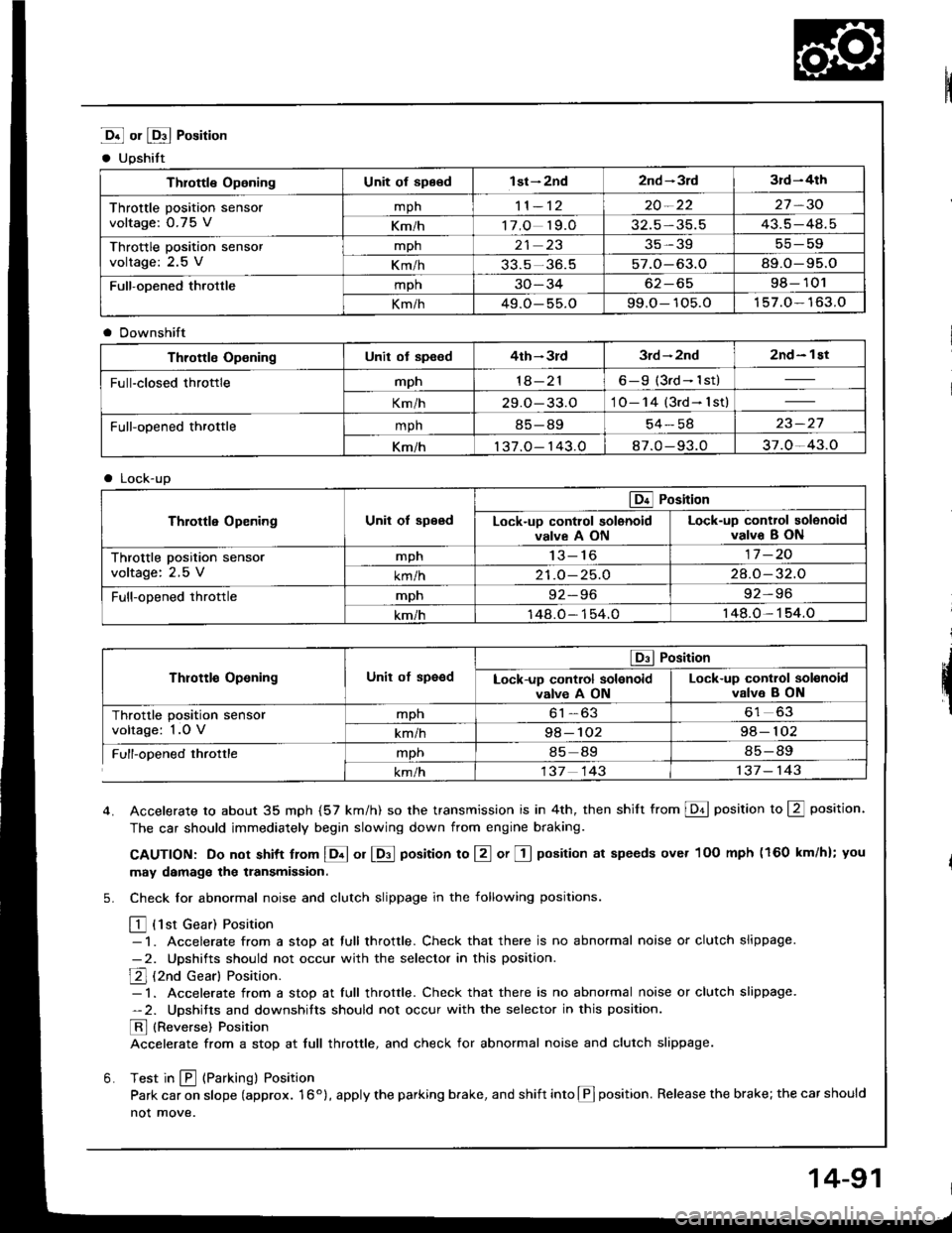
Throftle OpeningUnit of spe6dl st- 2nd2nd-3rd3rd-4th
Throttle position sensorvoltage: O.7 5 V
mph20-2227,30
Km/h17,O 19.O32.5 - 35.543.5-48.5
Throttle position sensorvoltage: 2.5 V
mpn
Km/h33.5 - 36.557.O-63.O89.O-95.O
Full-opened throttlemph30- 3462-6598- 101
Km/h49.O- 55.O99.O- 105.O1 57.O- 163.O
@ or @ Position
. Upshitt
Downshift
LOCK-Up
4. Accelerate to about 35 mph {57 km/h) so the transmission is in 4th, then shift from @ Oosition to E position.
The car should immediately begin slowing down from engine braking.
CAUTION: Do not shift from @ or @ position to @ of E position at speeds over 1OO mph (160 km/h); you
may damage the tlansmission,
5. Check lor abnormal noise and clutch slippage in the following positions.
E (1st Gear) Position- 1 . Accelerate from a stop at full throttle. Check that there is no abno.mal noise or clutch slippage.
-2. Upshifts should not occur with the selector in this position
E (2nd cear) Position.- 1 . Accelerate from a stop at full throttle. Check that there is no abnormal noise or clutch slippage.-2. Upshitts and downshitts should not occur with the selector in this position.
E {Reverse) Position
Accelerate from a stop at full throttle, and check for abnormal noise and clutch slippage.
6. Test in E {Parking) Position
Park car on slope (approx. 1 6o ), apply the parking brake, and shift into LE position. Release the brake; the car should
not move.
i
Throttle Op€ningUnit ot speed4th- 3rd3rd - 2nd2nd- l Et
Full-closed throttlemph1a-216-g (3rd- 1st)
Km/h29.O-33.O1O- 14 (3rd- lst)
Full-opened throttlemph85-8954- 5823-27
Km/h1 37.O- 143.08 7.0 - 93.037.0-43.O
Throttle OpeningUnit of speed
@ Position
Lock-uo control solenoidvalve A ON
Lock-up control solenoidvalve B ON
Throttle position sensorvoltage: 2,5 V
mpntJ- to17 -20
km/h21.O- 25.O2A.O-32.O
Full-opened throttlempn92-9692-96
km/h148.O - 1 54.0r 48.0,1 54.O
Throttlo OpeningUnit of sp6edE Position
Lock-up control solenoidvalve A ON
Lock-up control sol€noidvalv6 B ON
Throttle position sensorvoltage: 1.O Vmphb|-oJ61 63
kmih98- 10298- 102
Full-opened throttlemph85 8985-89
km/h137 143137 - 143
14-91
Page 484 of 1413
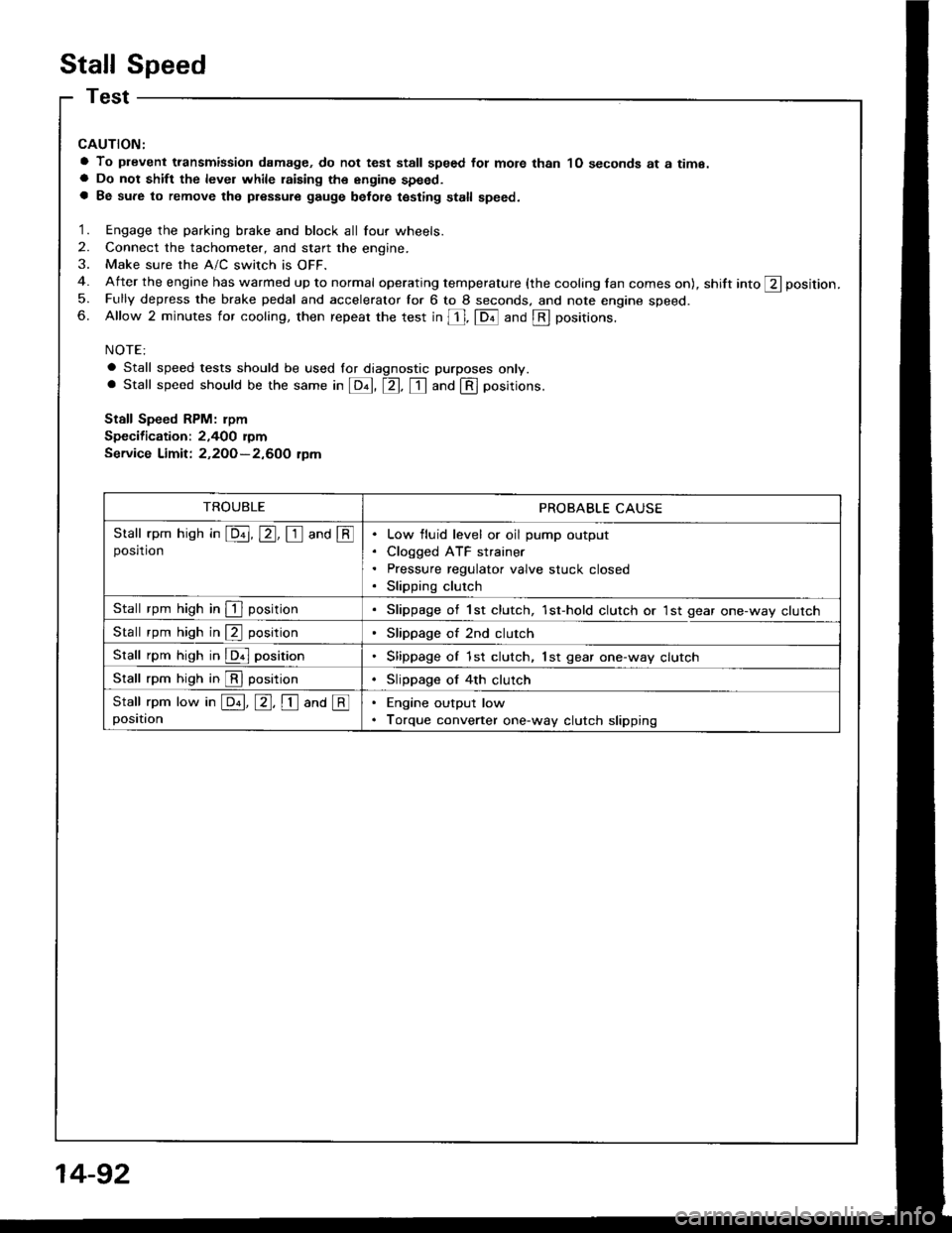
Stall Speed
CAUTION:
a To plevent transmission damage, do not test stall speed fot mote than 1O seconds at a time.a Do not shift the level while raising th€ engine speed.a Be sure to remove the pressure gauge belot€ testing stall speed.
1. Engage the parking brake and block all four wheels.
2. Connect the tachometer, and start the engine.
3. Make sure the A/C switch is OFF.
4. After the engine has warmed up to normal operating temperature (the cooling lan comes on), shift into ft position.
5. Fully depress the brake pedal and accelerator for 6 to 8 seconds. and note engine speed.6. Allow 2 minutes for cooling, then repeat the test in [, fDil and @ positions.
NOTE:
a Stall speed tests should be used lor diagnostic purposes only.. Stall speed should be the same in E, tr. tr and @ positions.
Stall Speed RPM: rpm
Specification: 2,400 rymService Limit: 2,2OO-2,600 tpm
TROUBLEPROBABLE CAUSE
Stall rpm hish in E, E, I and @posrtronLow fluid level or oil pump output
Cloqged ATF strainer
Pressure regulator valve stuck closed
Slipping clutch
Stall rpm high in I positionSlippage of 1st clutch, 1st-hold clutch or 1st gear one-way clutch
Stall rpm high in @ positionSlippage of 2nd clutch
Stall rpm high in @ positionSlippage of 1st clutch, lst gear one-way clutch
Stall rpm high in @ positionSlippage of 4th clutch
Stall rpm low in E, E, I ana @positionEngine output low
Torque converter one-way clutch slipping
14-92
Page 486 of 1413
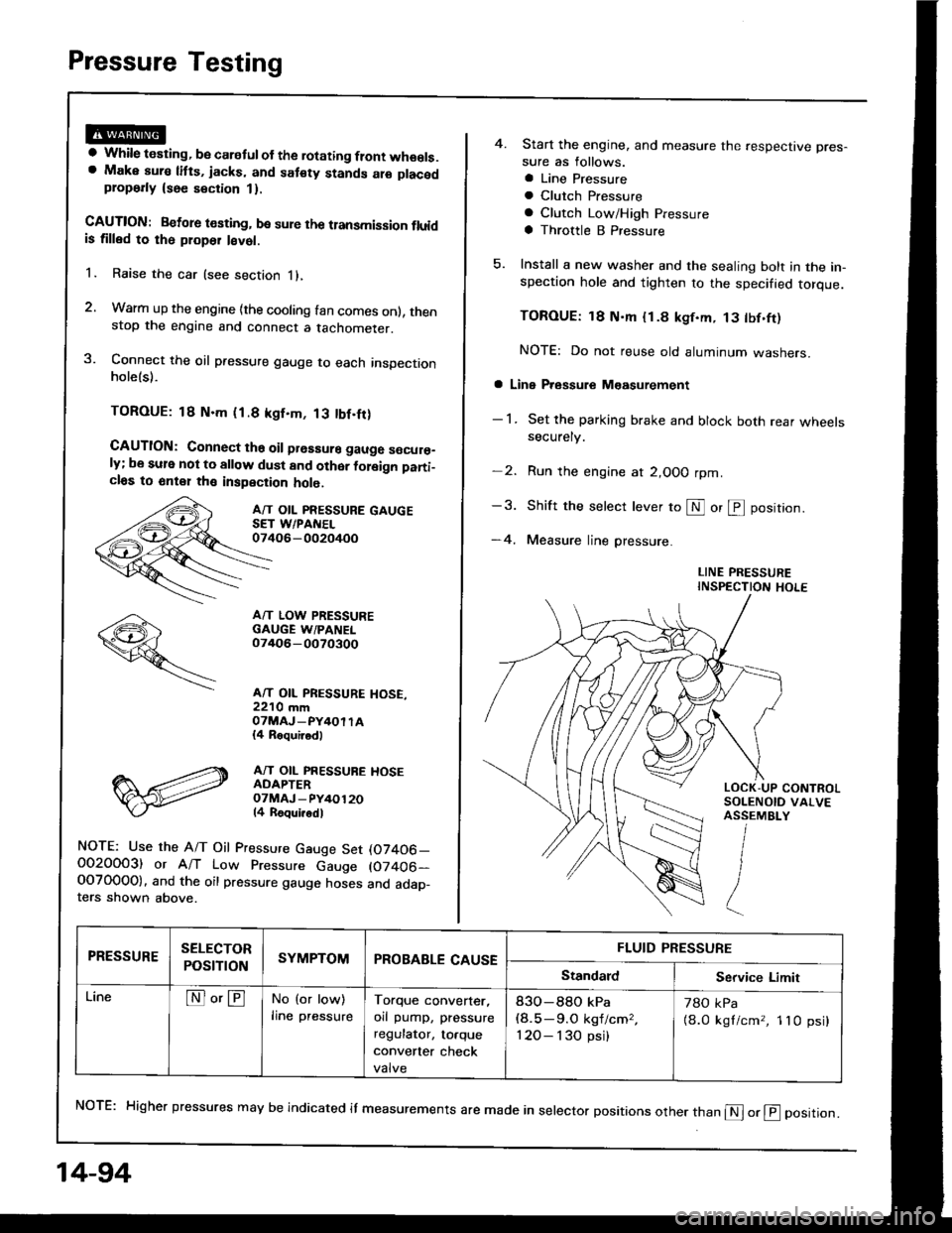
Pressure Testing
a While testing, be caretul of the rotating flont wheels.a Make aura litts, jacks, and sat€ty stands alo placedplop6rly {see section 1}.
CAUTION: Betore t€sting, be sure the transmission fluidis tilled to rh6 ploper l€vet.
1. Raise the car (see section i),
2. Warm up the engine {the cooling fan comes onl, thenstop the engine and connect a tachometer.
3. Connect the oil pressure gauge to each inspectionholels).
TOROUE: 18 N.m (1.8 kgf.m, 13 tbf.fr)
CAUTION: Connect ths oil prsssure gauge s€cur€_ly; be sule not to allow dust and other foleign pani_cl6s to 6nt€1 th€ inspection holo.
A/T OIL PRESSURE GAUGESET WPANEL07406-002oi+oo
A/T LOW PRESSUREGAUGE W/PANEL07/rO6-0O70300
A/T OIL PRESSURE HOSE,22'10 mmOTMAJ_PY4OI TA{4 Roquirod)
A/T OIL PRESSUBE HOSEADAPTEROTMAJ - PY/+O12014 Roqui.odl
NOTE: Use the A/T Oil Pressure Gauge Set (07406_O02OOO3) or A/T Low Pressure Gauge (07406-OOTO0OO). and the oil pressure gauge hoses and adap_ters shown above.
14-94
4. Start the engine, and measure the respective pres-
sure as follows.
a Line Pressure
a Clutch Pfessure
a Clutch Low/High Pressure
a Throttle B Pressure
5. Install a new washer and the sealing bolt in the in-spection hole and tighten to the specified torque.
TOROUE: 18 N'm {1.8 kgf.m, 13 tbf.ft)
NOTE: Do not reuse old aluminum washers.
a Line Pressure M€asurement
- 1 . Set the parking brake and block both rear wheelssecurely.
-2. Run the engine at 2,OOO rpm
-3. Shift the selecr lever to S or @ position.
-4. Measure line pressure.
LINE PRESSUREINSPECTION HOLE
NoTE: Higher pressures may be indicated it measurements are made in selector positions other than @ or @ position.
PRESSURESELECTOR
POStTTONSYMPTOMPROBABLE CAUSEFLUID PRESSURE
StandardService Limit
LineNo'ENo (or low)
lrne pressureTorque converter,
orl pump, pressure
regulator, to.que
convener check
valve
83O-88O kPa(8.5-9.O kgf/cm,,
120- I 30 psi)
78O kPa
{8.0 kgl/cm,, 1lO psi}
Page 487 of 1413
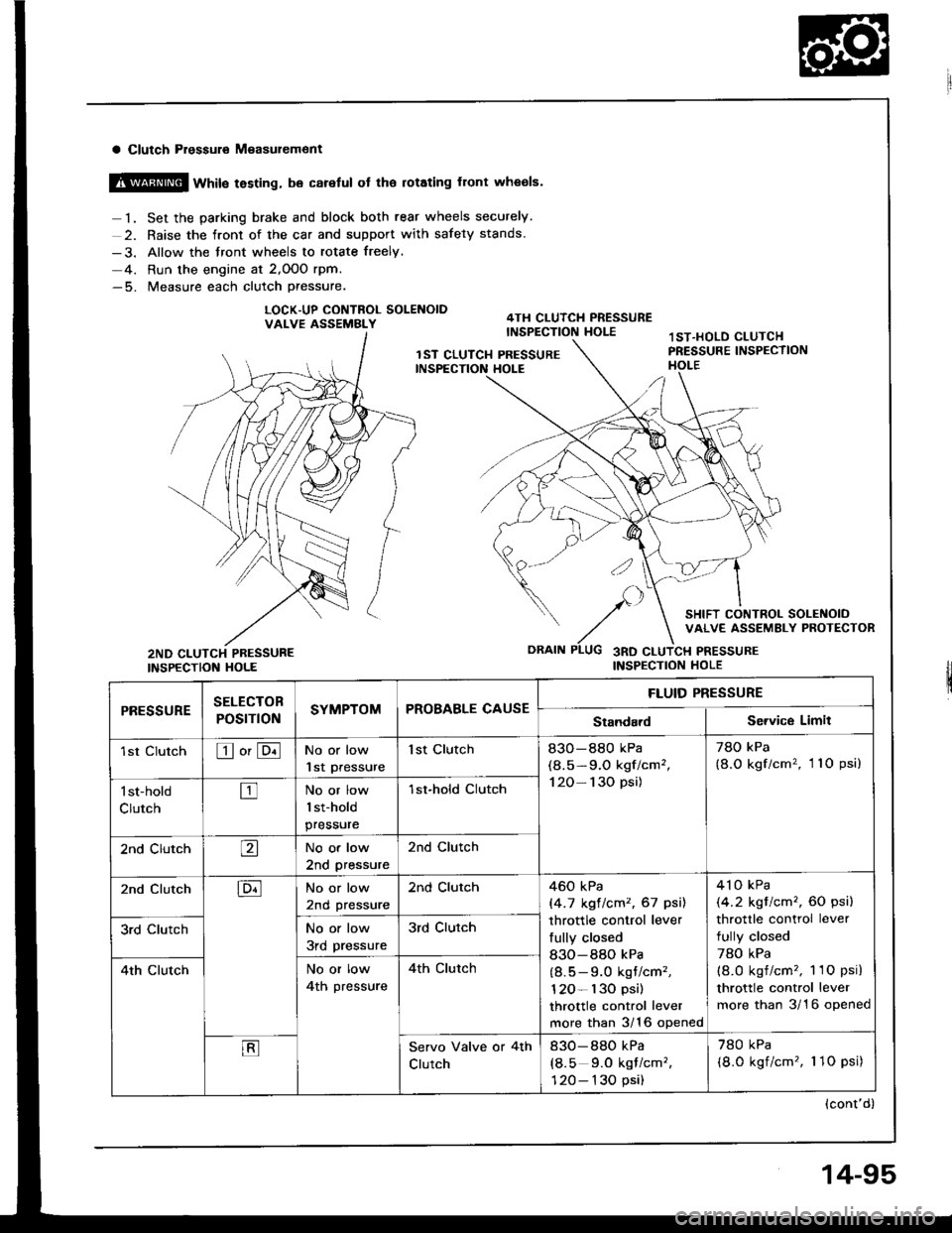
a Clutch Pressuro M€asur€ment
@ wtit" testing, be careful ot the rotating front wheols.
1. Set the parking brake and block both rear wheels securely.
2. Raise the front of the car and support with safety stands.
-3. Allow the front wheels to rotate freely,
-4. Run the engine at 2,OOO rpm.-5. Measure each clutch Pressure.
LOCK.UP CONTNOL SOLENOIDVALVE ASSEMBLY
INSPECTION HOLE
SELECTOB
POST ONSYMPTOMPROBABLE CAUSE
FLUID PRESSURE
rl|E!!UltEStandardService Limit
1st ClutchEo'ENo or low
lst Pressure
1st Clutch83O-880 kPa
(8.5-9.O kgf/cm',
120- 130 psi)
78O kPa
{8.O kgf/cm', 11O psi)
l st-hold
ClutchtrNo or low
1st-hold
pressure
1st-hold CIutch
2nd ClutchaNo or low
2nd pressure
2nd Clutch
2nd ClutchENo or low
2nd pressure
2nd Clutch460 kPa
|'4.7 kgt lcm2, 67 psil
throttle control lever
fully closed
830-880 kPa
(8.5 - 9.0 kgt/cm',
120- l30 psi)
throttle control lever
more than 3/16 opened
4'l o kPa
(4.2 kgt/cm', 60 psi)
throttle control lever
fully closed
78O kPa(8.O kgf/cm', 1 1O psi)
throttle control lever
more than 3/16 opened
3rd ClutchNo or low
3rd pressure
3rd Clutch
4th ClutchNo or low
4th pressure
4th clutch
EServo Valve or 4th
Clutch
830-880 kPa
(8.5 9.0 kqf/cm',
120- 130 psi)
780 kPa
(8.0 kgf/cm', 1 1O psi)
(cont'd)
14-95