ABS HONDA ODYSSEY 1995 User Guide
[x] Cancel search | Manufacturer: HONDA, Model Year: 1995, Model line: ODYSSEY, Model: HONDA ODYSSEY 1995Pages: 240, PDF Size: 2.44 MB
Page 172 of 240
Tires
It is best to replace all four tires at
the same time. If that is not possible
or necessary, then replace the two
front tires or the two rear tires as a
pair. Replacing just one tire can seriously affect your car's handling.
The ABS works by comparing the speed of the wheels. When replacing
tires, use the same size originally supplied with the car. Tire size and
construction can affect wheel speed
and may cause the system to work in-
consistently. If you ever need to replace a wheel,
make sure the wheel's specifications
match those of the original wheel
that came on your car. Replacement
wheels are available at your Honda
dealer.
Wheels and Tires Wheel:15 x 6JJ
Tire:
P205/65R15 92S
See Tire Information on page 221 for
additional information about tire and
wheel size designations. See page 222 for information about DOT Tire
Quality Grading.
Winter Driving
Tires that are marked "M + S" or
"All Season" on the sidewall have an
all-weather tread design. Theyshould be suitable for most winter
driving conditions. Tires without
these markings are designed for optimum traction in dry conditions.
They may not provide adequate performance in winter driving.
For the best performance in snowyor icy conditions, you should install
snow tires or tire chains. They may
be required by local laws under
certain conditions.
CONTINUED
Maintenance
installing improper tires on your
car can affect handling and
stability. This can cause a crash in which you can be seriously
hurt or killed.
Always use the size and type of
tires recommended in this owner's manual.
ProCarManuals.comMain Menu Table of Contents s t
Page 176 of 240
Lights
Replacing a Headlight Bulb
Your car has halogen headlight bulbs, one on each side. Whenreplacing a bulb, handle it by its steel
base and protect the glass from
contact with your skin or hardobjects. If you touch the glass, clean
it with denatured alcohol and a clean
cloth.
Halogen headlight bulbs get very hot
when lit. Oil, perspiration, or a scratch
on the glass can cause the bulb to
overheat and shatter.
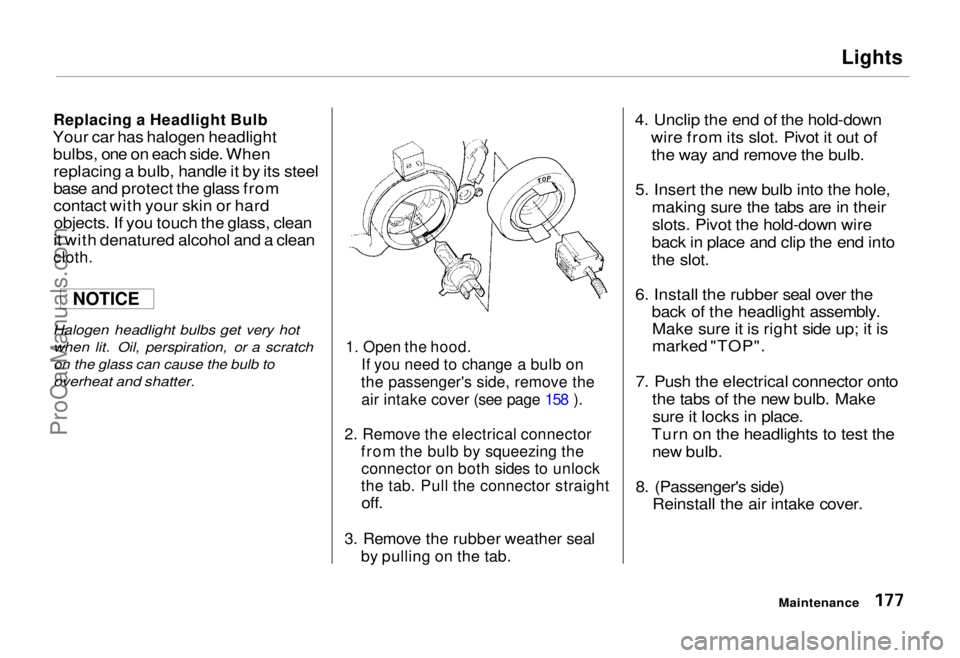
1. Open the hood.
If you need to change a bulb on
the passenger's side, remove the
air intake cover (see page 158 ).
2. Remove the electrical connector from the bulb by squeezing the
connector on both sides to unlock
the tab. Pull the connector straight
off.
3. Remove the rubber weather seal
by pulling on the tab.
4. Unclip the end of the hold-down
wire from its slot. Pivot it out ofthe way and remove the bulb.
5. Insert the new bulb into the hole, making sure the tabs are in theirslots. Pivot the hold-down wire
back in place and clip the end into
the slot.
6. Install the rubber seal over the back of the headlight assembly.Make sure it is right side up; it is
marked "TOP".
7. Push the electrical connector onto the tabs of the new bulb. Makesure it locks in place.
Turn on the headlights to test the new bulb.
8. (Passenger's side) Reinstall the air intake cover.
Maintenance
NOTICEProCarManuals.comMain Menu Table of Contents s t
Page 177 of 240
Lights
Replacing the Front Side Marker/
Turn Signal and Parking Light Bulb
SCREW
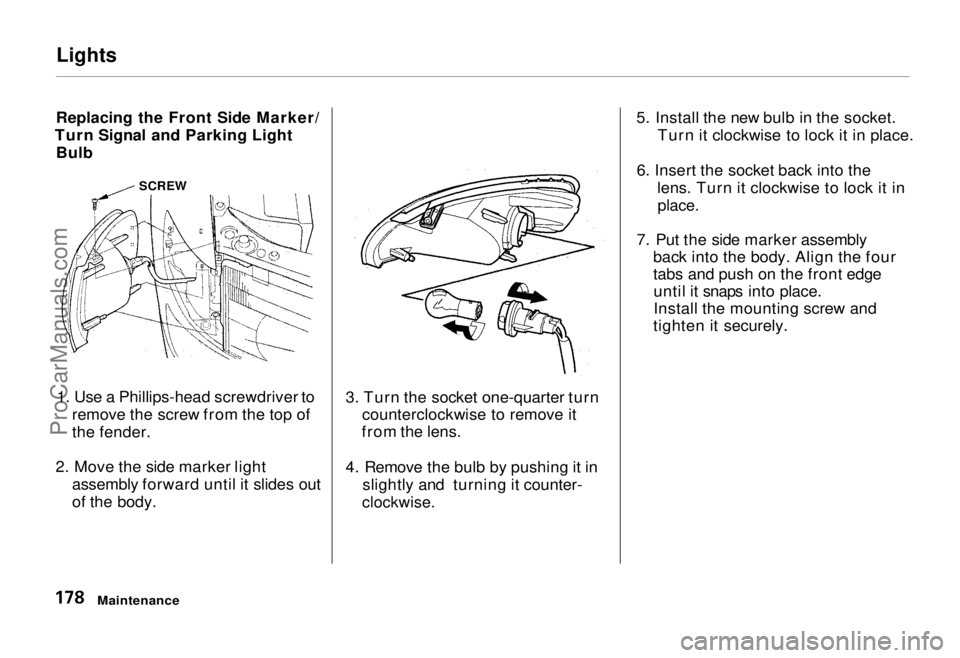
1. Use a Phillips-head screwdriver to remove the screw from the top of
the fender.
2. Move the side marker light assembly forward until it slides out
of the body. 3. Turn the socket one-quarter turn
counterclockwise to remove it
from the lens.
4. Remove the bulb by pushing it in slightly and turning it counter-
clockwise.
5. Install the new bulb in the socket.
Turn it clockwise to lock it in place.
6. Insert the socket back into the lens. Turn it clockwise to lock it in
place.
7. Put the side marker assembly back into the body. Align the four
tabs and push on the front edgeuntil it snaps into place.
Install the mounting screw and
tighten it securely.
MaintenanceProCarManuals.comMain Menu Table of Contents s t
Page 180 of 240
Lights
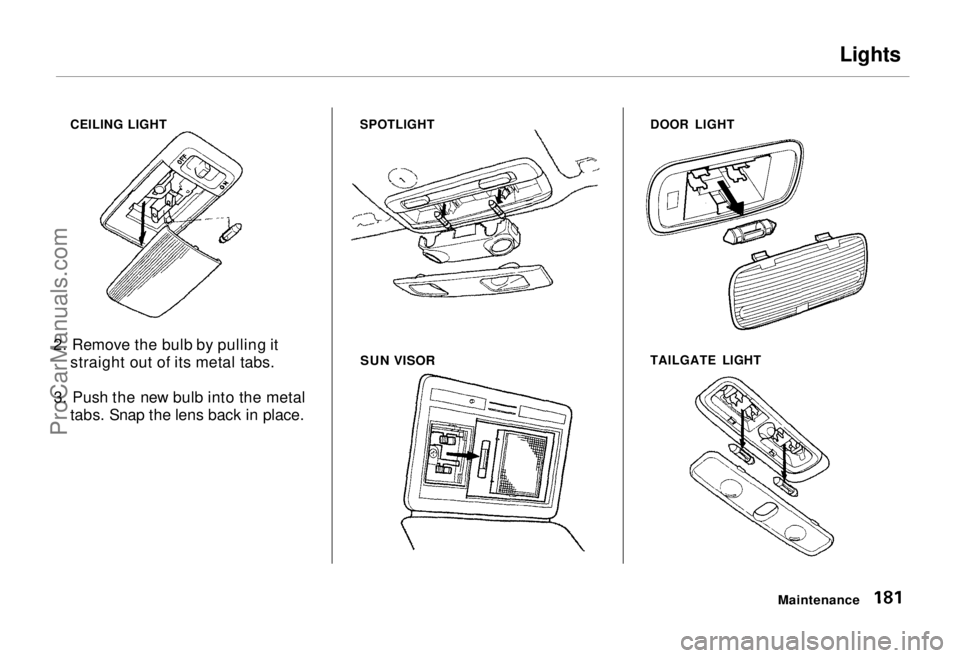
CEILING LIGHT SPOTLIGHT
2. Remove the bulb by pulling it straight out of its metal tabs.
3. Push the new bulb into the metal tabs. Snap the lens back in place.
SUN VISOR
DOOR LIGHT
TAILGATE LIGHT
MaintenanceProCarManuals.comMain Menu Table of Contents s t
Page 188 of 240
Corrosion Protection
Two factors normally contribute to causing corrosion in your car:
1. Moisture trapped in body cavities. Dirt and road salt that collects in
hollows on the underside of the car stays damp, promoting
corrosion in that area.
2. Removal of paint and protective coatings from the exterior and
underside of the car. Many corrosion-preventive measures
are built into your Honda. You can
help keep your car from corroding
by performing some simple periodic
maintenance:
Repair chips and scratches in the
paint as soon as you discover them.
Inspect and clean out the drain
holes in the bottom of the doors and body.
Check the floor coverings for
dampness. Carpeting and floor
mats may remain damp for a long
time, especially in winter. This dampness can eventually cause
the floor panels to corrode. Use a high-pressure spray to clean
the underside of your car. This is especially important in areas that
use road salt in winter. It is also a
good idea in humid climates and areas subject to salt air. Cars
equipped with ABS have a sensor and wiring at each wheel. Be
careful not to damage them.
Have the corrosion-preventive
coatings on the underside of your
car inspected and repaired
periodically.
Appearance CareProCarManuals.comMain Menu Table of Contents s t
Page 208 of 240
Fuses
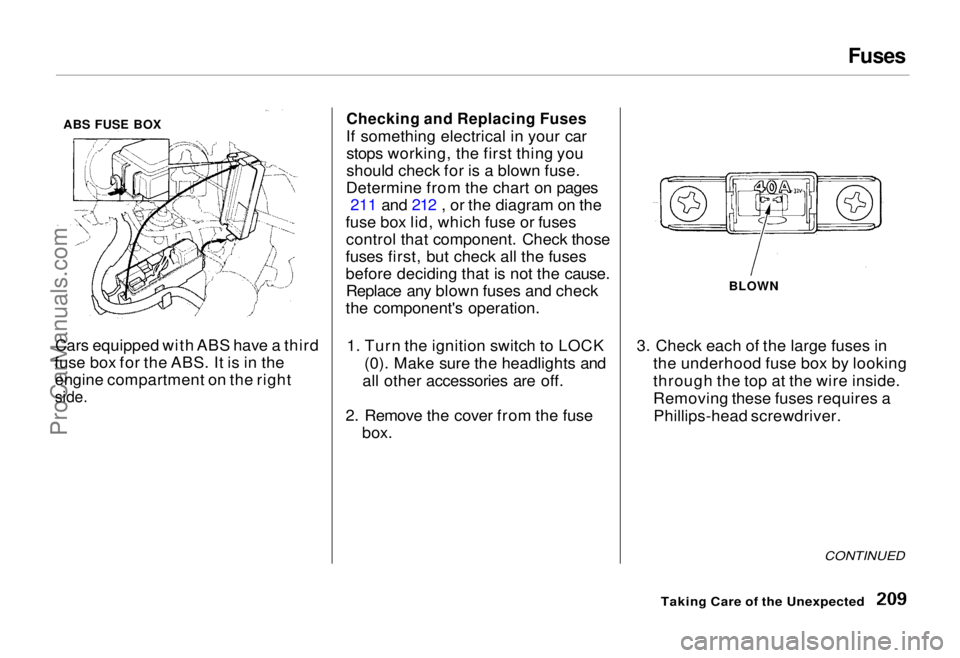
Cars equipped with ABS have a third
fuse box for the ABS. It is in the engine compartment on the right
side.
Checking and Replacing Fuses
If something electrical in your car stops working, the first thing you
should check for is a blown fuse.
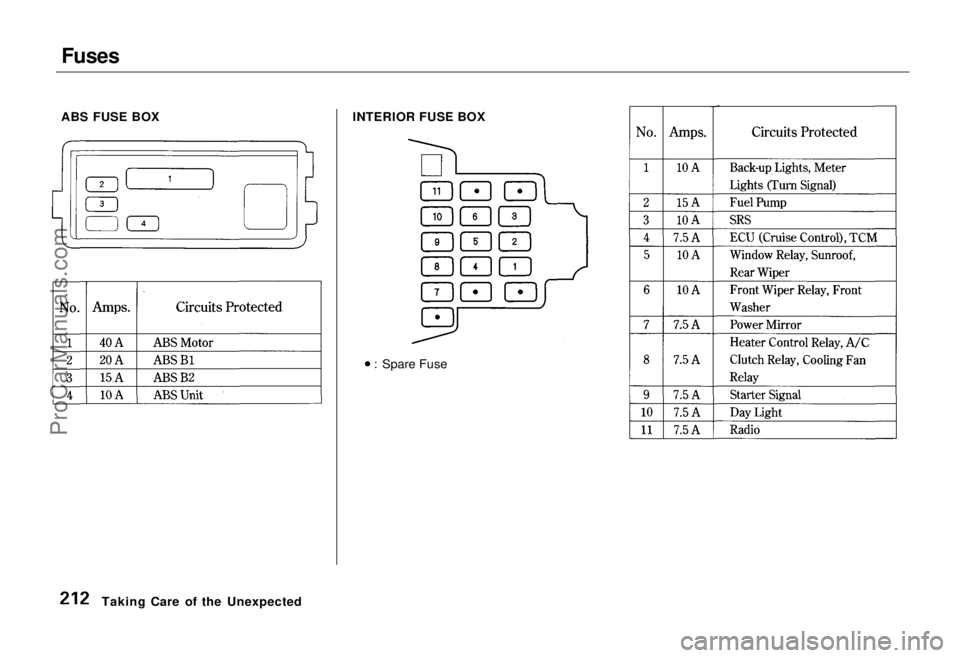
Determine from the chart on pages 211 and 212 , or the diagram on the
fuse box lid, which fuse or fuses control that component. Check those
fuses first, but check all the fuses
before deciding that is not the cause. Replace any blown fuses and check
the component's operation.
1. Turn the ignition switch to LOCK (0). Make sure the headlights and
all other accessories are off.
2. Remove the cover from the fuse box. 3. Check each of the large fuses in
the underhood fuse box by looking
through the top at the wire inside.
Removing these fuses requires aPhillips-head screwdriver.
CONTINUED
Taking Care of the Unexpected
BLOWN
ABS FUSE BOXProCarManuals.comMain Menu Table of Contents s t
Page 211 of 240
Fuses
ABS FUSE BOX INTERIOR FUSE BOX
: Spare Fuse
Taking Care of the UnexpectedProCarManuals.comMain Menu Table of Contents s t
Page 218 of 240
Anti-lock Brake System
The Anti-lock Brake System (ABS) is standard equipment on all U.S.
models and the Canadian six-
passenger model. It is optional on the
Canadian seven-passenger model.
The ABS works by measuring how fast the wheels are turning during
braking and comparing their speed.
If any wheel is rotating much slower
than the others (on the verge of
locking up and skidding), the system reduces hydraulic pressure to that
wheel's brake caliper. When that
wheel's speed matches the other
wheels, the system applies normal hydraulic pressure. This can take
place several times per second ateach wheel. You feel the ABS
working as rapid pulsations in the
brake pedal.
Each wheel has a wheel speed
sensor assembly. As the wheel
rotates, the sensor sends electrical
pulses to the ABS control unit. The
pulse frequency varies with the
wheel speed.
The electrical output of the ABS control unit is connected to the
modulator/solenoid unit. During
braking, the ABS control unit monitors the pulse frequencies from
the four wheels. When the control unit detects a wheel locking up, it
energizes the appropriate solenoid in
the modulator/solenoid unit. Thereare six solenoids: two for each front
wheel, and two for the rear wheels.
The energized solenoid reduces hydraulic pressure to one side of amodulator valve. This, in turn,
reduces hydraulic pressure in the
brake line going to the affected
wheel. When that wheel speeds up because of the reduced braking
effort, the control unit de-energizes the solenoid. This builds hydraulic
pressure on the modulator valve.
The pressure increases in the hydraulic line to the wheel.
For the system to react quickly, the
modulator/solenoid unit must have
brake fluid under high pressure.
This is supplied by a piston-type accumulator that is pressurized by
an electric pump. A pressure-sensingswitch on the accumulator controls
this pump.
The control unit also contains error detection circuitry. It monitors the
operation of the wheel sensors,
solenoids, pump, and electronics. If
the control unit detects any faults, it shuts off power to the pump motor
and solenoids. The light on the
instrument panel comes on. The
brakes then work like a conventional system without anti-lock capabilities.
Technical InformationProCarManuals.comMain Menu Table of Contents s t
Page 232 of 240
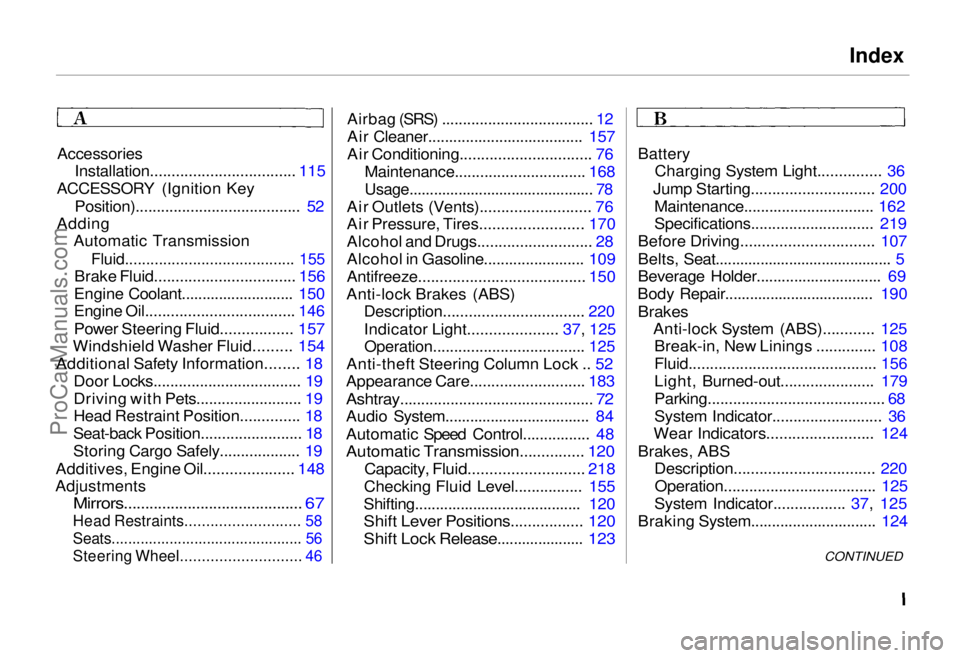
Index
Accessories
Installation.................................. 115
ACCESSORY (Ignition Key
Position)....................................... 52
Adding Automatic Transmission
Fluid........................................ 155
Brake Fluid................................. 156
Engine Coolant........................... 150
Engine Oil................................... 146
Power Steering Fluid................. 157
Windshield Washer Fluid......... 154
Additional Safety Information........ 18 Door Locks................................... 19
Driving with Pets......................... 19
Head Restraint Position.............. 18
Seat-back Position........................ 18
Storing Cargo Safely................... 19
Additives, Engine Oil..................... 148
Adjustments
Mirrors.......................................... 67
Head Restraints........................... 58
Seats.............................................. 56
Steering Wheel............................ 46
Airbag (SRS) .................................... 12
Air Cleaner..................................... 157
Air Conditioning............................... 76
Maintenance............................... 168
Usage............................................. 78
Air Outlets (Vents).......................... 76
Air Pressure, Tires........................ 170
Alcohol and Drugs........................... 28
Alcohol in Gasoline........................ 109
Antifreeze....................................... 150
Anti-lock Brakes (ABS)
Description................................. 220
Indicator Light..................... 37, 125
Operation.................................... 125
Anti-theft Steering Column Lock .. 52
Appearance Care........................... 183
Ashtray.............................................. 72
Audio System................................... 84
Automatic Speed Control................ 48
Automatic Transmission............... 120
Capacity, Fluid........................... 218
Checking Fluid Level................ 155
Shifting........................................ 120
Shift Lever Positions................. 120
Shift Lock Release..................... 123
Battery
Charging System Light............... 36
Jump Starting............................. 200 Maintenance............................... 162
Specifications............................. 219
Before Driving............................... 107
Belts, Seat........................................... 5
Beverage Holder.............................. 69
Body Repair.................................... 190
Brakes
Anti-lock System (ABS)............ 125Break-in, New Linings .............. 108
Fluid............................................ 156
Light, Burned-out...................... 179
Parking.......................................... 68
System Indicator.......................... 36
Wear Indicators......................... 124
Brakes, ABS Description................................. 220
Operation.................................... 125
System Indicator................. 37, 125
Braking System.............................. 124
CONTINUEDProCarManuals.comMain Menu s t Main Menu s t