ABS HONDA ODYSSEY 1995 Owners Manual
[x] Cancel search | Manufacturer: HONDA, Model Year: 1995, Model line: ODYSSEY, Model: HONDA ODYSSEY 1995Pages: 240, PDF Size: 2.44 MB
Page 13 of 240
Supplemental Restraint System
Your car is equipped with a Supple- mental Restraint System (SRS) to
help protect the head and chest of the driver and front seat passenger
during a severe frontal collision.
This system does not replace your seat
belts. It supplements, or adds to, the
protection offered by seat belts and
other occupant protection features.
SRS Components
Your supplemental restraint system
includes:
One airbag in the steering wheelfor the driver and another in thedashboard for the passenger.
Sensors that can detect a severe frontal collision.
A sophisticated electronic system that continually monitors thesensors, control unit, airbag
activators, and all related wiring
when the ignition is ON (II).
An indicator light on the instru- ment panel to alert you to a possi-
ble problem with the system.
Emergency backup power in case your car's electrical system isdisconnected in a crash. What Happens In a Crash
If you ever have a severe frontal
collision, the sensors will detect
rapid deceleration and signal the control unit to instantly inflate the
airbags.
During a crash, your seat belts will
help to restrain your lower body and
torso. The airbags will provide a cushion to absorb crash energy and
help keep the head and chest of thedriver and front passenger fromstriking the interior of the car.
After inflating, the airbags will immediately deflate. The entire
process, from detection to deflation,
takes a fraction of a second. This process occurs so quickly that you
may not hear the loud noise created
by the airbag inflators, or realize
what has happened.
Driver and Passenger Safety
Not wearing a seat belt
increases the chance of serious
injury or death in a crash, even
if you have airbags.
Be sure you and your
passengers always wear seat
belts and wear them properly.ProCarManuals.comMain Menu Table of Contents s t
Page 14 of 240
Supplemental Restraint System
After the crash, you may see what looks like smoke. This is actually
powder from the airbag's surface. People with respiratory problems
may experience some temporary
discomfort from the chemicals used
by the airbag's activators.
Important Facts About Airbags
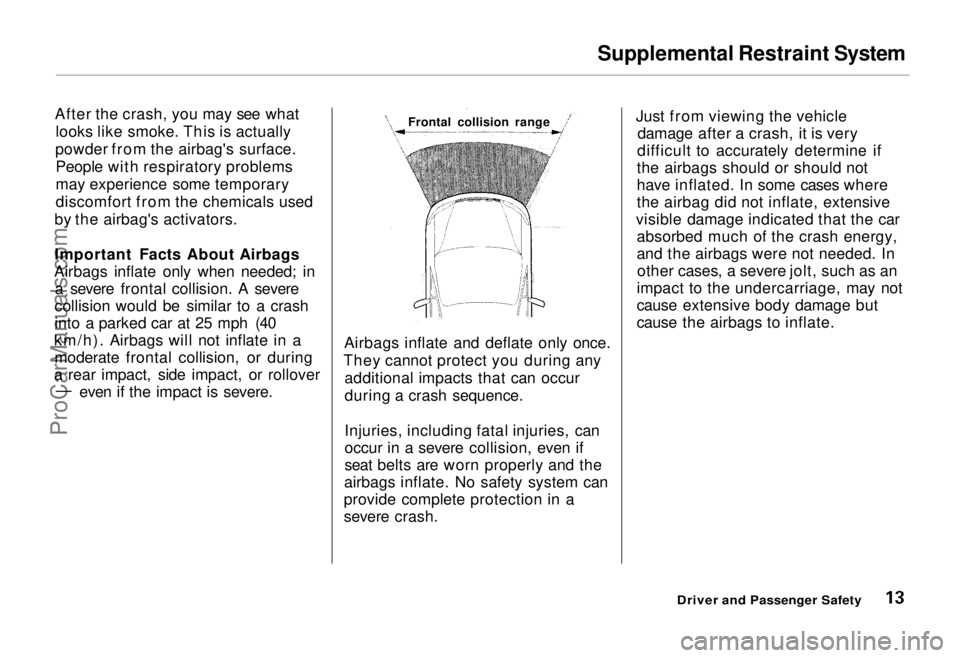
Airbags inflate only when needed; in a severe frontal collision. A severe
collision would be similar to a crash
into a parked car at 25 mph (40
km/h). Airbags will not inflate in a moderate frontal collision, or during
a rear impact, side impact, or rollover — even if the impact is severe. Airbags inflate and deflate only once.
They cannot protect you during any additional impacts that can occur
during a crash sequence.
Injuries, including fatal injuries, can
occur in a severe collision, even if
seat belts are worn properly and the
airbags inflate. No safety system can
provide complete protection in a
severe crash. Just from viewing the vehicle
damage after a crash, it is very
difficult to accurately determine if
the airbags should or should not
have inflated. In some cases where
the airbag did not inflate, extensive
visible damage indicated that the car absorbed much of the crash energy,
and the airbags were not needed. Inother cases, a severe jolt, such as an
impact to the undercarriage, may not
cause extensive body damage but
cause the airbags to inflate.
Driver and Passenger Safety
Frontal collision rangeProCarManuals.comMain Menu Table of Contents s t
Page 37 of 240
Indicator Lights
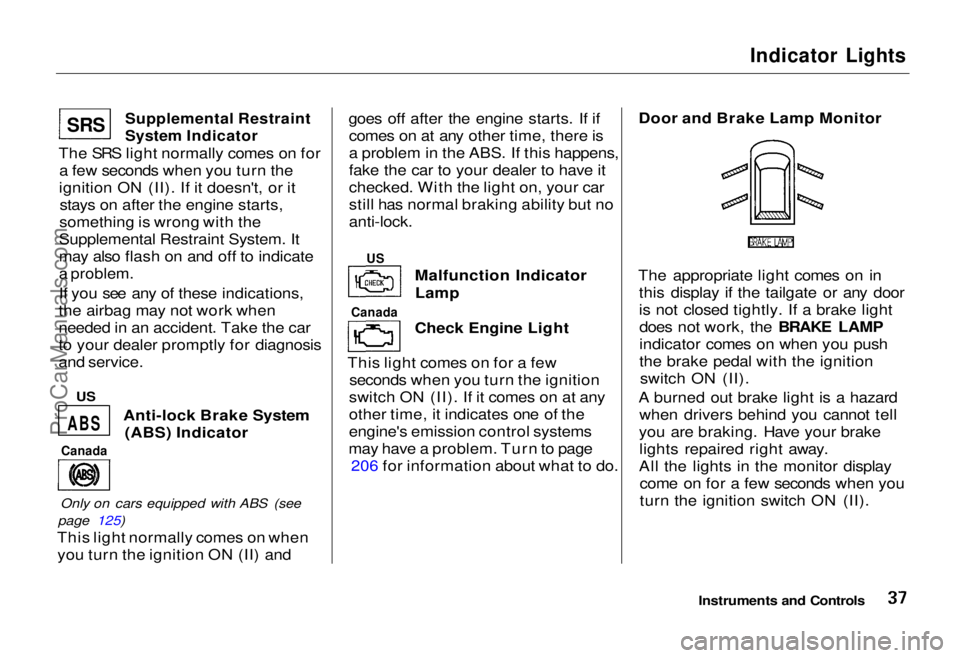
Supplemental Restraint
System Indicator
The SRS light normally comes on for a few seconds when you turn the
ignition ON (II). If it doesn't, or it stays on after the engine starts,
something is wrong with the
Supplemental Restraint System. It
may also flash on and off to indicate
a problem.
If you see any of these indications,
the airbag may not work when
needed in an accident. Take the car
to your dealer promptly for diagnosis
and service.
Anti-lock Brake System(ABS) Indicator
Only on cars equipped with ABS (see
page 125)
This light normally comes on when you turn the ignition ON (II) and goes off after the engine starts. If if
comes on at any other time, there is
a problem in the ABS. If this happens,
fake the car to your dealer to have it
checked. With the light on, your car
still has normal braking ability but no
anti-lock.
Malfunction IndicatorLamp
Check Engine Light
This light comes on for a few seconds when you turn the ignition
switch ON (II). If it comes on at any
other time, it indicates one of the
engine's emission control systems
may have a problem. Turn to page 206 for information about what to do. Door and Brake Lamp Monitor
The appropriate light comes on in this display if the tailgate or any door
is not closed tightly. If a brake lightdoes not work, the BRAKE LAMP
indicator comes on when you push
the brake pedal with the ignition switch ON (II).
A burned out brake light is a hazard when drivers behind you cannot tell
you are braking. Have your brake lights repaired right away.
All the lights in the monitor display come on for a few seconds when you
turn the ignition switch ON (II).
Instruments and Controls
Canada
ABS
Canada
US
SR
S
US
ProCarManuals.comMain Menu Table of Contents s t
Page 68 of 240
Parking Brake, Digital Clock
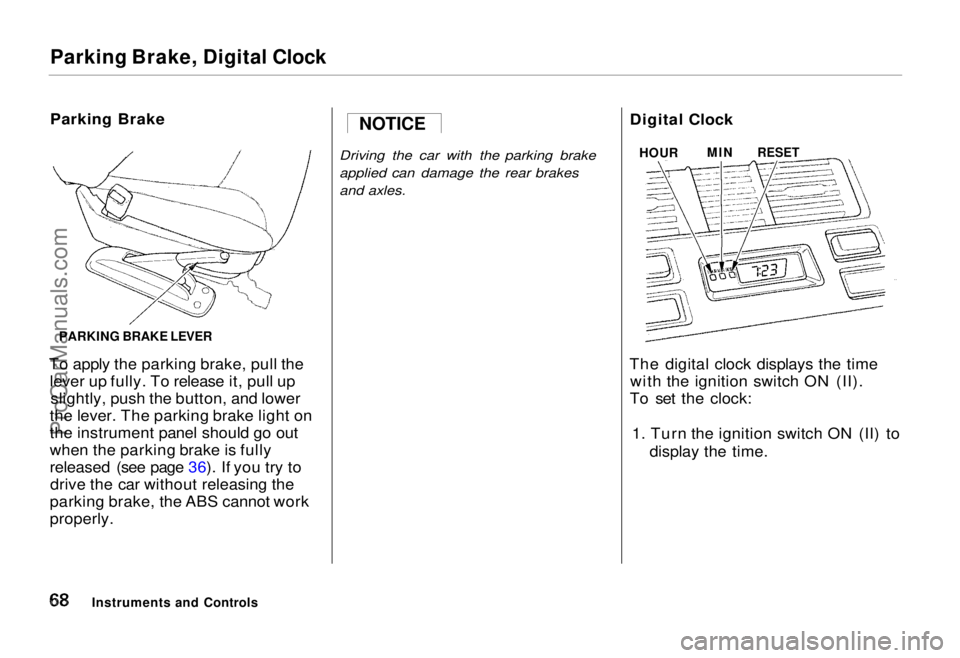
Parking Brake
To apply the parking brake, pull the lever up fully. To release it, pull upslightly, push the button, and lower
the lever. The parking brake light on
the instrument panel should go out
when the parking brake is fully
released (see page 36). If you try to drive the car without releasing the
parking brake, the ABS cannot work
properly.
Driving the car with the parking brake
applied can damage the rear brakes
and axles.
Digital Clock
The digital clock displays the time with the ignition switch ON (II).
To set the clock:
1. Turn the ignition switch ON (II) to display the time.
Instruments and Controls NOTICE
HOUR
MIN
RESET
PARKING BRAKE LEVERProCarManuals.comMain Menu Table of Contents s t
Page 125 of 240
The Braking System
If this happens, you will immediately
notice that the brake pedal goes down much farther and you need to
press on it much harder. A much
longer distance will be needed to stop the car.
Slow the car by downshifting to a
lower gear and removing your foot
from the accelerator pedal. Pull to the side of the road as soon as it issafe. Because of the longer stopping
distance needed, brake system
failure is very hazardous. It is best to
have your car towed, but if you must drive the car in this condition, be
extremely cautious. Have your car
repaired as soon as possible.
Anti-lock Brakes
All U.S. models and the Canadian six-passenger model have an Anti-lockBrake System (ABS) as standard
equipment. It is optional on the
Canadian seven-passenger model.
ABS helps you maintain steering control. It does this by helping you to
prevent the wheels from locking up and skidding.
The ABS is always "On". It requires no special effort or driving technique.
You will feel a pulsation in the brake pedal when the ABS activates.
Activation varies with the amount of traction your tires have. On dry
pavement, you will need to press on
the brake pedal very hard before you
feel the pedal pulsation that means
the ABS has activated. However, youmay feel the ABS activate immedi-
ately if you are trying to stop on
snow or ice. Under all conditions, the
ABS is helping to prevent the wheels from locking so you can retainsteering control. You should con-
tinue to press on the brake pedal
with the same force.
You may feel a slight movement of the brake pedal just after you start
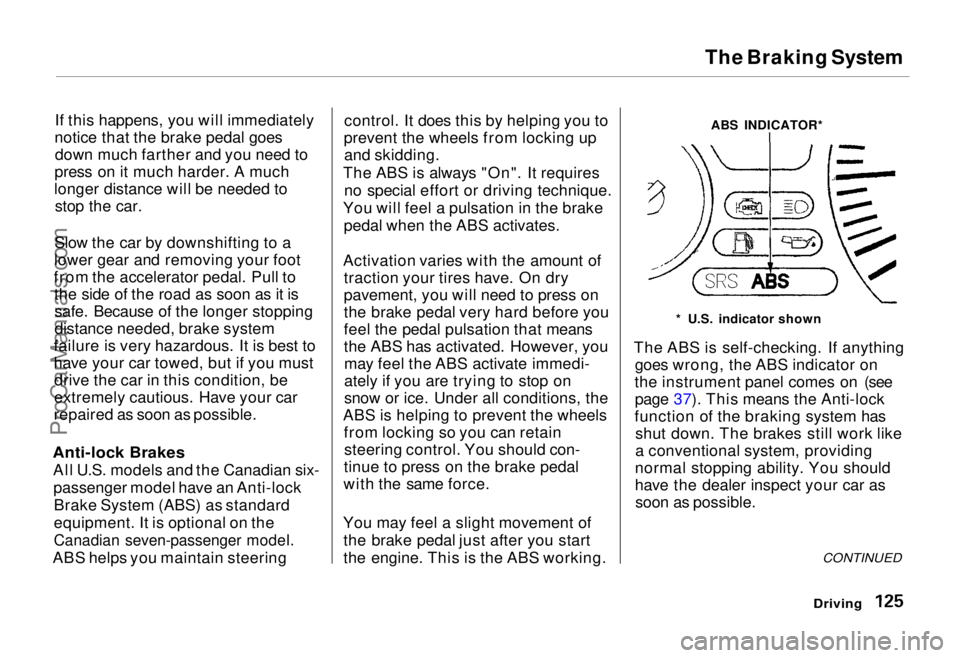
the engine. This is the ABS working. ABS INDICATOR*
* U.S. indicator shown
The ABS is self-checking. If anything goes wrong, the ABS indicator on
the instrument panel comes on (see page 37). This means the Anti-lock
function of the braking system has shut down. The brakes still work like
a conventional system, providing
normal stopping ability. You should
have the dealer inspect your car as soon as possible.
CONTINUED
DrivingProCarManuals.comMain Menu Table of Contents s t
Page 126 of 240
The Braking System, Driving in Bad Weather
A car with ABS may require a longer
distance to stop on loose or uneven
surfaces than an equivalent car with-
out Anti-lock. The ABS cannot make
up for road conditions or bad judg-
ment. It is still your responsibility to
drive at reasonable speeds for
weather and traffic conditions, and to leave a margin of safety.
For a technical description of the
ABS hardware, refer to page 220. Driving in Bad Weather
Rain, fog, and snow conditions re-
quire a different driving technique
because of reduced traction and
visibility. Keep your car well- maintained and exercise greater
caution when you need to drive in
bad weather. The cruise control should not be used in these condi-
tions. Driving Technique — Always drive
slower than you would in dry
weather. It takes your car longer to
react, even in conditions that may seem just barely damp. Apply
smooth, even pressure to all the
controls. Abrupt steering wheel
movements or sudden, hard appli-
cation of the brakes can cause loss of
control in wet weather. Be extra
cautious for the first few miles of driving while you adjust to the
change in driving conditions. This is especially true in snow. A person can
forget some snow-driving techniques during the summer months. Practice
is needed to relearn those skills.
Exercise extra caution when driving
in rain after a long dry spell. After
months of dry weather, the first
rains bring oil to the surface of the
roadway, making it slippery.
DrivingProCarManuals.comMain Menu Table of Contents s t
Page 155 of 240
Brake Fluid
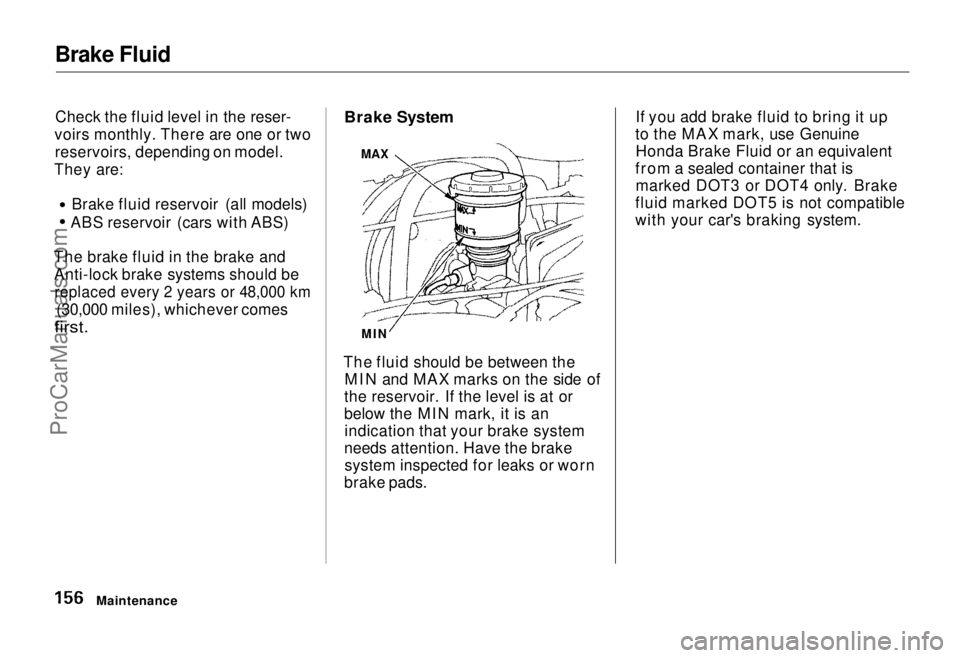
Check the fluid level in the reser-
voirs monthly. There are one or two reservoirs, depending on model.
They are: Brake fluid reservoir (all models)
ABS reservoir (cars with ABS)
The brake fluid in the brake and Anti-lock brake systems should be
replaced every 2 years or 48,000 km
(30,000 miles), whichever comes
first.
Brake System
MAX
MIN
The fluid should be between the MIN and MAX marks on the side of
the reservoir. If the level is at or
below the MIN mark, it is an indication that your brake system
needs attention. Have the brake system inspected for leaks or worn
brake pads. If you add brake fluid to bring it up
to the MAX mark, use Genuine Honda Brake Fluid or an equivalent
from a sealed container that is marked DOT3 or DOT4 only. Brake
fluid marked DOT5 is not compatible
with your car's braking system.
MaintenanceProCarManuals.comMain Menu Table of Contents s t
Page 156 of 240
Brake Fluid, Power Steering
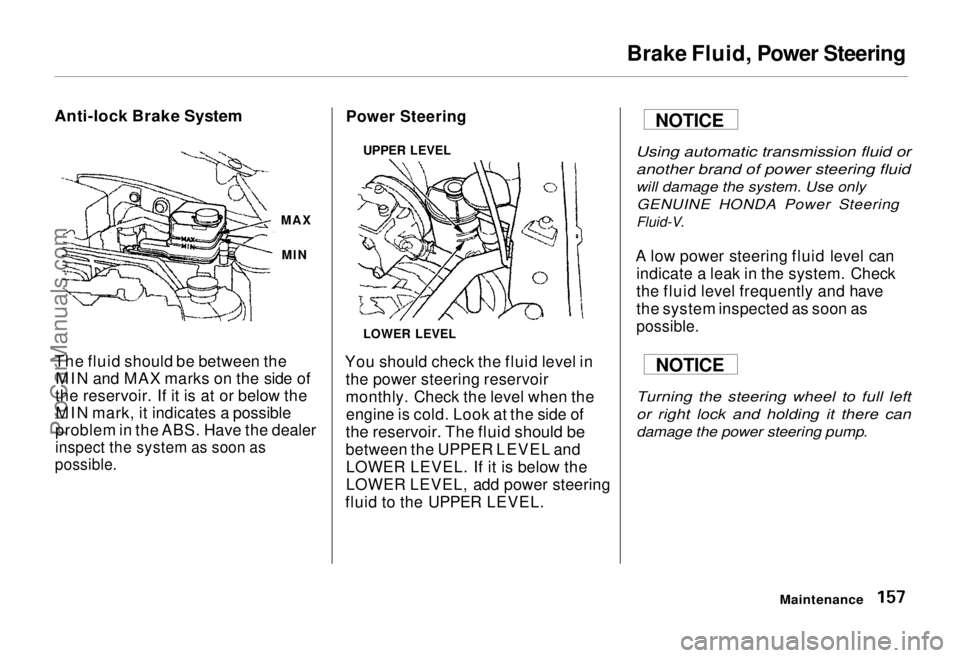
Anti-lock Brake System
The fluid should be between the MIN and MAX marks on the side of
the reservoir. If it is at or below the MIN mark, it indicates a possible
problem in the ABS. Have the dealer
inspect the system as soon as
possible.
Power Steering
You should check the fluid level in the power steering reservoir
monthly. Check the level when theengine is cold. Look at the side of
the reservoir. The fluid should be
between the UPPER LEVEL and LOWER LEVEL. If it is below the
LOWER LEVEL, add power steering
fluid to the UPPER LEVEL. A low power steering fluid level can
indicate a leak in the system. Check
the fluid level frequently and have
the system inspected as soon as
possible.
Maintenance
NOTICETurning the steering wheel to full left
or right lock and holding it there can
damage the power steering pump.
NOTICE
UPPER LEVE
L
MAX MIN
LOWER LEVEL
Using automatic transmission fluid or
another brand of power steering fluid
will damage the system. Use only
GENUINE HONDA Power Steering
Fluid-V.
ProCarManuals.comMain Menu Table of Contents s t
Page 164 of 240
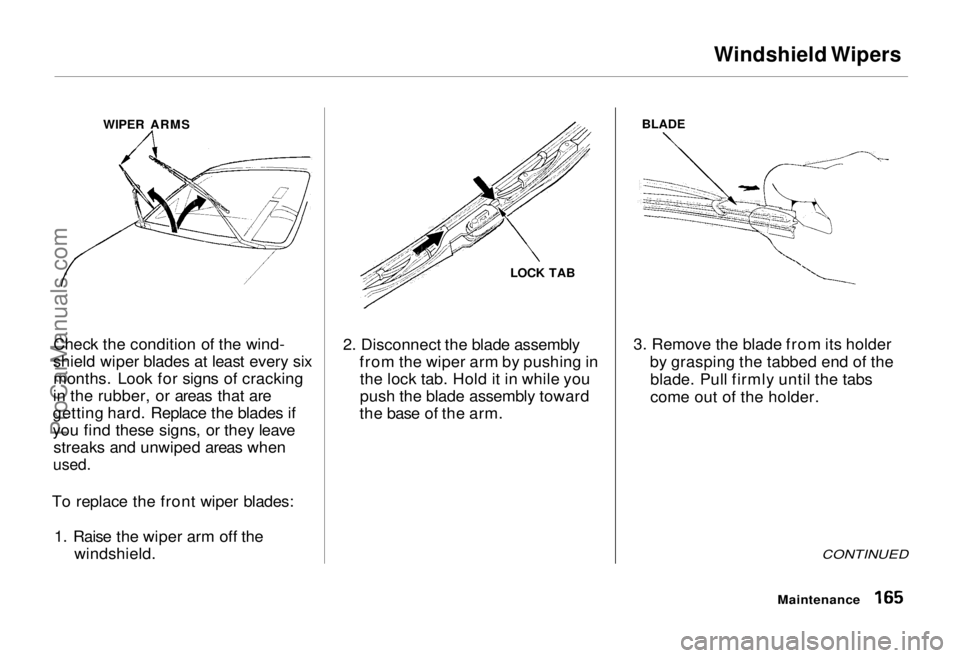
Windshield Wipers
Check the condition of the wind-
shield wiper blades at least every six months. Look for signs of cracking
in the rubber, or areas that are
getting hard. Replace the blades if
you find these signs, or they leave streaks and unwiped areas when
used.
To replace the front wiper blades: 1. Raise the wiper arm off the windshield. 2. Disconnect the blade assembly
from the wiper arm by pushing inthe lock tab. Hold it in while you
push the blade assembly toward
the base of the arm. 3. Remove the blade from its holder
by grasping the tabbed end of theblade. Pull firmly until the tabs
come out of the holder.
CONTINUED
Maintenance
WIPER ARMS
LOCK TABBLADEProCarManuals.comMain Menu Table of Contents s t
Page 165 of 240
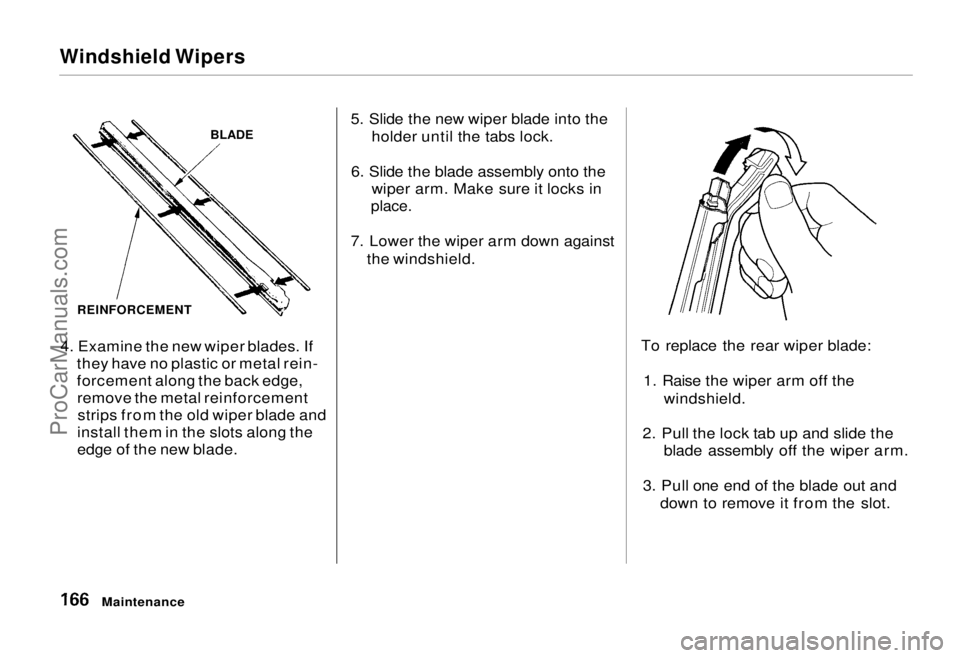
Windshield Wipers
4. Examine the new wiper blades. If they have no plastic or metal rein-
forcement along the back edge,remove the metal reinforcementstrips from the old wiper blade and
install them in the slots along the
edge of the new blade. 5. Slide the new wiper blade into the
holder until the tabs lock.
6. Slide the blade assembly onto the wiper arm. Make sure it locks in
place.
7. Lower the wiper arm down against the windshield.
To replace the rear wiper blade:1. Raise the wiper arm off the windshield.
2. Pull the lock tab up and slide the blade assembly off the wiper arm.
3. Pull one end of the blade out and down to remove it from the slot.
Maintenance
BLADE
REINFORCEMENTProCarManuals.comMain Menu Table of Contents s t