light HONDA ODYSSEY 1995 Repair Manual
[x] Cancel search | Manufacturer: HONDA, Model Year: 1995, Model line: ODYSSEY, Model: HONDA ODYSSEY 1995Pages: 240, PDF Size: 2.44 MB
Page 199 of 240
If Your Engine Won't Start, Jump Starting
The Starter Operates Normally In this case, the starter motorsounds normal when you turn the
ignition switch to START (III), but
the engine does not run.
Are you using the proper startingprocedure? Refer to Starting the
Engine on page 119 .
Do you have fuel? Turn the
ignition switch to ON (II) for a
minute and watch the fuel gauge.
The low fuel level warning light may not be working, so you were
not reminded to fill the tank.
There may be an electrical problem, such as no power to the
fuel pump. Check all the fuses (see page 208 ).
If you find nothing wrong, you will
need a qualified technician to find
the problem. See Towing on page 213. Jump Starting
If your car's battery has run clown,
you may be able to start the engine by using a booster battery. Although
this seems like a simple procedure,
there are several precautions youshould take. Follow the directions
closely.
You cannot start a Honda by pushing or pulling it. To jump start your car:
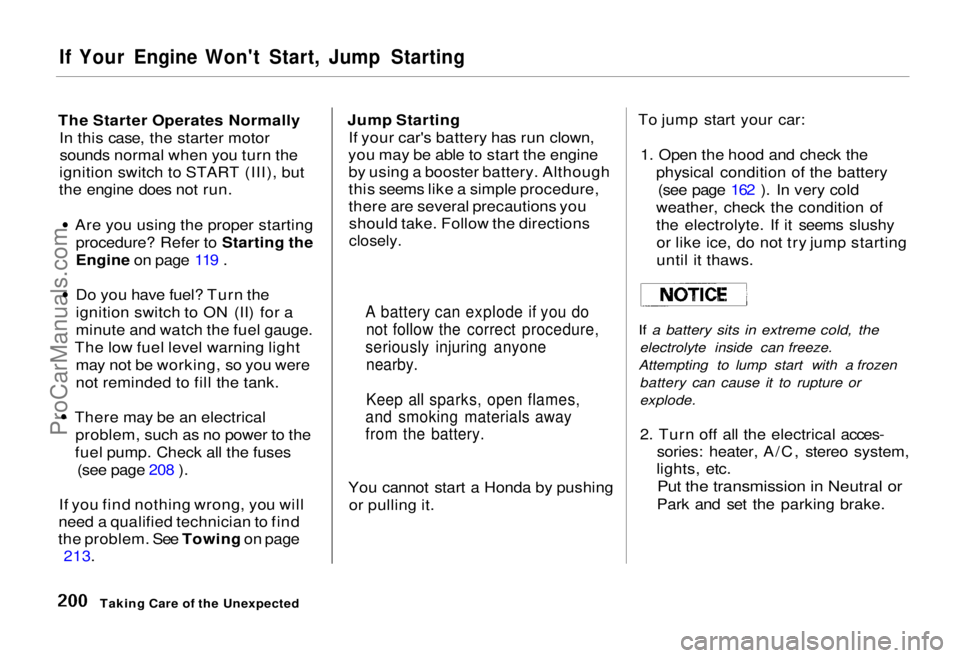
1. Open the hood and check the physical condition of the battery(see page 162 ). In very cold
weather, check the condition of
the electrolyte. If it seems slushy or like ice, do not try jump starting
until it thaws.
Taking Care of the Unexpected
If a battery sits in extreme cold, the
electrolyte inside can freeze.
Attempting to lump start with a frozen battery can cause it to rupture or
explode.
2. Turn off all the electrical acces- sories: heater, A/C, stereo system,
lights, etc.
Put the transmission in Neutral or
Park and set the parking brake.
A battery can explode if you do
not follow the correct procedure,
seriously injuring anyone nearby.
Keep all sparks, open flames,
and smoking materials away
from the battery.ProCarManuals.comMain Menu Table of Contents s t
Page 203 of 240
Low Oil Pressure
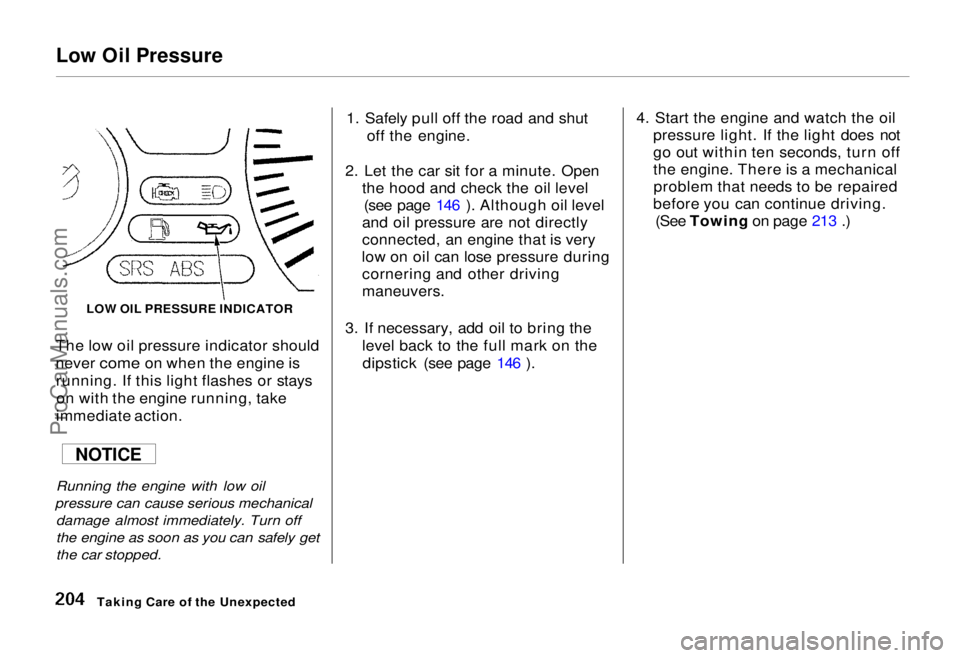
The low oil pressure indicator should
never come on when the engine is
running. If
this light flashes or stays
on with the engine running, take
immediate action.
Running the engine with low oil
pressure can cause serious mechanical
damage almost immediately. Turn off
the engine as soon as you can safely get
the car stopped.
1. Safely pull off the road and shut
off the engine.
2. Let the car sit for a minute. Open the hood and check the oil level(see page 146 ). Although oil level
and oil pressure are not directly
connected, an engine that is very
low on oil can lose pressure during cornering and other driving
maneuvers.
3. If necessary, add oil to bring the level back to the full mark on thedipstick (see page 146 ). 4. Start the engine and watch the oil
pressure light. If the light does not
go out within ten seconds, turn off
the engine. There is a mechanicalproblem that needs to be repaired
before you can continue driving. (See Towing on page 213 .)
Taking Care of the Unexpected
LOW OIL PRESSURE INDICATOR
NOTICEProCarManuals.comMain Menu Table of Contents s t
Page 205 of 240
Malfunction Indicator Lamp/Check Engine Light
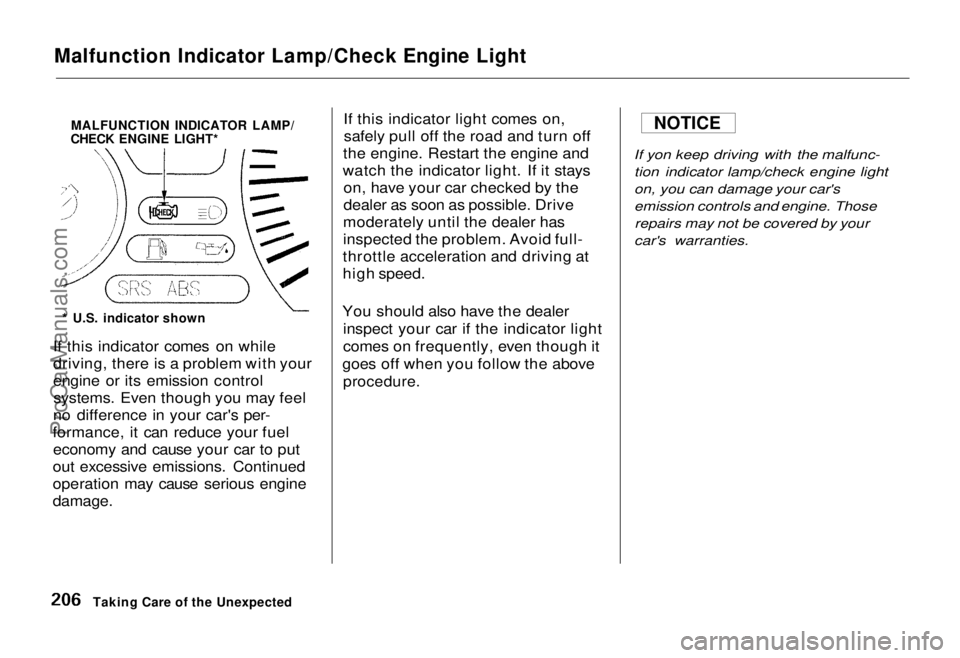
MALFUNCTION INDICATOR LAMP/
CHECK ENGINE LIGHT*
* U.S. indicator shown
If this indicator comes on while
driving, there is a problem with your
engine or its emission control systems. Even though you may feel
no difference in your car's per-
formance, it can reduce your fuel economy and cause your car to put
out excessive emissions. Continued
operation may cause serious engine
damage.
If this indicator light comes on,
safely pull off the road and turn off
the engine. Restart the engine and
watch the indicator light. If it stays on, have your car checked by the
dealer as soon as possible. Drive
moderately until the dealer has
inspected the problem. Avoid full-
throttle acceleration and driving at
high speed.
You should also have the dealer inspect your car if the indicator light
comes on frequently, even though it
goes off when you follow the above
procedure.
If yon keep driving with the malfunc-
tion indicator lamp/check engine light
on, you can damage your car's
emission controls and engine. Thoserepairs may not be covered by your
car's warranties.
Taking Care of the Unexpected NOTICEProCarManuals.comMain Menu Table of Contents s t
Page 208 of 240
Fuses
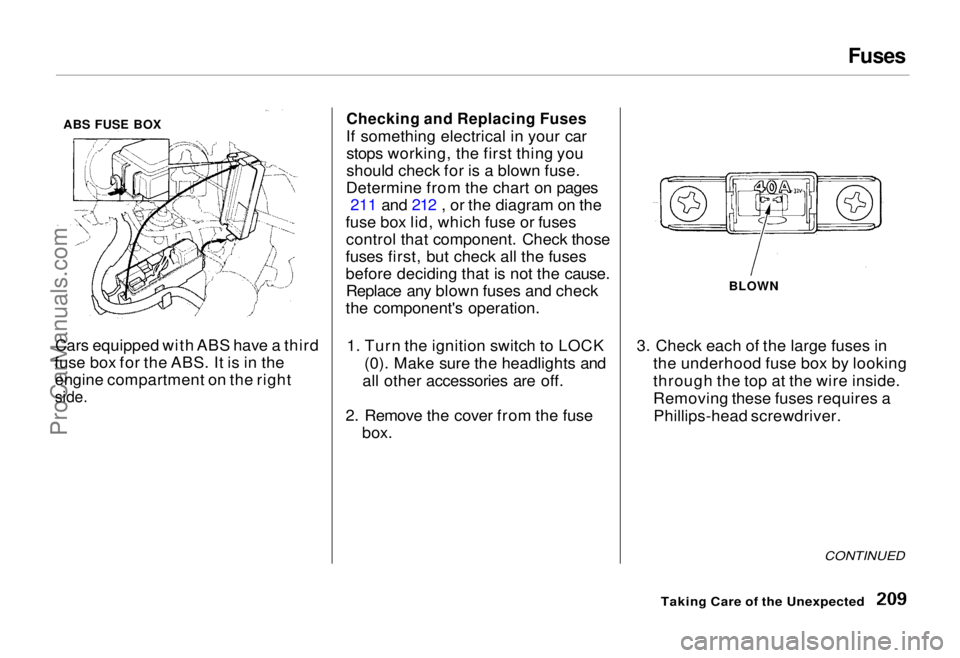
Cars equipped with ABS have a third
fuse box for the ABS. It is in the engine compartment on the right
side.
Checking and Replacing Fuses
If something electrical in your car stops working, the first thing you
should check for is a blown fuse.
Determine from the chart on pages 211 and 212 , or the diagram on the
fuse box lid, which fuse or fuses control that component. Check those
fuses first, but check all the fuses
before deciding that is not the cause. Replace any blown fuses and check
the component's operation.
1. Turn the ignition switch to LOCK (0). Make sure the headlights and
all other accessories are off.
2. Remove the cover from the fuse box. 3. Check each of the large fuses in
the underhood fuse box by looking
through the top at the wire inside.
Removing these fuses requires aPhillips-head screwdriver.
CONTINUED
Taking Care of the Unexpected
BLOWN
ABS FUSE BOXProCarManuals.comMain Menu Table of Contents s t
Page 209 of 240
Fuses
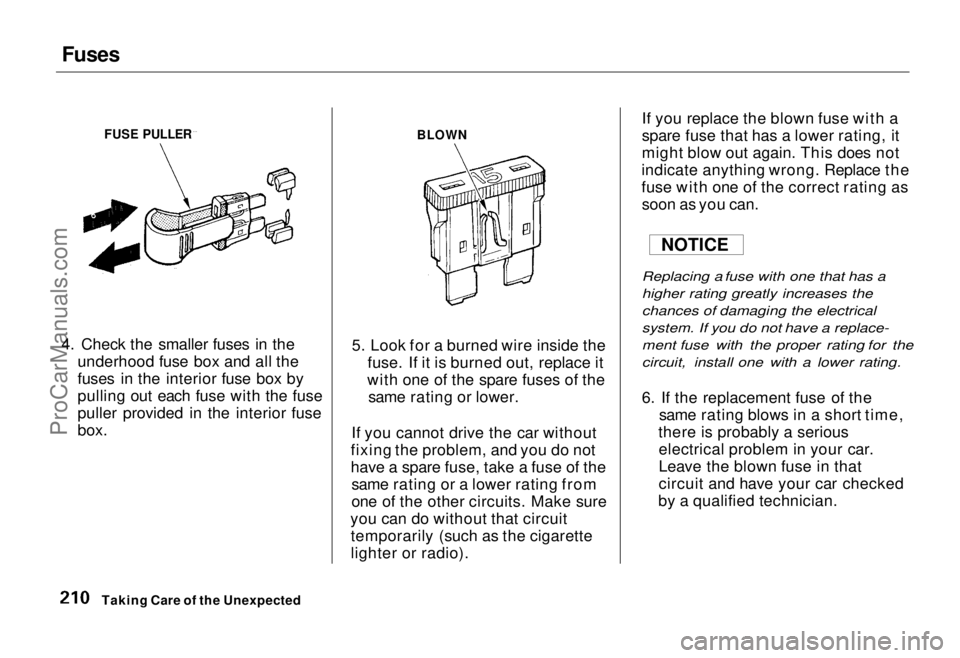
4. Check the smaller fuses in the underhood fuse box and all the
fuses in the interior fuse box by
pulling out each fuse with the fuse
puller provided in the interior fuse
box. 5. Look for a burned wire inside the
fuse. If it is burned out, replace it
with one of the spare fuses of the same rating or lower.
If you cannot drive the car without
fixing the problem, and you do not
have a spare fuse, take a fuse of the same rating or a lower rating from
one of the other circuits. Make sure
you can do without that circuit temporarily (such as the cigarette
lighter or radio). If you replace the blown fuse with a
spare fuse that has a lower rating, it
might blow out again. This does not
indicate anything wrong. Replace the
fuse with one of the correct rating as soon as you can.
Replacing a fuse with one that has a
higher rating greatly increases the
chances of damaging the electrical
system. If you do not have a replace-
ment fuse with the proper rating for the
circuit, install one with a lower rating.
6. If the replacement fuse of the same rating blows in a short time,
there is probably a serious electrical problem in your car.
Leave the blown fuse in that
circuit and have your car checked
by a qualified technician.
Taking Care of the Unexpected
FUSE PULLER
BLOWN
NOTICEProCarManuals.comMain Menu Table of Contents s t
Page 217 of 240
Specifications
Technical Information
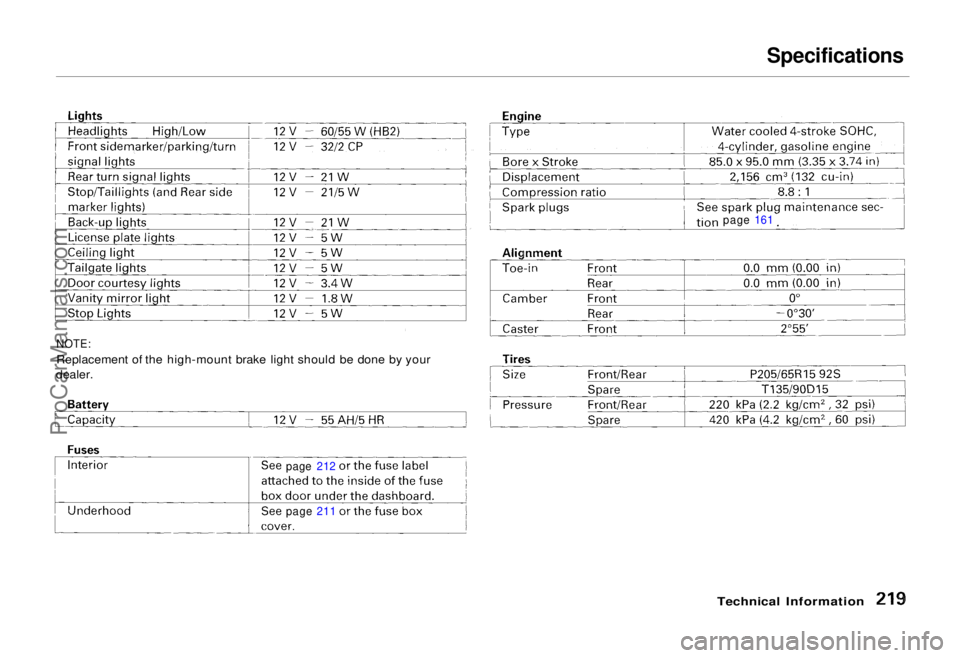
NOTE:
Replacement of the high-mount brake light should be done by your
dealer.
page 212
page 211 page 161ProCarManuals.comMain Menu Table of Contents s t
Page 218 of 240
Anti-lock Brake System
The Anti-lock Brake System (ABS) is standard equipment on all U.S.
models and the Canadian six-
passenger model. It is optional on the
Canadian seven-passenger model.
The ABS works by measuring how fast the wheels are turning during
braking and comparing their speed.
If any wheel is rotating much slower
than the others (on the verge of
locking up and skidding), the system reduces hydraulic pressure to that
wheel's brake caliper. When that
wheel's speed matches the other
wheels, the system applies normal hydraulic pressure. This can take
place several times per second ateach wheel. You feel the ABS
working as rapid pulsations in the
brake pedal.
Each wheel has a wheel speed
sensor assembly. As the wheel
rotates, the sensor sends electrical
pulses to the ABS control unit. The
pulse frequency varies with the
wheel speed.
The electrical output of the ABS control unit is connected to the
modulator/solenoid unit. During
braking, the ABS control unit monitors the pulse frequencies from
the four wheels. When the control unit detects a wheel locking up, it
energizes the appropriate solenoid in
the modulator/solenoid unit. Thereare six solenoids: two for each front
wheel, and two for the rear wheels.
The energized solenoid reduces hydraulic pressure to one side of amodulator valve. This, in turn,
reduces hydraulic pressure in the
brake line going to the affected
wheel. When that wheel speeds up because of the reduced braking
effort, the control unit de-energizes the solenoid. This builds hydraulic
pressure on the modulator valve.
The pressure increases in the hydraulic line to the wheel.
For the system to react quickly, the
modulator/solenoid unit must have
brake fluid under high pressure.
This is supplied by a piston-type accumulator that is pressurized by
an electric pump. A pressure-sensingswitch on the accumulator controls
this pump.
The control unit also contains error detection circuitry. It monitors the
operation of the wheel sensors,
solenoids, pump, and electronics. If
the control unit detects any faults, it shuts off power to the pump motor
and solenoids. The light on the
instrument panel comes on. The
brakes then work like a conventional system without anti-lock capabilities.
Technical InformationProCarManuals.comMain Menu Table of Contents s t
Page 222 of 240
Emission Controls
The burning of gasoline in your car's engine produces several byproducts.
Some of these are carbon monoxide (CO), oxides of nitrogen (NOx) and
hydrocarbons (HC). Gasoline
evaporating from the tank also
produces hydrocarbons. Controlling
the production of NOx, CO, and HC is important to the environment.
Under certain conditions of sunlight
and climate, NOx and HC react to
form photochemical "smog." Carbon
monoxide does not contribute to smog creation, but it is a poisonous
gas.
The Clean Air Act
The United States Clean Air Act* sets standards for automobile
emissions. It also requires that automobile manufacturers explain to
owners how their emission controls
work and what to do to maintain them. This section summarizes how
the emission controls work.
Scheduled maintenance is on page
140.
* In Canada, Honda vehicles comply
with the Canadian Motor Vehicle Safety Standards (CMVSS) for
Emissions valid at the time they are
manufactured. Crankcase Emission Control
System
Your car has a Positive Crankcase Ventilation System. This keepsgasses that build up in the engine'scrankcase from going into the
atmosphere. The Positive Crankcase
Ventilation valve routes them from the crankcase back to the intakemanifold. They are then drawn into
the engine and burned.
Evaporative Emission Control
System
As gasoline evaporates in the fuel tank, an evaporative emission control
canister filled with charcoal adsorbs
the vapor. It is stored in this canister
while the engine is off. After the engine is started and warmed up, the
vapor is drawn into the engine and burned during driving.
Technical InformationProCarManuals.comMain Menu Table of Contents s t
Page 232 of 240
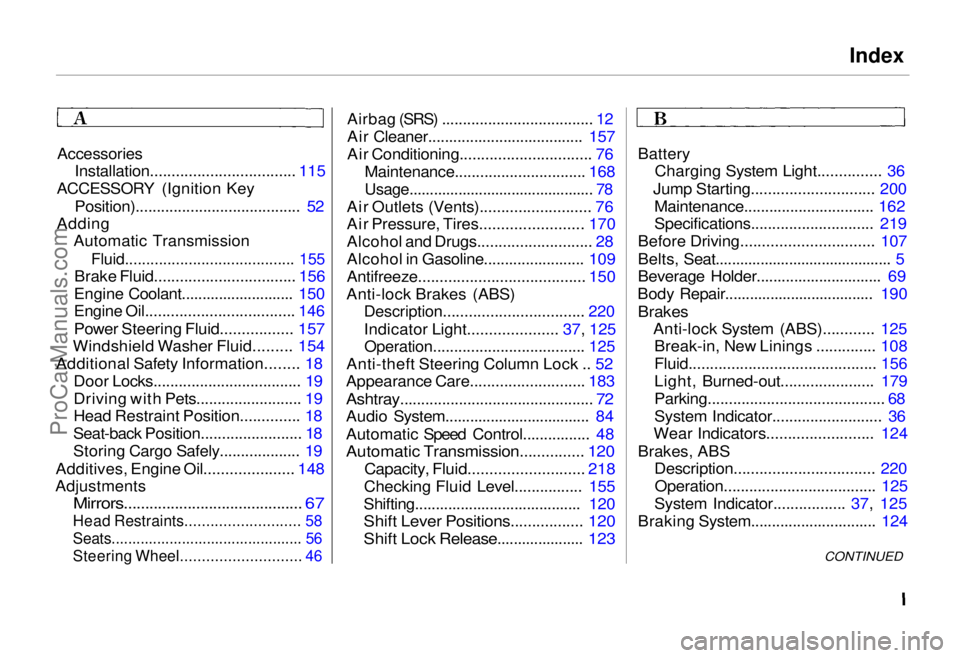
Index
Accessories
Installation.................................. 115
ACCESSORY (Ignition Key
Position)....................................... 52
Adding Automatic Transmission
Fluid........................................ 155
Brake Fluid................................. 156
Engine Coolant........................... 150
Engine Oil................................... 146
Power Steering Fluid................. 157
Windshield Washer Fluid......... 154
Additional Safety Information........ 18 Door Locks................................... 19
Driving with Pets......................... 19
Head Restraint Position.............. 18
Seat-back Position........................ 18
Storing Cargo Safely................... 19
Additives, Engine Oil..................... 148
Adjustments
Mirrors.......................................... 67
Head Restraints........................... 58
Seats.............................................. 56
Steering Wheel............................ 46
Airbag (SRS) .................................... 12
Air Cleaner..................................... 157
Air Conditioning............................... 76
Maintenance............................... 168
Usage............................................. 78
Air Outlets (Vents).......................... 76
Air Pressure, Tires........................ 170
Alcohol and Drugs........................... 28
Alcohol in Gasoline........................ 109
Antifreeze....................................... 150
Anti-lock Brakes (ABS)
Description................................. 220
Indicator Light..................... 37, 125
Operation.................................... 125
Anti-theft Steering Column Lock .. 52
Appearance Care........................... 183
Ashtray.............................................. 72
Audio System................................... 84
Automatic Speed Control................ 48
Automatic Transmission............... 120
Capacity, Fluid........................... 218
Checking Fluid Level................ 155
Shifting........................................ 120
Shift Lever Positions................. 120
Shift Lock Release..................... 123
Battery
Charging System Light............... 36
Jump Starting............................. 200 Maintenance............................... 162
Specifications............................. 219
Before Driving............................... 107
Belts, Seat........................................... 5
Beverage Holder.............................. 69
Body Repair.................................... 190
Brakes
Anti-lock System (ABS)............ 125Break-in, New Linings .............. 108
Fluid............................................ 156
Light, Burned-out...................... 179
Parking.......................................... 68
System Indicator.......................... 36
Wear Indicators......................... 124
Brakes, ABS Description................................. 220
Operation.................................... 125
System Indicator................. 37, 125
Braking System.............................. 124
CONTINUEDProCarManuals.comMain Menu s t Main Menu s t
Page 233 of 240
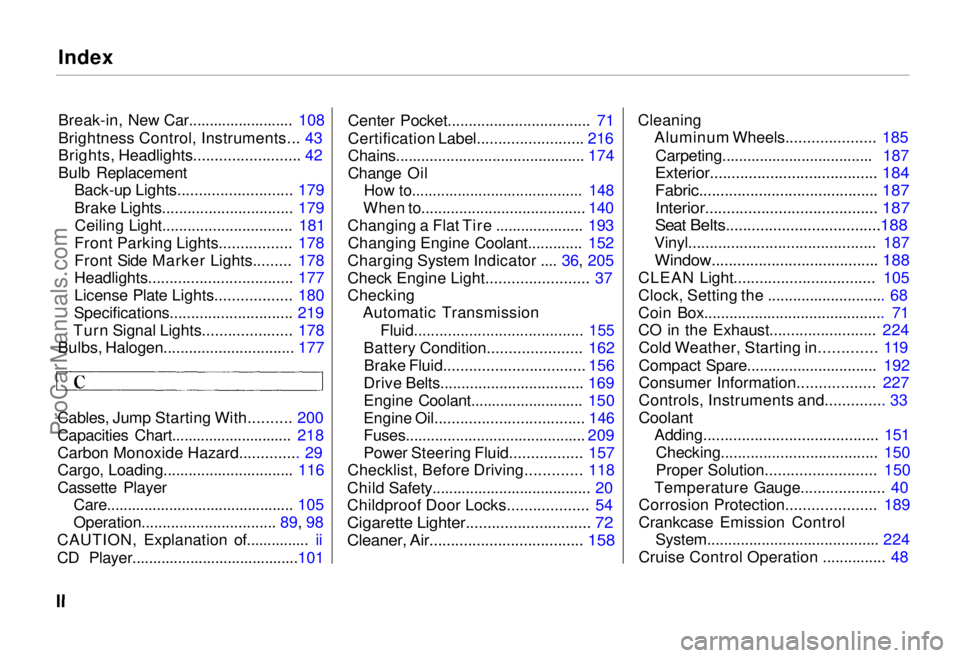
Index
Break-in, New Car......................... 108
Brightness Control, Instruments... 43
Brights, Headlights......................... 42
Bulb Replacement
Back-up Lights........................... 179
Brake Lights............................... 179
Ceiling Light............................... 181
Front Parking Lights................. 178
Front Side Marker Lights......... 178
Headlights.................................. 177
License Plate Lights.................. 180
Specifications............................. 219
Turn Signal Lights..................... 178
Bulbs, Halogen............................... 177
Cables, Jump Starting With.......... 200
Capacities Chart............................. 218
Carbon Monoxide Hazard.............. 29
Cargo, Loading............................... 116
Cassette Player Care............................................. 105
Operation................................ 89, 98
CAUTION, Explanation of............... ii
CD Player........................................101 Center Pocket.................................. 71
Certification Label......................... 216
Chains............................................. 174
Change Oil
How to......................................... 148
When to....................................... 140
Changing a Flat Tire ..................... 193 Changing Engine Coolant............. 152
Charging System Indicator .... 36, 205
Check Engine Light........................ 37
Checking Automatic Transmission
Fluid........................................ 155
Battery Condition...................... 162 Brake Fluid................................. 156
Drive Belts.................................. 169
Engine Coolant........................... 150
Engine Oil................................... 146
Fuses........................................... 209
Power Steering Fluid................. 157
Checklist, Before Driving............. 118
Child Safety...................................... 20
Childproof Door Locks................... 54
Cigarette Lighter............................. 72
Cleaner, Air.................................... 158
Cleaning
Aluminum Wheels..................... 185
Carpeting.................................... 187
Exterior....................................... 184
Fabric.......................................... 187
Interior........................................ 187
Seat Belts....................................188
Vinyl............................................ 187
Window....................................... 188
CLEAN Light................................. 105
Clock, Setting the ............................ 68
Coin Box........................................... 71
CO in the Exhaust......................... 224 Cold Weather, Starting in............. 119
Compact Spare............................... 192
Consumer Information.................. 227
Controls, Instruments and.............. 33
Coolant
Adding......................................... 151
Checking..................................... 150
Proper Solution.......................... 150
Temperature Gauge.................... 40
Corrosion Protection..................... 189
Crankcase Emission Control System......................................... 224
Cruise Control Operation ............... 48ProCarManuals.comMain Menu s t Main Menu s t