coolant temperature HONDA ODYSSEY 1995 Owners Manual
[x] Cancel search | Manufacturer: HONDA, Model Year: 1995, Model line: ODYSSEY, Model: HONDA ODYSSEY 1995Pages: 240, PDF Size: 2.44 MB
Page 40 of 240
Gauges
Temperature Gauge This shows the temperature of the engine's coolant. During normal
operation, the pointer should rise
from the bottom white mark to about
the middle of the gauge. In severe driving conditions, such as very hot
weather or a long period of uphill driving, the pointer may rise to the
upper white mark. If it reaches the
red "H" (Hot) mark, pull safely to
the side of the road. Turn to page
202 for instructions and precautions on checking the engine's cooling
system.
Fuel Gauge
This shows how much fuel you have. It is most accurate when the car is on
level ground. It may show slightly more or less than the actual amount
when you are driving on curvy or hilly roads.
The gauge stays at the same fuel level reading after you turn off the
ignition. When you add fuel, the
gauge slowly changes to the new
reading after you turn the ignition
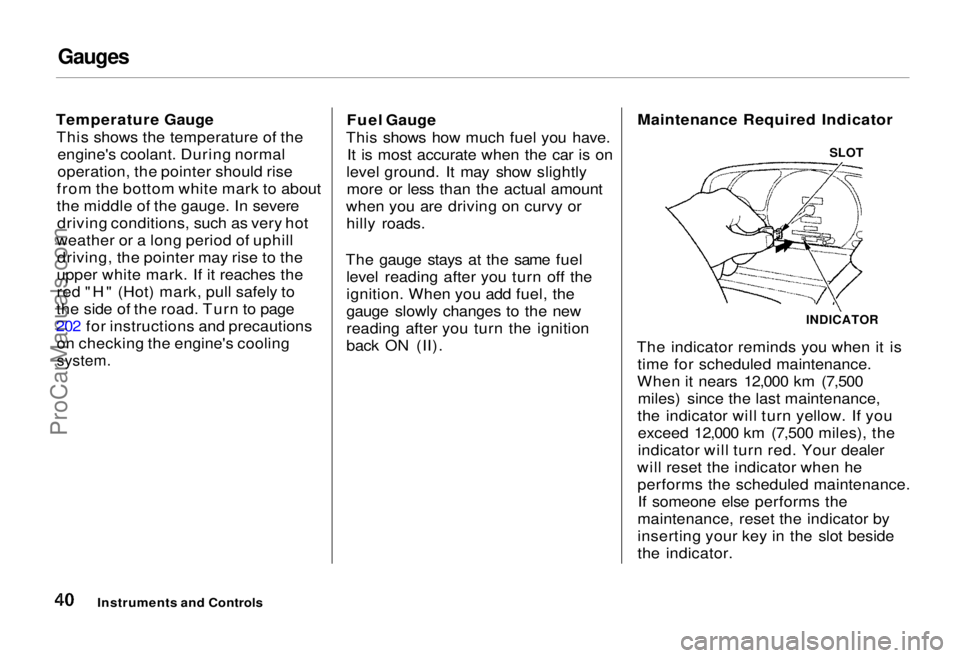
back ON (II). Maintenance Required Indicator
The indicator reminds you when it is time for scheduled maintenance.
When it nears 12,000 km (7,500 miles) since the last maintenance,
the indicator will turn yellow. If you exceed 12,000 km (7,500 miles), the
indicator will turn red. Your dealer
will reset the indicator when he performs the scheduled maintenance.If someone else performs the
maintenance, reset the indicator by
inserting your key in the slot beside
the indicator.
Instruments and Controls
INDICATOR
SLOTProCarManuals.comMain Menu Table of Contents s t
Page 79 of 240
Heating and Cooling
How to Use the System
This section covers the best way to use the system for ventilation,cooling, dehumidifying, defrosting
and heating. In most cases, the mode
and air source selections are only
recommendations. You may prefer different settings. Use mode to heat or cool the
interior more quickly, or to keep out
smoke and dust. Leaving the system
in the recirculation mode with the
A/C off can cause the windows to fog up. Switch to
mode as
soon as the interior reaches a
comfortable temperature or the
outside smoky, dusty condition
clears.
The engine must be running for the
heater and air conditioning to pro-
vide hot and cold air. The heater uses engine coolant to warm the air.If the engine is cold, it will be several
minutes before you feel warm air
circulating.
The air conditioning system does not depend on engine temperature. It
can produce cold air almost immedi-
ately.
Controlling Air Flow Direction
Air flows into the interior at three
levels: Toward the floor
through the dash vents and
toward the windshield and side
windows You select the air
flow level or combination of levels
with the five mode buttons.
Ventilation
Your car has a flow-through venti- lation system. Air enters the car
through vents in front of the wind-shield. It circulates through the
interior then exits through the rear side panels. This system provides
fresh air even when the car is standing still. To bring in outside air, press the button. Set the fan
at a comfortable speed.
CONTINUED
Comfort and Convenience FeaturesProCarManuals.comMain Menu Table of Contents s t
Page 80 of 240
Heating and Cooling
To Cool with A/C
To operate the air conditioning system, press the air conditioning
switch. Set the fan to the desired
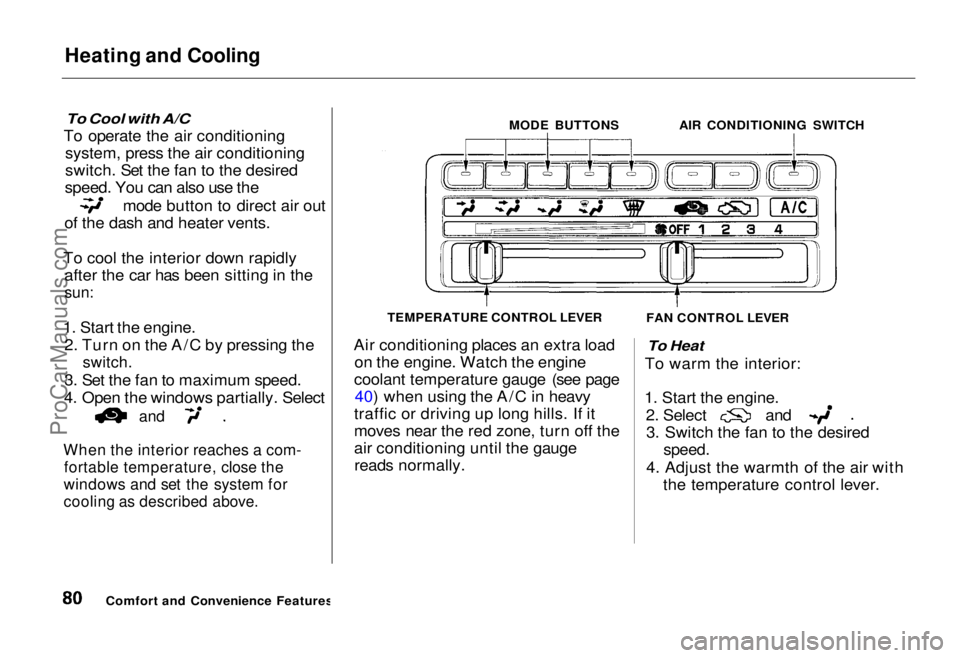
speed. You can also use the mode button to direct air out
of the dash and heater vents.
To cool the interior down rapidly after the car has been sitting in the
sun:
1. Start the engine. 2. Turn on the A/C by pressing the
switch.
3. Set the fan to maximum speed.
4. Open the windows partially. Select
and
When the interior reaches a com-
fortable temperature, close the
windows and set the system for
cooling as described above.
Air conditioning places an extra load
on the engine. Watch the engine
coolant temperature gauge (see page 40) when using the A/C in heavy
traffic or driving up long hills. If it
moves near the red zone, turn off the
air conditioning until the gauge reads normally.
To Heat
To warm the interior:
1. Start the engine. 2. Select and
3. Switch the fan to the desired
speed.
4. Adjust the warmth of the air with the temperature control lever.
Comfort and Convenience Features MODE BUTTONS
AIR CONDITIONING SWITCH
FAN CONTROL LEVER
TEMPERATURE CONTROL LEVERProCarManuals.comMain Menu Table of Contents s t
Page 82 of 240
Heating and Cooling
To Defog and Defrost
To remove fog from the inside of the windows:
1. Switch the fan on.
2. Turn on the air conditioning. 3. Select and
4. Adjust the temperature control lever so the airflow from the
defroster vents feels warm.
5. Turn on the rear window defogger to help clear the rear window.
To remove exterior frost or ice from the windshield and side windowsafter the car has been sitting out in
cold weather:
1. Start the engine. 2. Select and
3. Switch the fan and temperature
controls to maximum. To rapidly remove exterior frost or
ice from the windshield (on very cold days), first select Once the
windshield is clear, select to
avoid fogging the windows.
These settings direct all the air flow to the defroster vents at the base ofthe windshield and the side windowdefroster vents. The air flow will get
warmer and clear the windows faster as the engine warms up. You can
close the side vents with the dial
beside each vent. This will send more warm air to the windshielddefroster vents.
For safety, make sure you have a
clear view through all the windows
before driving away.
To Turn Everything Off
To shut off the system temporarily, slide the fan speed and temperature
control levers all the way to the left.
You should shut the system com- pletely off only for the first few
minutes of driving in cold weather,until the engine coolant warms up
enough to operate the heater. Keep
the fan on at all other times so stale air does not build up in the interior.
Comfort and Convenience FeaturesProCarManuals.comMain Menu Table of Contents s t
Page 151 of 240
Cooling System
Do not add any rust inhibitors or other additives to your car's cooling
system. They may not be compatible
with the coolant or engine compo- nents.
Replacing Engine Coolant
The cooling system should be completely drained and refilled with
new coolant according to the time
and distance recommendations in
the maintenance schedule. Only use
recommended antifreeze.
Draining the coolant requires access
to the underside of the car. Unless
you have the tools and knowledge,
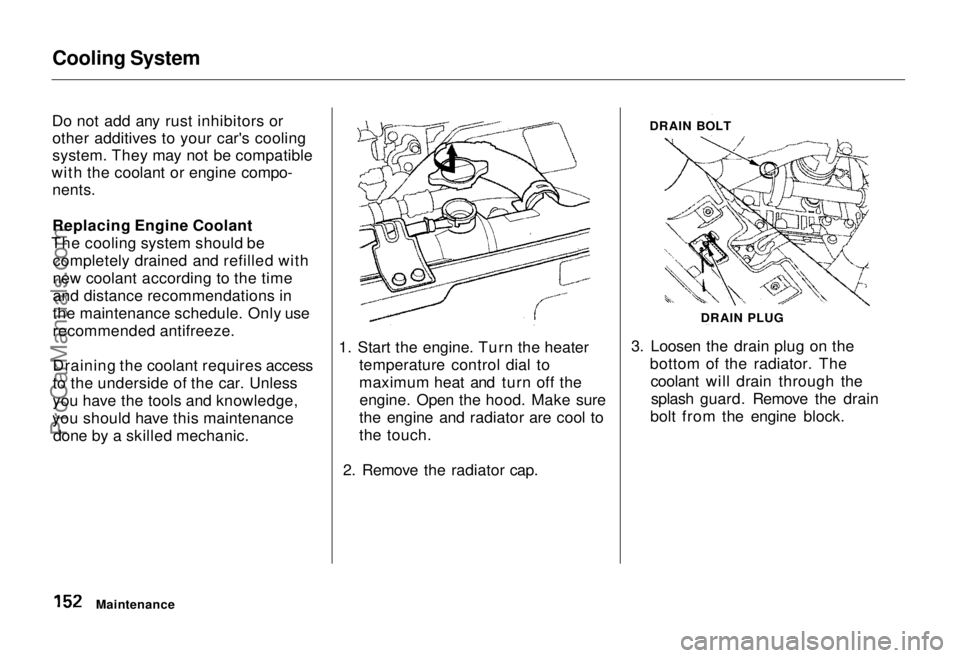
you should have this maintenance done by a skilled mechanic. 1. Start the engine. Turn the heater
temperature control dial to
maximum heat and turn off theengine. Open the hood. Make sure
the engine and radiator are cool to
the touch.
2. Remove the radiator cap. DRAIN BOLT
3. Loosen the drain plug on the bottom of the radiator. Thecoolant will drain through thesplash guard. Remove the drain
bolt from the engine block.
Maintenance DRAIN PLUGProCarManuals.comMain Menu Table of Contents s t
Page 201 of 240
If Your Engine Overheats
The pointer of your car's tempera- ture gauge should stay in the mid-
range under most conditions. It may
go higher if you are driving up a long steep hill on a very hot day. If it
climbs to the red mark, you should
determine the reason.
Driving with the temperature gauge
pointer at the red mark can cause serious damage to your engine. Your car can overheat for several
reasons, such as lack of coolant or a
mechanical problem. The only
indication may be the temperature
gauge climbing to or above the red mark. Or you may sec steam or
spray coming from under the hood.
In either case, you should take
immediate action.
1. Safely pull to the side of the road.
Put the transmission in neutral or
park and set the parking brake.
Turn off the heating and cooling system and all other accessories.
Turn on the hazard warning indicators.
2. If you see steam and/or spray coming from under the hood, turn
off the engine.
3. If you do not see steam or spray, leave the engine running and
watch the temperature gauge. If the high heat is due to overloading (climbing a long, steep hill on a
hot day with the A/C running, for example), the engine should start
to cool down almost immediately. If it does, wait until the tempera-
ture gauge comes down to the mid-
point then continue driving.
Taking Care of the Unexpected
NOTICE
Steam and spray from an
overheated engine can
seriously scald you.Do not open the hood if steam
is coming out.ProCarManuals.comMain Menu Table of Contents s t
Page 202 of 240
If Your Engine Overheats
4. If the temperature gauge stays at the red mark, turn off the engine.
5. Wait until you see no more signs of steam or spray, then open the
hood.
6. Look for any obvious coolant leaks, such as a split radiator hose.
Everything is still extremely hot, so use caution. If you find a leak, it
must be repaired before you
continue driving (see Towing on
page 213).
7. If you don't find an obvious leak, check the coolant level in the
radiator reserve tank (see page 150). If the level is below the
MIN mark, add coolant to half-way
between the MIN and MAX marks.
8. If there was no coolant in the reserve tank, you may also have to
add coolant to the radiator. Let the
engine cool down until the pointer reaches the middle of the tempera-
ture gauge, or lower, before check-
ing the radiator.
9. Using gloves or a large heavy cloth, turn the radiator cap
counterclockwise, without pushing
down, to the first stop. This
releases any remaining pressure in
the cooling system. After the
pressure releases, push down on
the cap and turn it until it comes
off.
10.Start the engine and set the
temperature control lever to
maximum. Add coolant to the
radiator up to the base of the filler
neck. If you do not have the proper coolant mixture available,
you can add plain water. Remember to have the coolingsystem drained and refilled with
the proper mixture as soon as you
can.
11. Put the radiator cap back on tightly. Run the engine and watch
the temperature gauge. If it goes
back to the red mark, the engine needs repair. (See Towing on
page 213.)
12.If the temperature stays normal, check the coolant level in the
radiator reserve tank. If it has
gone down, add coolant to the MAX mark. Put the cap back on
tightly.
Taking Care of the Unexpected
Removing the radiator cap
while the engine is hot can cause the coolant to spray out,
seriously scalding you.
Always let the engine and radiator cool down before
removing the radiator cap.ProCarManuals.comMain Menu Table of Contents s t
Page 233 of 240
Index
Break-in, New Car......................... 108
Brightness Control, Instruments... 43
Brights, Headlights......................... 42
Bulb Replacement
Back-up Lights........................... 179
Brake Lights............................... 179
Ceiling Light............................... 181
Front Parking Lights................. 178
Front Side Marker Lights......... 178
Headlights.................................. 177
License Plate Lights.................. 180
Specifications............................. 219
Turn Signal Lights..................... 178
Bulbs, Halogen............................... 177
Cables, Jump Starting With.......... 200
Capacities Chart............................. 218
Carbon Monoxide Hazard.............. 29
Cargo, Loading............................... 116
Cassette Player Care............................................. 105
Operation................................ 89, 98
CAUTION, Explanation of............... ii
CD Player........................................101 Center Pocket.................................. 71
Certification Label......................... 216
Chains............................................. 174
Change Oil
How to......................................... 148
When to....................................... 140
Changing a Flat Tire ..................... 193 Changing Engine Coolant............. 152
Charging System Indicator .... 36, 205
Check Engine Light........................ 37
Checking Automatic Transmission
Fluid........................................ 155
Battery Condition...................... 162 Brake Fluid................................. 156
Drive Belts.................................. 169
Engine Coolant........................... 150
Engine Oil................................... 146
Fuses........................................... 209
Power Steering Fluid................. 157
Checklist, Before Driving............. 118
Child Safety...................................... 20
Childproof Door Locks................... 54
Cigarette Lighter............................. 72
Cleaner, Air.................................... 158
Cleaning
Aluminum Wheels..................... 185
Carpeting.................................... 187
Exterior....................................... 184
Fabric.......................................... 187
Interior........................................ 187
Seat Belts....................................188
Vinyl............................................ 187
Window....................................... 188
CLEAN Light................................. 105
Clock, Setting the ............................ 68
Coin Box........................................... 71
CO in the Exhaust......................... 224 Cold Weather, Starting in............. 119
Compact Spare............................... 192
Consumer Information.................. 227
Controls, Instruments and.............. 33
Coolant
Adding......................................... 151
Checking..................................... 150
Proper Solution.......................... 150
Temperature Gauge.................... 40
Corrosion Protection..................... 189
Crankcase Emission Control System......................................... 224
Cruise Control Operation ............... 48ProCarManuals.comMain Menu s t Main Menu s t
Page 234 of 240
Index
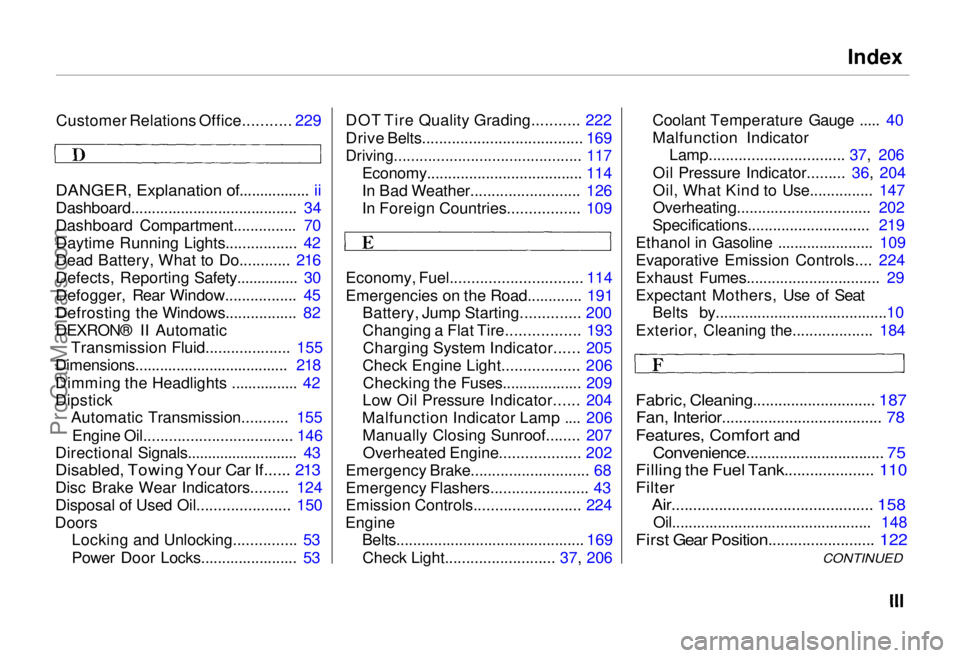
Customer Relations Office........... 229
DANGER, Explanation of................. ii
Dashboard........................................ 34
Dashboard Compartment............... 70
Daytime Running Lights................. 42
Dead Battery, What to Do............ 216
Defects, Reporting Safety............... 30
Defogger, Rear Window................. 45
Defrosting the Windows................. 82
DEXRON® II Automatic Transmission Fluid.................... 155
Dimensions..................................... 218
Dimming the Headlights ................ 42
Dipstick Automatic Transmission........... 155
Engine Oil................................... 146
Directional Signals........................... 43
Disabled, Towing Your Car If...... 213
Disc Brake Wear Indicators......... 124
Disposal of Used Oil...................... 150
Doors Locking and Unlocking............... 53
Power Door Locks....................... 53 DOT Tire Quality Grading........... 222
Drive Belts...................................... 169
Driving............................................ 117
Economy..................................... 114
In Bad Weather.......................... 126
In Foreign Countries................. 109
Economy, Fuel............................... 114
Emergencies on the Road............. 191 Battery, Jump Starting.............. 200
Changing a Flat Tire................. 193
Charging System Indicator...... 205
Check Engine Light.................. 206 Checking the Fuses................... 209
Low Oil Pressure Indicator...... 204
Malfunction Indicator Lamp .... 206 Manually Closing Sunroof........ 207Overheated Engine................... 202
Emergency Brake............................ 68
Emergency Flashers....................... 43
Emission Controls......................... 224
Engine Belts............................................. 169
Check Light.......................... 37, 206 Coolant Temperature Gauge ..... 40
Malfunction Indicator
Lamp................................ 37, 206
Oil Pressure Indicator......... 36, 204
Oil, What Kind to Use............... 147
Overheating................................ 202
Specifications............................. 219
Ethanol in Gasoline ....................... 109
Evaporative Emission Controls.... 224
Exhaust Fumes................................ 29
Expectant Mothers, Use of Seat Belts by.........................................10
Exterior, Cleaning the................... 184
Fabric, Cleaning............................. 187
Fan, Interior...................................... 78
Features, Comfort and
Convenience................................. 75
Filling the Fuel Tank..................... 110
Filter Air............................................... 158
Oil................................................ 148
First Gear Position......................... 122
CONTINUEDProCarManuals.comMain Menu s t Main Menu s t
Page 235 of 240
Index
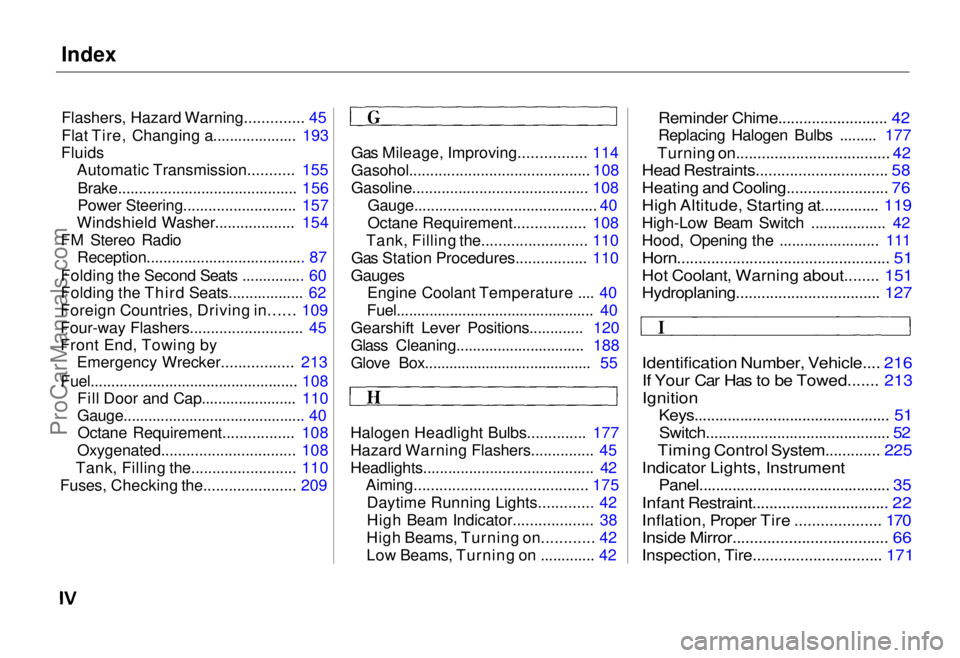
Flashers, Hazard Warning.............. 45
Flat Tire, Changing a.................... 193
Fluids Automatic Transmission........... 155
Brake........................................... 156
Power Steering........................... 157
Windshield Washer................... 154
FM Stereo Radio Reception...................................... 87
Folding the Second Seats ............... 60
Folding the Third Seats.................. 62
Foreign Countries, Driving in...... 109
Four-way Flashers........................... 45
Front End, Towing by Emergency Wrecker................. 213
Fuel.................................................. 108
Fill Door and Cap....................... 110
Gauge............................................ 40Octane Requirement................. 108
Oxygenated................................ 108
Tank, Filling the......................... 110
Fuses, Checking the...................... 209 Gas Mileage, Improving................ 114
Gasohol........................................... 108
Gasoline.......................................... 108
Gauge............................................ 40
Octane Requirement................. 108
Tank, Filling the......................... 110
Gas Station Procedures................. 110
Gauges
Engine Coolant Temperature .... 40
Fuel................................................ 40
Gearshift Lever Positions............. 120
Glass Cleaning............................... 188
Glove Box......................................... 55
Halogen Headlight Bulbs.............. 177
Hazard Warning Flashers............... 45
Headlights......................................... 42 Aiming......................................... 175
Daytime Running Lights............. 42
High Beam Indicator................... 38
High Beams, Turning on............ 42
Low Beams, Turning on ............. 42
Reminder Chime.......................... 42
Replacing Halogen Bulbs ......... 177
Turning on.................................... 42
Head Restraints............................... 58
Heating and Cooling........................ 76
High Altitude, Starting at.............. 119
High-Low Beam Switch .................. 42
Hood, Opening the ........................ 111
Horn.................................................. 51
Hot Coolant, Warning about........ 151
Hydroplaning.................................. 127
Identification Number, Vehicle.... 216
If Your Car Has to be Towed....... 213
Ignition
Keys............................................... 51
Switch............................................ 52
Timing Control System............. 225
Indicator Lights, Instrument
Panel.............................................. 35
Infant Restraint................................ 22
Inflation, Proper Tire .................... 170
Inside Mirror.................................... 66
Inspection, Tire.............................. 171ProCarManuals.comMain Menu s t Main Menu s t