airbag HONDA ODYSSEY 1995 Owners Manual
[x] Cancel search | Manufacturer: HONDA, Model Year: 1995, Model line: ODYSSEY, Model: HONDA ODYSSEY 1995Pages: 240, PDF Size: 2.44 MB
Page 4 of 240
Driver and Passenger Safety
This section gives you important
information about occupant protec-
tion. It shows how to use seat belts
properly. It explains the Supple-
mental Restraint System. And it
gives useful information about how
to protect infants and children in
your car.
Your Occupant Protection System.. 4
The Seat Belt System
and How It Works...................... 5
Why Wear Seat Belts.................... 5
Important Safety Reminders........ 5
Seat Belt System Components..... 6
Lap/Shoulder Belt......................... 6
Lap Belt........................................... 7
Wearing Seat Belts Properly........ 7 Wearing a Lap/Shoulder Belt...... 7
Wearing the Lap Belt.................... 9
Advice for Pregnant Women...... 10
Seat Belt Maintenance............... 11
Supplemental Restraint System..... 12 SRS Components......................... 12
What Happens In a Crash........... 12
Important Facts About
Airbags...................................... 13
How the Driver's Airbag
Works........................................14
How the Passenger's Airbag
Works........................................ 15
How the SRS Indicator Light
Works........................................16
System Service............................. 16
System Service Precautions....... 17
Additional Safety Information........ 18
Seat-back Position........................ 18
Head Restraint Position.............. 18
Door Locks................................... 19 Storing Cargo Safely ................... 19
Driving with Pets......................... 19
Child Safety...................................... 20 Where Should Children Sit?....... 20Important Safety Reminders...... 21General Guidelines for Restraining Children Under 18 kg (40 lbs) ...............
22
Restraining
an Infan
t Who Weighs
Less Than 9 kg (20 lbs).......... 22
Restraining
a Child Who Weighs Between9 and 18 kg (20 and 40 lbs)..... 23
Restraining a Child Who Weighs Over 18 kg (40 Ibs).................. 24
Securing a Child Seat with a Lap/Shoulder Belt................... 25
Using Child Restraints
with Tethers............................. 26
Storing a Child Seat.....................
27
Alcohol and
Drugs........................... 28
Carbon Monoxide Hazard .............. 29
Reporting Safety Defects
(U.S. Cars).................................... 30
Safety Labels.................................... 31
Driver and Passenger SafetyProCarManuals.comMain Menu s t
Page 5 of 240
Your Occupant Protection System
Your Honda is equipped with seat belts and other features that worktogether to protect you and your
passenger during a crash.
Seat belts are the most important
part of your occupant protection system. When worn properly, seat
belts can reduce the chance of serious injury or death in a crash.
For added protection during a severe
frontal collision, your Odyssey has a Supplemental Restraint System (SRS) with airbags for the driver and
a front seat passenger. Two indicator lights are also part of
your safety system. One reminds youto make sure you and your passen-
gers wear seat belts. The otheralerts you to a possible problem with
your supplemental restraint system (see page 16).
The seats, head restraints, and door locks also play a role in occupantsafety. For example, reclining the
seat-back can decrease the effec-
tiveness of your seat belt. Head
restraints can help protect your neck and head, especially during rear-end
impacts. Door locks help keep your doors from being accidentally
opened during a crash. To get the maximum protection from
your occupant protection system, check the following before you drive
away:
Everyone in the car is wearing aseat belt properly (see page 7). Infants and small children are
properly secured in child safety seats (see page 20). All doors and the tailgate are
closed and locked (see page 19). Seat-backs are upright and head
restraints are properly adjusted
(see pages 18 and 56).
There are no loose items that could be thrown around and hurtsomeone during a crash or sudden
stop (see page 19).
By following these guidelines, you
can reduce injuries to yourself and
your passengers in many crash situations. Remember, however, that
no safety system can prevent all
injuries or deaths that can occur in severe crashes.
Driver and Passenger SafetyProCarManuals.comMain Menu Table of Contents s t
Page 13 of 240
Supplemental Restraint System
Your car is equipped with a Supple- mental Restraint System (SRS) to
help protect the head and chest of the driver and front seat passenger
during a severe frontal collision.
This system does not replace your seat
belts. It supplements, or adds to, the
protection offered by seat belts and
other occupant protection features.
SRS Components
Your supplemental restraint system
includes:
One airbag in the steering wheelfor the driver and another in thedashboard for the passenger.
Sensors that can detect a severe frontal collision.
A sophisticated electronic system that continually monitors thesensors, control unit, airbag
activators, and all related wiring
when the ignition is ON (II).
An indicator light on the instru- ment panel to alert you to a possi-
ble problem with the system.
Emergency backup power in case your car's electrical system isdisconnected in a crash. What Happens In a Crash
If you ever have a severe frontal
collision, the sensors will detect
rapid deceleration and signal the control unit to instantly inflate the
airbags.
During a crash, your seat belts will
help to restrain your lower body and
torso. The airbags will provide a cushion to absorb crash energy and
help keep the head and chest of thedriver and front passenger fromstriking the interior of the car.
After inflating, the airbags will immediately deflate. The entire
process, from detection to deflation,
takes a fraction of a second. This process occurs so quickly that you
may not hear the loud noise created
by the airbag inflators, or realize
what has happened.
Driver and Passenger Safety
Not wearing a seat belt
increases the chance of serious
injury or death in a crash, even
if you have airbags.
Be sure you and your
passengers always wear seat
belts and wear them properly.ProCarManuals.comMain Menu Table of Contents s t
Page 14 of 240
Supplemental Restraint System
After the crash, you may see what looks like smoke. This is actually
powder from the airbag's surface. People with respiratory problems
may experience some temporary
discomfort from the chemicals used
by the airbag's activators.
Important Facts About Airbags
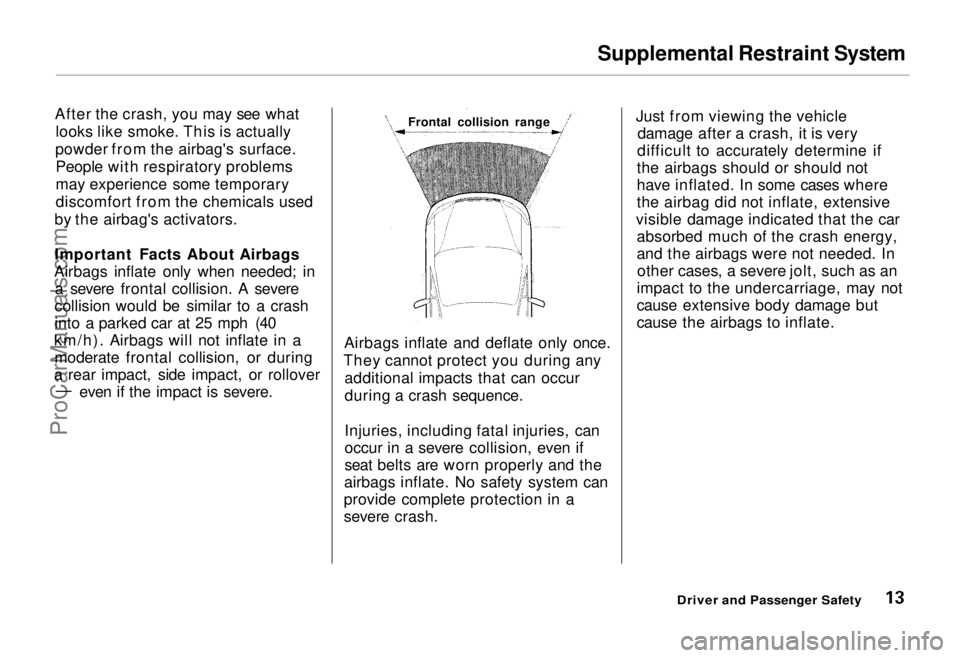
Airbags inflate only when needed; in a severe frontal collision. A severe
collision would be similar to a crash
into a parked car at 25 mph (40
km/h). Airbags will not inflate in a moderate frontal collision, or during
a rear impact, side impact, or rollover — even if the impact is severe. Airbags inflate and deflate only once.
They cannot protect you during any additional impacts that can occur
during a crash sequence.
Injuries, including fatal injuries, can
occur in a severe collision, even if
seat belts are worn properly and the
airbags inflate. No safety system can
provide complete protection in a
severe crash. Just from viewing the vehicle
damage after a crash, it is very
difficult to accurately determine if
the airbags should or should not
have inflated. In some cases where
the airbag did not inflate, extensive
visible damage indicated that the car absorbed much of the crash energy,
and the airbags were not needed. Inother cases, a severe jolt, such as an
impact to the undercarriage, may not
cause extensive body damage but
cause the airbags to inflate.
Driver and Passenger Safety
Frontal collision rangeProCarManuals.comMain Menu Table of Contents s t
Page 15 of 240
Supplemental Restraint System
How the Driver's Airbag Works
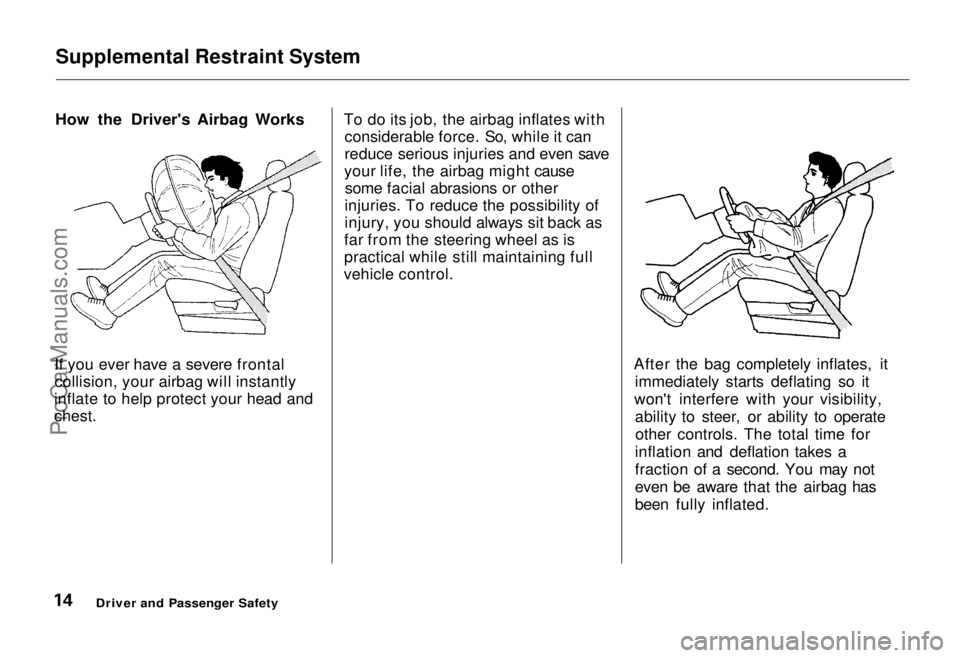
If you
ever have a severe frontal
collision, your airbag will instantly
inflate to help protect your head and
chest.
To do its job, the airbag inflates with
considerable force. So, while it can
reduce serious injuries and even save
your life, the airbag might cause some facial abrasions or other
injuries. To reduce the possibility of
injury, you should always sit back as
far from the steering wheel as is
practical while still maintaining full
vehicle control.
After the bag completely inflates, itimmediately starts deflating so it
won't interfere with your visibility, ability to steer, or ability to operateother controls. The total time for
inflation and deflation takes a
fraction of a second. You may not
even be aware that the airbag has
been fully inflated.
Driver and Passenger SafetyProCarManuals.comMain Menu Table of Contents s t
Page 16 of 240
Supplemental Restraint System
The driver's airbag is stored in the center of the steering wheel. For
your safety, do not attach any items to the steering wheel. They could
interfere with the proper operation of the airbag. Or, if the airbag
inflates, they could be propelled
inside the car and hurt someone. How the Passenger's Airbag
Works
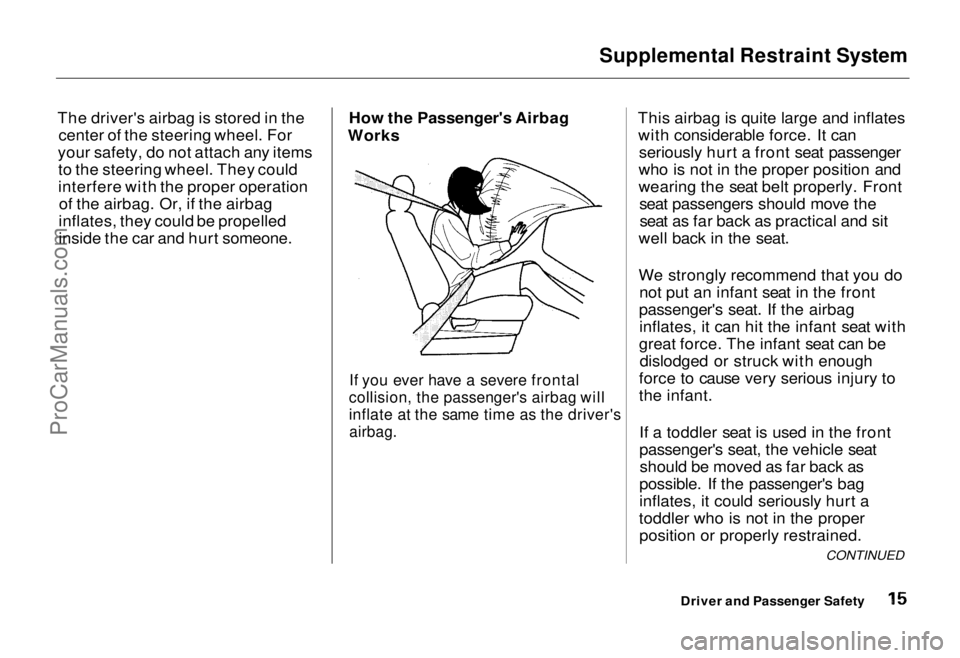
If you ever have a severe frontal
collision, the passenger's airbag will
inflate at the same time as the driver's
airbag.
This airbag is quite large and inflates
with considerable force. It can seriously hurt a front seat passenger
who is not in the proper position and
wearing the seat belt properly. Front seat passengers should move theseat as far back as practical and sit
well back in the seat.
We strongly recommend that you do not put an infant seat in the front
passenger's seat. If the airbag inflates, it can hit the infant seat with
great force. The infant seat can be dislodged or struck with enough
force to cause very serious injury to
the infant.
If a toddler seat is used in the front
passenger's seat, the vehicle seatshould be moved as far back as
possible. If the passenger's bag
inflates, it could seriously hurt a
toddler who is not in the proper position or properly restrained.
CONTINUED
Driver and Passenger SafetyProCarManuals.comMain Menu Table of Contents s t
Page 17 of 240
Supplemental Restraint System
The passenger's airbag is stored near the top of the dashboard, under
a lid marked SRS. Do not place any
objects on top of this lid. If the airbag
inflates, those objects can be
propelled inside the car and possibly
hurt someone.
How the SRS Indicator
Light Works
The purpose of the SRS light on your instrument panel is to alert you of a
potential problem with your supple- mental restraint system.
Have the system checked if: The light does not come on when
you turn the ignition ON (II).
The light stays on after the engine
starts.
The light comes on or flashes while you are driving.
System Service
Your supplemental restraint system is virtually maintenance-free. Thereare no parts you can safely service.
You must have the system serviced by an authorized Honda dealer:
If your airbags ever inflate, the
airbags and control unit must be
replaced. Do not try to remove or discard the airbags by yourself.
This must be done by a Honda
dealer.
If the SRS indicator light alerts
you of a problem. Have the supplemental restraint system
checked as soon as possible.Otherwise, your airbags might not
inflate when you need them.
When the car is ten years old. Have the dealer inspect thesystem. The production date is on
the driver's doorjamb for your
convenience.
Driver and Passenger Safety
SRS
ProCarManuals.comMain Menu Table of Contents s t
Page 18 of 240
Supplemental Restraint System
System Service Precautions
Do not modify your steering wheel or any other part of the supplemental
restraint system. Modifications could
make the system ineffective.
Do not tamper with the system's
components or wiring. This could
cause the airbags to inflate inadver-
tently, possibly injuring someone
very seriously.
Tell anyone who works on your car that you have a supplemental
restraint system. Failure to followthe procedures and precautions in
the official Honda service manualcould result in personal injury or
damage to the system. Scrapping an entire car that has an
uninflated airbag can be dangerous.
Get assistance from a Honda dealer
if your car must be scrapped.
If you sell your car, please be sure to
tell the new owner that the car has a supplemental restraint system. Alert
them to the information and precau-
tions in this part of the owner's
manual.
Driver and Passenger SafetyProCarManuals.comMain Menu Table of Contents s t
Page 19 of 240
Additional Safety Information
The seat belts and airbags are obvi- ously important parts of your occu-
pant protection system.
In addition, you should know that sitting upright, adjusting the head
restraint properly, locking the doors, and stowing things properly can also
increase your safety and possibly even save your life. Seat-back Position
The seat-backs should be in an upright position for you and your
passengers to get the most protec-
tion from the seat belts.
If you recline a seat-back, you reduce
the protective capability of your seat
belt. The farther a seat-back is reclined, the greater the risk that
you will slide under the belt in a severe crash and be very seriously
injured.
For information on how to adjust the
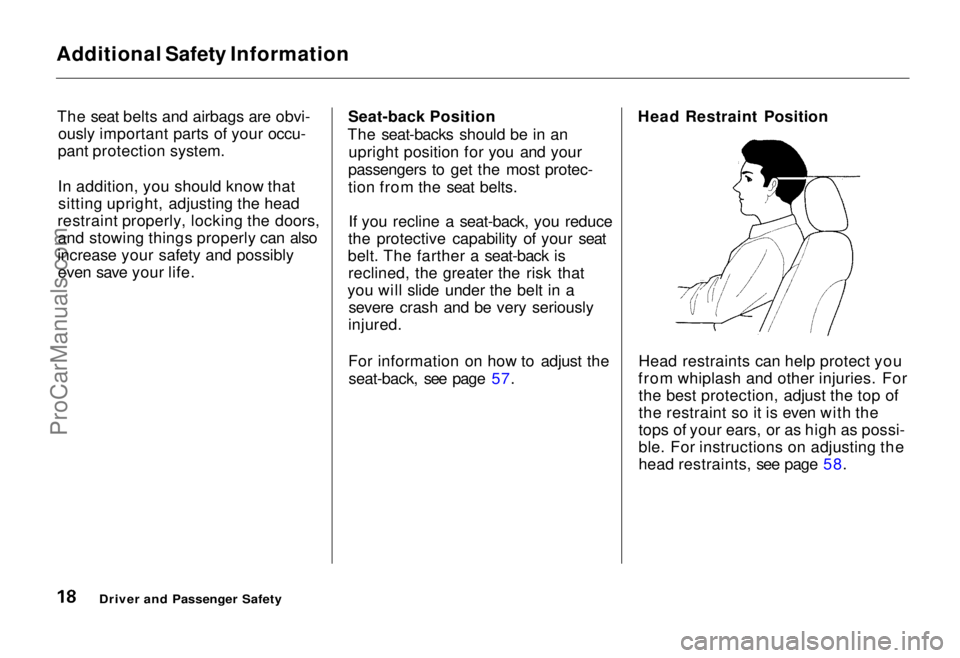
seat-back, see page 57. Head Restraint Position
Head restraints can help protect you
from whiplash and other injuries. For the best protection, adjust the top of
the restraint so it is even with the
tops of your ears, or as high as possi-
ble. For instructions on adjusting the
head restraints, see page 58.
Driver and Passenger SafetyProCarManuals.comMain Menu Table of Contents s t
Page 21 of 240
Child Safety
Children depend on adults to protect
them. To help make sure we do, every state and Canadian province
has laws requiring infants and young children to be properly restrained
whenever they ride in a car.
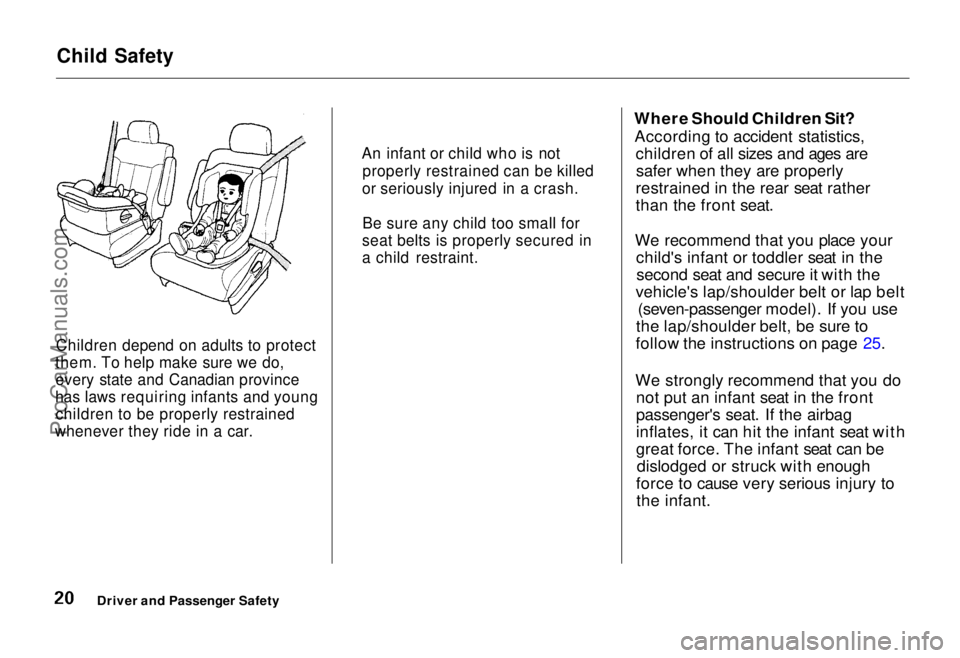
Where Should Children Sit?
According to accident statistics, children of all sizes and ages aresafer when they are properly
restrained in the rear seat rather
than the front seat.
We recommend that you place your child's infant or toddler seat in thesecond seat and secure it with the
vehicle's lap/shoulder belt or lap belt (seven-passenger model). If you use
the lap/shoulder belt, be sure to
follow the instructions on page 25.
We strongly recommend that you do not put an infant seat in the front
passenger's seat. If the airbag
inflates, it can hit the infant seat with
great force. The infant seat can bedislodged or struck with enough
force to cause very serious injury to the infant.
Driver and Passenger Safety
An infant or child who is not
properly restrained can be killed
or seriously injured in a crash.
Be sure any child too small for
seat belts is properly secured in
a child restraint.ProCarManuals.comMain Menu Table of Contents s t