fuel type HONDA ODYSSEY 1995 Owners Manual
[x] Cancel search | Manufacturer: HONDA, Model Year: 1995, Model line: ODYSSEY, Model: HONDA ODYSSEY 1995Pages: 240, PDF Size: 2.44 MB
Page 109 of 240
Gasoline
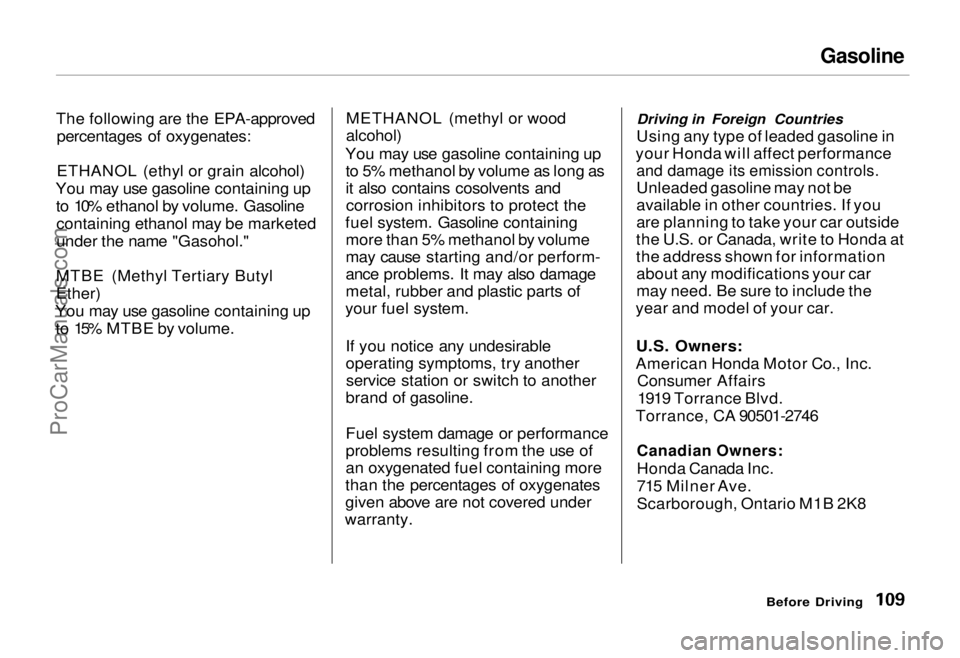
The following are the EPA-approved percentages of oxygenates:
ETHANOL (ethyl or grain alcohol)
You may use gasoline containing up to 10% ethanol by volume. Gasolinecontaining ethanol may be marketed
under the name "Gasohol."
MTBE (Methyl Tertiary Butyl
Ether)
You may use gasoline containing up to 15% MTBE by volume. METHANOL (methyl or wood
alcohol)
You may use gasoline containing up to 5% methanol by volume as long as
it also contains cosolvents andcorrosion inhibitors to protect the
fuel system. Gasoline containing more than 5% methanol by volume
may cause starting and/or perform-
ance problems. It may also damage
metal, rubber and plastic parts of
your fuel system.
If you notice any undesirable
operating symptoms, try anotherservice station or switch to another
brand of gasoline.
Fuel system damage or performance
problems resulting from the use of
an oxygenated fuel containing more
than the percentages of oxygenates
given above are not covered under
warranty. Driving in Foreign Countries
Using any type of leaded gasoline in
your Honda will affect performance
and damage its emission controls.
Unleaded gasoline may not be
available in other countries. If you
are planning to take your car outside
the U.S. or Canada, write to Honda at
the address shown for information about any modifications your car
may need. Be sure to include the
year and model of your car.
U.S. Owners:
American Honda Motor Co., Inc. Consumer Affairs
1919 Torrance Blvd.
Torrance, CA 90501-2746
Canadian Owners:
Honda Canada Inc.
715 Milner Ave.
Scarborough, Ontario M1B 2K8
Before DrivingProCarManuals.comMain Menu Table of Contents s t
Page 147 of 240
Engine Oil
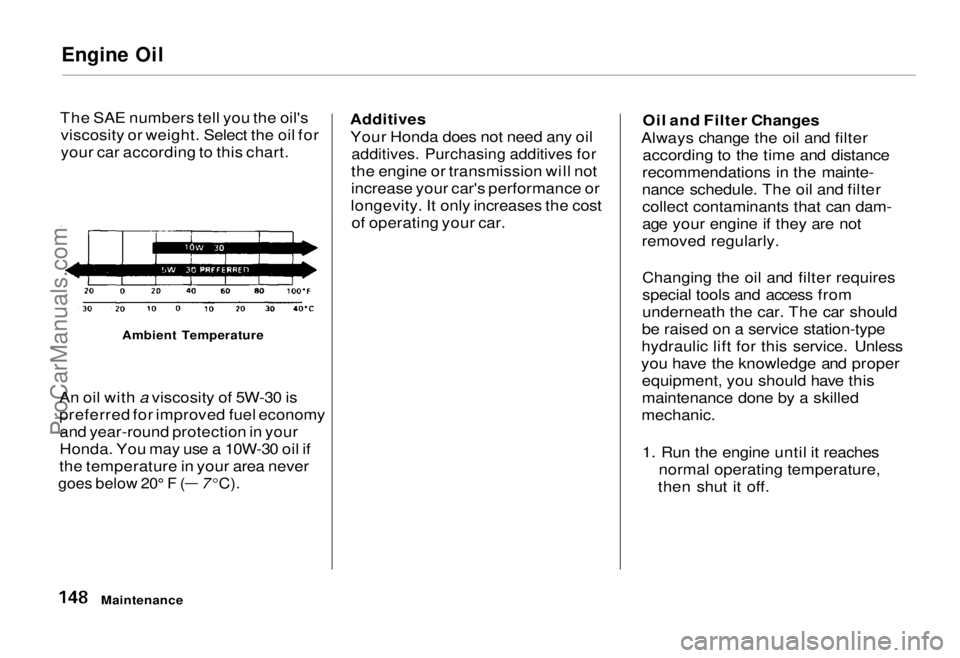
The SAE numbers tell you the oil's viscosity or weight. Select the oil for
your car according to this chart.
Ambient Temperature
An oil with a viscosity of 5W-30 is
preferred for improved fuel economy and year-round protection in your
Honda. You may use a 10W-30 oil if
the temperature in your area never
goes below 20° F ( —
7° C).
Additives
Your Honda does not need any oil
additives. Purchasing additives for
the engine or transmission will not
increase your car's performance or
longevity. It only increases the cost of operating your car. Oil and Filter Changes
Always change the oil and filter according to the time and distance
recommendations in the mainte-
nance schedule. The oil and filter collect contaminants that can dam-
age your engine if they are not
removed regularly.
Changing the oil and filter requires
special tools and access from
underneath the car. The car should
be raised on a service station-type
hydraulic lift for this service. Unless
you have the knowledge and proper equipment, you should have this
maintenance done by a skilled
mechanic.
1. Run the engine until it reaches normal operating temperature,
then shut it off.
MaintenanceProCarManuals.comMain Menu Table of Contents s t
Page 174 of 240
Lights
Check the operation of your car's
exterior lights at least once a month.
A burned out bulb can create an unsafe condition by reducing your
car's visibility and the ability to
signal your intentions to other
drivers.
Check the following:
Headlights (low and high beam)
Parking lights
Taillights Brake lights
High-mount brake light
Turn signals Back-up lights
Hazard light function
License plate light
Side marker lights
Daytime running lights (Canadian cars)
If you find any bulbs are burned out,
replace them as soon as possible. Refer to the chart on page 219 to
determine what type of replacement
bulb is needed. Headlight Aiming
The headlights were properly aimed when your car was new. You shouldcheck their aim if you regularly carry
heavy items in the cargo area or pull a trailer. Each headlight assembly
has horizontal and vertical adjust-
ment indicators. These are set to
their "0" positions after the
headlights are aimed at the factory.
To check these settings: 1. Make sure the fuel tank is full. Park the car on level ground.
2. The driver or someone who weighs the same should be sittingin the driver's seat for all checksand adjustments.
Load your car with the items you
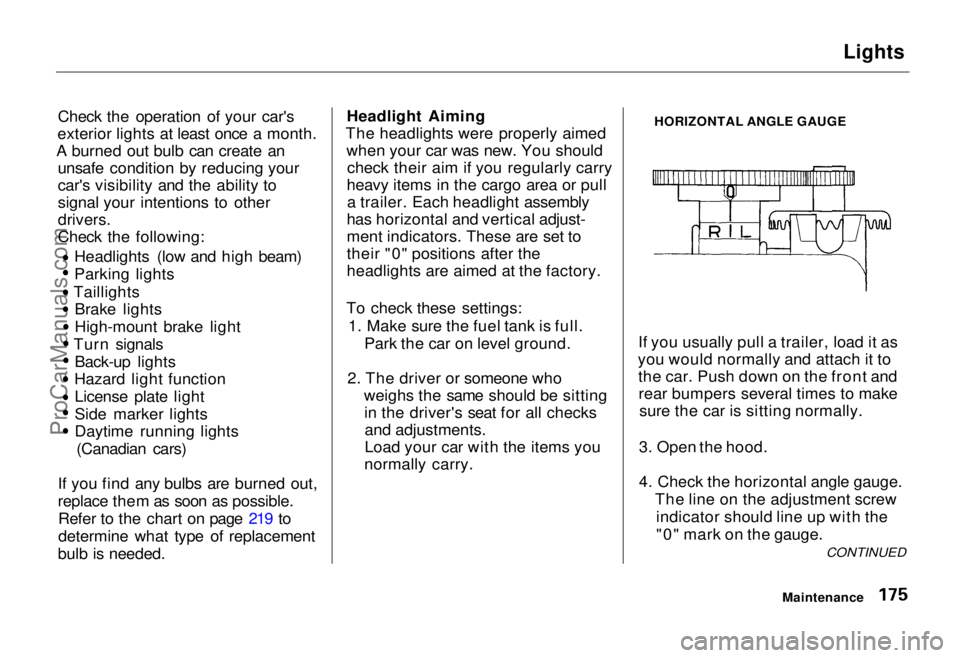
normally carry. HORIZONTAL ANGLE GAUGE
If you usually pull a trailer, load it as
you would normally and attach it to the car. Push down on the front andrear bumpers several times to make sure the car is sitting normally.
3. Open the hood.
4. Check the horizontal angle gauge. The line on the adjustment screwindicator should line up with the
"0" mark on the gauge.
Maintenance
CONTINUEDProCarManuals.comMain Menu Table of Contents s t
Page 240 of 240
Gas Station Information
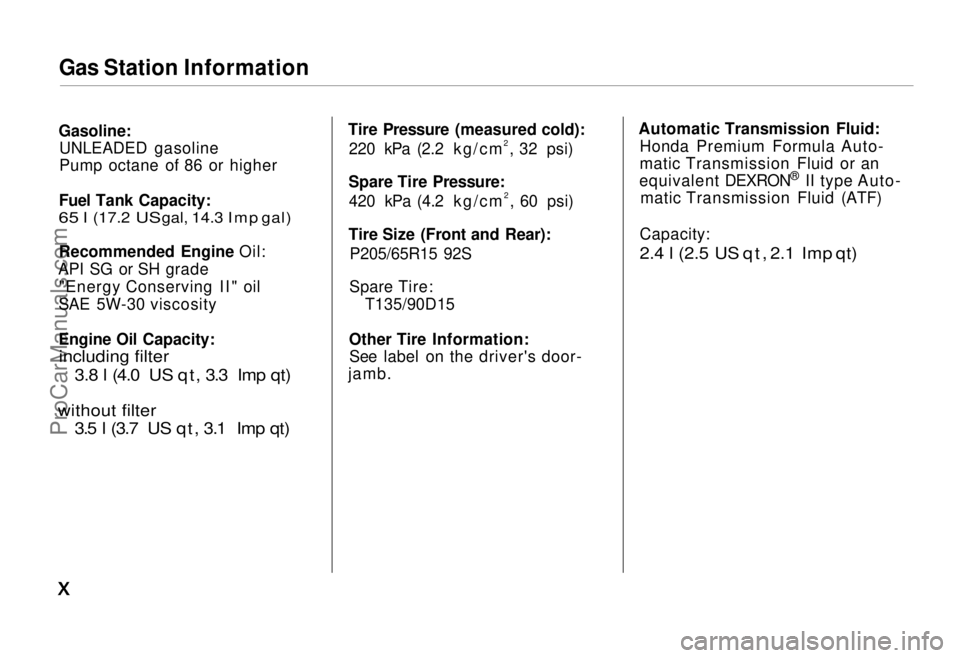
Gasoline:
UNLEADED gasoline
Pump octane of 86 or higher
Fuel Tank Capacity:
65 l (17.2 US gal, 14.3 Imp gal)
Recommended Engine Oil:
API SG or SH grade "Energy Conserving II" oil
SAE 5W-30 viscosity
Engine Oil Capacity:
including filter
3.8 l (4.0 US qt, 3.3 Imp qt)
without filter 3.5 l (3.7
US qt, 3.1 Imp qt)
Tire Pressure (measured cold):
220 kPa (2.2 kg/cm2, 32 psi)
Spare Tire Pressure: 420 kPa (4.2 kg/cm2, 60 psi)
Tire Size (Front and Rear): P205/65R15 92S
Spare Tire: T135/90D15
Other Tire Information: See label on the driver's door-
jamb. Automatic Transmission Fluid:
Honda Premium Formula Auto-
matic Transmission Fluid or an
equivalent DEXRON ®
II type Auto-
matic Transmission Fluid (ATF)
Capacity:
2.4 l (2.5 US qt, 2.1 Imp qt)ProCarManuals.comMain Menu s t