instrument panel HONDA ODYSSEY 1996 Owner's Manual
[x] Cancel search | Manufacturer: HONDA, Model Year: 1996, Model line: ODYSSEY, Model: HONDA ODYSSEY 1996Pages: 240, PDF Size: 2.64 MB
Page 86 of 240
Audio System
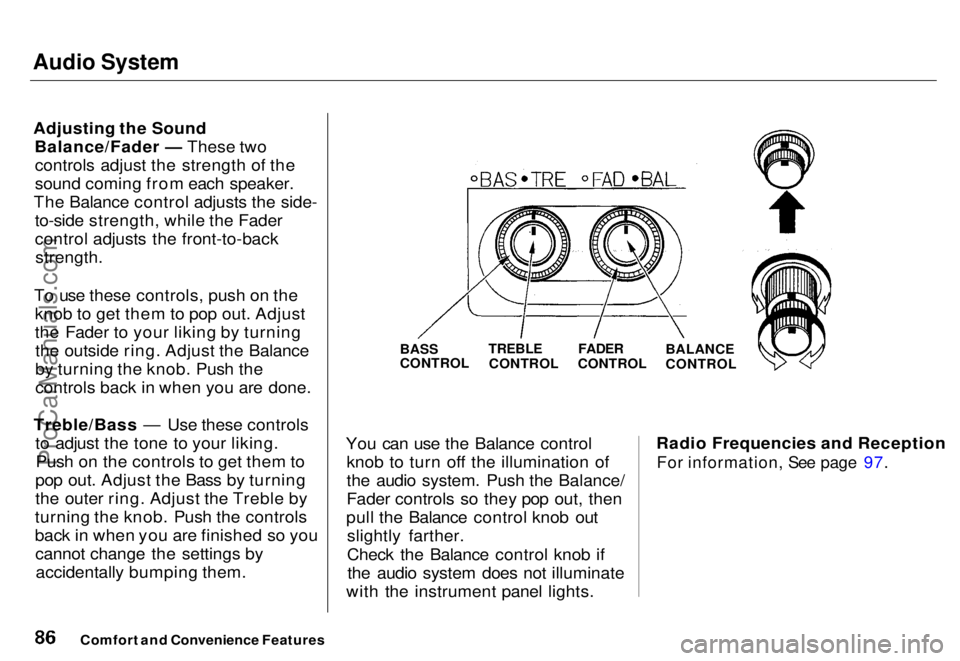
Adjusting the Sound Balance/Fader — These twocontrols adjust the strength of the
sound coming from each speaker.
The Balance control adjusts the side- to-side strength, while the Fader
control adjusts the front-to-back
strength.
To use these controls, push on the knob to get them to pop out. Adjust
the Fader to your liking by turningthe outside ring. Adjust the Balance
by turning the knob. Push the
controls back in when you are done.
Treble/Bass — Use these controls to adjust the tone to your liking.Push on the controls to get them to
pop out. Adjust the Bass by turning
the outer ring. Adjust the Treble by
turning the knob. Push the controls
back in when you are finished so you cannot change the settings byaccidentally bumping them.
BASS
CONTROL
You can use the Balance control knob to turn off the illumination of
the audio system. Push the Balance/
Fader controls so they pop out, then
pull the Balance control knob out slightly farther.
Check the Balance control knob ifthe audio system does not illuminate
with the instrument panel lights. Radio Frequencies and Reception
For information, See page 97.
Comfort and Convenience Features
TREBLE
CONTROL
FADER
CONTROL
BALANCE
CONTROLProCarManuals.comMain Menu s t Table of Contents
Page 118 of 240
Preparing to Drive
You should do the following checks
and adjustments every day before
you drive your car.
1. Make sure all windows, mirrors, and outside
lights are clean and
unobstructed. Remove frost, snow,
or ice.
2. Check that the hood and tailgate are fully closed.
3. Visually check the tires. If a tire looks low, use a gauge to check its
pressure.
4. Check that any items you may be carrying with you inside are stored
properly or fastened down
securely. 5. Check the adjustment of the seat
(see page 54).
6. Check the adjustment of the inside and outside mirrors (see
page 64).
7. Check the adjustment of the steering wheel (see page 44).
8. Make sure the doors are securely closed and locked.
9. Fasten your seat belt. Check that your passengers have fastened
their seat belts (see page 7 ). 10.Turn the ignition ON (II). Check
the indicator lights in the instru-
ment panel.
11. Start the engine (see page 119 ).
12. Check the gauges and indicator lights in the instrument panel (see
page 33 ).
DrivingProCarManuals.comMain Menu s t Table of Contents
Page 120 of 240
Automatic Transmission
Your Honda's transmission has fourforward speeds, and is electronicallycontrolled for smoother shifting. It
also has a "lock-up" torque converter
for better fuel economy. You may
feel what seems like another shift
when the converter locks. Shift Lever Positions
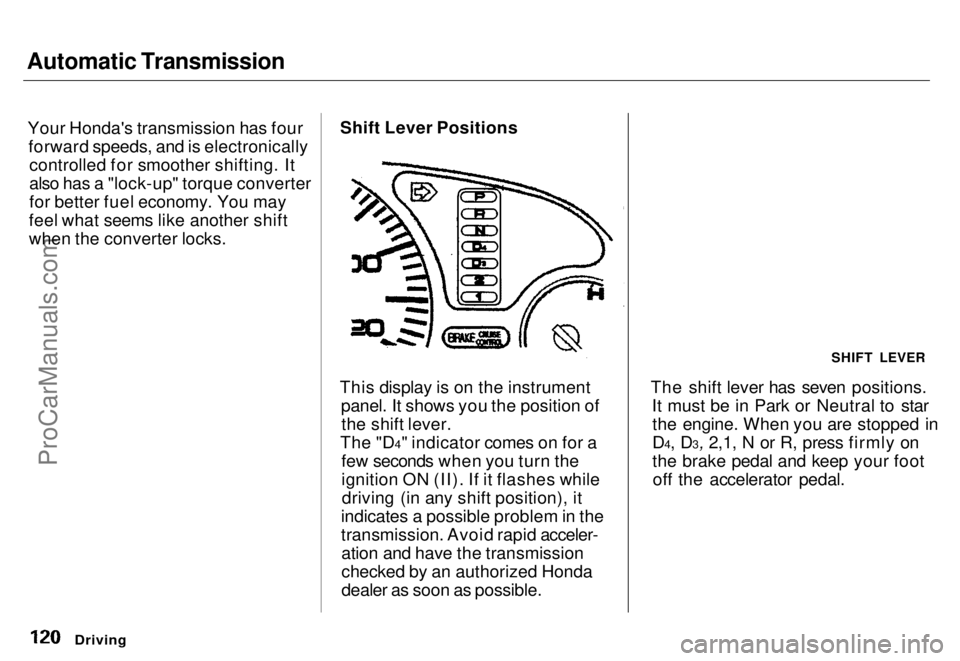
This display is on the instrument panel. It shows you the position ofthe shift lever.
The "D4" indicator comes on for a few seconds when you turn the
ignition ON (II). If it flashes whiledriving (in any shift position), it
indicates a possible problem in the
transmission. Avoid rapid acceler- ation and have the transmission
checked by an authorized Honda
dealer as soon as possible. The shift lever has seven positions.
It must be in Park or Neutral to starthe engine. When you are stopped in
D4, D3, 2,1, N or R, press firmly on
the brake pedal and keep your footoff the accelerator pedal.
Driving
SHIFT LEVERProCarManuals.comMain Menu s t Table of Contents
Page 125 of 240
The Braking System
If this happens, you will immediately notice that the brake pedal goes
down much farther and you need to
press on it much harder. A much
longer distance will be needed to stop the car.
Slow the car by downshifting to a
lower gear and removing your foot from the accelerator pedal. Pull to
the side of the road as soon as it issafe. Because of the longer stopping
distance needed, brake system
failure is very hazardous. It is best to have your car towed, but if you mustdrive the car in this condition, be
extremely cautious. Have your carrepaired as soon as possible.
Anti-lock Brakes
All U.S. models and the Canadian six- passenger model have an Anti-lock
Brake System (ABS) as standard
equipment. It is optional on the
Canadian seven-passenger model.
ABS helps you maintain steering control during braking. It does this
by helping you to prevent the wheels
from locking up and skidding.
The ABS is always "On". It requires no special effort or driving technique.
You will feel a pulsation in the brake pedal when the ABS activates.
Activation varies with the amount of traction your tires have. On dry
pavement, you will need to press on
the brake pedal very hard before you
feel the pedal pulsation that means the ABS has activated. However, you
may feel the ABS activate immedi- ately if you are trying to stop onsnow or ice. Under all conditions, the
ABS is helping to prevent the wheels from locking so you can retain steering control. You should con-
tinue to press on the brake pedal
with the same force.
You may feel a slight movement of
the brake pedal just after you start
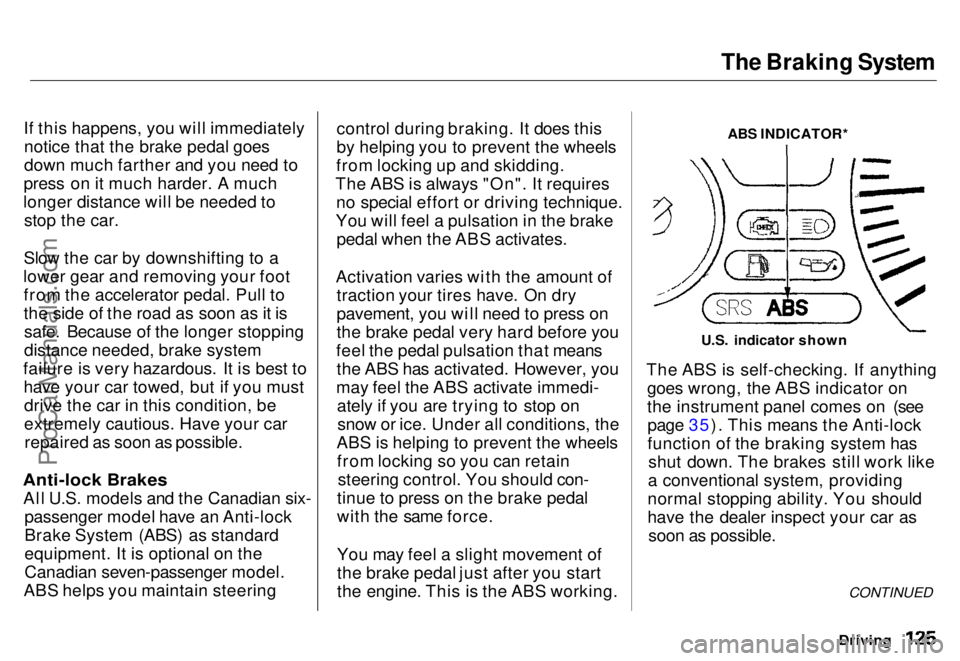
the engine. This is the ABS working. ABS INDICATOR*
U.S. indicator shown
The ABS is self-checking. If anything goes wrong, the ABS indicator on
the instrument panel comes on (seepage 35). This means the Anti-lock
function of the braking system has shut down. The brakes still work like
a conventional system, providing
normal stopping ability. You should
have the dealer inspect your car as soon as possible.
Driving
CONTINUEDProCarManuals.comMain Menu s t Table of Contents
Page 217 of 240
Anti-lock Brake System
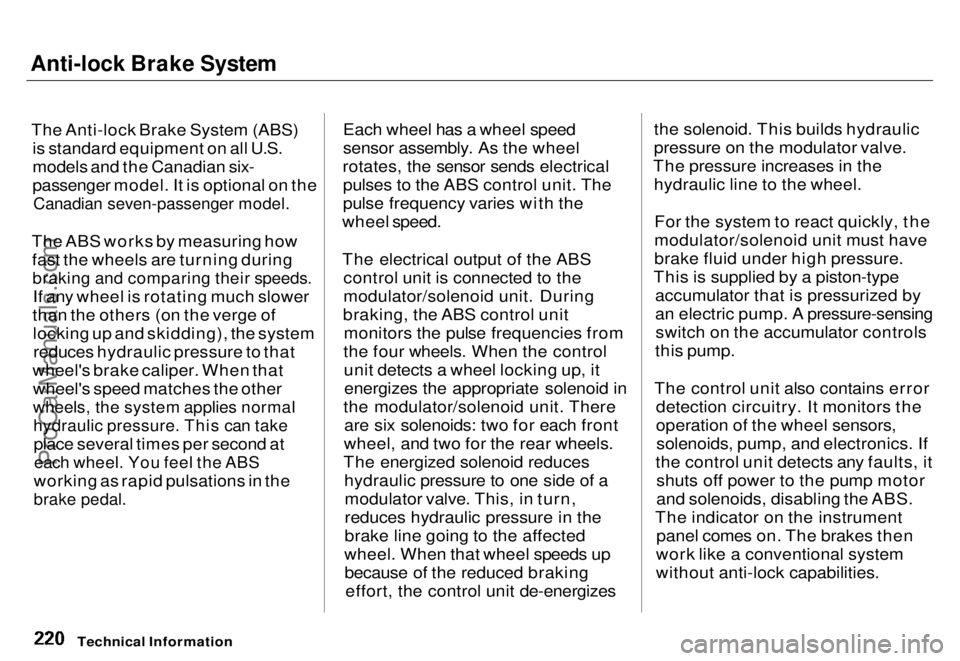
The Anti-lock Brake System (ABS) is standard equipment on all U.S.
models and the Canadian six-
passenger model. It is optional on the
Canadian seven-passenger model.
The ABS works by measuring how fast the wheels are turning during
braking and comparing their speeds.
If any wheel is rotating much slower
than the others (on the verge of locking up and skidding), the systemreduces hydraulic pressure to that
wheel's brake caliper. When that wheel's speed matches the other
wheels, the system applies normal
hydraulic pressure. This can take
place several times per second at
each wheel. You feel the ABS
working as rapid pulsations in the
brake pedal.
Each wheel has a wheel speed
sensor assembly. As the wheel
rotates, the sensor sends electrical pulses to the ABS control unit. The
pulse frequency varies with the
wheel speed.
The electrical output of the ABS control unit is connected to the
modulator/solenoid unit. During
braking, the ABS control unit monitors the pulse frequencies from
the four wheels. When the control unit detects a wheel locking up, itenergizes the appropriate solenoid in
the modulator/solenoid unit. There are six solenoids: two for each front
wheel, and two for the rear wheels.
The energized solenoid reduces hydraulic pressure to one side of amodulator valve. This, in turn,
reduces hydraulic pressure in the
brake line going to the affected
wheel. When that wheel speeds up because of the reduced braking effort, the control unit de-energizes the solenoid. This builds hydraulic
pressure on the modulator valve.
The pressure increases in the hydraulic line to the wheel.
For the system to react quickly, the
modulator/solenoid unit must have
brake fluid under high pressure.
This is supplied by a piston-type accumulator that is pressurized by
an electric pump. A pressure-sensingswitch on the accumulator controls
this pump.
The control unit also contains error detection circuitry. It monitors the
operation of the wheel sensors,solenoids, pump, and electronics. If
the control unit detects any faults, it shuts off power to the pump motor
and solenoids, disabling the ABS.
The indicator on the instrument panel comes on. The brakes then
work like a conventional system
without anti-lock capabilities.
Technical InformationProCarManuals.comMain Menu s t Table of Contents
Page 235 of 240
Index
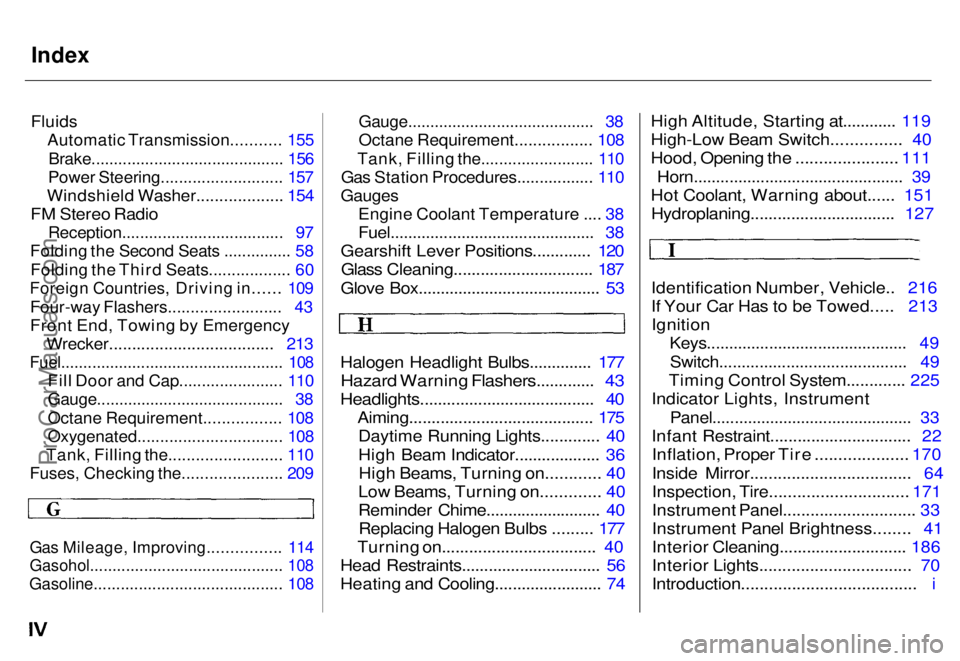
Fluids
Automatic Transmission........... 155
Brake........................................... 156
Power Steering........................... 157
Windshield Washer................... 154
FM Stereo Radio
Reception.................................... 97
Folding the Second Seats ............... 58
Folding the Third Seats.................. 60
Foreign Countries, Driving in...... 109
Four-way Flashers......................... 43
Front End, Towing by Emergency
Wrecker.................................... 213
Fuel.................................................. 108
Fill Door and Cap....................... 110
Gauge.......................................... 38
Octane Requirement................. 108
Oxygenated................................ 108
Tank, Filling the......................... 110
Fuses, Checking the...................... 209
Gas Mileage, Improving................ 114
Gasohol........................................... 108
Gasoline.......................................... 108
Gauge.......................................... 38
Octane Requirement................. 108
Tank, Filling the......................... 110
Gas Station Procedures................. 110
Gauges Engine Coolant Temperature .... 38
Fuel.............................................. 38
Gearshift Lever Positions............. 120 Glass Cleaning............................... 187
Glove Box......................................... 53
Halogen Headlight Bulbs.............. 177
Hazard Warning Flashers............. 43
Headlights....................................... 40
Aiming......................................... 175Daytime Running Lights............. 40
High Beam Indicator................... 36High Beams, Turning on............ 40
Low Beams, Turning on............. 40
Reminder Chime.......................... 40 Replacing Halogen Bulbs ......... 177
Turning on.................................. 40
Head Restraints............................... 56
Heating and Cooling........................ 74 High Altitude, Starting at............ 119
High-Low Beam Switch............... 40
Hood, Opening the ...................... 111
Horn............................................... 39
Hot Coolant, Warning about...... 151 Hydroplaning................................ 127
Identification Number, Vehicle.. 216
If Your Car Has to be Towed..... 213Ignition
Keys............................................. 49
Switch.......................................... 49
Timing Control System............. 225
Indicator Lights, Instrument
Panel............................................. 33
Infant Restraint............................... 22 Inflation, Proper Tire .................... 170
Inside Mirror................................... 64
Inspection, Tire.............................. 171
Instrument Panel............................. 33
Instrument Panel Brightness........ 41
Interior Cleaning............................ 186
Interior Lights................................. 70
Introduction...................................... iProCarManuals.comMain Menu s t