engine HONDA ODYSSEY 1997 Repair Manual
[x] Cancel search | Manufacturer: HONDA, Model Year: 1997, Model line: ODYSSEY, Model: HONDA ODYSSEY 1997Pages: 241, PDF Size: 2.52 MB
Page 209 of 241
Fuses
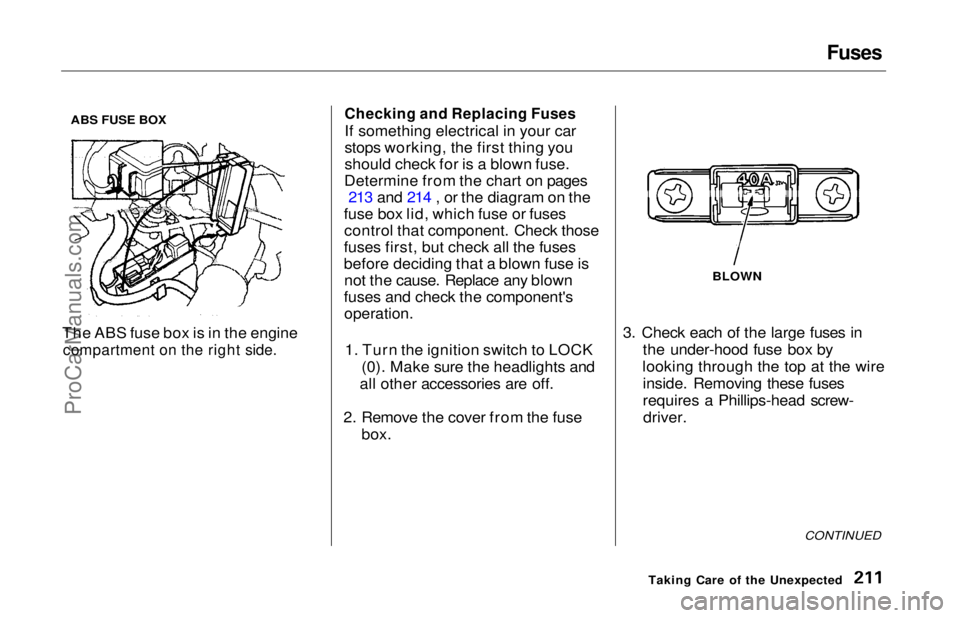
ABS FUSE BOX
The ABS fuse box is in the engine
compartment on the right side.
Checking and Replacing Fuses
If something electrical in your car
stops working, the first thing you
should check for is a blown fuse.
Determine from the chart on pages 213 and 214 , or the diagram on the
fuse box lid, which fuse or fuses control that component. Check those
fuses first, but check all the fuses
before deciding that a blown fuse is not the cause. Replace any blown
fuses and check the component's
operation.
1. Turn the ignition switch to LOCK (0). Make sure the headlights and
all other accessories are off.
2. Remove the cover from the fuse box. 3. Check each of the large fuses in
the under-hood fuse box by
looking through the top at the wire inside. Removing these fuses
requires a Phillips-head screw-driver.
CONTINUED
Taking Care of the Unexpected
BLOWNProCarManuals.comMain Menu Table of Contents s t
Page 213 of 241
Towing
If your car needs to be towed, call a
professional towing service or, if you
belong to one, an organization that
provides roadside assistance. Never
tow your car behind another car with
just a rope or chain. It is very
dangerous.
Emergency Towing
There are three popular methods of towing a car:
Flat-bed Equipment — The operator
loads your car on the back of a truck.
This is the best way of trans- porting your Honda.
Wheel Lift Equipment — The tow
truck uses two pivoting arms that go
under the tires (front or rear) and lift
them off the ground. The other two
tires remain on the ground.
Sling-type Equipment — The tow
truck uses metal cables with hooks on the ends. These hooks go around
parts of the frame or suspension and
the cables lift that end of the car off
the ground. Your car's suspension and body can be seriously damaged
if this method of towing is attempted.
If your Honda cannot be transported
by flat-bed, it should be towed with
the front wheels off the ground. If due to damage, your car must be
towed with the front wheels on the
ground, do the following:
Release the parking brake.
Start the engine.
Shift to D4, then to N.
Turn off the engine.
Improper towing preparation will
damage the transmission. Follow the
above procedure exactly. If you cannot
shift the transmission or start the
engine, your car must be transported
on a flat-bed.
It is best to tow the car no farther
than 50 miles (80 km), and keep
the speed below 35 mph (55
km/h).
Trying to lift or tow your car by the
bumpers will cause serious damage. The bumpers are not designed to
support the car's weight.
Taking Care of the Unexpected
NOTICE
NOTICEProCarManuals.comMain Menu Table of Contents s t
Page 215 of 241
Identification Numbers
Your car has several identifying numbers located in various places.
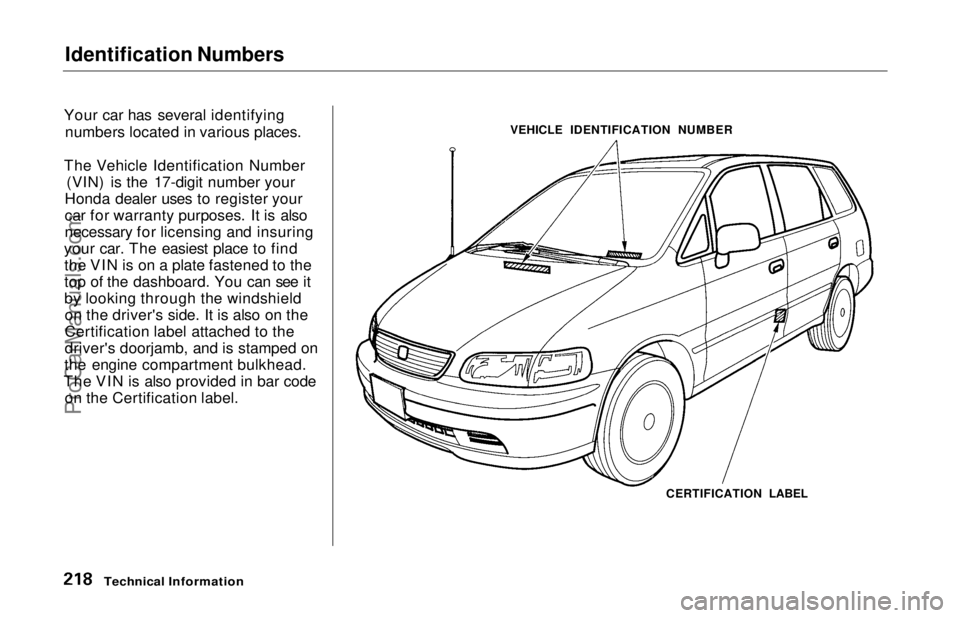
The Vehicle Identification Number (VIN) is the 17-digit number your
Honda dealer uses to register your
car for warranty purposes. It is also
necessary for licensing and insuring
your car. The easiest place to find the VIN is on a plate fastened to the
top of the dashboard. You can see it
by looking through the windshieldon the driver's side. It is also on the
Certification label attached to the
driver's doorjamb, and is stamped on
the engine compartment bulkhead.
The VIN is also provided in bar code on the Certification label. VEHICLE IDENTIFICATION NUMBER
CERTIFICATION LABEL
Technical InformationProCarManuals.comMain Menu Table of Contents s t
Page 216 of 241
Identification Numbers
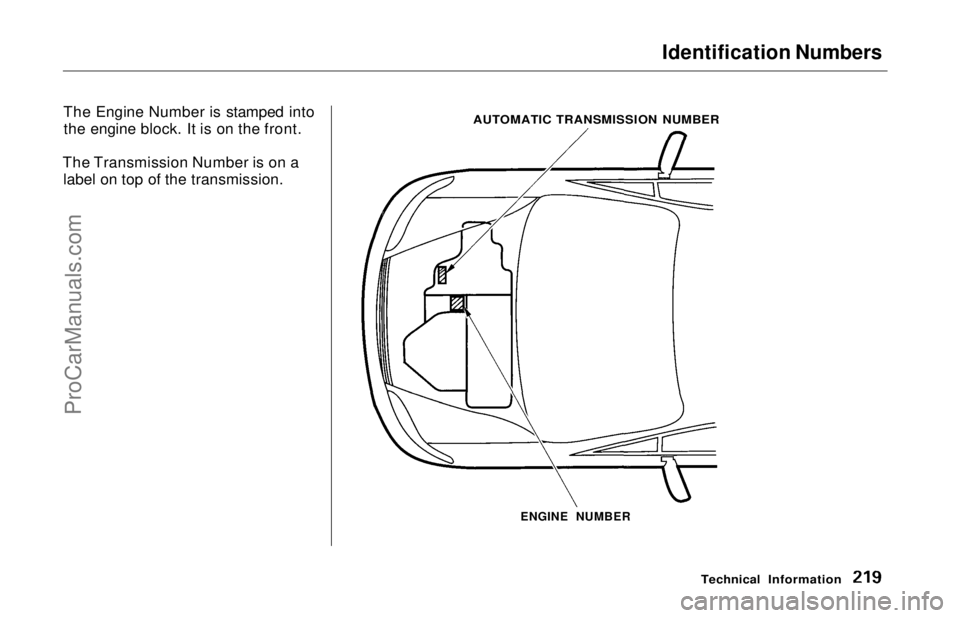
The Engine Number is stamped into the engine block. It is on the front.
The Transmission Number is on a label on top of the transmission.
Technical Information
AUTOMATIC TRANSMISSION NUMBER
ENGINE NUMBERProCarManuals.comMain Menu Table of Contents s t
Page 217 of 241
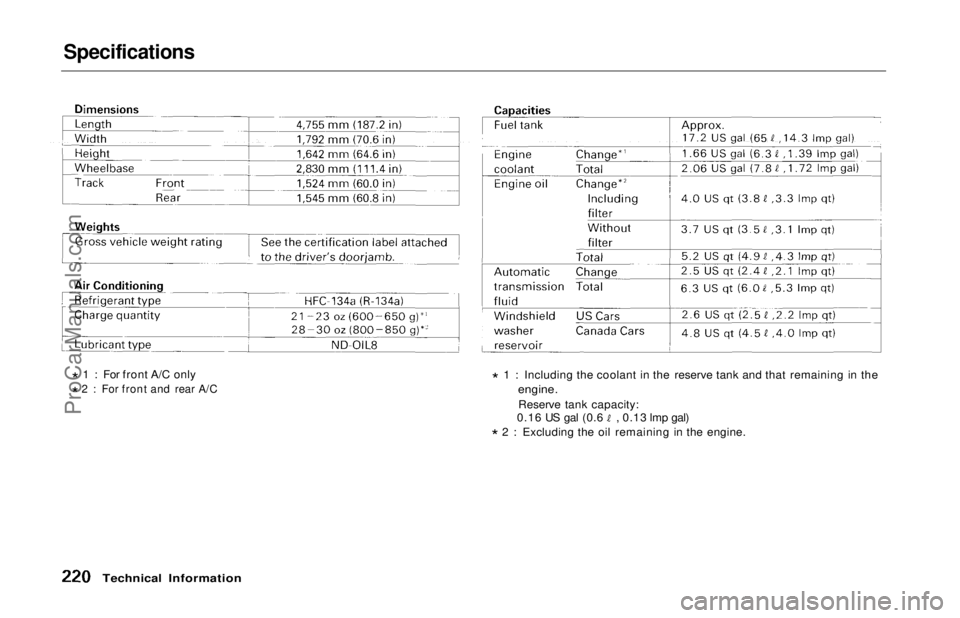
Specifications
* 1 : For front A/C only
* 2 : For front and rear A/C
*
1 : Including the coolant in the reserve tank and that remaining in the
engine.
Reserve tank capacity:
0.16
US gal
(0.6 , 0.13 lmp gal)
* 2 : Excluding the oil remaining in the engine.
Technical InformationProCarManuals.comMain Menu Table of Contents s t
Page 222 of 241
Emission Controls
The burning of gasoline in your car's engine produces several byproducts.
Some of these are carbon monoxide (CO), oxides of nitrogen (NOx) and
hydrocarbons (HC). Gasoline evaporating from the tank also
produces hydrocarbons. Controlling
the production of NOx, CO, and HC is important to the environment.
Under certain conditions of sunlight
and climate, NOx and HC react to
form photochemical "smog." Carbon
monoxide does not contribute to smog creation, but it is a poisonous
gas.
The Clean Air Act
The United States Clean Air Act* sets standards for automobile
emissions. It also requires that
automobile manufacturers explain to owners how their emission controls
work and what to do to maintain them. This section summarizes how
the emission controls work.
Scheduled maintenance is on page 142.
* In Canada, Honda vehicles comply
with the Canadian Motor Vehicle Safety Standards (CMVSS) for
Emissions valid at the time they are
manufactured. Crankcase Emission Control
System
Your car has a Positive Crankcase
Ventilation System. This keeps gasses that build up in the engine's crankcase from going into the
atmosphere. The Positive Crankcase
Ventilation valve routes them from the crankcase back to the intakemanifold. They are then drawn into
the engine and burned.
Evaporative Emission Control
System
As gasoline evaporates in the fuel tank, an evaporative emission controlcanister filled with charcoal adsorbs
the vapor. It is stored in this canister
while the engine is off. After the engine is started and warmed up, the
vapor is drawn into the engine and burned during driving.
Technical InformationProCarManuals.comMain Menu Table of Contents s t
Page 223 of 241
Emission Controls
Exhaust Emission Controls
The exhaust emission controls include four systems: PGM-FI,
Ignition Timing Control, ExhaustGas Recirculation and Three Way
Catalytic Converter. These four
systems work together to control the
engine's combustion and minimize
the amount of HC, CO, and NOx that
comes out the tailpipe. The exhaust
emission control systems are
separate from the crankcase and
evaporative emission control
systems.
PGM-FI System
The PGM-FI System uses sequential multiport fuel injection.It has three subsystems: Air Intake,
Engine Control, and Fuel Control.
The Powertrain Control Module (PCM) uses various sensors to
determine how much air is going
into the engine. It then controls how
much fuel to inject under all operat-
ing conditions. Ignition Timing Control System
This system constantly adjusts the ignition timing, reducing the amountof HC, CO and NOx produced.
Exhaust Gas Recirculation (EGR)
System
The Exhaust Gas Recirculation (EGR) system takes some of the
exhaust gas and routes it back into
the intake manifold. Adding exhaust
gas to the air/fuel mixture reduces
the amount of NOx produced when
the fuel is burned.
Three Way Catalytic Converter
The three way catalytic converter is in the exhaust system. Through
chemical reactions, it converts HC,CO, and NOx in the engine's exhaust
to carbon dioxide (CO 2), dinitrogen
(N 2), and water vapor. Replacement Parts
The emission control systems are designed and certified to work to-
gether in reducing emissions to
levels that comply with the Clean Air
Act. To make sure the emissions remain low, you should use only newGenuine Honda replacement parts or
their equivalent for repairs. Using
lower quality parts may increase the emissions from your car.
The emissions control systems are covered by warranties separate from
the rest of your car. Read your
warranty manual for more informa-
tion.
Technical InformationProCarManuals.comMain Menu Table of Contents s t
Page 224 of 241
Three Way Catalytic Converter
The three way catalytic converter contains precious metals that serve
as catalysts, promoting chemical
reactions to convert the exhaust
gasses without affecting the metals.
The catalytic converter is referred to as a three-way catalyst, since it acts
on HC, CO, and NOx. A replacement
unit must be an original Honda part or its equivalent.
The three way catalytic converter must operate at a high temperature
for the chemical reactions to take
place. It can set on fire any com- bustible materials that come near it.
Park your car away from high grass,
dry leaves, or other flammables. A defective three way catalytic
converter contributes to air pollution,and can impair your engine's per-
formance. Follow these guidelines to
protect your car's three way catalytic converter.
Always use unleaded gasoline.Even a small amount of leaded
gasoline can contaminate the catalyst metals, making the three
way catalytic converter ineffective. Keep the engine tuned-up.
Have your car diagnosed and
repaired if it is misfiring, back-
firing, stalling, or otherwise not running properly.
Technical Information
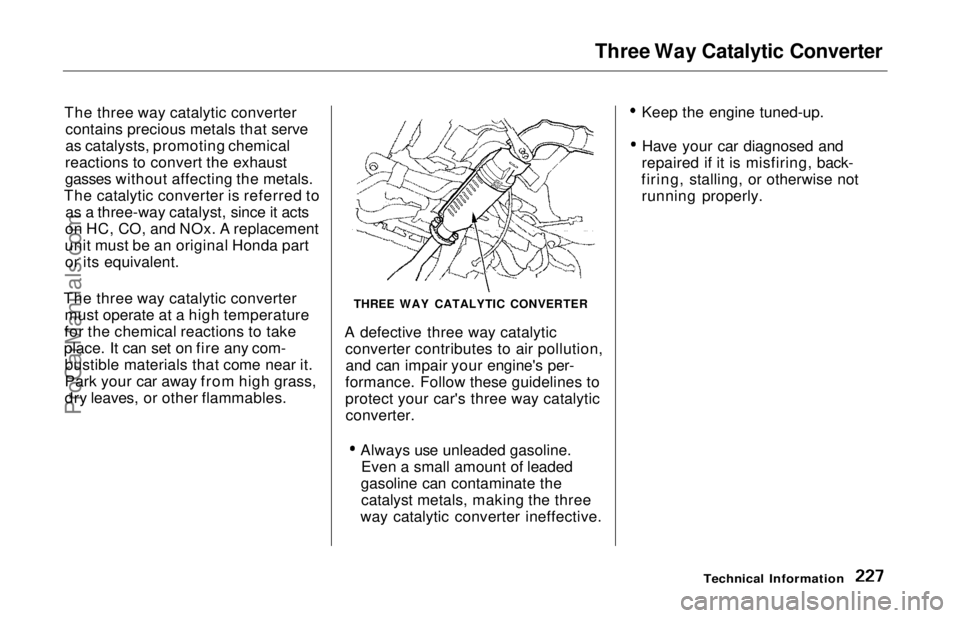
THREE WAY CATALYTIC CONVERTERProCarManuals.comMain Menu Table of Contents s t
Page 232 of 241
Authorized Manuals
These Publications cannot be returned for credit without receiving advance authorization within 14days of delivery. On returns, a restocking fee may be applied against the original order.
P.O. BOX 07280 DETROIT, MICHIGAN 48207 1-800-782-4356
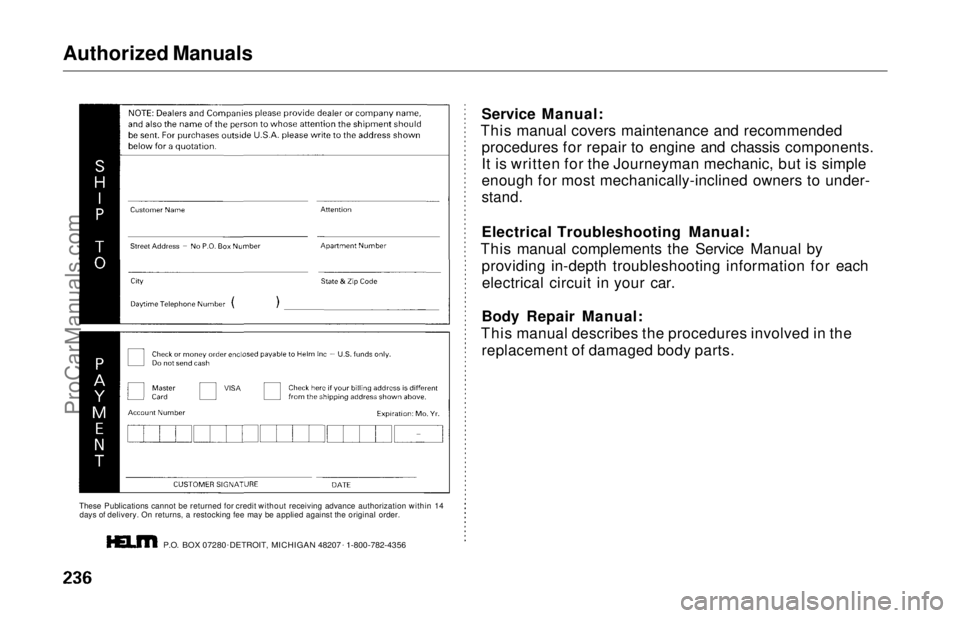
Service Manual:
This manual covers maintenance and recommended procedures for repair to engine and chassis components.
It is written for the Journeyman mechanic, but is simple
enough for most mechanically-inclined owners to under-
stand.
Electrical Troubleshooting Manual:
This manual complements the Service Manual by providing in-depth troubleshooting information for eachelectrical circuit in your car.
Body Repair Manual:
This manual describes the procedures involved in the replacement of damaged body parts.ProCarManuals.comMain Menu Table of Contents s t
Page 233 of 241
Index
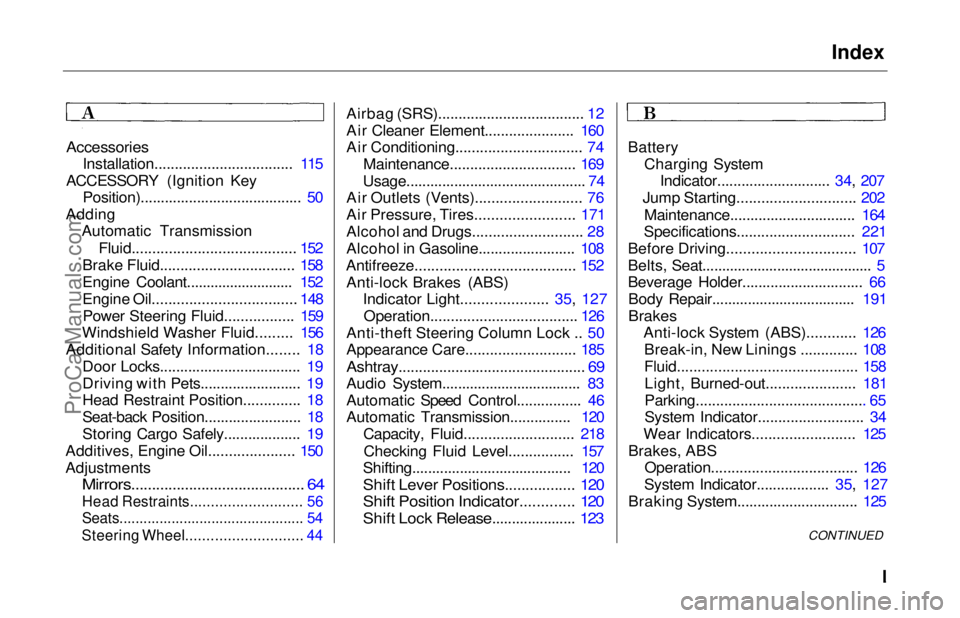
Accessories
Installation.................................. 115
ACCESSORY (Ignition Key Position)........................................ 50
Adding Automatic Transmission
Fluid........................................ 152
Brake Fluid................................. 158
Engine Coolant........................... 152
Engine Oil................................... 148 Power Steering Fluid................. 159
Windshield Washer Fluid......... 156
Additional Safety Information........ 18 Door Locks................................... 19
Driving with Pets......................... 19
Head Restraint Position.............. 18
Seat-back Position........................ 18
Storing Cargo Safely................... 19
Additives, Engine Oil..................... 150
Adjustments
Mirrors.......................................... 64
Head Restraints........................... 56
Seats.............................................. 54
Steering Wheel............................ 44
Airbag (SRS).................................... 12
Air Cleaner Element...................... 160
Air Conditioning............................... 74
Maintenance............................... 169
Usage............................................. 74
Air Outlets (Vents).......................... 76
Air Pressure, Tires........................ 171
Alcohol and Drugs........................... 28
Alcohol in Gasoline........................ 108
Antifreeze....................................... 152 Anti-lock Brakes (ABS) Indicator Light..................... 35, 127
Operation.................................... 126
Anti-theft Steering Column Lock .. 50
Appearance Care........................... 185
Ashtray.............................................. 69
Audio System................................... 83
Automatic Speed Control................ 46
Automatic Transmission............... 120 Capacity, Fluid........................... 218
Checking Fluid Level................ 157
Shifting........................................ 120
Shift Lever Positions................. 120
Shift Position Indicator............. 120
Shift Lock Release..................... 123
Battery
Charging SystemIndicator............................ 34, 207
Jump Starting............................. 202
Maintenance............................... 164
Specifications............................. 221
Before Driving............................... 107
Belts, Seat........................................... 5
Beverage Holder.............................. 66 Body Repair.................................... 191
Brakes
Anti-lock System (ABS)............ 126
Break-in, New Linings .............. 108
Fluid............................................ 158
Light, Burned-out...................... 181
Parking.......................................... 65
System Indicator.......................... 34
Wear Indicators......................... 125
Brakes, ABS Operation.................................... 126
System Indicator.................. 35, 127
Braking System.............................. 125
CONTINUEDProCarManuals.comMain Menu s t