mileage HONDA ODYSSEY 1997 Owners Manual
[x] Cancel search | Manufacturer: HONDA, Model Year: 1997, Model line: ODYSSEY, Model: HONDA ODYSSEY 1997Pages: 241, PDF Size: 2.52 MB
Page 109 of 241

Gasoline
The following are the EPA-approved percentages of oxygenates:
ETHANOL (ethyl or grain alcohol)
You may use gasoline containing up to 10 percent ethanol by volume.Gasoline containing ethanol may be
marketed under the name "Gasohol."
MTBE (Methyl Tertiary Butyl Ether)
You may use gasoline containing up to 15 percent MTBE by volume.
METHANOL (methyl or wood
alcohol)
You may use gasoline containing up to 5 percent methanol by volume as
long as it also contains cosolventsand corrosion inhibitors to protect
the fuel system. Gasoline containing
more than 5 percent methanol by
volume may cause starting and/or performance problems. It may alsodamage metal, rubber and plastic
parts of your fuel system. If you notice any undesirable
operating symptoms, try another
service station or switch to another
brand of gasoline.
Fuel system damage or performance
problems resulting from the use of an oxygenated fuel containing more
than the percentages of oxygenates
given above are not covered under
warranty.
Driving in Foreign Countries
If you are planning to take your Honda outside the U.S. or Canada,
contact the tourist bureaus in the
areas you will be traveling in to find out about the availability of unleaded
gasoline with the proper octane
rating.
If unleaded gasoline is not available,
be aware that using leaded gasoline in your Honda will affect perfor-
mance and fuel mileage, and damage
its emissions controls. It will no
longer comply with U.S. andCanadian emissions regulations, and
will be illegal to operate in North
America. To bring your car back into compliance will require the replace-
ment of several components, such as
the oxygen sensors and the three
way catalytic converter. These re- placements are not covered under
warranty.
Before DrivingProCarManuals.comMain Menu Table of Contents s t
Page 114 of 241
Fuel Economy
The condition of your car and your driving habits are the two most
important things that affect the fuel
mileage you get.
Vehicle Condition
Always maintain your car according to the maintenance schedule. This
will keep it in top operating condition.
An important part of that mainte- nance is the Owner Maintenance
Checks (see page 146). For
example, an underinflated tire
causes more "rolling resistance,"
which uses fuel. It also wears out
faster, so check the tire pressure at
least monthly.
In winter, the build-up of snow on
your car's underside adds weight and
rolling resistance. Frequent cleaning
helps your fuel mileage and reduces
the chance of corrosion. Driving Habits
You can improve fuel economy by driving moderately. Rapid acceler-
ation, abrupt cornering, and hard
braking use more fuel.
Always drive in the highest gear that allows the engine to run and acceler-
ate smoothly.
Depending on traffic conditions, try
to maintain a constant speed. Every
time you slow down and speed up,
your car uses extra fuel. Use the cruise control, when appropriate, to
increase fuel economy. A cold engine uses more fuel than a
warm engine. It is not necessary to"warm-up" a cold engine by letting it
idle for a long time. You can drive
away in about a minute, no matter
how cold it is outside. The engine
will warm up faster, and you get better fuel economy. To cut down on
the number of "cold starts," try to combine several short trips into one.
The air conditioning puts an extra load on the engine which makes it use more fuel. Turn off the A/C to
cut down on air conditioning use. Use the flow-through ventilation
when the outside air temperature is moderate.
Before DrivingProCarManuals.comMain Menu Table of Contents s t
Page 139 of 241
Maintenance Schedule
The Maintenance Schedule specifies how often you should have your carserviced and what things need
attention. It is essential that you have
your car serviced as scheduled to retain its high level of safety,dependability, and emission control
performance.
The services and time or distance
intervals shown in the maintenance
schedule assume you will use your
car as normal transportation for
passengers and their possessions.
You should also follow these
recommendations:
Avoid exceeding your car's loadlimit. This puts excess stress on
the engine, brakes, and manyother parts of your car. The load
limit is shown on the label on the driver's doorjamb.
Operate your car on reasonable
roads within the legal speed limit.
Drive your car regularly over a
distance of several miles
(kilometers).
Always use unleaded gasoline with the proper octane rating (see page
108
).
Which Schedule to Follow:
Service your car according to the
time and mileage periods on one of
the Maintenance Schedules on the
following pages. Select the schedule
for "Severe Conditions" if most of
your driving is done under one or more of the conditions listed on that
page. Otherwise, follow the schedule
for "Normal Conditions."
MaintenanceProCarManuals.comMain Menu Table of Contents s t
Page 140 of 241

Maintenance Schedule
Your authorized Honda dealer knows your car best and can provide
competent, efficient service.
However, service at a dealer is not
mandatory to keep your warranties
in effect. Maintenance may be done
by any qualified service facility or
person who is skilled in this type of
automotive service. Keep all the
receipts as proof of completion, and
have the person who does the work
fill out the Maintenance Record. Check your warranty booklet for
more information. We recommend the use of Genuine
Honda parts and fluids whenever you
have maintenance done. These are
manufactured to the same high- quality standards as the original
components, so you can be confident
of their performance and durability.
U.S. Cars:
Maintenance, replacement or
repair of emission control devices
and systems may be done by any
automotive repair establishment or individual using parts that are
"certified" to EPA standards. According to state and federal
regulations, failure to perform
maintenance on the items marked
with an asterisk (*) will not void your emissions warranties. However,Honda recommends that all mainte-
nance services be performed at the
recommended time or mileage
period to ensure long-term reliability.
MaintenanceProCarManuals.comMain Menu Table of Contents s t
Page 183 of 241
Storing Your Car
If you need to park your car for an
extended period (more than one
month), there are several things you should do to prepare it for storage.
Proper preparation helps prevent deterioration and makes it easier to
get your car back on the road. If
possible, store your car indoors.
Fill the fuel tank.Change the engine oil and filter (see page 150).
Wash and dry the exterior completely.
Clean the interior. Make sure the
carpeting, floor mats, etc. are
completely dry.
Leave the parking brake off. Put
the transmission in Park. Block the rear wheels.
If the car is to be stored for a
longer period, it should be supported on jackstands so the
tires are off the ground.
Leave one window open slightly (if
the car is being stored indoors).
Disconnect the battery.
Support the front and rear wiper
blade arms with a folded towel or
rag so they do not touch the
windshield.
To minimize sticking, apply a silicone spray lubricant to all door
and trunk seals. Also, apply a car
body wax to the painted surfaces
that mate with the door and trunk
seals.
Cover the car with a "breathable"
car cover, one made from a porous
material such as cotton.
Nonporous materials, such as
plastic sheeting, trap moisture,
which can damage the paint.
If possible, run the engine for a
while periodically (preferably once a month).
If you store your car for 12 months
or longer, have your Honda dealer
perform the inspections called for in the 24 months/30,000 miles (48,000
km) maintenance schedule (Normal Conditions) as soon as you take it
out of storage (see page 142). The
replacements called for in the maintenance schedule are not
needed unless the car has actually
reached that time or mileage.
MaintenanceProCarManuals.comMain Menu Table of Contents s t
Page 226 of 241
Customer Relations Information
Honda dealership personnel are
trained professionals. They should
be able to answer all your questions. If you encounter a problem that your
dealership does not solve to your
satisfaction, please discuss it with
the dealership's management. The
Service Manager or General
Manager can help. Almost all
problems are solved in this way. If you are dissatisfied with the
decision made by the dealership's
management, contact your Honda Customer Relations Zone Office.
Refer to the U.S. and Canadian Zone Office maps on the following pages.
When you call or write, please give
us this information:
Vehicle Identification Number
(see page 218)
Name and address of the dealer
who services your car Date of purchaseMileage on your car
Your name, address, and tele- phone number
A detailed description of the problem
Name of the dealer who sold the
car to you
Warranty and Customer RelationsProCarManuals.comMain Menu Table of Contents s t
Page 229 of 241

Warranty Coverages
U.S. Owners
Your new Honda is covered by these
warranties:
New Car Limited Warranty — covers
your new car, except for the battery, emissions control systems and
accessories, against defects in
materials and workmanship.
Emissions Control Systems Defects
Warranty and Emissions
Performance Warranty — these two
warranties cover your car's emis- sions control systems. Time, mileage,
and coverage are conditional. Please
read the warranty manual for exact information.
Original Equipment Battery Limited
Warranty — this warranty gives up
to 100 percent credit toward a
replacement battery.
Seat Belt Limited Warranty — a seat
belt that fails to function properly is
covered for the useful life of the car.
Rust Perforation Limited Warranty
— all exterior body panels are
covered for rust-through from the
inside for the specified time period
with no mileage limit.
Accessory Limited Warranty —
Genuine Honda Accessories are
covered under this warranty. Time
and mileage limits depend on the
type of accessory and other factors. Please read your warranty manual
for details.
Replacement Parts Limited
Warranty — covers all Genuine
Honda replacement parts against defects in materials and workman-
ship.
Replacement Battery Limited
Warranty — provides prorated
coverage for a replacement battery
purchased from a Honda dealer.
Replacement Muffler Lifetime
Limited Warranty — provides
coverage for as long as the pur-
chaser of the muffler owns the car.
Restrictions and exclusions apply to
all these warranties. Please read the 1997 Honda Warranties booklet that
came with your car for precise
information on warranty coverages.
Your Honda's original tires are covered by their manufacturer. Tire
warranty information is in a separate
booklet.
Canadian Owners
Please refer to the 1997 Warranty
Manual that came with your car.
Warranty and Customer RelationsProCarManuals.comMain Menu Table of Contents s t
Page 236 of 241
Index
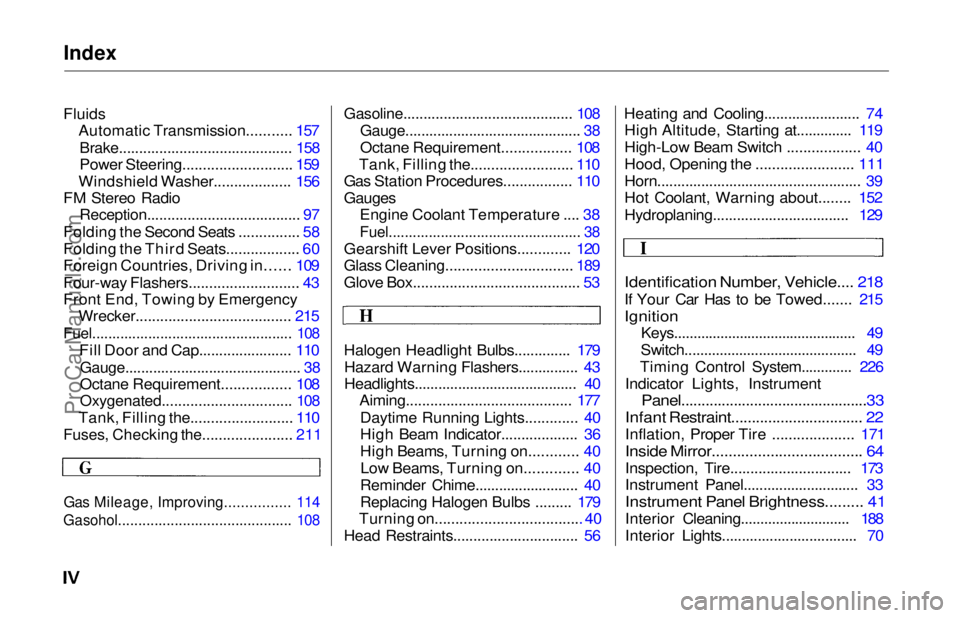
Fluids Automatic Transmission........... 157
Brake........................................... 158
Power Steering........................... 159
Windshield Washer................... 156
FM Stereo Radio
Reception...................................... 97
Folding the Second Seats ............... 58
Folding the Third Seats.................. 60
Foreign Countries, Driving in...... 109
Four-way Flashers........................... 43
Front End, Towing by Emergency Wrecker...................................... 215
Fuel.................................................. 108
Fill Door and Cap....................... 110
Gauge............................................ 38
Octane Requirement................. 108
Oxygenated................................ 108
Tank, Filling the......................... 110
Fuses, Checking the...................... 211
Gas Mileage, Improving................ 114
Gasohol........................................... 108
Gasoline.......................................... 108
Gauge............................................ 38
Octane Requirement................. 108
Tank, Filling the......................... 110
Gas Station Procedures................. 110
Gauges Engine Coolant Temperature .... 38
Fuel................................................ 38
Gearshift Lever Positions............. 120
Glass Cleaning............................... 189
Glove Box......................................... 53
Halogen Headlight Bulbs.............. 179 Hazard Warning Flashers............... 43
Headlights......................................... 40 Aiming......................................... 177
Daytime Running Lights............. 40
High Beam Indicator................... 36
High Beams, Turning on............ 40Low Beams, Turning on............. 40
Reminder Chime.......................... 40
Replacing Halogen Bulbs ......... 179
Turning on....................................
40
Head Restraints...............................
56Heating and Cooling........................ 74
High Altitude, Starting at.............. 119
High-Low Beam Switch .................. 40
Hood, Opening the ........................ 111
Horn................................................... 39
Hot Coolant, Warning about........ 152
Hydroplaning.................................. 129
Identification Number, Vehicle.... 218
If Your Car Has to be Towed....... 215
Ignition
Keys............................................... 49
Switch............................................ 49
Timing Control System............. 226
Indicator Lights, Instrument
Panel..............................................33
Infant Restraint................................ 22
Inflation, Proper Tire .................... 171
Inside Mirror.................................... 64
Inspection, Tire.............................. 173
Instrument Panel............................. 33
Instrument Panel Brightness......... 41
Interior Cleaning............................ 188
Interior Lights.................................. 70ProCarManuals.comMain Menu s t