light HONDA ODYSSEY 1997 Repair Manual
[x] Cancel search | Manufacturer: HONDA, Model Year: 1997, Model line: ODYSSEY, Model: HONDA ODYSSEY 1997Pages: 241, PDF Size: 2.52 MB
Page 182 of 241
Lights
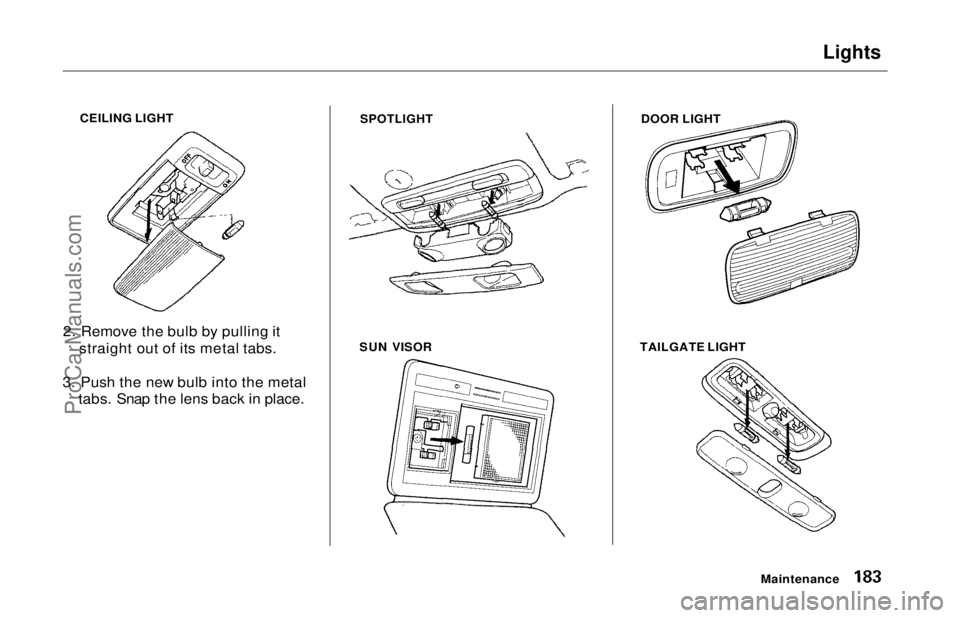
CEILING LIGHT
2. Remove the bulb by pulling it straight out of its metal tabs.
3. Push the new bulb into the metal tabs. Snap the lens back in place.
SPOTLIGHT
SUN VISOR DOOR LIGHT
TAILGATE LIGHT
MaintenanceProCarManuals.comMain Menu Table of Contents s t
Page 183 of 241
Storing Your Car
If you need to park your car for an
extended period (more than one
month), there are several things you should do to prepare it for storage.
Proper preparation helps prevent deterioration and makes it easier to
get your car back on the road. If
possible, store your car indoors.
Fill the fuel tank.Change the engine oil and filter (see page 150).
Wash and dry the exterior completely.
Clean the interior. Make sure the
carpeting, floor mats, etc. are
completely dry.
Leave the parking brake off. Put
the transmission in Park. Block the rear wheels.
If the car is to be stored for a
longer period, it should be supported on jackstands so the
tires are off the ground.
Leave one window open slightly (if
the car is being stored indoors).
Disconnect the battery.
Support the front and rear wiper
blade arms with a folded towel or
rag so they do not touch the
windshield.
To minimize sticking, apply a silicone spray lubricant to all door
and trunk seals. Also, apply a car
body wax to the painted surfaces
that mate with the door and trunk
seals.
Cover the car with a "breathable"
car cover, one made from a porous
material such as cotton.
Nonporous materials, such as
plastic sheeting, trap moisture,
which can damage the paint.
If possible, run the engine for a
while periodically (preferably once a month).
If you store your car for 12 months
or longer, have your Honda dealer
perform the inspections called for in the 24 months/30,000 miles (48,000
km) maintenance schedule (Normal Conditions) as soon as you take it
out of storage (see page 142). The
replacements called for in the maintenance schedule are not
needed unless the car has actually
reached that time or mileage.
MaintenanceProCarManuals.comMain Menu Table of Contents s t
Page 185 of 241
Exterior Care
Washing
Frequent washing helps preserve
your car's beauty. Dirt and grit can scratch the paint, while tree sap and
bird droppings can permanently ruin the finish.
Wash your car in a shady area, not in direct sunlight. If the car is parked in
the sun, move it into the shade and
let the exterior cool down before you start.
Only use the solvents and cleaners
recommended in this Owner's
Manual.
Chemical solvents and strong cleaners
can damage the paint, metal, and
plastic on your car.
Rinse the car thoroughly with cool
water to remove loose dirt.
Fill a bucket with cool water. Mix
in a mild detergent, such as
dishwashing liquid or a product
made especially for car washing.
Wash the car, using the water and detergent solution and a soft-
bristle brush, sponge, or soft cloth. Start at the top and work your way
down. Rinse frequently.
Check the body for road tar, tree
sap, etc. Remove these stains with
tar remover or turpentine. Rinse it off immediately so it does not
harm the finish. Remember to re-
wax these areas, even if the rest of the car does not need waxing. When you have washed and rinsed
the whole exterior, dry it with a
chamois or soft towel. Letting itair-dry will cause dulling and water
spots.
As you dry the car, inspect it for chips and scratches that could allow
corrosion to start. Repair them with
touch-up paint (see page 187).
The radio antenna on your car does not
need to be removed when you use a "drive-through'' car wash. However, if
you remove the antenna, make sure to
reinstall it and tighten it securely using
an appropriate tool.
Appearance Care
NOTICE
NOTICEProCarManuals.comMain Menu Table of Contents s t
Page 186 of 241

Exterior Care
Waxing Always wash and dry the whole car before waxing it. You should wax
your car, including the metal trim,
whenever water sits on the surface in large patches. It should form into
beads or droplets after waxing.
You should use a quality liquid or paste wax. Apply it according to the
instructions on the container. In
general, there are two types of
products:
Waxes — A wax coats the finish and protects it from damage by exposure
to sunlight, air pollution, etc. You should use a wax on your Honda
when it is new.
Polishes — Polishes and cleaner/
waxes can restore the shine to paint that has oxidized and lost some of itsshine. They normally contain mild
abrasives and solvents that remove
the top layer of the finish. You should use a polish on your Honda if
the finish does not have its original shine after using a wax.
Cleaning tar, insects, etc. with
removers also takes off the wax.
Remember to re-wax those areas,
even if the rest of the car does not
need waxing.
Aluminum Wheels
On some models
Clean your Honda's aluminum alloy
wheels as you do the rest of the exterior. Wash them with the same
solution, and rinse them thoroughly.
The wheels have a protective clear- coat that keeps the aluminum from
corroding and tarnishing. Using
harsh chemicals, including some commercial wheel cleaners, or stiff
brushes can damage this clear-coat. Only use a mild detergent and soft
brush or sponge to clean the wheels.
Paint Touch-up
Your dealer has touch-up paint to match your car's color. The color
code is printed on a sticker on thedriver's doorjamb. Take this code to
your dealer so you are sure to get the correct color.
Inspect your car frequently for chipsor scratches in the paint. Repair
them right away to prevent corrosion of the metal underneath. Use the
touch-up paint only on small chips and scratches. More extensive paint
damage should be repaired by a
professional.
Appearance CareProCarManuals.comMain Menu Table of Contents s t
Page 193 of 241
Changing a Flat Tire
If you have a flat tire while driving, stop in a safe place to change it.
Stopping in traffic or on the shoulder
of a busy road is dangerous. Drive
slowly along the shoulder until you
get to an exit or an area to stop that
is far away from the traffic lanes.
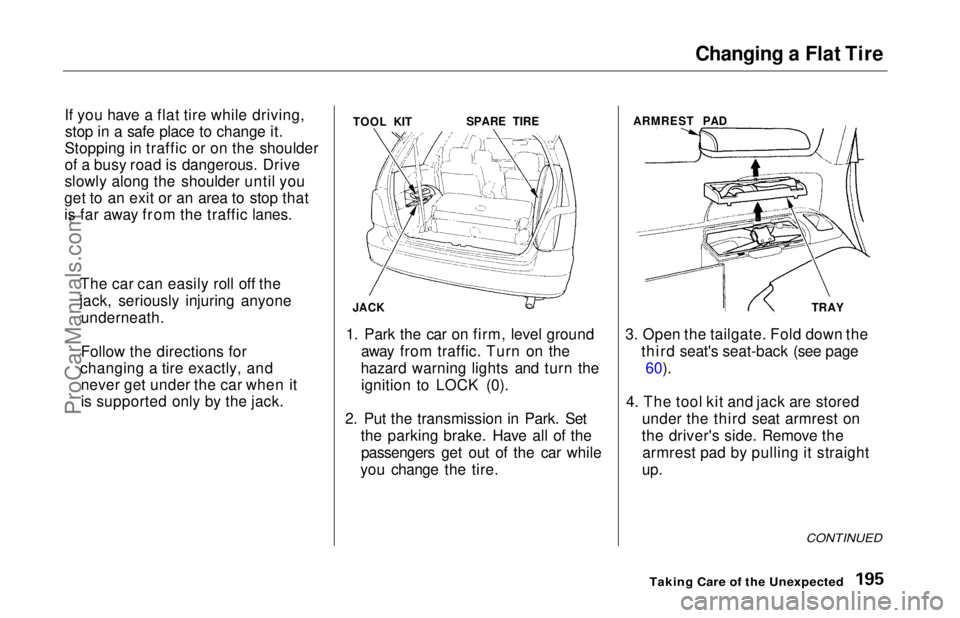
1. Park the car on firm, level groundaway from traffic. Turn on the
hazard warning lights and turn the ignition to LOCK (0).
2. Put the transmission in Park. Set the parking brake. Have all of thepassengers get out of the car while
you change the tire. 3. Open the tailgate. Fold down the
third seat's seat-back (see page60).
4. The tool kit and jack are stored under the third seat armrest on
the driver's side. Remove the armrest pad by pulling it straight
up.
CONTINUED
Taking Care of the Unexpected
The car can easily roll off the
jack, seriously injuring anyone underneath.
Follow the directions for
changing a tire exactly, and never get under the car when it
is supported only by the jack. TOOL KIT
JACK SPARE TIRE
ARMREST PAD
TRAYProCarManuals.comMain Menu Table of Contents s t
Page 199 of 241
If Your Engine Won't Start
Diagnosing why your engine won't
start falls into two areas, depending
on what you hear when you turn the
key to START (III):
You hear nothing, or almostnothing. The engine's starter
motor does not operate at all, oroperates very slowly.
You can hear the starter motor operating normally, or the starter
motor sounds like it is spinning
faster than normal, but the engine does not start up and run. Nothing Happens or the Starter
Motor Operates Very Slowly
When you turn the ignition switch to START (III), you do not hear the
normal noise of the engine trying to start. You may hear a clicking sound
or series of clicks, or nothing at all. Check these things:
Check the transmission interlock.
The transmission must be in Park or Neutral or the starter will not
operate.
Turn the ignition switch to ON (II).
Turn on the headlights and check their brightness. If the headlightsare very dim or don't light at all,
the battery is discharged. See
Jump Starting on page 202.
Turn the ignition switch to START
(III). If the headlights do not dim,
check the condition of the fuses. If
the fuses are OK, there is proba-
bly something wrong with the electrical circuit for the ignition
switch or starter motor. You will
need a qualified technician to determine the problem. (See
Towing on page 215.)
If the headlights dim noticeably or
go out when you try to start the engine, either the battery is dis-
charged or the connections are
corroded. Check the condition of
the battery and terminal connec-
tions (see page 164). You can
then try jump starting the car from a booster battery (see page 203).
Taking Care of the UnexpectedProCarManuals.comMain Menu Table of Contents s t
Page 200 of 241
If Your Engine Won't Start, Jump Starting
The Starter Operates Normally In this case, the starter motor'sspeed sounds normal, or even faster
than normal, when you turn the
ignition switch to START (III), but
the engine does not run.
Are you using the proper startingprocedure? Refer to Starting the
Engine on page 119.
Do you have fuel? Turn the
ignition switch to ON (II) for a
minute and watch the fuel gauge.
The low fuel level warning light may not be working, so you were
not reminded to fill the tank.
There may be an electrical problem, such as no power to the
fuel pump. Check all the fuses (see page 211).
If you find nothing wrong, you will
need a qualified technician to find
the problem. See Towing on page
215.
Jump Starting
If your car's battery has run down,
you may be able to start the engine by using a booster battery. Although
this seems like a simple procedure,
you should take several precautions.
You cannot start a Honda by pushing or pulling it. To jump start your car, follow these
directions closely:
1. Open the hood and check the physical condition of the battery(see page 164). In very cold
weather, check the condition of
the electrolyte. If it seems slushy or like ice, do not try jump starting
until it thaws.
If a battery sits in extreme cold, the electrolyte, inside can freeze.
Attempting to jump start with a frozen battery can cause it to rupture.
2. Turn off all the electrical acces-
sories: heater, A/C, stereo system,
lights, etc.
Put the transmission in Neutral or
Park and set the parking brake.
Taking Care of the Unexpected
A battery can explode if you do
not follow the correct procedure,
seriously injuring anyone nearby.
Keep all sparks, open flames,
and smoking materials away
from the battery.
NOTICEProCarManuals.comMain Menu Table of Contents s t
Page 204 of 241
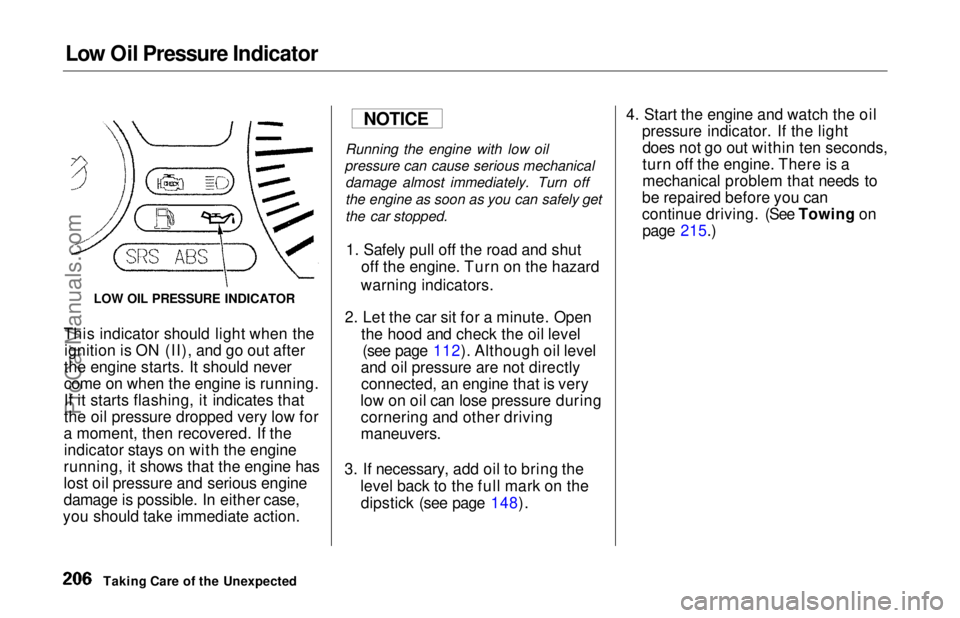
Low Oil Pressure Indicator
This indicator should light when the ignition is ON (II), and go out after
the engine starts. It should never
come on when the engine is running.
If it starts flashing, it indicates that
the oil pressure dropped very low for
a moment, then recovered. If the indicator stays on with the engine
running, it shows that the engine has
lost oil pressure and serious engine
damage is possible. In either case,
you should take immediate action. Running the engine with low oil
pressure can cause serious mechanical damage almost immediately. Turn off
the engine as soon as you can safely get
the car stopped.
1. Safely pull off the road and shut off the engine. Turn on the hazard
warning indicators.
2. Let the car sit for a minute. Open the hood and check the oil level(see page 112). Although oil level
and oil pressure are not directly connected, an engine that is very
low on oil can lose pressure during cornering and other driving
maneuvers.
3. If necessary, add oil to bring the level back to the full mark on thedipstick (see page 148). 4. Start the engine and watch the oil
pressure indicator. If the lightdoes not go out within ten seconds,
turn off the engine. There is a
mechanical problem that needs to
be repaired before you can
continue driving. (See Towing on page 215.)
Taking Care of the Unexpected
NOTICE
LOW OIL PRESSURE INDICATORProCarManuals.comMain Menu Table of Contents s t
Page 209 of 241
Fuses
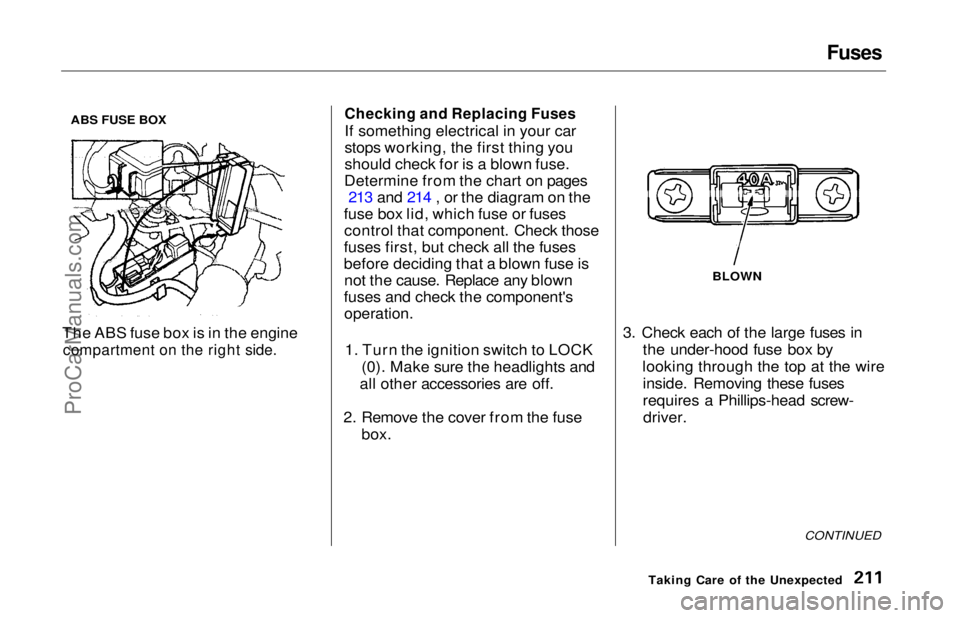
ABS FUSE BOX
The ABS fuse box is in the engine
compartment on the right side.
Checking and Replacing Fuses
If something electrical in your car
stops working, the first thing you
should check for is a blown fuse.
Determine from the chart on pages 213 and 214 , or the diagram on the
fuse box lid, which fuse or fuses control that component. Check those
fuses first, but check all the fuses
before deciding that a blown fuse is not the cause. Replace any blown
fuses and check the component's
operation.
1. Turn the ignition switch to LOCK (0). Make sure the headlights and
all other accessories are off.
2. Remove the cover from the fuse box. 3. Check each of the large fuses in
the under-hood fuse box by
looking through the top at the wire inside. Removing these fuses
requires a Phillips-head screw-driver.
CONTINUED
Taking Care of the Unexpected
BLOWNProCarManuals.comMain Menu Table of Contents s t
Page 210 of 241
Fuses
FUSE PULLER
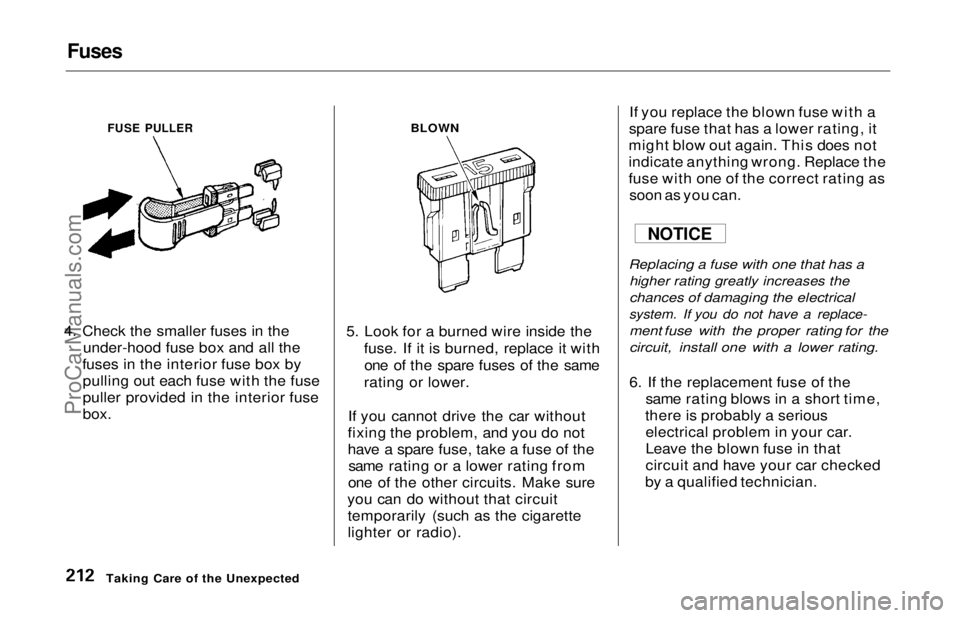
4. Check the smaller fuses in the under-hood fuse box and all the
fuses in the interior fuse box by pulling out each fuse with the fuse
puller provided in the interior fuse
box. BLOWN
5. Look for a burned wire inside the fuse. If it is burned, replace it withone of the spare fuses of the same
rating or lower.
If you cannot drive the car without
fixing the problem, and you do not
have a spare fuse, take a fuse of the same rating or a lower rating from
one of the other circuits. Make sure
you can do without that circuit temporarily (such as the cigarette
lighter or radio). If you replace the blown fuse with a
spare fuse that has a lower rating, it
might blow out again. This does not
indicate anything wrong. Replace the
fuse with one of the correct rating as soon as you can.
Replacing a fuse with one that has a
higher rating greatly increases the
chances of damaging the electrical
system. If you do not have a replace-
ment fuse with the proper rating for the
circuit, install one with a lower rating.
6. If the replacement fuse of the same rating blows in a short time,
there is probably a serious electrical problem in your car.
Leave the blown fuse in that
circuit and have your car checked
by a qualified technician.
Taking Care of the Unexpected
NOTICEProCarManuals.comMain Menu Table of Contents s t