ECU HONDA ODYSSEY 1999 User Guide
[x] Cancel search | Manufacturer: HONDA, Model Year: 1999, Model line: ODYSSEY, Model: HONDA ODYSSEY 1999Pages: 343, PDF Size: 3.73 MB
Page 34 of 343
Protecting Children
To deactivate the locking mechanism and remove a child seat,
unlatch the buckle, unroute the seat
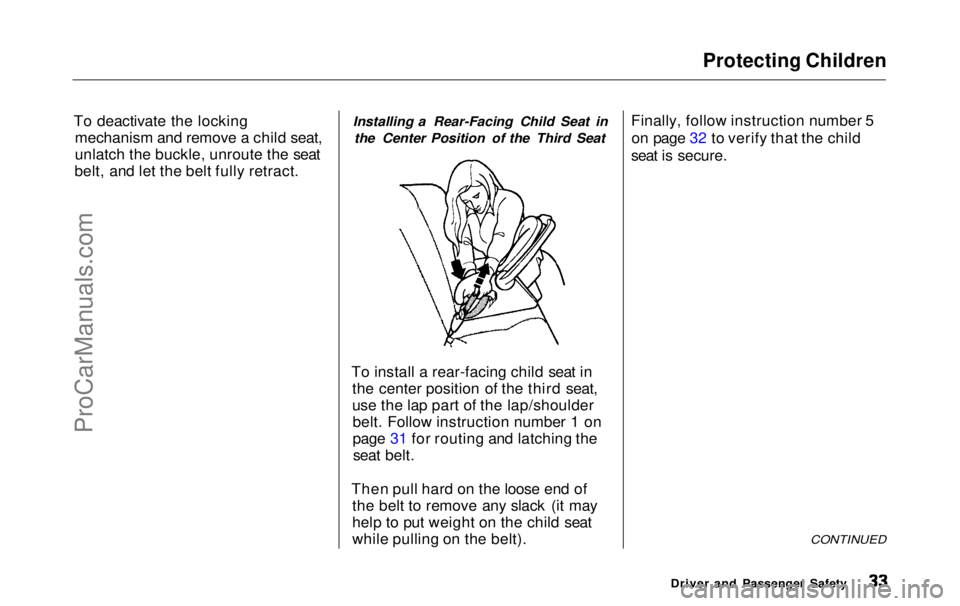
belt, and let the belt fully retract. Installing a Rear-Facing Child Seat in
the Center Position of the Third Seat
To install a rear-facing child seat in the center position of the third seat,
use the lap part of the lap/shoulderbelt. Follow instruction number 1 on
page 31 for routing and latching theseat belt.
Then pull hard on the loose end of the belt to remove any slack (it may
help to put weight on the child seat
while pulling on the belt). Finally, follow instruction number 5
on page 32 to verify that the child
seat is secure.
CONTINUED
Driver and Passenger SafetyProCarManuals.comMain Menu Table of Contents s t
Page 37 of 343
Protecting Children
If it is necessary to put a forward-
facing child seat in the front, move
the vehicle seat as far to the rear as
possible, be sure the child seat is firmly secured to the vehicle, and the
child is properly strapped in the seat.
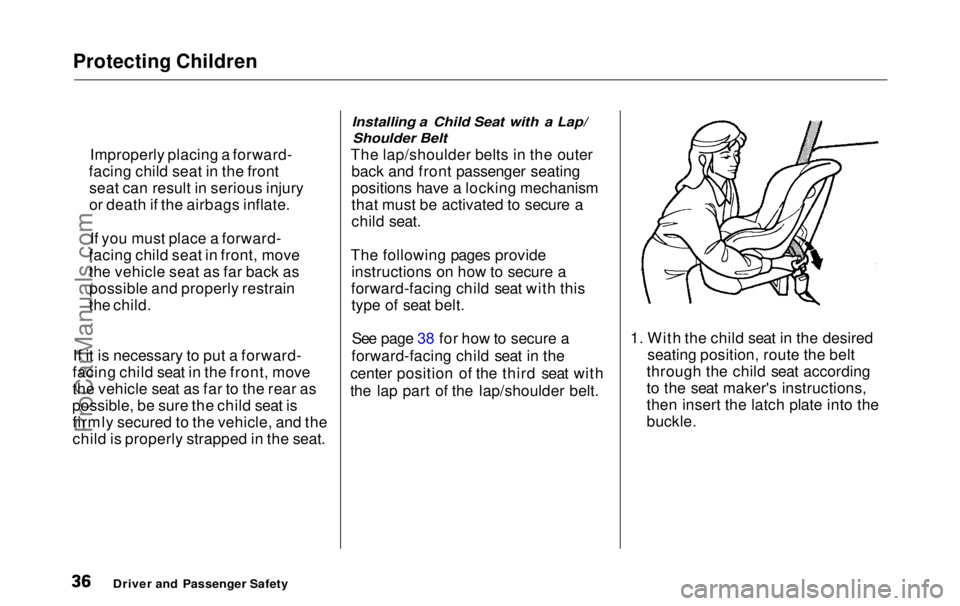
Installing a Child Seat with a Lap/
Shoulder Belt
The lap/shoulder belts in the outer back and front passenger seating
positions have a locking mechanism
that must be activated to secure a
child seat.
The following pages provide instructions on how to secure a
forward-facing child seat with this type of seat belt.
See page 38 for how to secure a
forward-facing child seat in the
center position of the third seat with
the lap part of the lap/shoulder belt. 1. With the child seat in the desired
seating position, route the belt
through the child seat according
to the seat maker's instructions,
then insert the latch plate into the
buckle.
Driver and Passenger Safety
Improperly placing a forward-
facing child seat in the front seat can result in serious injury
or death if the airbags inflate.
If you must place a forward-
facing child seat in front, move
the vehicle seat as far back as possible and properly restrain
the child.ProCarManuals.comMain Menu Table of Contents s t
Page 38 of 343
Protecting Children
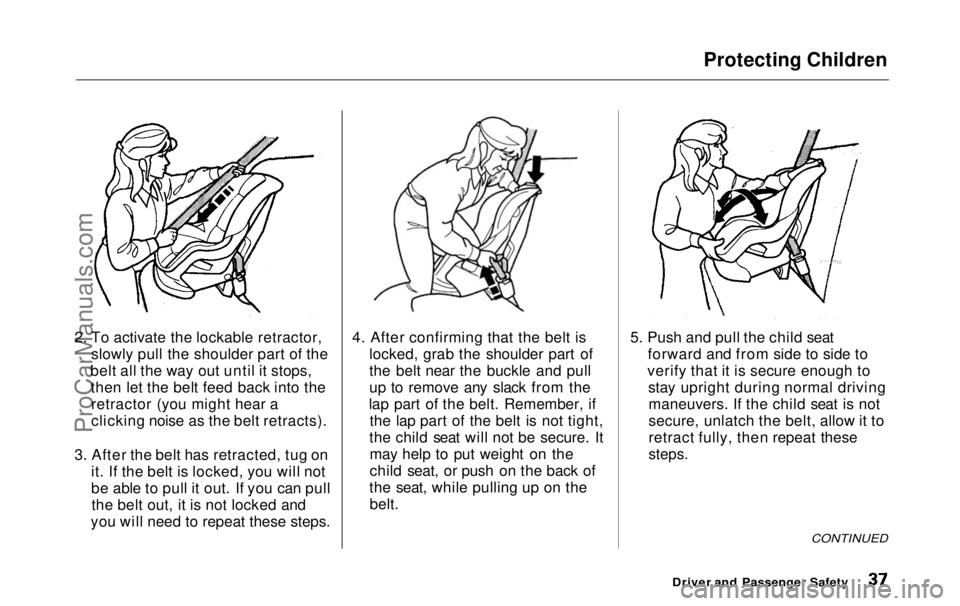
2. To activate the lockable retractor, slowly pull the shoulder part of the
belt all the way out until it stops, then let the belt feed back into theretractor (you might hear a
clicking noise as the belt retracts).
3. After the belt has retracted, tug on it. If the belt is locked, you will not
be able to pull it out. If you can pullthe belt out, it is not locked and
you will need to repeat these steps. 4. After confirming that the belt is
locked, grab the shoulder part of
the belt near the buckle and pull
up to remove any slack from the
lap part of the belt. Remember, if the lap part of the belt is not tight,
the child seat will not be secure. It may help to put weight on the
child seat, or push on the back of
the seat, while pulling up on the belt. 5. Push and pull the child seat
forward and from side to side to
verify that it is secure enough to stay upright during normal drivingmaneuvers. If the child seat is not
secure, unlatch the belt, allow it to
retract fully, then repeat these
steps.
CONTINUED
Driver and Passenger SafetyProCarManuals.comMain Menu Table of Contents s t
Page 39 of 343
Protecting Children
To deactivate the locking
mechanism and remove a child seat, unlatch the buckle, unroute
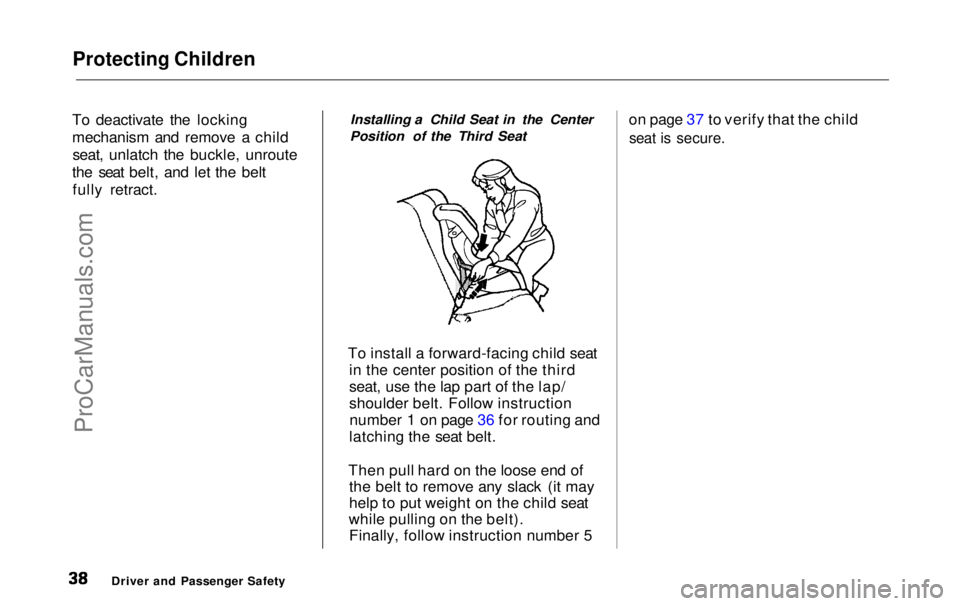
the seat belt, and let the belt fully retract. Installing a Child Seat in the Center
Position of the Third Seat
To install a forward-facing child seat in the center position of the third
seat, use the lap part of the lap/
shoulder belt. Follow instructionnumber 1 on page 36 for routing and
latching the seat belt.
Then pull hard on the loose end of the belt to remove any slack (it may
help to put weight on the child seat
while pulling on the belt). Finally, follow instruction number 5 on page 37 to verify that the child
seat is secure.
Driver and Passenger SafetyProCarManuals.comMain Menu Table of Contents s t
Page 43 of 343
Protecting Children
Physical Size
Physically, a child must be large
enough for the lap/shoulder belt to
properly fit over the hips, chest, and shoulder (see pages 15 and 39). If
the seat belt does not fit properly,
the child should not sit in the front.
Maturity
To safely ride in front, a child must be able to follow the rules, includingsitting properly and wearing the seat
belt properly throughout a ride. If you decide that a child can safely
ride up front, be sure to: Carefully read the owner's manual
and make sure you understand all seat belt instructions and all safety
information. Move the vehicle seat to the rear-
most position. Have the child sit up straight, back
against the seat, and feet on or
near the floor.
Check that the child's seat belt is
properly positioned and secured. Supervise the child. Even mature
children sometimes need to be
reminded to fasten the seat belts or sit properly.
Driver and Passenger SafetyProCarManuals.comMain Menu Table of Contents s t
Page 44 of 343
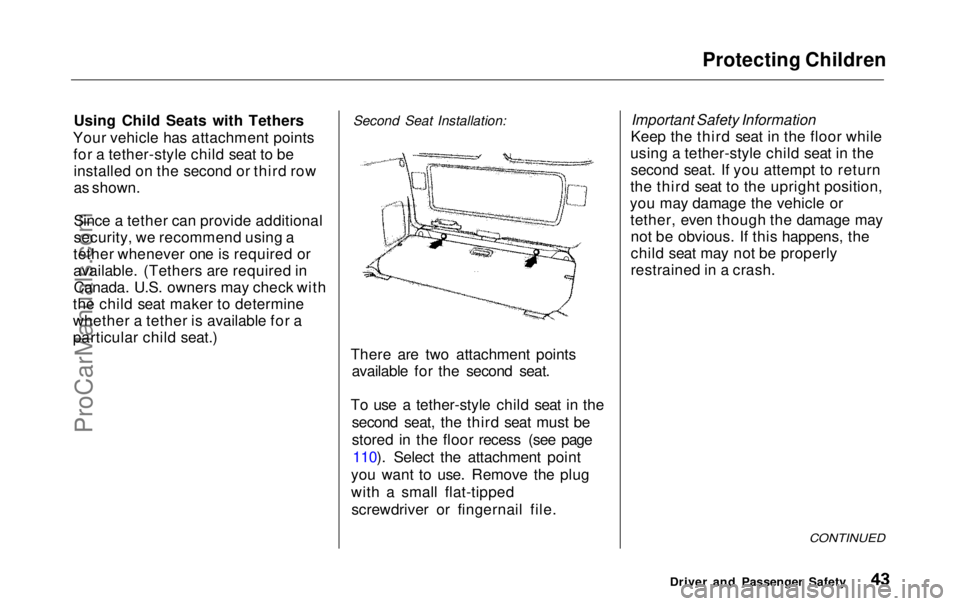
Protecting ChildrenUsing Child Seats with Tethers
Your vehicle has attachment points
for a tether-style child seat to beinstalled on the second or third row
as shown.
Since a tether can provide additional
security, we recommend using a
tether whenever one is required or
available. (Tethers are required in Canada. U.S. owners may check with
the child seat maker to determine
whether a tether is available for a
particular child seat.) Second Seat Installation:
There are two attachment points available for the second seat.
To use a tether-style child seat in the second seat, the third seat must be
stored in the floor recess (see page110). Select the attachment point
you want to use. Remove the plug
with a small flat-tipped screwdriver or fingernail file.
Important Safety Information
Keep the third seat in the floor while
using a tether-style child seat in the second seat. If you attempt to return
the third seat to the upright position,
you may damage the vehicle or tether, even though the damage maynot be obvious. If this happens, the
child seat may not be properly
restrained in a crash.
CONTINUED
Driver and Passenger Safety
ProCarManuals.comMain Menu Table of Contents s t
Page 47 of 343
Additional Information About Your Seat Belts
The seat belts in all positions except the driver's and the center position
of the third seat have an additional
locking mechanism that must be
activated to secure a child seat. (See
pages 31 and 36 for instructions on
how to secure child seats with this type of seat belt.)
If the shoulder part of the belt is
pulled all the way out, the locking
mechanism will activate. The belt
will retract, but it will not allow a
passenger to move freely.
To deactivate the locking mechanism, unlatch the buckle and
let the seat belt fully retract. To
refasten the belt, pull it out only as
far as needed.
See page 15 for instructions on how to wear the lap/shoulder belt
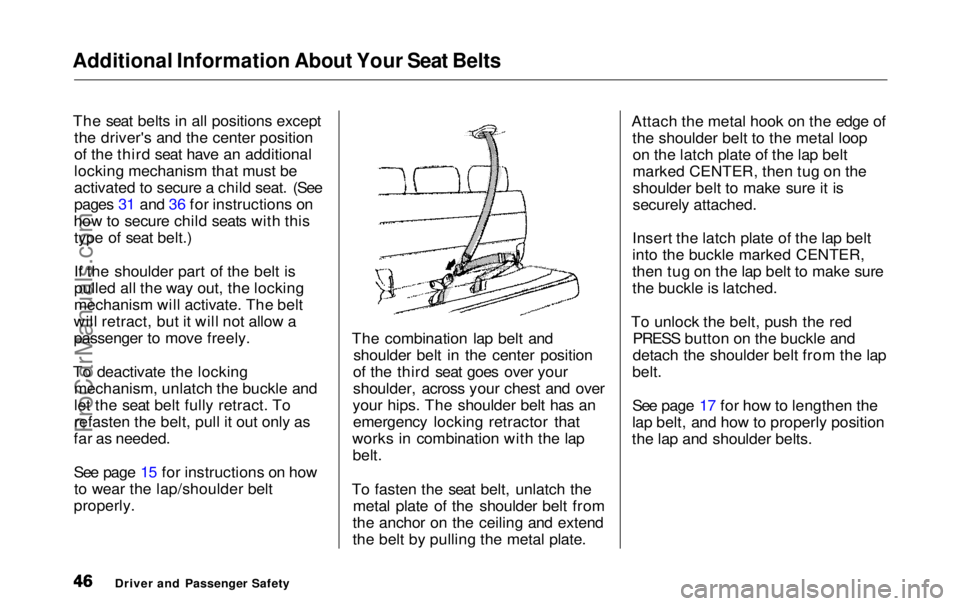
properly. The combination lap belt and
shoulder belt in the center position
of the third seat goes over your
shoulder, across your chest and over
your hips. The shoulder belt has an emergency locking retractor that
works in combination with the lap belt.
To fasten the seat belt, unlatch the metal plate of the shoulder belt from
the anchor on the ceiling and extend
the belt by pulling the metal plate. Attach the metal hook on the edge of
the shoulder belt to the metal loopon the latch plate of the lap belt
marked CENTER, then tug on the
shoulder belt to make sure it is
securely attached.
Insert the latch plate of the lap belt
into the buckle marked CENTER,
then tug on the lap belt to make sure
the buckle is latched.
To unlock the belt, push the red PRESS button on the buckle and
detach the shoulder belt from the lap
belt.
See page 17 for how to lengthen the
lap belt, and how to properly position
the lap and shoulder belts.
Driver and Passenger SafetyProCarManuals.comMain Menu Table of Contents s t
Page 73 of 343
Controls Near the Steering Wheel
Steering Wheel Adjustment
See page 19 for important safety
information about how to properly
position the steering wheel.
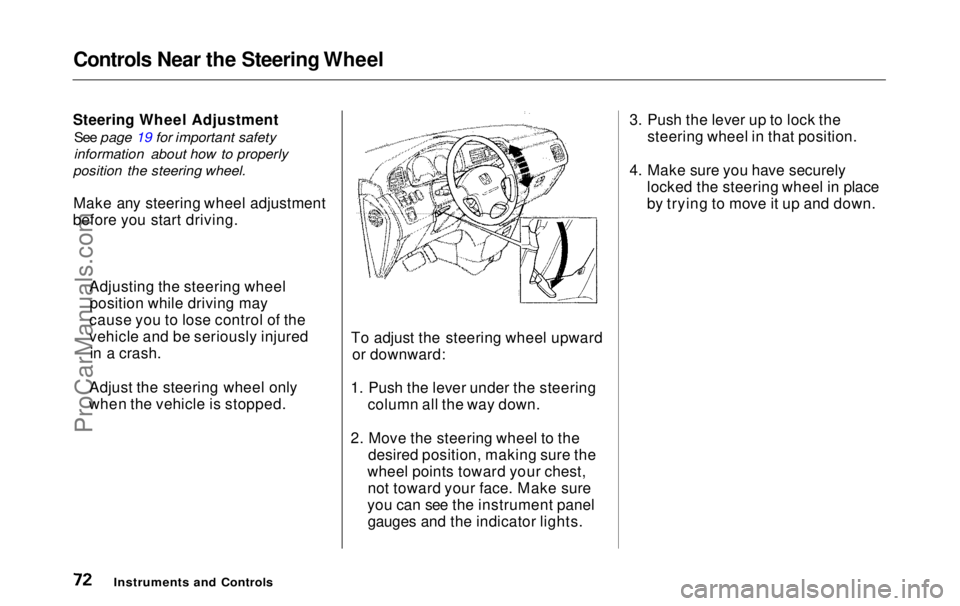
Make any steering wheel adjustment
before you start driving.
To adjust the steering wheel upwardor downward:
1. Push the lever under the steering column all the way down.
2. Move the steering wheel to the desired position, making sure the
wheel points toward your chest, not toward your face. Make sure
you can see the instrument panel gauges and the indicator lights. 3. Push the lever up to lock the
steering wheel in that position.
4. Make sure you have securely locked the steering wheel in place
by trying to move it up and down.
Instruments and Controls
Adjusting the steering wheel
position while driving may
cause you to lose control of the
vehicle and be seriously injured in a crash.
Adjust the steering wheel only
when the vehicle is stopped.ProCarManuals.comMain Menu Table of Contents s t
Page 89 of 343
Sliding Doors
Your Honda is equipped with dual sliding doors. The doors on the LX
model are manually operated. The EX model's doors are electrically-
powered and can be operated with
the remote transmitter, the door
handles, or the switches on the dashboard.
Be sure all passengers are clear of
the sliding doors before closing them. Manual Sliding Doors
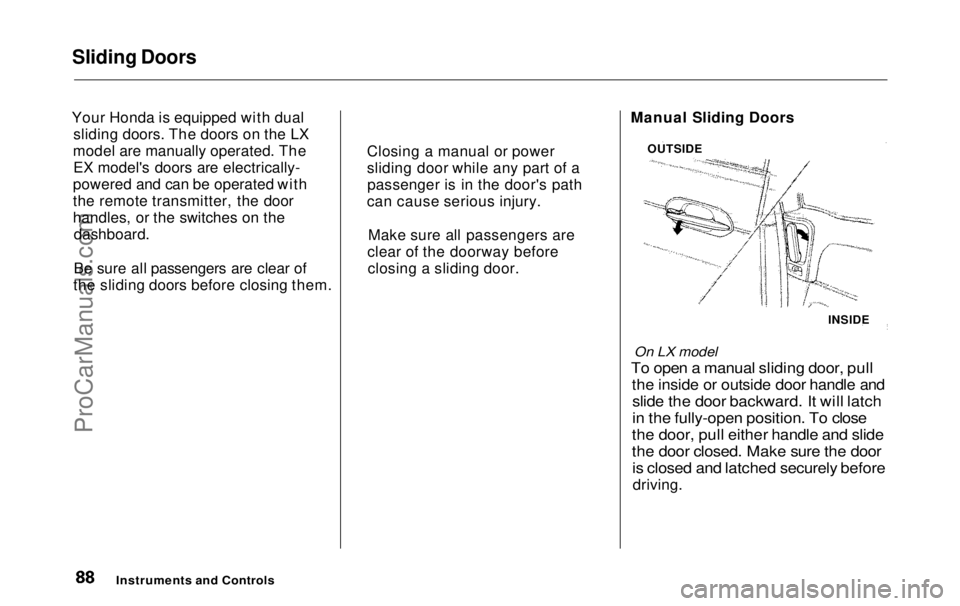
On LX model
To open a manual sliding door, pull
the inside or outside door handle and
slide the door backward. It will latch
in the fully-open position. To close
the door, pull either handle and slide
the door closed. Make sure the door
is closed and latched securely before
driving.
Instruments and Controls
OUTSIDE
INSIDE
Closing a manual or power
sliding door while any part of a
passenger is in the door's path
can cause serious injury.
Make sure all passengers are
clear of the doorway before closing a sliding door.ProCarManuals.comMain Menu Table of Contents s t
Page 96 of 343
HomeLink Universal Transmitter
On EX model
The HomeLink Universal Transmit- ter built into your vehicle can be
programmed to operate remotely-controlled devices around your home,
such as garage doors, lighting, or
home security systems. It can
replace up to three remote
transmitters.
Customer Assistance
If you have problems with training
the HomeLink Universal
Transmitter, or would like information on home products that
can be operated by the transmitter,
call (800) 355-3515.
Important Safety Precautions
Always refer to the operating instruc- tions and safety information thatcame with your garage door opener
or other equipment you intend to
operate with the HomeLink
Universal Transmitter. If you do not
have this information, you should contact the manufacturer of the
equipment.
While training or using the transmitter, make sure you have a
clear view of the garage door or gate,and that no one will be injured by its
movement.
If your garage door opener was
manufactured before April 1982, you
may not be able to program the
HomeLink Universal Transmitter to operate it. Garage door openers
manufactured before that date do
not have a safety feature that causes
them to stop and reverse if an obstacle is detected during closing,
increasing the risk of injury. If you
have questions, call (800) 355-3515. Training the Transmitter
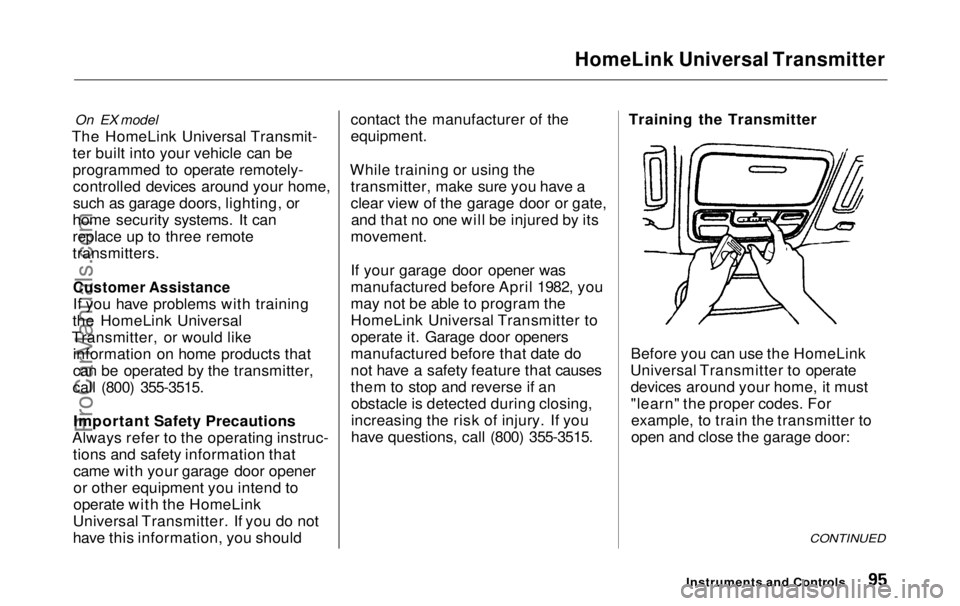
Before you can use the HomeLink
Universal Transmitter to operate devices around your home, it must
"learn" the proper codes. Forexample, to train the transmitter to
open and close the garage door:
CONTINUED
Instruments and ControlsProCarManuals.comMain Menu Table of Contents s t