airbag HONDA ODYSSEY 1999 User Guide
[x] Cancel search | Manufacturer: HONDA, Model Year: 1999, Model line: ODYSSEY, Model: HONDA ODYSSEY 1999Pages: 343, PDF Size: 3.73 MB
Page 20 of 343
Protecting Adults
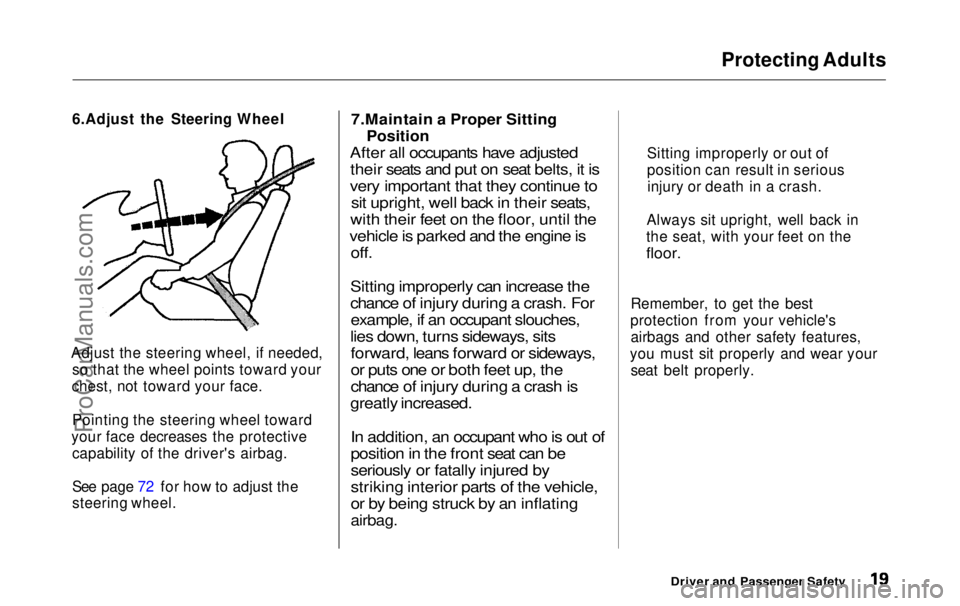
6.Adjust the Steering Wheel
Adjust the steering wheel, if needed, so that the wheel points toward your
chest, not toward your face.
Pointing the steering wheel toward
your face decreases the protective capability of the driver's airbag.
See page 72 for how to adjust the
steering wheel.
7.Maintain a Proper Sitting
Position
After all occupants have adjusted their seats and put on seat belts, it is
very important that they continue to sit upright, well back in their seats,
with their feet on the floor, until the
vehicle is parked and the engine is off.
Sitting improperly can increase the
chance of injury during a crash. For example, if an occupant slouches,
lies down, turns sideways, sits forward, leans forward or sideways,
or puts one or both feet up, the
chance of injury during a crash is
greatly increased.
In addition, an occupant who is out of
position in the front seat can be
seriously or fatally injured by
striking interior parts of the vehicle,
or by being struck by an inflating
airbag.
Remember, to get the best
protection from your vehicle's airbags and other safety features,
you must sit properly and wear your seat belt properly.
Driver and Passenger Safety
Sitting improperly or out of
position can result in serious
injury or death in a crash.
Always sit upright, well back in
the seat, with your feet on the
floor.ProCarManuals.comMain Menu Table of Contents s t
Page 21 of 343
Protecting Adults
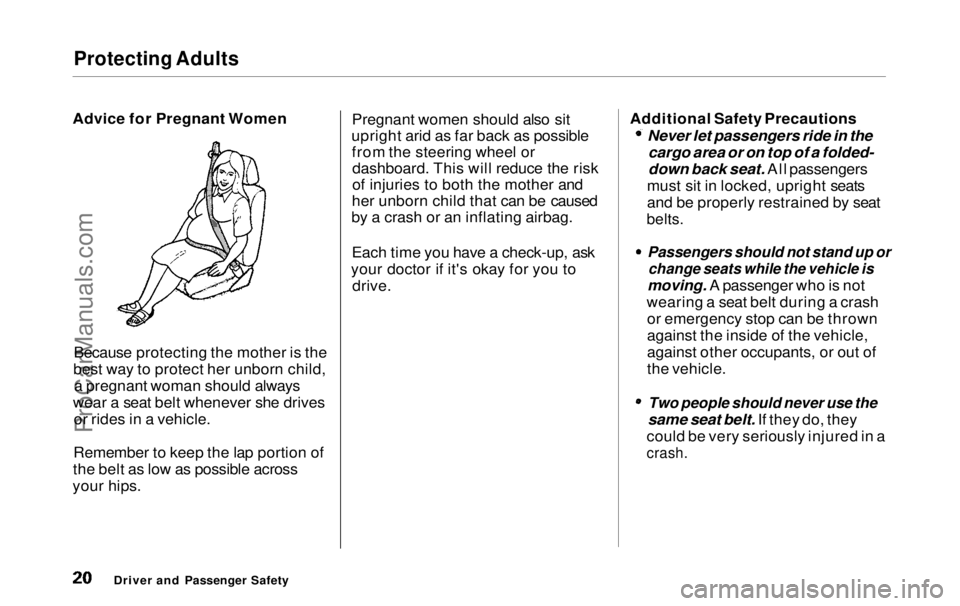
Advice for Pregnant Women
Because protecting the mother is the
best way to protect her unborn child, a pregnant woman should always
wear a seat belt whenever she drives or rides in a vehicle.
Remember to keep the lap portion of
the belt as low as possible across
your hips. Pregnant women should also sit
upright arid as far back as possible from the steering wheel ordashboard. This will reduce the risk
of injuries to both the mother and
her unborn child that can be caused
by a crash or an inflating airbag.
Each time you have a check-up, ask
your doctor if it's okay for you to drive. Additional Safety Precautions Never let passengers ride in the
cargo area or on top of a folded-
down back seat. All passengers
must sit in locked, upright seats
and be properly restrained by seat
belts.
Passengers should not stand up or
change seats while the vehicle is
moving. A passenger who is not
wearing a seat belt during a crash or emergency stop can be thrown
against the inside of the vehicle,
against other occupants, or out of
the vehicle.
Two people should never use the
same seat belt. If they do, they
could be very seriously injured in a
crash.
Driver and Passenger SafetyProCarManuals.comMain Menu Table of Contents s t
Page 22 of 343
Protecting Adults
Do not put any accessories on seat
belts. Devices intended to improve
occupant comfort or reposition the
shoulder part of a seat belt, can
severely compromise the
protective capability of seat belts and increase the chance of serious
injury in a crash. Do not place hard or sharp objects
between yourself and an airbag.
Carrying hard or sharp objects on
your lap, or driving with a pipe or other sharp object in your mouth,
can result in injuries if your
airbags inflate.
Keep your hands and arms away
from the airbag covers. If your
hands or arms are close to the SRS
covers in the center of the steering wheel and on top of the
dashboard, they could be injured if
the airbags inflate.
Driver and Passenger SafetyProCarManuals.comMain Menu Table of Contents s t
Page 24 of 343
Protecting Children
Children Should Sit in the Back
Seat
According to accident statistics, children of all ages and sizes aresafer when they are restrained in the
back seat, not the front seat. The National Highway Traffic Safety
Administration and Transport Canada recommend that all children
ages 12 and under be properly
restrained in a back seat.
In a back seat, children are less
likely to be injured by striking hard interior parts during a collision or
hard braking. Also, children cannot be injured by an inflating airbag
when they ride in the back.
The Passenger's Airbag Poses
Serious Risks to Children
Airbags have been designed to help protect adults in a moderate to severe frontal collision. To do this,
the passenger's airbag is quite large, and it inflates with tremendous
speed.
Infants
Never put a rear-facing child seat in the front seat of a vehicle equipped
with a passenger's airbag. If the
airbag inflates, it can hit the back of
the child seat with enough force to
kill or very seriously injure an infant.
Small Children
Placing a forward-facing child seat in the front seat of a vehicle equipped
with a passenger's airbag can be
hazardous. If the vehicle seat is too
far forward, or the child's head is thrown forward during a collision, an
inflating airbag can strike the child
with enough force to kill or very seriously injure a small child.
Larger Children
Children who have outgrown child
seats are also at risk of being injured
or killed by an inflating passenger's
airbag. Whenever possible, larger
children should sit in a back seat,
properly restrained with a seat belt. (See page 39 for important
information about protecting larger
children.)
CONTINUED
Driver and Passenger SafetyProCarManuals.comMain Menu Table of Contents s t
Page 25 of 343
Protecting Children
U.S. Models
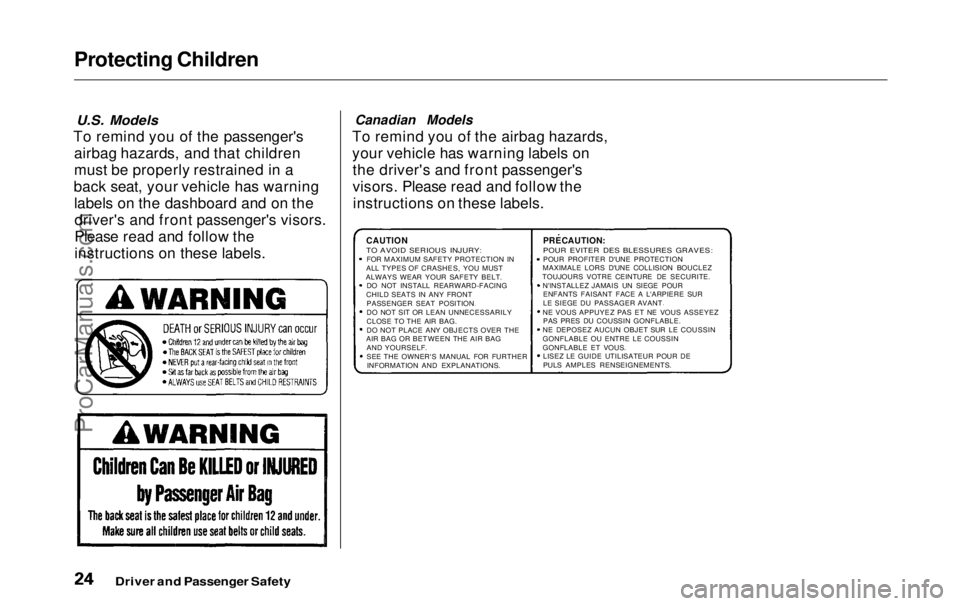
To remind you of the passenger's airbag hazards, and that children
must be properly restrained in a
back seat, your vehicle has warning labels on the dashboard and on thedriver's and front passenger's visors.
Please read and follow the
instructions on these labels. Canadian Models
To remind you of the airbag hazards,
your vehicle has warning labels on the driver's and front passenger's
visors. Please read and follow theinstructions on these labels.
Driver and Passenger Safety
CAUTION
TO AVOID SERIOUS INJURY:
FOR MAXIMUM SAFETY PROTECTION IN
ALL TYPES OF CRASHES, YOU MUST
ALWAYS WEAR YOUR SAFETY BELT. DO NOT INSTALL REARWARD-FACING
CHILD SEATS IN ANY FRONT PASSENGER SEAT POSITION
DO NOT SIT OR LEAN UNNECESSARILY
CLOSE TO THE AIR BAG.
DO NOT PLACE ANY OBJECTS OVER THE
AIR BAG OR BETWEEN THE AIR BAG
AND YOURSELF.
SEE THE OWNER'S MANUAL FOR FURTHERINFORMATION AND EXPLANATIONS. PRECAUTION:
POUR EVITER DES BLESSURES GRAVES:
POUR PROFITER D'UNE PROTECTION
MAXIMALE LORS D'UNE COLLISION BOUCLEZ
TOUJOURS VOTRE CEINTURE DE SECURITE. N'lNSTALLEZ JAMAIS UN SIEGE POURENFANTS FAISANT FACE A L'ARPIERE SUR
LE SIEGE DU PASSAGER AVANT
NE VOUS APPUYEZ PAS ET NE VOUS ASSEYEZ PAS PRES DU COUSSIN GONFLABLE.
NE DEPOSEZ AUCUN OBJET SUR LE COUSSIN
GONFLABLE OU ENTRE LE COUSSIN
GONFLABLE ET VOUS. LISEZ LE GUIDE UTILISATEUR POUR DE
PULS AMPLES RENSEIGNEMENTS.ProCarManuals.comMain Menu Table of Contents s t
Page 26 of 343
Protecting Children
If You Must Drive with Several Children
Your vehicle has two rows of back
seats where children can be properly
restrained.
If you ever have to carry a group of
children (when carpooling for
example), and a child must ride in
front:
Place the largest child in the front
seat, provided the child is large
enough to wear a seat belt
properly (see page 39 ).
Move the vehicle seat as far to the
rear as possible (see page 12 ).
Have the child sit upright and well
back in the seat (see page 19 ).
Make sure the seat belt is properly
positioned and secured (see page 15). If a Child Requires Close
Attention Many parents say they prefer to put
an infant or small child in the front
passenger seat so they can watch the
child, or because the child requires attention.
Placing a child in the front seat
exposes the child to hazards from
the airbag, and paying close attention to a child distracts the
driver from the important tasks of
driving, placing both of you at risk.
If a child requires physical attention or frequent visual contact, we
strongly recommend that another
adult ride with the child in a back
seat. The back seat is far safer for a
child than the front. Additional Safety Precautions
Use childproof door locks to
prevent children from opening the
doors. Using this feature will
prevent children from opening the doors and accidentally falling out (see page 85 ).
Do not leave children alone in your
vehicle. Leaving children without
adult supervision is illegal in most
states and provinces, and can be
very hazardous. For example, infants and small children left in a
vehicle on a hot day can die from heatstroke. And children left alone
with the key in the ignition can accidentally set the vehicle in
motion, possibly injuring
themselves or others.
Driver and Passenger SafetyProCarManuals.comMain Menu Table of Contents s t
Page 29 of 343
Protecting Children
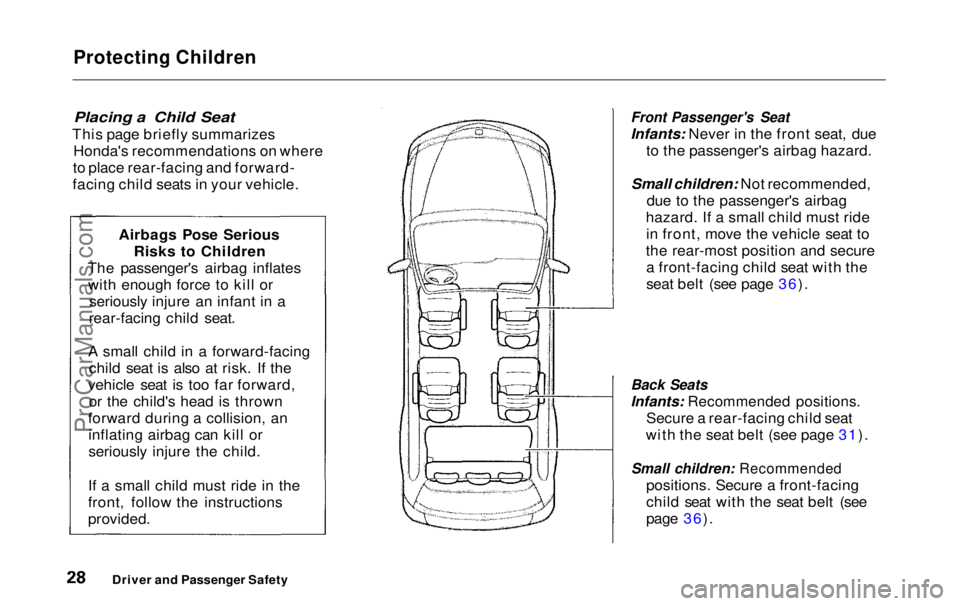
Placing a Child Seat
This page briefly summarizes Honda's recommendations on where
to place rear-facing and forward-
facing child seats in your vehicle.
Front Passenger's Seat
Infants: Never in the front seat, due
to the passenger's airbag hazard.
Small children: Not recommended, due to the passenger's airbag
hazard. If a small child must ride in front, move the vehicle seat to
the rear-most position and secure a front-facing child seat with the
seat belt (see page 36).
Back Seats
Infants: Recommended positions.
Secure a rear-facing child seat
with the seat belt (see page 31).
Small children: Recommended
positions. Secure a front-facing
child seat with the seat belt (see
page 36).
Driver and Passenger Safety Airbags Pose Serious
Risks to Children
The passenger's airbag inflates with enough force to kill or seriously injure an infant in a
rear-facing child seat.
A small child in a forward-facing child seat is also at risk. If the
vehicle seat is too far forward, or the child's head is thrown
forward during a collision, an inflating airbag can kill or
seriously injure the child.
If a small child must ride in the
front, follow the instructions
provided.ProCarManuals.comMain Menu Table of Contents s t
Page 31 of 343
Protecting Children
Protecting Infants
Child Seat Type
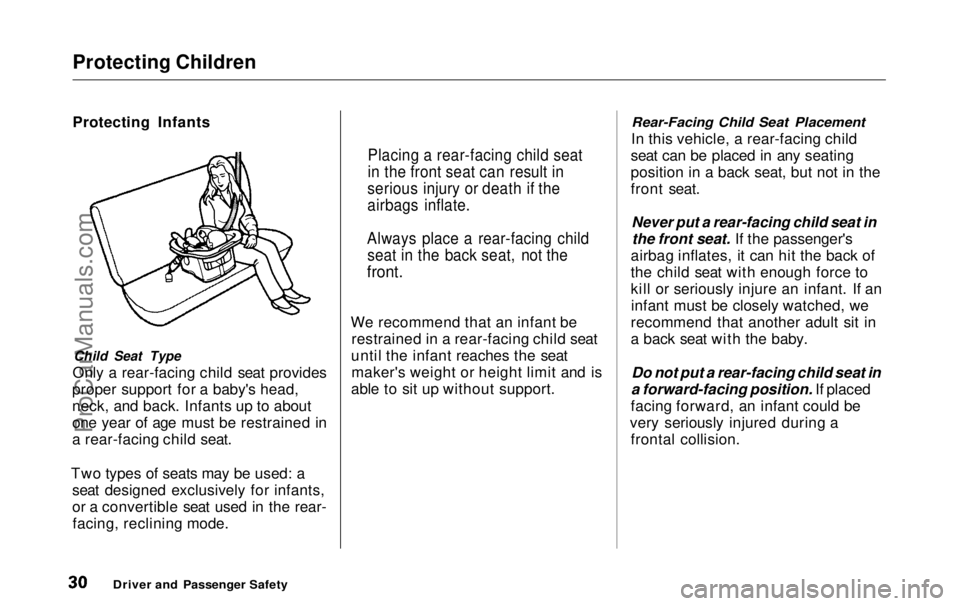
Only a rear-facing child seat provides
proper support for a baby's head,
neck, and back. Infants up to about
one year of age must be restrained in
a rear-facing child seat.
Two types of seats may be used: a seat designed exclusively for infants,
or a convertible seat used in the rear-facing, reclining mode. We recommend that an infant be
restrained in a rear-facing child seat
until the infant reaches the seat maker's weight or height limit and is
able to sit up without support.
Rear-Facing Child Seat Placement
In this vehicle, a rear-facing child
seat can be placed in any seating
position in a back seat, but not in the
front seat.
Never put a rear-facing child seat in
the front seat. If the passenger's
airbag inflates, it can hit the back of
the child seat with enough force to
kill or seriously injure an infant. If an infant must be closely watched, we
recommend that another adult sit in
a back seat with the baby.
Do not put a rear-facing child seat in
a forward-facing position. If placed
facing forward, an infant could be
very seriously injured during a frontal collision.
Driver and Passenger Safety
Placing a rear-facing child seat
in the front seat can result in
serious injury or death if the
airbags inflate.
Always place a rear-facing child seat in the back seat, not the
front.ProCarManuals.comMain Menu Table of Contents s t
Page 36 of 343
Protecting Children
Protecting Small Children
Child Seat Type
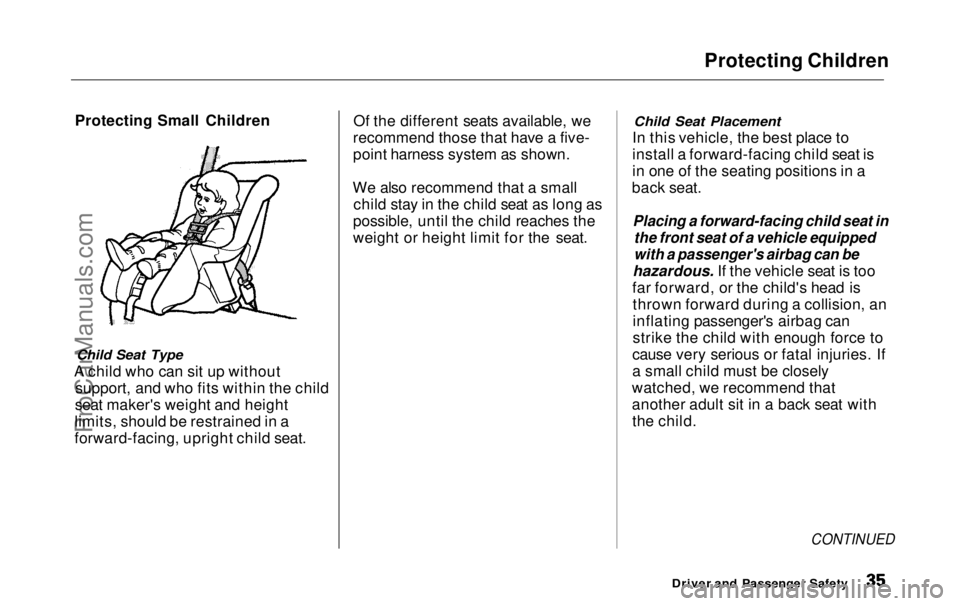
A child who can sit up without support, and who fits within the child
seat maker's weight and height
limits, should be restrained in a
forward-facing, upright child seat. Of the different seats available, we
recommend those that have a five-
point harness system as shown.
We also recommend that a small child stay in the child seat as long as
possible, until the child reaches the
weight or height limit for the seat.
Child Seat Placement
In this vehicle, the best place to
install a forward-facing child seat is
in one of the seating positions in a
back seat.
Placing a forward-facing child seat in
the front seat of a vehicle equipped
with a passenger's airbag can be
hazardous. If the vehicle seat is too
far forward, or the child's head is thrown forward during a collision, an
inflating passenger's airbag can
strike the child with enough force to
cause very serious or fatal injuries. If
a small child must be closely
watched, we recommend that
another adult sit in a back seat with the child.
CONTINUED
Driver and Passenger SafetyProCarManuals.comMain Menu Table of Contents s t
Page 37 of 343
Protecting Children
If it is necessary to put a forward-
facing child seat in the front, move
the vehicle seat as far to the rear as
possible, be sure the child seat is firmly secured to the vehicle, and the
child is properly strapped in the seat.
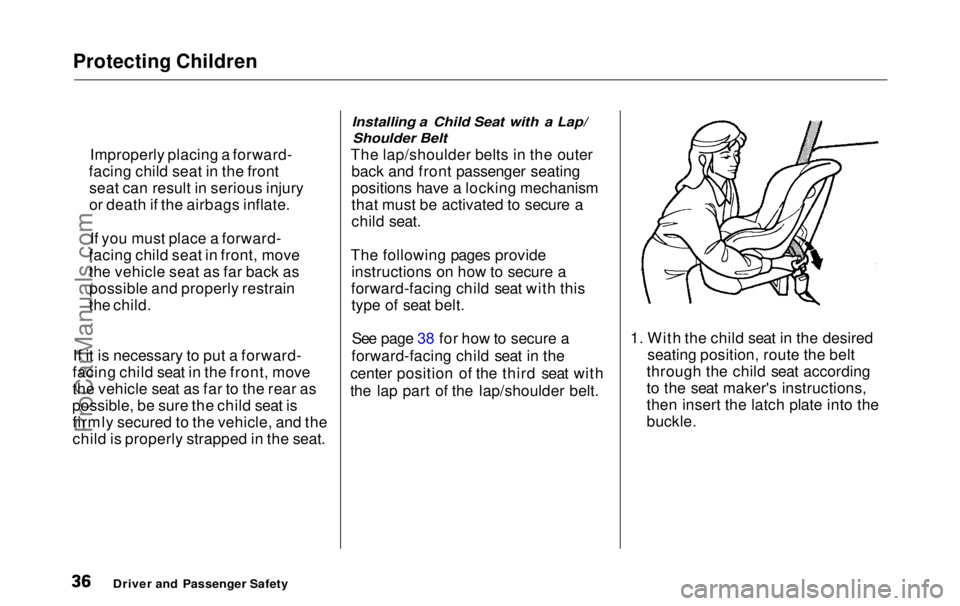
Installing a Child Seat with a Lap/
Shoulder Belt
The lap/shoulder belts in the outer back and front passenger seating
positions have a locking mechanism
that must be activated to secure a
child seat.
The following pages provide instructions on how to secure a
forward-facing child seat with this type of seat belt.
See page 38 for how to secure a
forward-facing child seat in the
center position of the third seat with
the lap part of the lap/shoulder belt. 1. With the child seat in the desired
seating position, route the belt
through the child seat according
to the seat maker's instructions,
then insert the latch plate into the
buckle.
Driver and Passenger Safety
Improperly placing a forward-
facing child seat in the front seat can result in serious injury
or death if the airbags inflate.
If you must place a forward-
facing child seat in front, move
the vehicle seat as far back as possible and properly restrain
the child.ProCarManuals.comMain Menu Table of Contents s t