airbag HONDA ODYSSEY 1999 Owner's Manual
[x] Cancel search | Manufacturer: HONDA, Model Year: 1999, Model line: ODYSSEY, Model: HONDA ODYSSEY 1999Pages: 343, PDF Size: 3.73 MB
Page 40 of 343
Protecting Children
Additional Precautions for Small
Children
Never hold a small child on your
lap. If you are not wearing a seat
belt in a crash, you could be
thrown forward into the dashboard and crush the child.
If you are wearing a seat belt, the
child can be torn from your armsduring a crash. For example, if
your vehicle crashes into a parked
vehicle at 30 mph (48 km/h), a 30-lb (14 kg) child will become a
900-lb (410 kg) force, and you will
not be able to hold on.
Never put a seat belt over yourself
and a child. During a crash, the
belt could press deep into the child
and cause very serious injuries.
Protecting Larger Children
When a child reaches the recommended weight or height limit
for a forward-facing child seat, the child should sit in the back seat and
wear a lap/shoulder belt.
If a child is too short for the shoulder
part of the belt to properly fit, we
recommend that the child use a
booster seat until they are tallenough to use the seat belt without a
booster.
The following pages give instructions on how to check properseat belt fit, what kind of boosterseat to use if one is needed, and
important precautions for children
who must sit in the front seat.
CONTINUED
Driver and Passenger Safety
Allowing a larger child to sit
improperly in the front seat can
result in injury or death if the
airbags inflate.
If a larger child must sit in front,
make sure the child moves the
seat as far back as possible
and wears the seat belt properly.ProCarManuals.comMain Menu Table of Contents s t
Page 42 of 343
Protecting Children
Using a Booster Seat
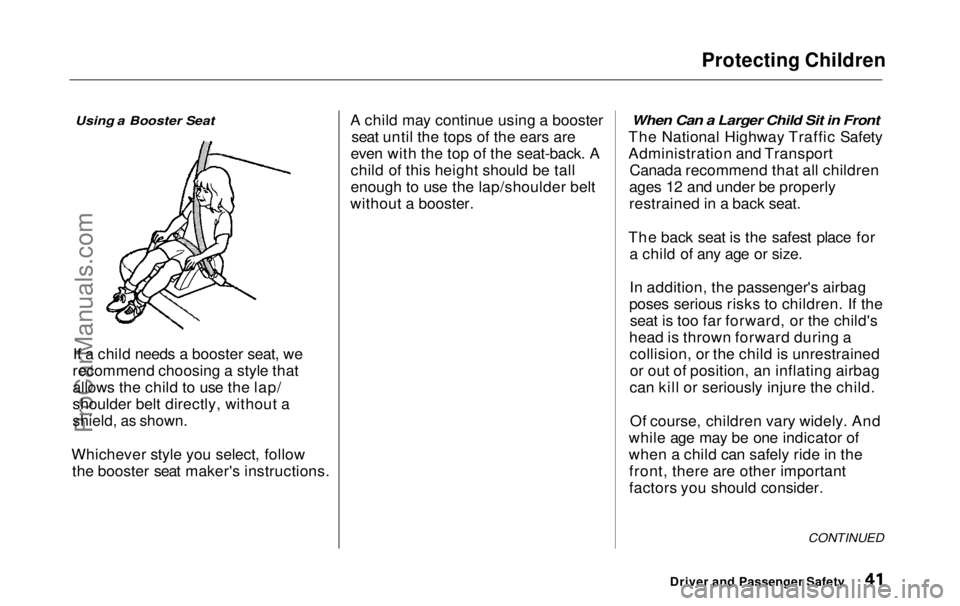
If a child needs a booster seat, we
recommend choosing a style that
allows the child to use the lap/
shoulder belt directly, without a
shield, as shown.
Whichever style you select, follow the booster seat maker's instructions. A child may continue using a booster
seat until the tops of the ears are
even with the top of the seat-back. A
child of this height should be tall
enough to use the lap/shoulder belt
without a booster.
When Can a Larger Child Sit in Front
The National Highway Traffic Safety
Administration and Transport Canada recommend that all children
ages 12 and under be properly
restrained in a back seat.
The back seat is the safest place for a child of any age or size.
In addition, the passenger's airbag
poses serious risks to children. If the seat is too far forward, or the child's
head is thrown forward during a collision, or the child is unrestrainedor out of position, an inflating airbag
can kill or seriously injure the child.
Of course, children vary widely. And
while age may be one indicator of
when a child can safely ride in the front, there are other important
factors you should consider.
CONTINUED
Driver and Passenger Safety
ProCarManuals.comMain Menu Table of Contents s t
Page 49 of 343
Additional Information About Your SRS
SRS Components
Your Supplemental Restraint System (SRS) includes: Two front airbags. The driver's
airbag is stored in the center of
the steering wheel; the front
passenger's airbag is stored in thedashboard. Both are marked "SRS
AIRBAG." Automatic seat belt tensioners
that tighten the front seat beltsduring a moderate to severe
frontal collision. Sensors that can detect a
moderate to severe frontal
collision.
A sophisticated electronic system
that continually monitors the sensors, control unit, the airbag
activators, and all related wiring
when the ignition is ON (II). An indicator light on the
instrument panel that alerts you toa possible problem with the
system (see page 50). Emergency backup power in case
your vehicle's electrical system is
disconnected in a crash. How Your Airbags Work
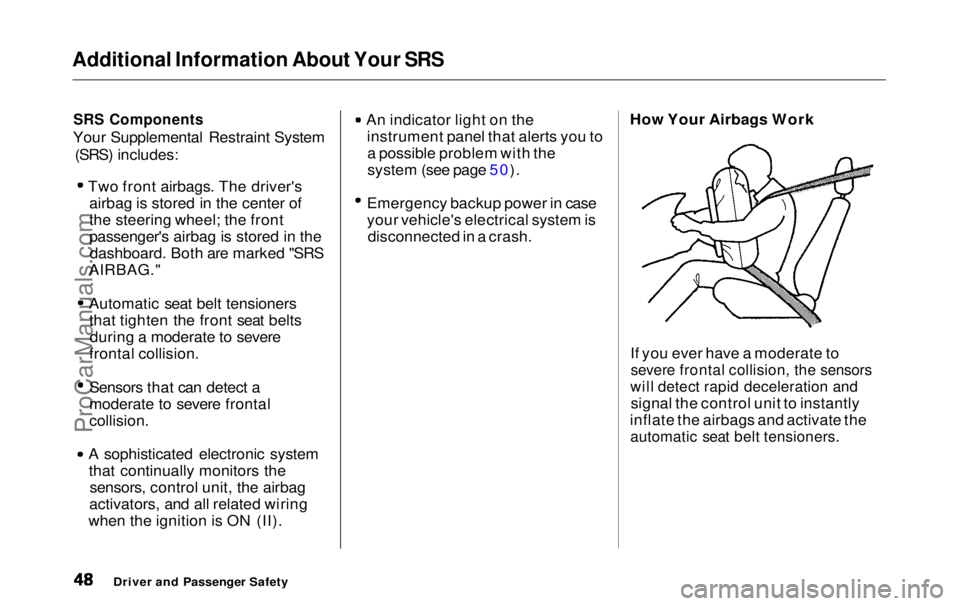
If you ever have a moderate to
severe frontal collision, the sensors
will detect rapid deceleration and
signal the control unit to instantly
inflate the airbags and activate the
automatic seat belt tensioners.
Driver and Passenger SafetyProCarManuals.comMain Menu Table of Contents s t
Page 50 of 343
Additional Information About Your SRS
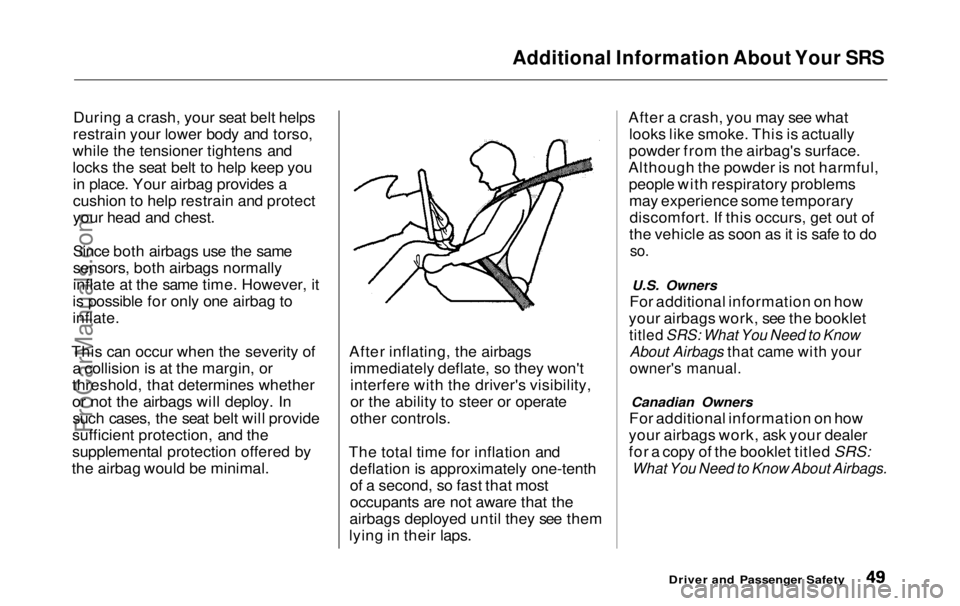
During a crash, your seat belt helps
restrain your lower body and torso,
while the tensioner tightens and
locks the seat belt to help keep you in place. Your airbag provides a
cushion to help restrain and protect
your head and chest.
Since both airbags use the same
sensors, both airbags normally
inflate at the same time. However, it
is possible for only one airbag to
inflate.
This can occur when the severity of a collision is at the margin, or
threshold, that determines whether
or not the airbags will deploy. In such cases, the seat belt will provide
sufficient protection, and the
supplemental protection offered by
the airbag would be minimal. After inflating, the airbags
immediately deflate, so they won'tinterfere with the driver's visibility,
or the ability to steer or operate
other controls.
The total time for inflation and deflation is approximately one-tenth
of a second, so fast that most
occupants are not aware that the
airbags deployed until they see them
lying in their laps. After a crash, you may see what
looks like smoke. This is actually
powder from the airbag's surface.
Although the powder is not harmful, people with respiratory problemsmay experience some temporarydiscomfort. If this occurs, get out of
the vehicle as soon as it is safe to do
so.
U.S. Owners
For additional information on how
your airbags work, see the booklet
titled SRS: What You Need to Know
About Airbags that came with your
owner's manual.
Canadian Owners
For additional information on how
your airbags work, ask your dealer
for a copy of the booklet titled SRS:
What You Need to Know About Airbags.
Driver and Passenger SafetyProCarManuals.comMain Menu Table of Contents s t
Page 51 of 343
Additional Information About Your SRS
How the Automatic Seat Belt
Tensioners Work
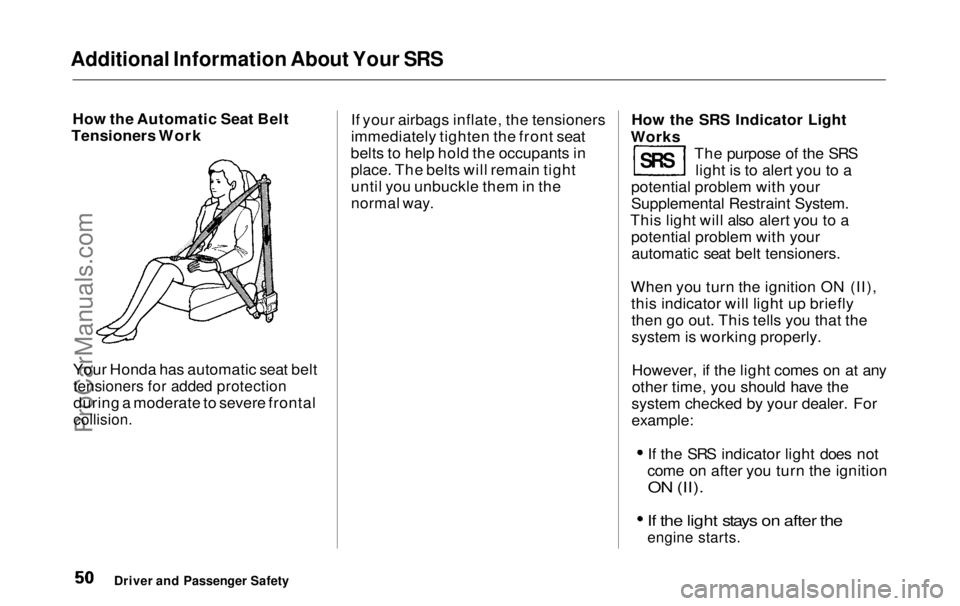
Your Honda has automatic seat belt
tensioners for added protection
during a moderate to severe frontal
collision.
If your airbags inflate, the tensioners
immediately tighten the front seat
belts to help hold the occupants in
place. The belts will remain tight until you unbuckle them in the
normal way.
How the SRS Indicator Light
Works The purpose of the SRSlight is to alert you to a
potential problem with your
Supplemental Restraint System.
This light will also alert you to a potential problem with yourautomatic seat belt tensioners.
When you turn the ignition ON (II), this indicator will light up brieflythen go out. This tells you that the
system is working properly.
However, if the light comes on at any
other time, you should have the
system checked by your dealer. For
example:
If the SRS indicator light does not
come on after you turn the ignition
ON (II).
If the light stays on after the
engine starts.
Driver and Passenger Safety
SRSProCarManuals.comMain Menu Table of Contents s t
Page 52 of 343
Additional Information About Your SRS
If the light comes on or flashes on
and off while you drive.
If you see any of these indications,
your airbags may not deploy or your seat belt tensioners may not work
when you need them. See your Honda dealer as soon as possible. SRS Service
Your Supplemental Restraint System is virtually maintenance-free, and
there are no parts you can safely service. However, you must have
your vehicle serviced if:
Your airbags ever inflate. The
airbags, seat belt tensioners, and
control unit must be replaced. Do
not try to remove or replace the airbags yourself.
This must be done by a Honda dealer or a knowledgeable body
shop.
The SRS indicator light alerts you
to a problem. Take your vehicle to
an authorized Honda dealer as soon as possible. If you ignore this
indication, the airbags might not
inflate when you need them (see
page 50).
Driver and Passenger Safety
Ignoring the SRS indicator light
can result in serious injury or
death if the airbags do not inflate when needed.
Have your vehicle checked by a
dealer as soon as possible if
the SRS light alerts you to a potential problem.ProCarManuals.comMain Menu Table of Contents s t
Page 53 of 343

Additional Information About Your SRS
Additional Safety Precautions
Do not attempt to deactivate your
airbags. Together, airbags and seat belts provide the best
protection in a moderate to severe
frontal collision.
Do not tamper with SRS
components or wiring for any
reason. Tampering could cause the airbags to deploy, possibly
causing very serious injury.
See page 190 for further information
and precautions relating to your SRS.
Driver and Passenger SafetyProCarManuals.comMain Menu Table of Contents s t
Page 190 of 343
Accessories and Modifications
Modifying your vehicle, or installing some non-Honda accessories, can
make your vehicle unsafe. Before
you make any modifications or add any accessories, be sure to read the
following information.
Accessories
Your dealer has Genuine Hondaaccessories that allow you to
personalize your vehicle. These accessories have been designed and
approved for your vehicle, and are
covered by warranty.
Non-Honda accessories are usually
designed for universal applications.
Although aftermarket accessories may fit on your vehicle, they may not
meet factory specifications, and
could adversely affect your vehicle's
handling and stability. (See "Modifications" on the page 190 for
additional information.) When properly installed, cellular
phones, alarms, two-way radios, and
low-powered audio systems should not interfere with your vehicle's
computer-controlled systems, such
as the SRS and anti-lock brake
system.
However, if electronic accessories
are improperly installed, or exceed
your vehicle's electrical system capacity, they can interfere with the operation of your vehicle, or even
cause the airbags to deploy.
Before installing any accessory: Make sure the accessory does not
obscure any lights, or interfere
with proper vehicle operation or performance.
Be sure electronic accessories donot overload electrical circuits (see page 305 ).
Have the installer contact your
Honda dealer for assistance before
installing any electronic accessory.
If possible, have your dealer inspect
the final installation.
Before Driving
Improper accessories or
modifications can affect your
vehicle's handling, stability and performance, and cause a
crash in which you can be hurt
or killed.
Follow all instructions in this
owner's manual regarding accessories and modifications.ProCarManuals.comMain Menu Table of Contents s t
Page 191 of 343
Accessories and Modifications
Modifications
Do not remove any original
equipment or modify your vehicle in any way that would alter its design or
operation. This could make your
vehicle unsafe and illegal to drive.
For example, do not make any
modifications that would change the
ride height of your vehicle, or install
wheels and tires with a different overall diameter.
Such modifications can adversely affect handling, and interfere with
the operation of the vehicle's anti-
lock brakes and other systems. In addition, any modifications that
decrease ground clearance increase
the chance of undercarriage parts striking a curb, speed bump, or other
raised object, which could cause
your airbags to deploy.
Do not modify your steering wheelor any other part of your
Supplemental Restraint System.
Modifications could make thesystem ineffective. Additional Safety Precaution
Do not attach or place objects on the
airbag covers. Any object attached to
or placed on the covers marked "SRS
AIRBAG," in the center of the steering wheel and on top of the
dashboard, could interfere with the
proper operation of the airbags. Or,
if the airbags inflate, the objects could be propelled inside the vehicle
and hurt someone.
Before DrivingProCarManuals.comMain Menu Table of Contents s t
Page 333 of 343
Index
Accessories and Modifications.... 189 Accessories................................. 189
Additional Safety Precaution.... 190Modifications............................. 190
ACCESSORY (Ignition Key Position)........................................ 79
Accessory Power Sockets............. 124
Adding Automatic Transmission
Fluid........................................ 243
Brake Fluid................................. 244
Engine Coolant........................... 237
Engine Oil................................... 233
Power Steering Fluid................. 245
Windshield Washer Fluid......... 242
Additional Information About Your Seat Belts........................ 45
Lap/Shoulder Belt....................... 45
Seat Belt Maintenance................ 47
Seat Belt System Components... 45
Additional Information About Your SRS................................... 48
Additional Safety Precautions.... 52
How the Automatic Seat Belt
Tensioners Work..................... 50
How the SRS Indicator
Works...................................... 50
How Your Airbags Work............ 48
SRS Components......................... 48
Additives, Engine Oil..................... 235
Adjustments Head Restraints......................... 104
Mirrors........................................ 115
Seats............................................ 100
Steering Wheel............................
72
Airbag (SRS)............................... 9
, 49
Air Cleaner Element...................... 246
Air Conditioning Filter.................. 256 Air Conditioning System.......130, 138 Maintenance............................... 255
Rear A/C Control......................
146
Usage..................................130 ,
138
Air Outlet
s
(Vents)................132, 138
Air Pressure, Tires........................ 25
7
Alcohol i n
Gasoline........................ 321
Aluminum Wheels, Cleaning........ 279
Antifreeze....................................... 237
Anti-lock Brakes (ABS) Indicator Light..................... 59, 206 Operation.................................... 205
Anti-theft, Audio System............... 180 Anti-theft Steering Column Lock .. 78
Appearance Care........................... 277
Armrests......................................... 103
Audio Controls, Remote................ 179
Audio System......................... 149, 161Automatic Seat Belt Tensioners.... 50
Automatic Lighting Off Feature.... 67
Automatic Speed Control................ 73
Automatic Transmission............... 198
Capacity, Fluid........................... 316
Checking Fluid Level................ 243
Shifting........................................199
Shift Lever Position Indicator.. 198 Shift Lever Positions................. 199
Shift Lock Release..................... 201
CONTINUEDProCarManuals.comMain Menu s t