climate control HONDA ODYSSEY 1999 User Guide
[x] Cancel search | Manufacturer: HONDA, Model Year: 1999, Model line: ODYSSEY, Model: HONDA ODYSSEY 1999Pages: 343, PDF Size: 3.73 MB
Page 144 of 343
Climate Control System
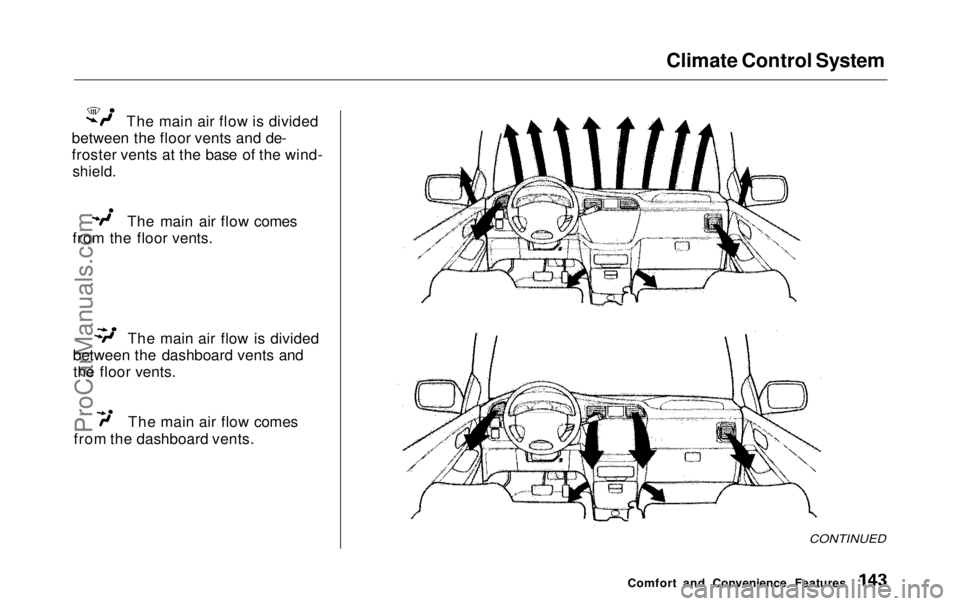
The main air flow is divided
between the floor vents and de-
froster vents at the base of the wind-
shield.
The main air flow comes
from the floor vents. The main air flow is divided
between the dashboard vents and the floor vents. The main air flow comes
from the dashboard vents.
CONTINUED
Comfort and Convenience FeaturesProCarManuals.comMain Menu Table of Contents s t
Page 145 of 343
Climate Control System
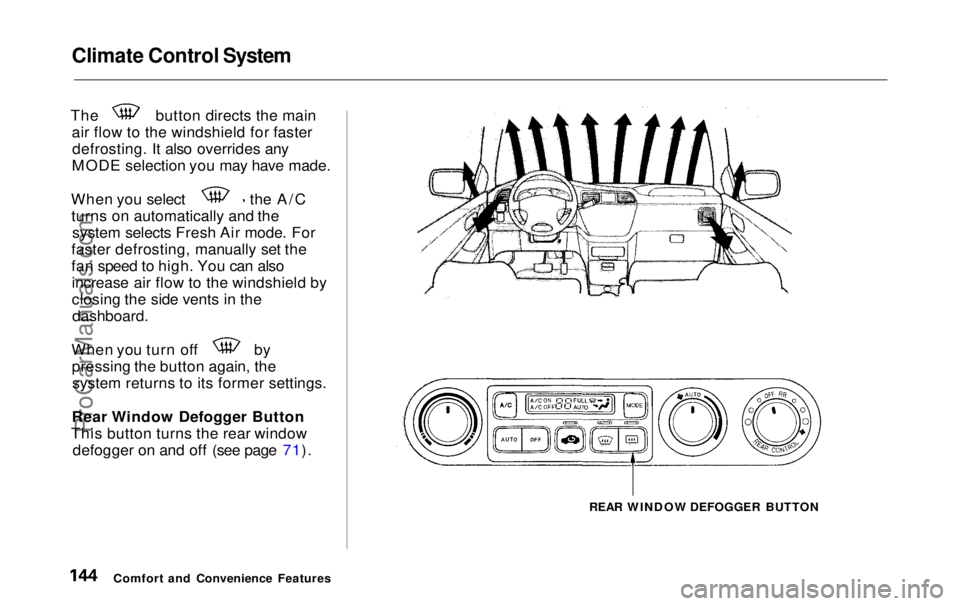
The button directs the main
air flow to the windshield for fasterdefrosting. It also overrides any
MODE selection you may have made. When you select the A/C
turns on automatically and the system selects Fresh Air mode. For
faster defrosting, manually set the
fan speed to high. You can also increase air flow to the windshield by
closing the side vents in the
dashboard.
When you turn off by
pressing the button again, thesystem returns to its former settings.
Rear Window Defogger Button
This button turns the rear window defogger on and off (see page 71).
REAR WINDOW DEFOGGER BUTTON
Comfort and Convenience FeaturesProCarManuals.comMain Menu Table of Contents s t
Page 146 of 343
Climate Control System
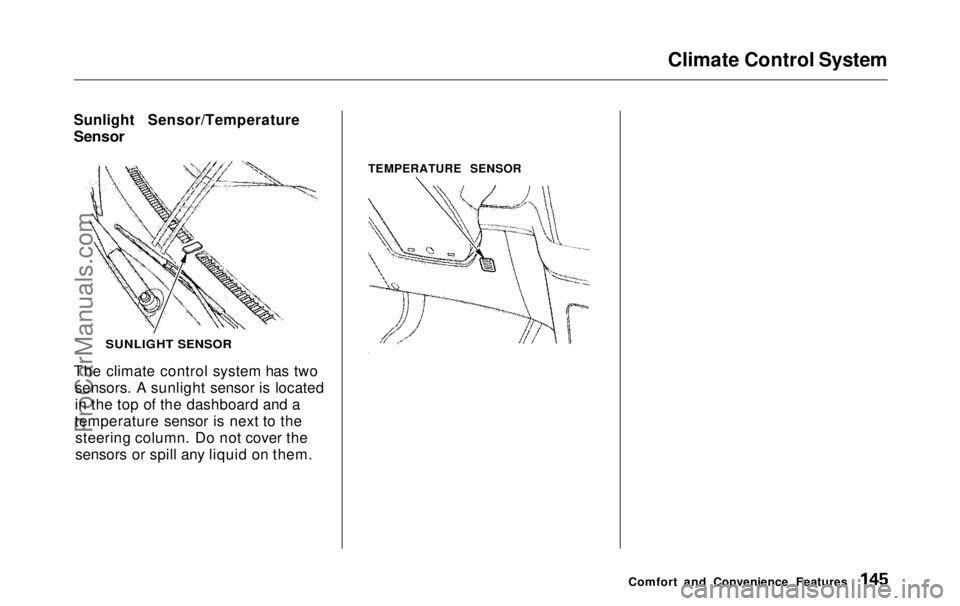
Sunlight Sensor/Temperature
Sensor
The climate control system has two sensors. A sunlight sensor is located
in the top of the dashboard and a
temperature sensor is next to the steering column. Do not cover the
sensors or spill any liquid on them. TEMPERATURE SENSOR
Comfort and Convenience Features
SUNLIGHT SENSORProCarManuals.comMain Menu Table of Contents s t
Page 147 of 343
Climate Control System
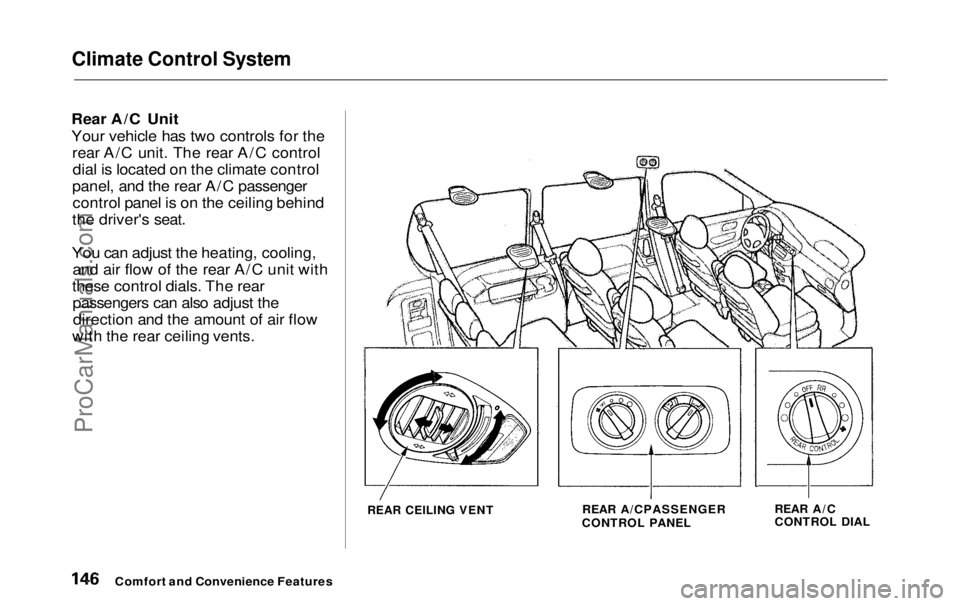
Rear A/C Unit
Your vehicle has two controls for the rear A/C unit. The rear A/C controldial is located on the climate control
panel, and the rear A/C passenger control panel is on the ceiling behind
the driver's seat.
You can adjust the heating, cooling, and air flow of the rear A/C unit with
these control dials. The rear passengers can also adjust thedirection and the amount of air flow
with the rear ceiling vents.
REAR CEILING VENT
REAR A/CPASSENGER
CONTROL PANEL REAR A/C
CONTROL DIAL
Comfort and Convenience FeaturesProCarManuals.comMain Menu Table of Contents s t
Page 148 of 343
Climate Control System
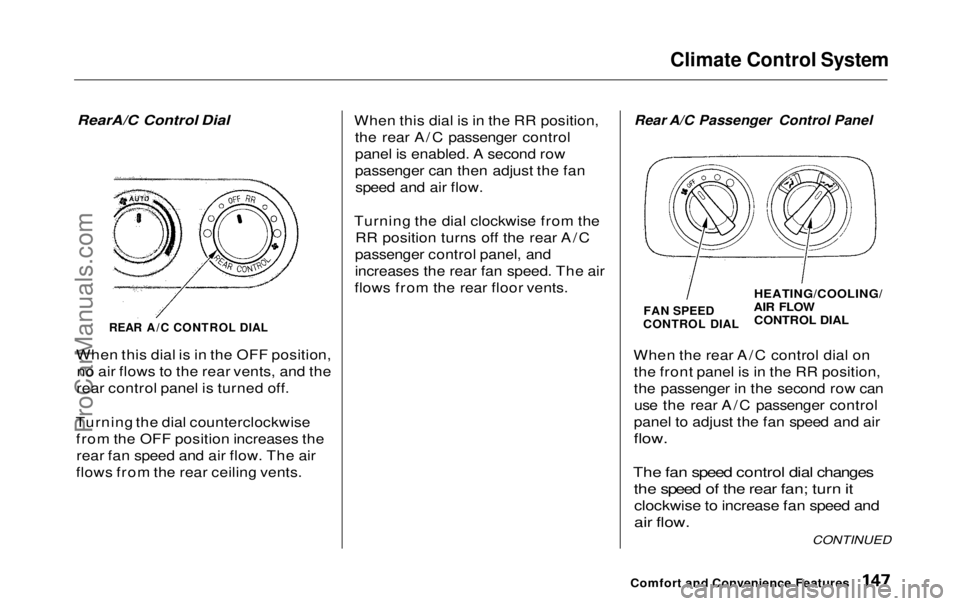
RearA/C Control Dial
REAR A/C CONTROL DIAL
When this dial is in the OFF position, no air flows to the rear vents, and the
rear control panel is turned off.
Turning the dial counterclockwise from the OFF position increases therear fan speed and air flow. The air
flows from the rear ceiling vents. When this dial is in the RR position,
the rear A/C passenger control
panel is enabled. A second row
passenger can then adjust the fanspeed and air flow.
Turning the dial clockwise from the RR position turns off the rear A/C
passenger control panel, and
increases the rear fan speed. The air
flows from the rear floor vents.
Rear A/C Passenger Control Panel
FAN SPEED
CONTROL DIAL
HEATING/COOLING/
AIR FLOW
CONTROL DIAL
When the rear A/C control dial on the front panel is in the RR position,
the passenger in the second row canuse the rear A/C passenger control
panel to adjust the fan speed and air
flow.
The fan speed control dial changes the speed of the rear fan; turn it
clockwise to increase fan speed and
air flow.
Comfort and Convenience Features
CONTINUEDProCarManuals.comMain Menu Table of Contents s t
Page 149 of 343
Climate Control System
The heating/cooling/air flow control dial selects the temperature and
level of the air flow.
When the dial is in the position, heated air flows
from the rear floor vents.
When the dial is in the position, cooled air flows
from the rear ceiling vents. Cooled air can be selected when the A/C
switch on the front control panel is
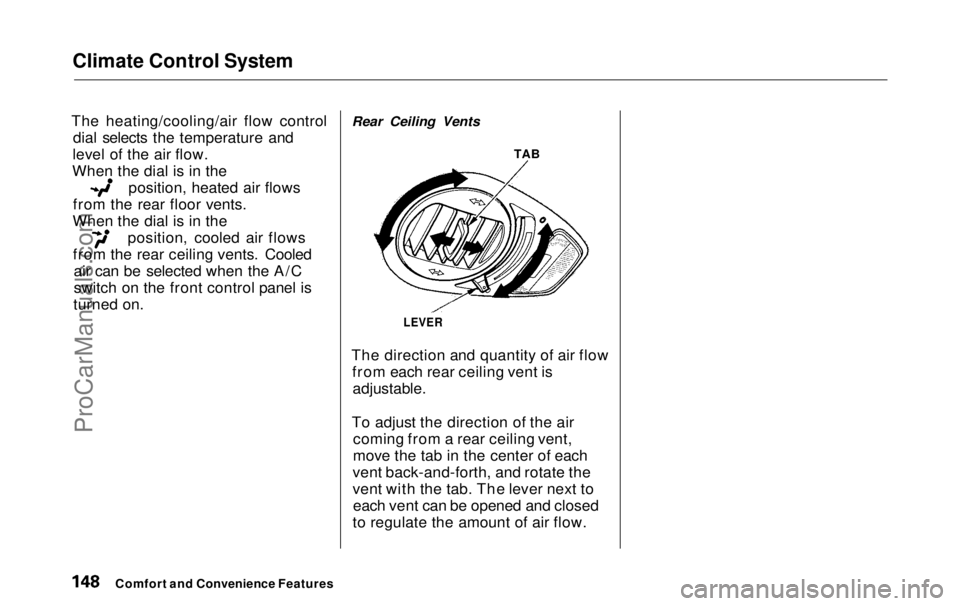
turned on. Rear Ceiling Vents
TAB
LEVER
The direction and quantity of air flow from each rear ceiling vent is
adjustable.
To adjust the direction of the air coming from a rear ceiling vent,
move the tab in the center of each
vent back-and-forth, and rotate the
vent with the tab. The lever next to each vent can be opened and closed
to regulate the amount of air flow.
Comfort and Convenience FeaturesProCarManuals.comMain Menu Table of Contents s t
Page 257 of 343
Air Conditioning Filter, Drive Belts
Air Conditioning Filter
The air conditioning filter removes pollen and dust that is brought in
from the outside through the heating and cooling system/climate control
system.
This filter should be replaced every 30,000 miles (48,000 km) under
normal conditions. It should be
replaced every 15,000 miles (24,000
km) if you drive primarily in urbanareas that have high concentrationsof soot in the air from industry and
diesel-powered vehicles. Replace it
more often if air flow from the
heating and cooling system/climate control system becomes less than
usual. Have the air conditioning filter
replaced by your Honda dealer.
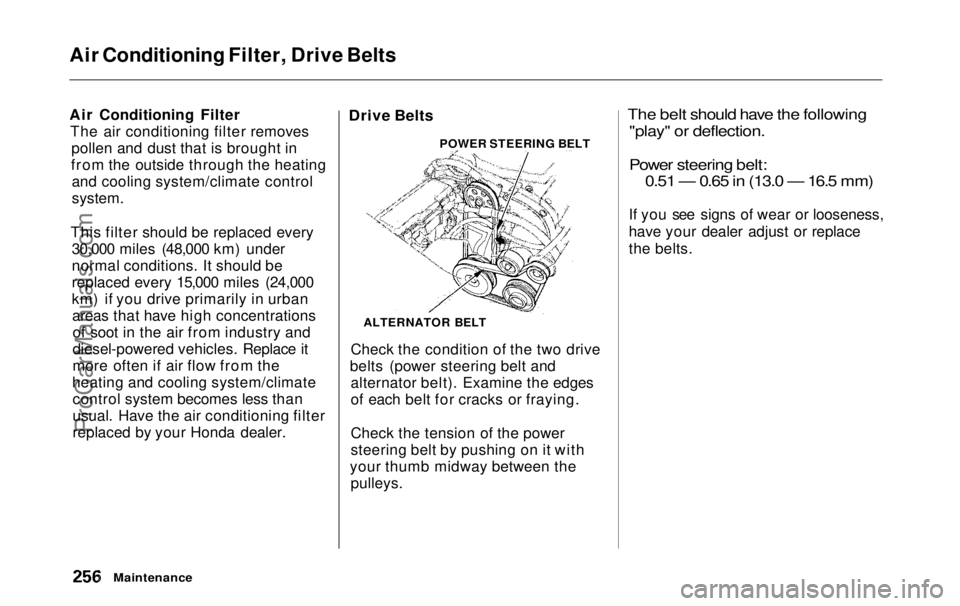
Drive Belts
POWER STEERING BELT
Check the condition of the two drive
belts (power steering belt and alternator belt). Examine the edges
of each belt for cracks or fraying.
Check the tension of the power
steering belt by pushing on it with
your thumb midway between the pulleys.
The belt should have the following
"play" or deflection.
Power steering belt: 0.51 — 0.65 in (13.0 — 16.5 mm)
If you see signs of wear or looseness,
have your dealer adjust or replace
the belts.
Maintenance
ALTERNATOR BELTProCarManuals.comMain Menu Table of Contents s t
Page 296 of 343
If Your Engine Won't Start, Jump Starting
Your vehicle has the Immobilizer
System. You should use a
properly-coded master or valet key
to start the engine (see page 77).
A key that is not properly coded
will cause the immobilizer system indicator in the dash panel to blink
rapidly. Do you have fuel? Turn the
ignition switch to ON (II) for a
minute and watch the fuel gauge.
The low fuel level warning light may not be working, so you were
not reminded to fill the tank. There may be an electrical
problem, such as no power to the
fuel pump. Check all the fuses (see page 305).
If you find nothing wrong, you will
need a qualified technician to find
the problem. See Emergency
Towing on page 311. Jump Starting
If your vehicle's battery has run
down, you may be able to start the
engine by using a booster battery.
Although this seems like a simple procedure, you should take several
precautions.
You cannot start a Honda by pushing or pulling it. To jump start your vehicle, follow
these directions closely:
1. Open the hood and check the physical condition of the battery(see page 251). In very cold
weather, check the condition of the electrolyte. If it seems slushyor like ice, do not try jump starting
until it thaws.
If a battery sits in extreme cold, the
electrolyte inside can freeze.
Attempting to jump start with a frozen
battery can cause it to rupture.
2. Turn off all the electrical acces- sories: heater, A/C, climate
control, stereo system, lights, etc.
Put the transmission in Neutral or
Park and set the parking brake.
CONTINUED
Taking Care of the Unexpected
A battery can explode if you do
not follow the correct procedure,
seriously injuring anyone nearby.
Keep all sparks, open flames,
and smoking materials away
from the battery.
NOTICEProCarManuals.comMain Menu Table of Contents s t
Page 298 of 343
If Your Engine Overheats
The pointer of your vehicle's
temperature gauge should stay in
the midrange under most conditions.
It may go higher if you are driving up
a long steep hill on a very hot day. If
it climbs to the red mark, you should
determine the reason.
Driving with the temperature gauge
pointer at the red mark can cause serious damage to your engine.
Your vehicle can overheat for several
reasons, such as lack of coolant or a
mechanical problem. The only
indication may be the temperature
gauge climbing to or above the red
mark. Or you may see steam or
spray coming from under the hood.
In either case, you should take
immediate action.
1. Safely pull to the side of the road.
Put the transmission in Neutral or
Park and set the parking brake.
Turn off the heating and cooling/ climate control system and all
other accessories. Turn on the
hazard warning indicators.
2. If you see steam and/or spray coining from under the hood, turnoff the engine.
3. If you do not see steam or spray, leave the engine running and
watch the temperature gauge. If the high heat is due to overloading (climbing a long, steep hill on a
hot day with the A/C running, for example), the engine should start
to cool down almost immediately.
If it does, wait until the tempera-
ture gauge comes down to the mid-
point then continue driving.
CONTINUED
Taking Care of the Unexpected
NOTICE
Steam and spray from an
overheated engine can
seriously scald you.
Do not open the hood if steam
is coming out.ProCarManuals.comMain Menu Table of Contents s t
Page 299 of 343
If Your Engine Overheats
4. If the temperature gauge stays at
the red mark, turn off the engine.
5. Wait until you see no more signs of steam or spray, then open the
hood.
6. Look for any obvious coolant leaks, such as a split radiator hose.
Everything is still extremely hot, so use caution. If you find a leak, it
must be repaired before you
continue driving (see Emergency
Towing on page 311).
7. If you don't find an obvious leak, check the coolant level in the
radiator reserve tank (see page187). If the level is below the
MIN mark, add coolant to halfway
between the MIN and MAX marks.
8. If there was no coolant in the reserve tank, you may also have to
add coolant to the radiator. Let the
engine cool down until the pointer reaches the middle of the tempera-
ture gauge, or lower, before check-
ing the radiator.
9. Using gloves or a large heavy cloth, turn the radiator cap
counterclockwise, without pushing
down, to the first stop. This
releases any remaining pressure in
the cooling system. After the
pressure releases, push down on
the cap and turn it until it comes off. 10.Start the engine and set the
temperature control dial tomaximum (climate control to
FULL AUTO at 90°F/32°C). Add
coolant to the radiator up to the
base of the filler neck. If you do not have the proper coolant
mixture available, you can add
plain water. Remember to have
the cooling system drained and refilled with the proper mixture assoon as you can.
11.Put the radiator cap back on tightly. Run the engine and watch
the temperature gauge. If it goes
back to the red mark, the engineneeds repair. (See Emergency
Towing on page 311.)
12.If the temperature stays normal, check the coolant level in the
radiator reserve tank. If it has
gone down, add coolant to the MAX mark. Put the cap back on
tightly.
Taking Care of the Unexpected
Removing the radiator cap
while the engine is hot can
cause the coolant to spray out,
seriously scalding you.
Always let the engine and radiator cool down before
removing the radiator cap.ProCarManuals.comMain Menu Table of Contents s t