climate control HONDA ODYSSEY 1999 Owner's Manual
[x] Cancel search | Manufacturer: HONDA, Model Year: 1999, Model line: ODYSSEY, Model: HONDA ODYSSEY 1999Pages: 343, PDF Size: 3.73 MB
Page 301 of 343
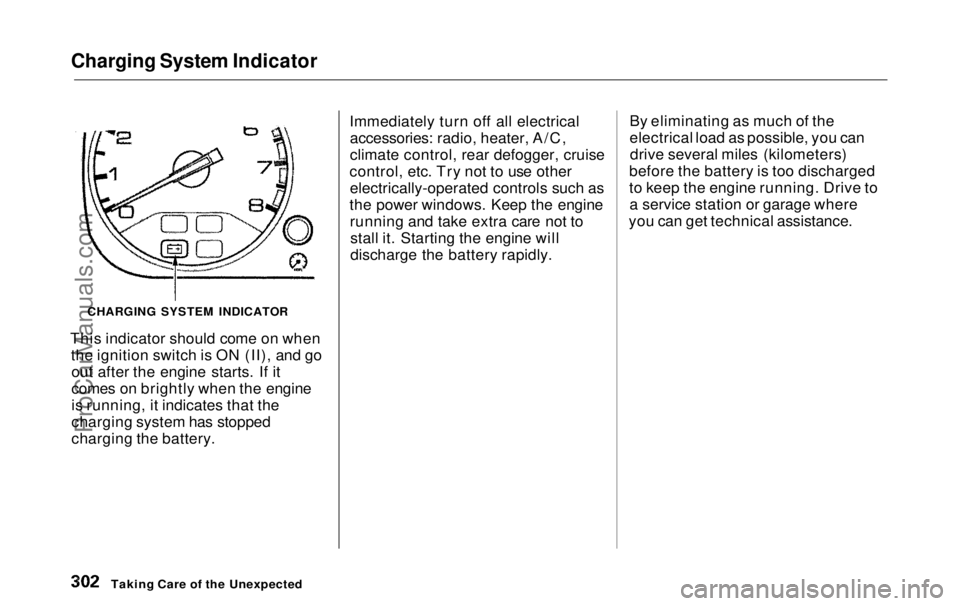
Charging System Indicator
This indicator should come on when the ignition switch is ON (II), and goout after the engine starts. If it
comes on brightly when the engine
is running, it indicates that the
charging system has stopped
charging the battery. Immediately turn off all electrical
accessories: radio, heater, A/C,
climate control, rear defogger, cruise
control, etc. Try not to use other electrically-operated controls such as
the power windows. Keep the engine running and take extra care not tostall it. Starting the engine will
discharge the battery rapidly. By eliminating as much of the
electrical load as possible, you can
drive several miles (kilometers)
before the battery is too discharged
to keep the engine running. Drive to a service station or garage where
you can get technical assistance.
Taking Care of the Unexpected
CHARGING SYSTEM INDICATORProCarManuals.comMain Menu Table of Contents s t
Page 318 of 343

Tire Information
DOT Tire Quality Grading
(U.S. Vehicles)
The tires on your vehicle meet all U.S. Federal Safety Requirements.
All tires are also graded for treadwear, traction, and temperature
performance according toDepartment of Transportation (DOT) standards. The following
explains these gradings.
Treadwear
The treadwear grade is a compara- tive rating based on the wear rate of
the tire when tested under controlledconditions on a specified government
test course. For example, a tire
graded 150 would wear one and one half (1-1/2) times as well on the
government course as a tire graded 100. The relative performance of
tires depends upon the actual condi-
tions of their use, however, and may depart significantly from the norm
due to variations in driving habits,service practices, and differences in
road characteristics and climate. Traction
The traction grades, from highest to lowest, are A, B, and C, and they
represent the tire's ability to stop on
wet pavement as measured under controlled conditions on specified
government test surfaces of asphalt and concrete. A tire marked C may
have poor traction performance.
Warning: The traction grade as- signed to this tire is based on brak-
ing (straight ahead) traction tests and does not include cornering (turning) traction.
CONTINUED
Technical InformationProCarManuals.comMain Menu Table of Contents s t
Page 322 of 343

Emissions Controls
The burning of gasoline in your
vehicle's engine produces several by- products. Some of these are carbonmonoxide (CO), oxides of nitrogen (NOx) and hydrocarbons (HC).
Gasoline evaporating from the tank
also produces hydrocarbons. Con-
trolling the production of NOx, CO, and HC is important to the environ-
ment. Under certain conditions of sunlight and climate, NOx and HC
react to form photochemical "smog." Carbon monoxide does not contri-
bute to smog creation, but it is a
poisonous gas. The Clean Air Act
The United States Clean Air Act*
sets standards for automobile
emissions. It also requires that
automobile manufacturers explain to
owners how their emissions controls
work and what to do to maintain them. This section summarizes how
the emissions controls work.Scheduled maintenance is on page 224.
* In Canada, Honda vehicles comply
with the Canadian Motor Vehicle Safety Standards (CMVSS) for
Emissions valid at the time they are
manufactured. Crankcase Emissions Control
System
Your vehicle has a Positive Crankcase Ventilation System. This
keeps gasses that build up in the engine's crankcase from going into
the atmosphere. The Positive Crank- case Ventilation valve routes them
from the crankcase back to the intake manifold. They are then
drawn into the engine and burned.
Evaporative Emissions Control
System
As gasoline evaporates in the fuel tank, an evaporative emissionscontrol canister filled with charcoal
adsorbs the vapor. It is stored in thiscanister while the engine is off. After
the engine is started and warmed up,
the vapor is drawn into the engine and burned during driving.
Technical InformationProCarManuals.comMain Menu Table of Contents s t
Page 335 of 343
Index
Checklist, Before Driving............. 196
Childproof Door Locks................... 85
Child Safety...................................... 22
Cleaner Element, Air..................... 246
Cleaning
Aluminum Wheels..................... 279
Carpeting.................................... 280
Exterior....................................... 278
Fabric.......................................... 280
Interior........................................ 280
Seat Belts.................................... 280
Vinyl............................................280
Windows..................................... 281
Climate Control System................ 138
Clock, Setting the.......................... 117
Coat Hook....................................... 123
Code, Audio System...................... 180
CO in the Exhaust......................... 323
Coin Holder.................................... 122
Cold Weather, Starting in............. 197
Compact Spare............................... 286
Consumer Information*................ 328
Controls, Instruments and.............. 55
Coolant
Adding......................................... 237
Checking..................................... 187
Proper Solution.......................... 237
Replacing.................................... 239
Temperature Gauge.................... 63
Corrosion Protection..................... 282
Crankcase Emissions Control
System.........................................323
Cruise Control Operation............... 73
Customer Relations Office........... 328
DANGER, Explanation of................. ii
Dashboard.................................... 2, 56
Daytime Running Lights................. 67
Dead Battery, What to Do............ 297
Defects, Reporting Safety............. 332
Defogger, Rear Window................. 71
Defrosting the Windows.......135, 144
DEXRON ®
III Automatic
Transmission Fluid.................... 243
Dimensions..................................... 316
Dimming the Headlights................ 66
Dipstick
Automatic Transmission........... 243
Engine Oil................................... 186
Directional Signals........................... 68
Disabled, Towing Your
Vehicle If..................................... 311
Disc Brake Wear Indicators......... 204
Disposal of Used Oil...................... 236
Doors
Locking and Unlocking............... 79Lockout Prevention..................... 80
Manual Sliding Doors.................. 88
Monitor Light............................... 60
Power Door Locks....................... 79
Power Sliding Doors.................... 90
DOT Tire Quality Grading........... 319
Drive Belts...................................... 256
Driver and Passenger Safety............ 5
Driving............................................ 195 Economy..................................... 188
In Bad Weather.......................... 210
In Foreign Countries................. 322
Economy, Fuel............................... 188
Emergencies on the Road............. 285
Battery, Jump Starting.............. 297
CONTINUEDProCarManuals.comMain Menu s t