weight HONDA ODYSSEY 1999 User Guide
[x] Cancel search | Manufacturer: HONDA, Model Year: 1999, Model line: ODYSSEY, Model: HONDA ODYSSEY 1999Pages: 343, PDF Size: 3.73 MB
Page 193 of 343
Carrying Cargo
Load Limit
The maximum load for your vehicle
is
1,277 lbs
(580 kg).
This figure includes the total weight
of all occupants, cargo, accessories,
and the tongue weight if you are
towing a trailer.
To figure out how much cargo you can carry:
Add up the weight of all occupants.
If you are towing a trailer, add the
tongue weight to the number
above.
Subtract the total from 1,277 Ibs
(580kg).
The final number is the total weight
of cargo you can carry.
When you load luggage, the total
weight of the vehicle, all passengers,cargo, and trailer tongue load must
not exceed the Gross Vehicle
Weight Rating (GVWR). The load for the front and rear axles also must not exceed the Gross Axle Weight
Rating (GAWR). The GVWR and
GAWR are printed on the tire
information label attached to the driver's doorjamb (see page 316 ). Carrying Items in the Passenger
Compartment
Store or secure all items that could
be thrown around and hurt someone during a crash.
Be sure items placed on the floor
behind the front seats cannot roll
under the seats and interfere with
the driver's ability to operate the
pedals, or with the proper operation of the seats.
Keep the glove box closed while
driving. If the lid is open, a
passenger could injure their knees during a crash or sudden stop.
Before Driving Overloading or improper
loading can affect handling and
stability and cause a crash in
which you can be hurt or killed.
Follow all load limits and other
loading guidelines in this
manual.ProCarManuals.comMain Menu Table of Contents s t
Page 194 of 343
Carrying Cargo
Carrying Cargo in the Cargo Area
or on a Roof Rack
Distribute cargo evenly on the
floor of the cargo area, placing the
heaviest items on the bottom andas far forward as possible. Tiedown items that could be thrown
about the vehicle during a crash or
sudden stop.
If you carry large items that
prevent you from closing the
tailgate, exhaust gas can enter the
passenger area. To avoid the
possibility of carbon monoxide
poisoning, follow the instructions on page 53 . If you can carry any items on a
roof rack, be sure the total weight of the rack and the items does not
exceed the maximum allowable
weight. Please contact your Honda dealer for further information. Side Cargo Net
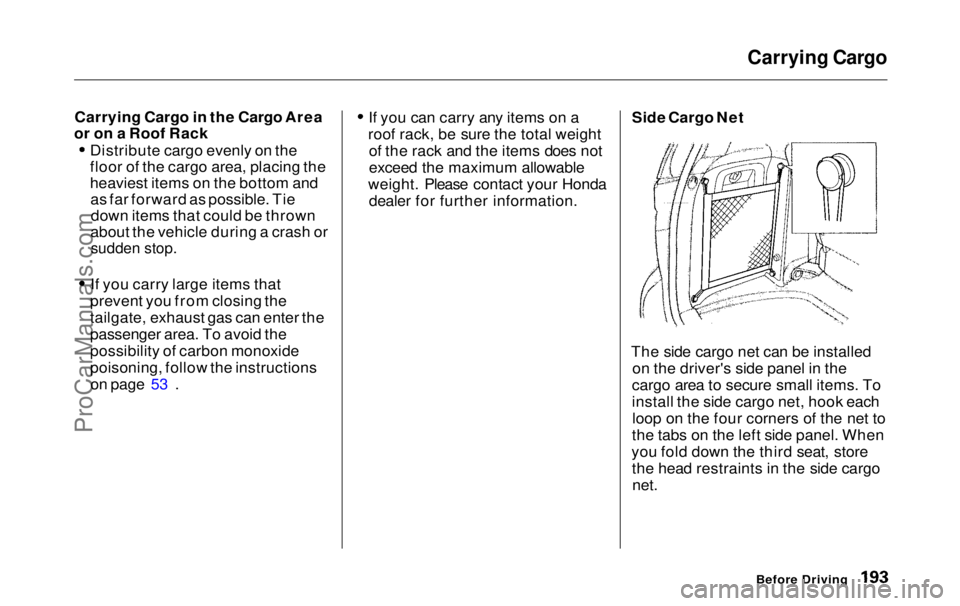
The side cargo net can be installed on the driver's side panel in the
cargo area to secure small items. To
install the side cargo net, hook each loop on the four corners of the net to
the tabs on the left side panel. When
you fold down the third seat, store the head restraints in the side cargo
net.
Before DrivingProCarManuals.comMain Menu Table of Contents s t
Page 213 of 343
Towing a Trailer
Your Odyssey has been designed totow a trailer, as well as for carrying
passengers and their cargo.
To safely tow a trailer, you must observe the load limits, use the
proper equipment, and follow the
guidelines in this section.
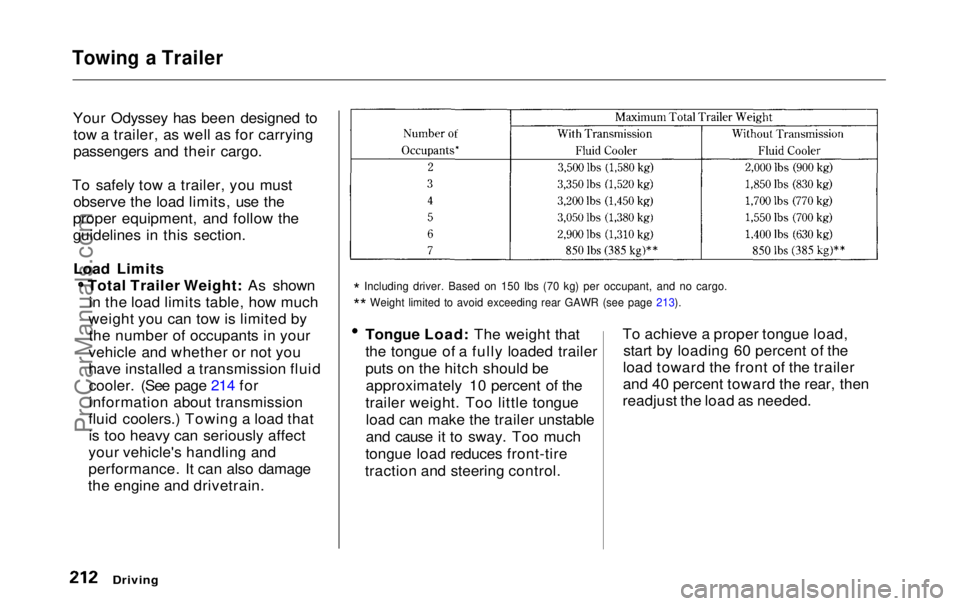
Load Limits Total Trailer Weight: As shownin the load limits table, how much
weight you can tow is limited by the number of occupants in your
vehicle and whether or not you
have installed a transmission fluid cooler. (See page 214 for
information about transmission
fluid coolers.) Towing a load that is too heavy can seriously affect
your vehicle's handling and
performance. It can also damage
the engine and drivetrain.
*
Including driver. Based on 150 Ibs (70 kg) per occupant, and no cargo\
.
*
*
Weight limited to avoid exceeding rear GAWR (see page 213).
Tongue Load: The weight that
the tongue of a fully loaded trailer
puts on the hitch should be
approximately 10 percent of the
trailer weight. Too little tongue load can make the trailer unstable
and cause it to sway. Too much
tongue load reduces front-tire
traction and steering control. To achieve a proper tongue load,
start by loading 60 percent of the
load toward the front of the trailer
and 40 percent toward the rear, then
readjust the load as needed.
Driving
ProCarManuals.comMain Menu Table of Contents s t
Page 214 of 343

Towing a Trailer
Gross Vehicle Weight Rating
(GVWR):
The total weight of the vehicle, all occupants, all cargo, and the
tongue load must not exceed: 5,565 Ibs (2,525 kg)
Gross Axle Weight Rating
(GAWR):
The total weight of the vehicle, all occupants, all cargo, and the
tongue load must not exceed:
2,775 Ibs (1,260 kg)
on the front axle
2,840 Ibs (1,290 kg)
on the rear axle
Gross Combined Weight Rating
(GCWR):
The total weight of the vehicle, all occupants and cargo, and the
trailer and everything in or on it,
must not exceed:
8,160 Ibs (3,700 kg)
with transmission fluid cooler
6,660 Ibs (3,025 kg) without transmission fluid cooler
Checking Loads
The best way to confirm that vehicle and trailer weights are within limitsis to have them checked at a public
scale.
Using a suitable scale or a special
tongue load gauge, check the tongue
load the first time you set up a
towing combination (a fully-loaded
vehicle and trailer), then recheck the tongue load whenever the conditions
change.
Driving
Exceeding load limits or
improperly loading your vehicle
and trailer can cause a crash in
which you can be seriously injured or killed.
Check the loading of your
vehicle and trailer carefully before starting to drive.ProCarManuals.comMain Menu Table of Contents s t
Page 215 of 343

Towing a Trailer
Towing Equipment and
Accessories
Towing can require a variety of equipment, depending on the size of
your trailer, how it will be used, and how much load you are towing.
Discuss your needs with your trailersales or rental agency, and follow the
guidelines in the rest of this section.
Also make sure that all equipment is properly installed and that it meets
federal, state, province, and local
regulations.
Hitches
Any hitch used on your vehicle must
be properly bolted to the underbody, using the six threaded holes
provided. A hitch designed especially
for your Odyssey can be obtained
from your Honda dealer.
Weight Distributing Hitch
If the total trailer weight is more
than 2,000 Ibs (900 kg), you must also use a weight distributing hitch.
This device transfers weight from the vehicle's rear wheels to the front
wheels, and to the trailer's wheels. Carefully follow the hitch maker's
instructions for proper installation
and adjustment.
Safety Chain
Always use a safety chain. Make sure that it is secured to both the
trailer and hitch, and that it crosses under the tongue so it can catch the
trailer if it becomes unhitched.
Leave enough slack to allow the
trailer to turn corners easily, but do not let the chain drag on the ground. Sway Control
If the total trailer weight exceeds 2,000 Ibs (900 kg), you should install
a sway control device to minimize
swaying that can occur in crosswinds
and in normal and emergency
driving maneuvers. Your trailer
maker can tell you what kind of sway
control you need and how to install it.
Transmission Fluid Cooler
If the total trailer weight is more
than 2,000 Ibs (900 kg), you must
also have a transmission fluid cooler
installed. This device will help
prevent transmission overheating,
which could cause serious damage.
A transmission fluid cooler designed for your Odyssey can be obtainedfrom your Honda dealer.
DrivingProCarManuals.comMain Menu Table of Contents s t
Page 216 of 343
Towing a Trailer
Trailer Brakes
Honda recommends that any trailer
having a total weight of 1,000 Ibs (450 kg) or more be equipped with
its own electric or surge-type brakes.
If you choose electric brakes, be
sure they are electronically actuated.
Do not attempt to tap into your
vehicle's hydraulic system. No matter how successful it may seem,
any attempt to attach trailer brakes
to your vehicle's hydraulic system
will lower braking effectiveness and create a potential hazard.
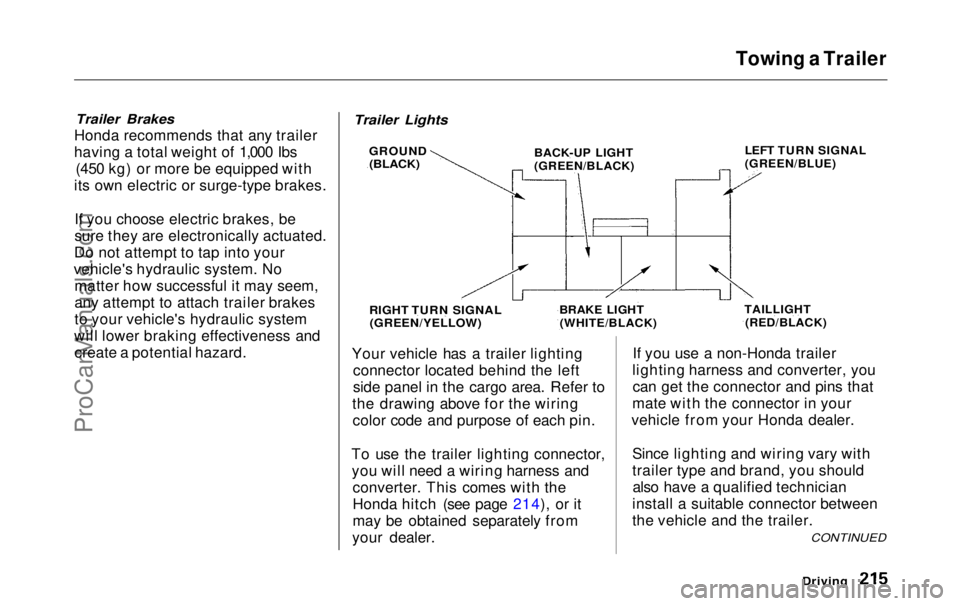
Your vehicle has a trailer lighting
connector located behind the left
side panel in the cargo area. Refer to
the drawing above for the wiring color code and purpose of each pin.
To use the trailer lighting connector, you will need a wiring harness and converter. This comes with the
Honda hitch (see page 214), or it
may be obtained separately from
your dealer. If you use a non-Honda trailer
lighting harness and converter, you can get the connector and pins that
mate with the connector in your
vehicle from your Honda dealer.
Since lighting and wiring vary with
trailer type and brand, you shouldalso have a qualified technician
install a suitable connector between
the vehicle and the trailer.
Driving
CONTINUED
Trailer Lights
GROUND
(BLACK)
BACK-UP LIGHT
(GREEN/BLACK)
LEFT TURN SIGNAL
(GREEN/BLUE)
TAILLIGHT
(RED/BLACK)
BRAKE LIGHT
(WHITE/BLACK)
RIGHT TURN SIGNAL
(GREEN/YELLOW)ProCarManuals.comMain Menu Table of Contents s t
Page 217 of 343
Towing a Trailer
Spare Vehicle Tire
When towing a trailer, you should carry a full-size wheel and tire as aspare in case you have a flat. If you
use the compact spare tire that came
with the vehicle, it may adversely affect vehicle handling. See page 317 for information on proper tire
size, and page 293 for information on
how to store a full-size tire. When storing a full-size spare tire in the
trailer, follow the trailer maker's
instructions.
Additional Trailer equipment
Many states and provinces require
special outside mirrors when towing
a trailer. Even if they don't, you should install special mirrors if you
cannot clearly see behind you, or if
the trailer creates a blind spot.
Ask your trailer sales or rental agency if any other items are
recommended or required for your
towing situation. Pre-Tow Checklist
When preparing to tow, and before driving away, be sure to check the
following:
The vehicle has been properlyserviced, and the tires, brakes,
suspension, and cooling system
are in good operating condition.
All weights and loads are within limits (see pages 212 and 213).
The hitch, safety chain, and any other attachments are secure.
All items on and in the trailer are properly secured and cannot shift
while you drive.
The lights and brakes on your vehicle and the trailer are workingproperly. Your vehicle tires and spare are
properly inflated (see page 317),and the trailer tires and spare are
inflated as recommended by the
trailer maker.
You may want to fill the fuel tank with premium fuel. Premium fuelprovides improved performance.
DrivingProCarManuals.comMain Menu Table of Contents s t
Page 218 of 343

Towing a Trailer
Driving Safely With a Trailer
The added weight, length, and height of a trailer will affect your
vehicle's handling and performance, so driving with a trailer requires
some special driving skills and
techniques.
For your safety and the safety of
others, take time to practice driving
maneuvers before heading for the
open road, and follow the guidelines
discussed below.
Towing Speeds and Gears
Driving slower than normal in all driving situations, and obey posted
speed limits for vehicles with trailers.
Use the D 4
position when towing
a trailer on level roads. D 3
is the
proper shift lever position to use when towing a trailer in hilly terrain.
(See "Driving on Hills" in the next
column for additional gear
information.)
Making Turns and Braking
Make turns more slowly and wider
than normal. The trailer tracks a smaller arc than your vehicle, and it
can hit or run over something the
vehicle misses. Allow more time and distance for braking. Do not brake or
turn suddenly as this could cause the
trailer to jackknife or turn over.
Driving on Hills
When climbing hills, closely watch your temperature gauge. If it nearsthe red mark, turn the air
conditioning off, reduce speed and, if
necessary, pull to the side of the
road to let the engine cool. Do notdrive over 45 mph (72 km/h) on a
long uphill stretch.
If the transmission shifts frequently
between 3rd and 4th gears while
going up a hill, shift to D 3
. If you must stop when facing uphill,
use the foot brake or parking brake.
Do not try to hold the vehicle in
place by pressing on the accelerator,
as this can cause the transmission to
overheat.
When driving down hills, reduce your speed and shift down to 2ndgear. Do not "ride" the brakes, and
remember it will take longer to slowdown and stop when towing a trailer.
CONTINUED
DrivingProCarManuals.comMain Menu Table of Contents s t
Page 235 of 343
Engine Oil
The oil container may also display the API Certification seal. Make sure
it says "For Gasoline Engines."
API CERTIFICATION SEAL
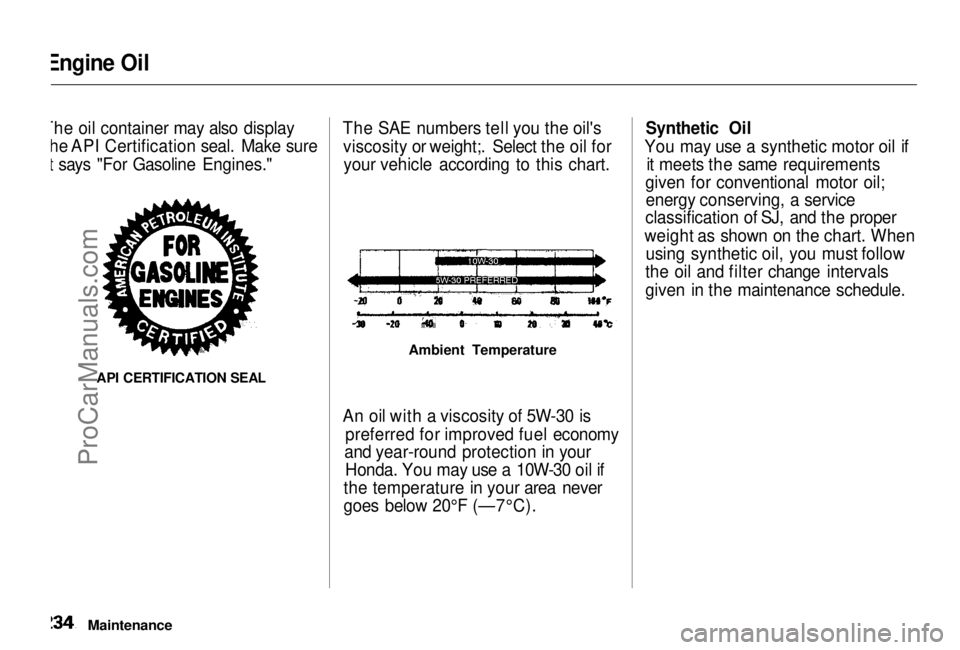
The SAE numbers tell you the oil's
viscosity or weight;. Select the oil foryour vehicle according to this chart.
Ambient Temperature
An oil with a viscosity of 5W-30 is preferred for improved fuel economy
and year-round protection in your
Honda. You may use a 10W-30 oil if
the temperature in your area never
goes below 20°F (—7°C). Synthetic Oil
You may use a synthetic motor oil if it meets the same requirements
given for conventional motor oil; energy conserving, a service
classification of SJ, and the proper
weight as shown on the chart. When using synthetic oil, you must follow
the oil and filter change intervals
given in the maintenance schedule.
MaintenanceProCarManuals.comMain Menu Table of Contents s t
Page 261 of 343
Tires
Maintenance
In addition to proper inflation,correct wheel alignment helps to
decrease tire wear. If you find a tire
is worn unevenly, have your dealer
check the wheel alignment.
The tires were properly balanced by the factory. They may need to berebalanced at some time before they
are worn out. Have your dealer
check the tires if you feel a consis-
tent vibration while driving. A tire should always be rebalanced if it is
removed from the wheel for repair. Make sure the installer balances the
wheels when you have new tires installed. This increases riding
comfort and tire life. Your vehicle's
original tires were dynamic or "spin"
balanced at the factory. For best results, have the installer perform adynamic balance.
On some models
Improper wheel weights can damage
your vehicle 'x aluminum wheels. Use only Genuine Honda wheel weights for
balancing.
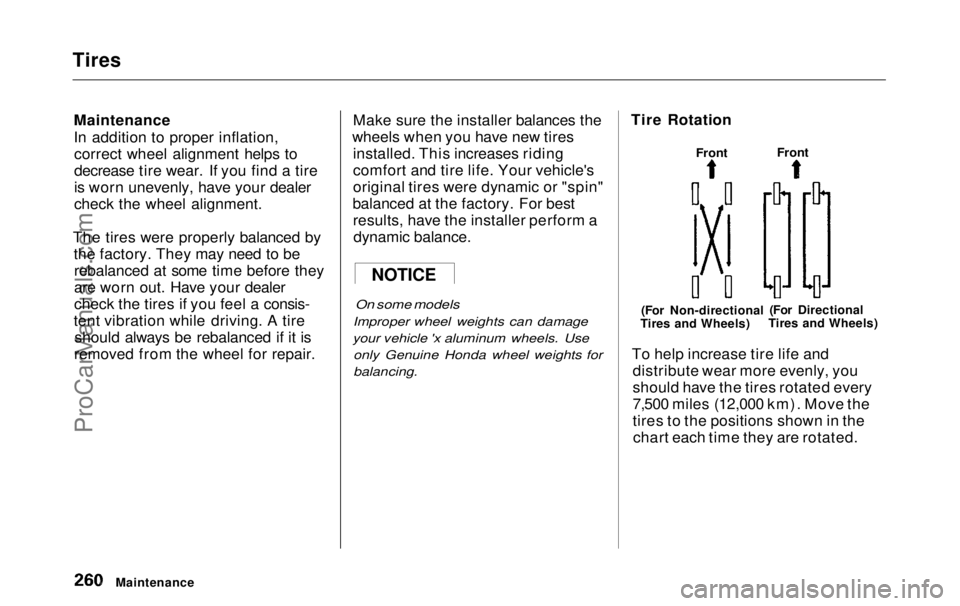
Tire Rotation
To help increase tire life anddistribute wear more evenly, you
should have the tires rotated every
7,500 miles (12,000 km). Move the
tires to the positions shown in thechart each time they are rotated.
Maintenance
NOTICE
(For Non-directional
Tires and Wheels) (For Directional
Tires and Wheels)
Front
FrontProCarManuals.comMain Menu Table of Contents s t