hood release HONDA ODYSSEY 1999 Owners Manual
[x] Cancel search | Manufacturer: HONDA, Model Year: 1999, Model line: ODYSSEY, Model: HONDA ODYSSEY 1999Pages: 343, PDF Size: 3.73 MB
Page 4 of 343
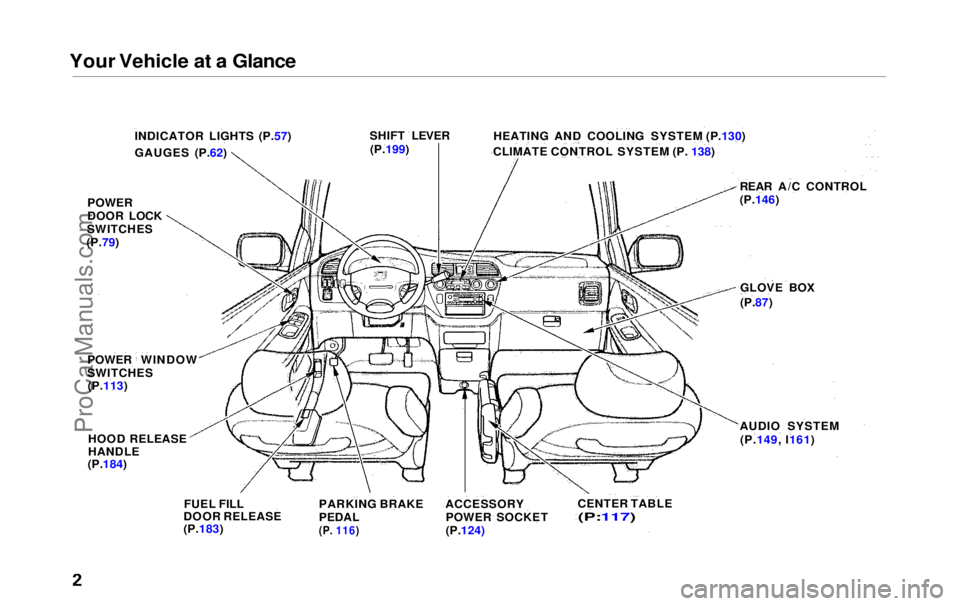
Your Vehicle at a Glance
INDICATOR LIGHTS (P.57)
GAUGES (P.62) HEATING AND COOLING SYSTEM (P.130)
CLIMATE CONTROL SYSTEM (P. 138)
SHIFT LEVER
(P.199)
REAR A/C CONTROL
(P.146)
GLOVE BOX
(P.87)
AUDIO SYSTEM (P.149, l161)
CENTER TABLE
(P:117)
ACCESSORY
POWER SOCKET
(P.124)
PARKING BRAKE
PEDAL
(P.
116)
FUEL FILL
DOOR RELEASE
(P.183)
HOOD RELEASE
HANDLE
(P.184)
POWER
DOOR LOCK
SWITCHES
(P.79)
POWER WINDOW
SWITCHES(P.113)ProCarManuals.comMain Menu s t
Page 57 of 343
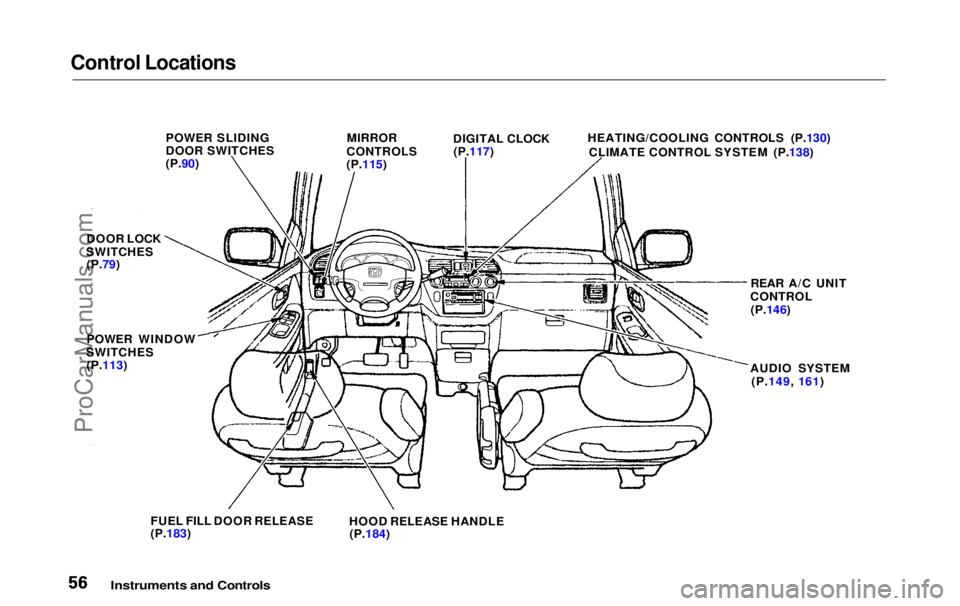
Control Locations
Instruments and Controls
POWER SLIDING
DOOR SWITCHES
(P.90)
MIRROR
CONTROLS
(P.115) DIGITAL CLOCK
(P.117) HEATING/COOLING CONTROLS (P.130)
CLIMATE CONTROL SYSTEM (P.138)
REAR A/C UNIT
CONTROL (P.146)
AUDIO SYSTEM (P.149, 161)
FUEL FILL DOOR RELEASE
(P.183)
HOOD RELEASE HANDLE
(P.184)
POWER WINDOW
SWITCHES
(P.113)
DOOR LOCK
SWITCHES (P.79)ProCarManuals.comMain Menu Table of Contents s t
Page 185 of 343
Service Station Procedures
3. Remove the fuel fill cap slowly.
You may hear a hissing sound aspressure inside the tank escapes.Place the cap in the holder on the
fuel fill door.
4. Stop filling the tank after the fuel pump automatically clicks off. Donot try to "top off" the tank, leavesome room for the fuel to expand
with temperature changes.
5. Screw the fuel fill cap back on, tighten it until it clicks at least
three times. If you do not properly
tighten the cap, the MalfunctionIndicator Lamp may come on (see
page 303 ).
6. Push the fuel fill door closed until it latches.
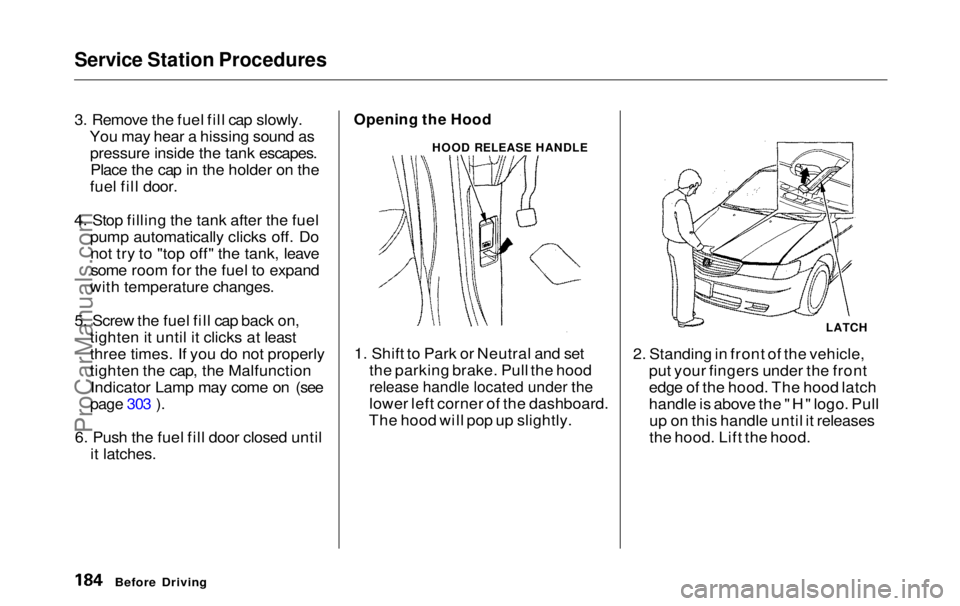
Opening the Hood
1. Shift to Park or Neutral and set the parking brake. Pull the hood
release handle located under the
lower left corner of the dashboard.
The hood will pop up slightly. 2. Standing in front of the vehicle,
put your fingers under the front
edge of the hood. The hood latch
handle is above the "H" logo. Pullup on this handle until it releases
the hood. Lift the hood.
Before Driving
HOOD RELEASE HANDLE
LATCHProCarManuals.comMain Menu Table of Contents s t
Page 299 of 343
If Your Engine Overheats
4. If the temperature gauge stays at
the red mark, turn off the engine.
5. Wait until you see no more signs of steam or spray, then open the
hood.
6. Look for any obvious coolant leaks, such as a split radiator hose.
Everything is still extremely hot, so use caution. If you find a leak, it
must be repaired before you
continue driving (see Emergency
Towing on page 311).
7. If you don't find an obvious leak, check the coolant level in the
radiator reserve tank (see page187). If the level is below the
MIN mark, add coolant to halfway
between the MIN and MAX marks.
8. If there was no coolant in the reserve tank, you may also have to
add coolant to the radiator. Let the
engine cool down until the pointer reaches the middle of the tempera-
ture gauge, or lower, before check-
ing the radiator.
9. Using gloves or a large heavy cloth, turn the radiator cap
counterclockwise, without pushing
down, to the first stop. This
releases any remaining pressure in
the cooling system. After the
pressure releases, push down on
the cap and turn it until it comes off. 10.Start the engine and set the
temperature control dial tomaximum (climate control to
FULL AUTO at 90°F/32°C). Add
coolant to the radiator up to the
base of the filler neck. If you do not have the proper coolant
mixture available, you can add
plain water. Remember to have
the cooling system drained and refilled with the proper mixture assoon as you can.
11.Put the radiator cap back on tightly. Run the engine and watch
the temperature gauge. If it goes
back to the red mark, the engineneeds repair. (See Emergency
Towing on page 311.)
12.If the temperature stays normal, check the coolant level in the
radiator reserve tank. If it has
gone down, add coolant to the MAX mark. Put the cap back on
tightly.
Taking Care of the Unexpected
Removing the radiator cap
while the engine is hot can
cause the coolant to spray out,
seriously scalding you.
Always let the engine and radiator cool down before
removing the radiator cap.ProCarManuals.comMain Menu Table of Contents s t