rear HONDA ODYSSEY 2002 RA6-RA9 / 2.G Owners Manual
[x] Cancel search | Manufacturer: HONDA, Model Year: 2002, Model line: ODYSSEY, Model: HONDA ODYSSEY 2002 RA6-RA9 / 2.GPages: 399, PDF Size: 4.97 MB
Page 10 of 399
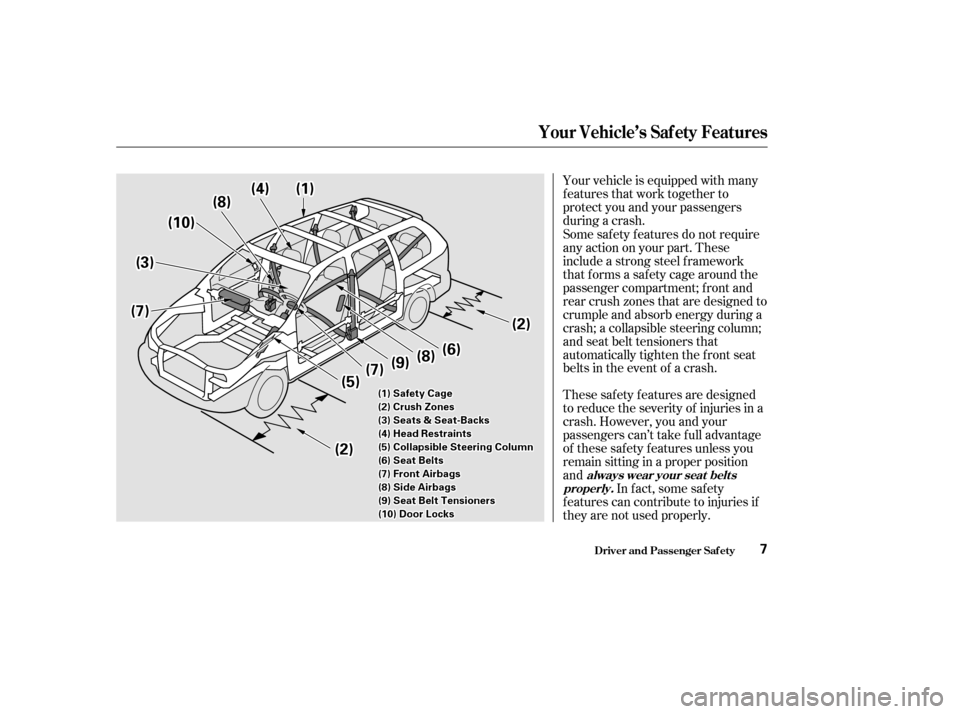
Your vehicle is equipped with many
features that work together to
protect you and your passengers
during a crash.
These saf ety f eatures are designed
to reduce the severity of injuries in a
crash. However, you and your
passengers can’t take f ull advantage
of these saf ety f eatures unless you
remain sitting in a proper position
andIn f act, some saf ety
f eatures can contribute to injuries if
they are not used properly. Some saf ety f eatures do not require
anyactiononyourpart.These
include a strong steel f ramework
that forms a safety cage around the
passenger compartment; f ront and
rear crush zones that are designed to
crumple and absorb energy during a
crash; a collapsible steering column;
and seat belt tensioners that
automatically tighten the front seat
belts in the event of a crash.
Driver and Passenger Saf ety
Your Vehicle’s Saf ety Features
always wear your seat belts
properly.
7
( ( 3
3) )
(
(6
6) )
(
(
7
7) )
(
(5
5) )
(
( 2
2) ) (
(
2
2) )
(
( 7
7) )
(
(
4
4) )
(
(8
8) )
(
( 9
9) )
(
(
8
8) )
(
( 1
10 0)) (
(
1
1) )
(
(1
1) ) S
Sa affe
et tyy C
Caagg e
e
(
( 2
2) ) C
Cr ruu s
shh Z
Zo
on
ne
ess
(
( 3
3) ) S
Se eaattss &
& S
Seeaatt--B
Ba acckks s
(
( 4
4) ) H
H e
eaadd R
Reessttrraai inn t
tss
(
( 5
5) ) C
Co ol
lllaap p s
siibb l
lee S
Stteee erriinn g
g C
Cool
luu m
m n
n
(
( 6
6) ) S
Se eaatt B
Be elltts s
(
( 7
7) ) F
Frroo n
nt
t A
A i
irrb b a
agg s
s
(
( 8
8) ) S
Si idd e
e A
Ai
irrb b a
agg s
s
(
( 9
9) ) S
Se eaatt B
Be elltt T
Te
enn s
siioo n
ne
errss
(
( 1
10 0)) D
D o
oo
or
r L
Loo c
ckks s
Page 11 of 399
Your seat belt system also
includes a light on the
instrument panel to remind you and
your passengers to f asten your seat
belts.
Seat belts are the single most
effectivesafetydeviceforadultsand
larger children. (Inf ants and smaller
children must be properly restrained
in child seats.)
Not wearing a seat belt properly
increases the chance of serious
injury or death in a crash, even
though your vehicle has airbags. Foryoursafety,andthesafetyof
your passengers, your vehicle is
equipped with seat belts in all seating
positions. In addition, most states and all
Canadian provinces require you to
wear seat belts.
Keep you connected to the vehicle
so you can take advantage of the
vehicle’s built-in saf ety f eatures.
When properly worn, seat belts:
Help protect you in almost every
type of crash, including f rontal,
side, and rear impacts and
rollovers. Help keep you f rom being thrown
against the inside of the vehicle
and against other occupants.
Keep you f rom being thrown out
of the vehicle.
Help keep you in a good position
should the airbags ever deploy. A
good position reduces the risk of
injury f rom an inf lating airbag, and
allows you to get the best
advantage f rom the airbag.
Of course, seat belts cannot
completely protect you in every
crash.Butinmostcases,seatbelts
can reduce your risk of serious
injury. Always wear
your seat belt, and make sure you
wear it properly.
Driver and Passenger Saf ety
Seat Belts
Why Wear Seat Belt s
What you should do:
Your Vehicle’s Saf ety Features
8
Not wearing a seat belt properly
increases the chance of serious
injury or death in a crash, even
if you have airbags.
Be sure you and your
passengers always wear seat
belts and wear them properly.
Page 12 of 399
Always wear
your seat belt properly, and sit
upright and as f ar back as possible
f rom the steering wheel or
dashboard. They are designed to supplement
the seat belts.
To do their job, airbags must
inf late with tremendous f orce and
speed. So while airbags help save
lives, they can cause minor injuries,
or more serious or even fatal
injuries if occupants are not
properly restrained or sitting
properly.
The most important things you need
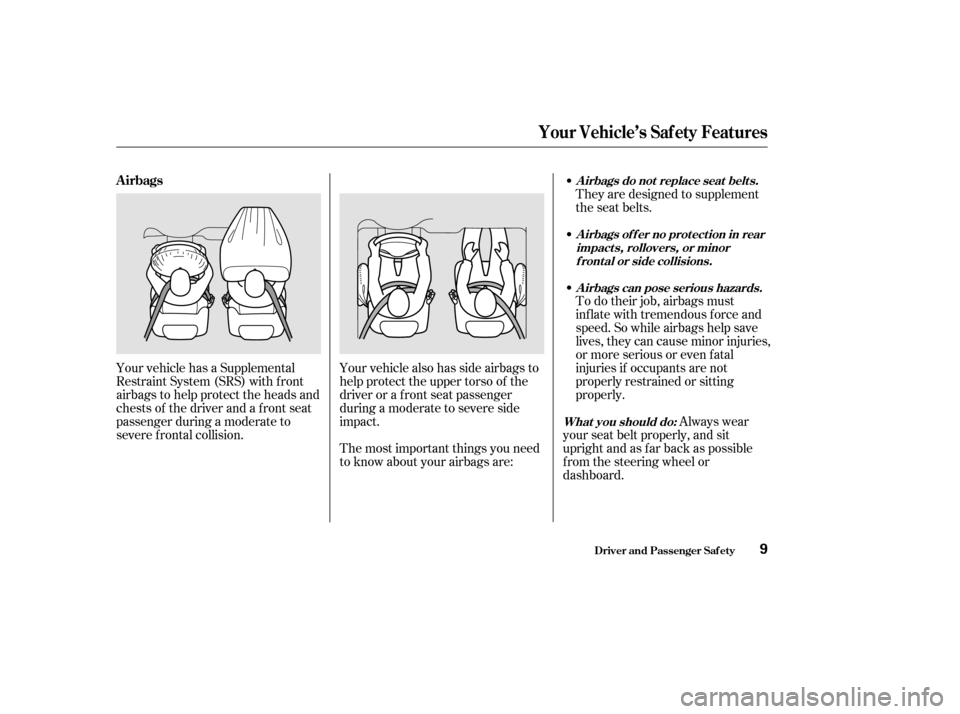
to know about your airbags are: Your vehicle also has side airbags to
help protect the upper torso of the
driver or a f ront seat passenger
during a moderate to severe side
impact.
Your vehicle has a Supplemental
Restraint System (SRS) with f ront
airbags to help protect the heads and
chests of the driver and a front seat
passenger during a moderate to
severe f rontal collision.
Your Vehicle’s Saf ety Features
Driver and Passenger Saf ety
What you should do:
Airbags do not replace seat belts.
A irbags of f er no prot ect ion in rearimpact s, rollovers, or minorf ront al or side collisions.
Airbags can pose serious hazards.
Airbags
9
Page 16 of 399
CONT INUED
See page f or how to adjust the
f ront seats. Once your seat is adjusted correctly,
rock it back and f orth to make sure
the seat is locked in position. Most shorter drivers can get f ar
enough away f rom the steering
wheel and still reach the pedals.
However, if you are concerned about
sitting too close, we recommend that
you investigate whether some type
of adaptive equipment may help.
To reduce the chance of injury, wear
your seat belt properly, sit upright
with your back against the seat, and
movetheseatawayfromthe
steering wheel to the f arthest
distance that allows you to maintain
f ull control of the vehicle. Also make
sure your f ront seat passenger
moves the seat as far to the rear as
possible.
The National Highway Traffic Safety
Administration and Transport
Canada recommend that drivers
adjust the seat so the center of the
chest is at least 10 inches (25 cm)
away f rom the center of the steering
wheel.Alsomakesureyourfront
seat passenger moves the seat as f ar
to the rear as possible.
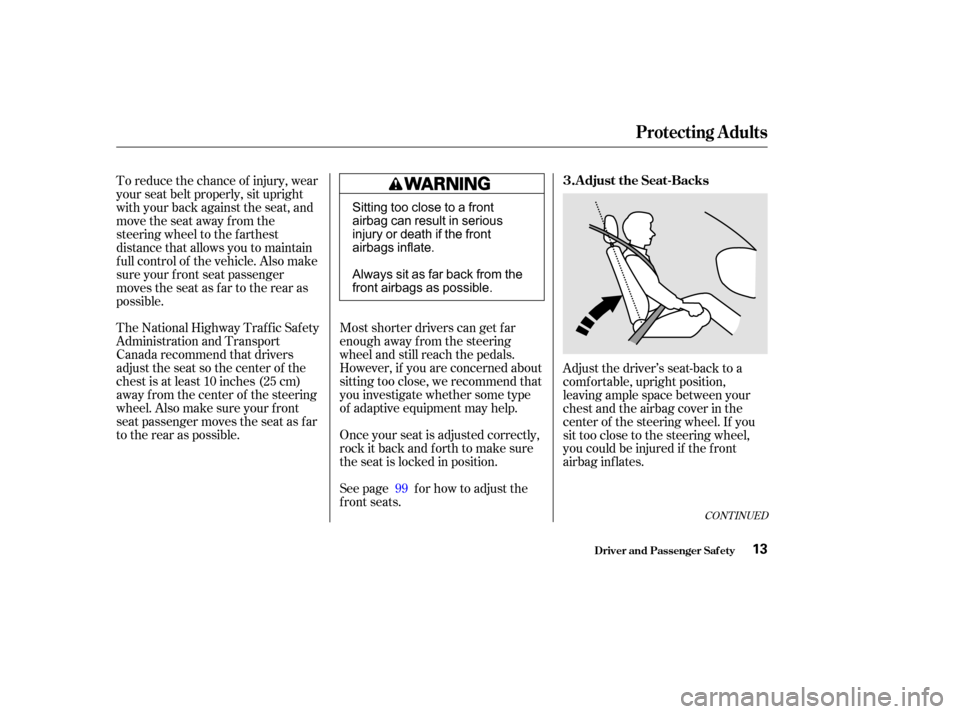
Adjust the driver’s seat-back to a
comf ortable, upright position,
leaving ample space between your
chest and the airbag cover in the
center of the steering wheel. If you
sit too close to the steering wheel,
you could be injured if the f ront
airbag inflates.
99
Driver and Passenger Saf ety
Protecting Adults
Adjust the Seat-Backs
3.
13
Sitting too close to a front
airbag can result in serious
injury or death if the front
airbags inflate.
Always sit as far back from the
front airbags as possible.
Page 27 of 399
Front airbags have been designed to
help protect adults in a moderate to
severe f rontal collision. To do this,
the passenger’s f ront airbag is quite
large, and it inf lates with tremendous
speed.If
the airbag inf lates, it can hit the back
of the child seat with enough force
to kill or very seriously injure an
inf ant. If the vehicle seat is
too far forward, or the child’s head is
thrown f orward during a collision, an
inflating front airbag can strike the
child with enough f orce to kill or
very seriously injure a small child.
Whenever possible,
larger children should sit in the back
seat, properly restrained with a seat
belt. (See page f or important
inf ormation about protecting larger
children.) 41
Inf ant s Small Children
Larger Children
Never put a rear-f acing child seat in
t he f ront seat of a vehicle equippedwit h a passenger’s f ront airbag. Placing a f orward-f acing child seat in
t he f ront seat of a vehicle equippedwit h a passenger’s f ront airbag canbe hazardous.
Children who have outgrown childseat s are also at risk of being injuredor killed by an inf lat ing passenger’sfront airbag.
Protecting Children
Driver and Passenger Saf ety
The Passenger’s Front Airbag
Poses Serious Risks to Children
24
Page 29 of 399
Many parents say they pref er to put
an inf ant or small child in the f ront
passenger seat so they can watch the
child, or because the child requires
attention.
Your vehicle has two rows of back
seats where children can be properly
restrained.
Place the largest child in the f ront
seat, provided the child is large
enough to wear a seat belt
properly (see page ).
Move the vehicle seat as far to the
rear as possible (see page ).
Have the child sit upright and well
backintheseat(seepage ).
Make sure the seat belt is properly
positioned and secured (see page ).
If you ever have to carry a group of
children (when carpooling f or
example), and a child must ride in
front:
Placing a child in the f ront seat
exposes the child to hazards f rom
the passenger’s f ront airbag, and
paying close attention to a child
distracts the driver f rom the
important tasks of driving, placing
both of you at risk.
If a child requires physical attention
or f requent visual contact, we
strongly recommend that another
adult ride with the child in a back
seat. The back seat is far safer for a
child than the front.
12
19
15 41 If a Child Requires Close
Attention
If You Must Drive with Several
Children
Protecting Children
Driver and Passenger Saf ety26
Page 30 of 399
Using this f eature will
prevent children f rom opening the
doors and accidentally f alling out
(see page ).
Using this f eature
will prevent children f rom
operating the doors accidentally
(see page ). Leaving children without
adult supervision is illegal in most
states and Canadian provinces,
and can be very hazardous. For
example, inf ants and small
childrenleftinavehicleonahot
day can die f rom heatstroke. And
children lef t alone with the key in
the ignition can accidentally set
the vehicle in motion, possibly
injuring themselves or others.
88
93
Protecting Children
Driver and Passenger Saf ety
Additional Saf ety Precautions
Use childproof door locks t o prevent children f rom opening t hedoors.
Use t he power sliding door mainswit ch t o prevent children f romopening and closing t he rearsliding doors. Do not leave children alone in your
vehicle.
27
Page 31 of 399
The f ollowing pages give general
guidelines f or selecting and installing
child seats f or inf ants and small
children.
To provide proper protection, a child
seat should meet three
requirements:The child seat should
meet Federal Motor Vehicle
Saf ety Standard 213 (FMVSS 213)
or Canadian Motor Vehicle Saf ety
Standard 213 (CMVSS 213). Look
for the manufacturer’s statement
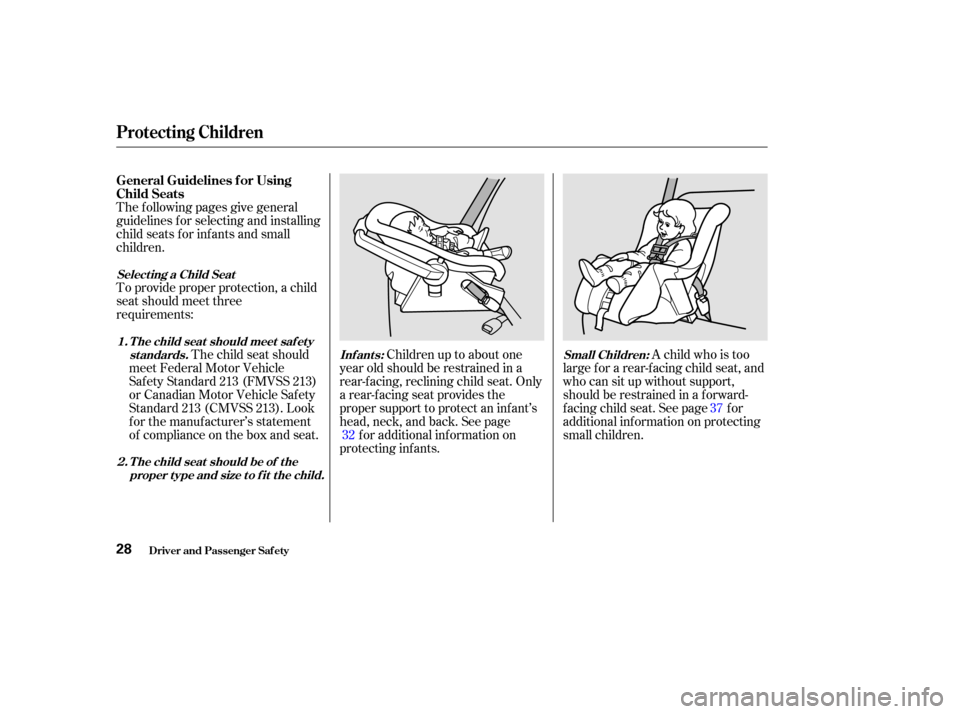
of compliance on the box and seat. Childrenuptoaboutone
year old should be restrained in a
rear-f acing, reclining child seat. Only
a rear-f acing seat provides the
proper support to protect an inf ant’s
head, neck, and back. See page for additional information on
protecting inf ants. A child who is too
large f or a rear-f acing child seat, and
who can sit up without support,
should be restrained in a f orward-
f acing child seat. See page f or
additional inf ormation on protecting
small children.
32 37
Protecting Children
Driver and Passenger Saf ety
General Guidelines f or Using
Child Seats
Select ing a Child Seat
T he child seat should meet saf et yst andards.
T he child seat should be of theproper t ype and size t o f it t he child. Inf ant s:
Small Children:
1.
2.
28
Page 33 of 399
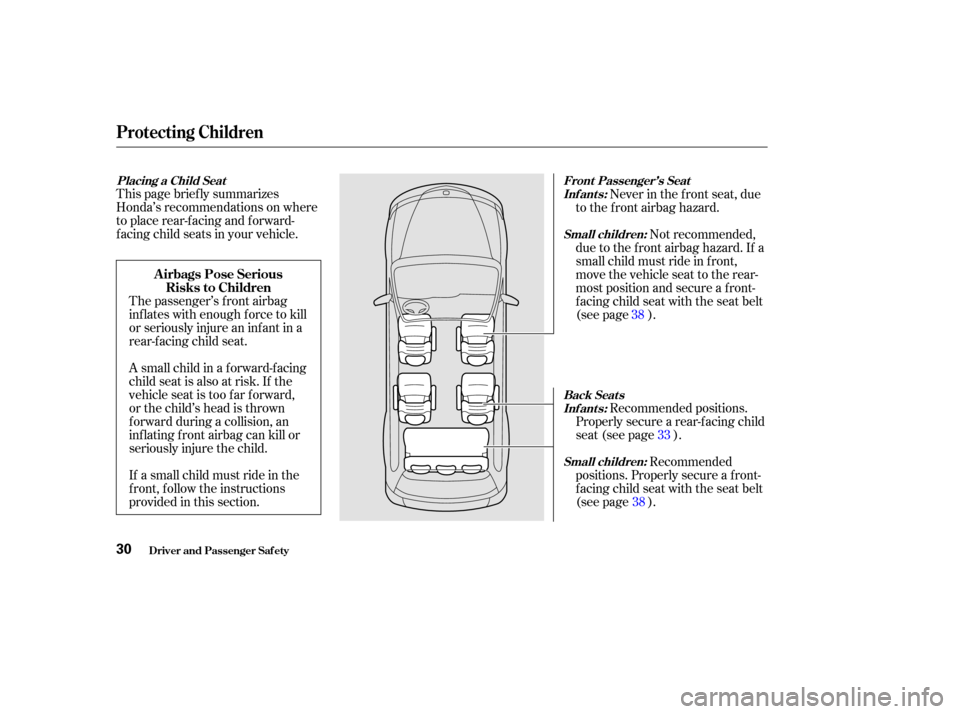
If a small child must ride in the
f ront, f ollow the instructions
provided in this section.
This page brief ly summarizes
Honda’s recommendations on where
to place rear-facing and forward-
f acing child seats in your vehicle.
Recommended
positions. Properly secure a f ront-
f acing child seat with the seat belt
(see page ). Recommended positions.
Properlysecurearear-facingchild
seat (see page ).
The passenger’s f ront airbag
inf lates with enough f orce to kill
or seriously injure an inf ant in a
rear-facing child seat.
A small child in a f orward-f acing
child seat is also at risk. If the
vehicle seat is too f ar f orward,
or the child’s head is thrown
f orward during a collision, an
inf lating f ront airbag can kill or
seriously injure the child. Never in the f ront seat, due
to the f ront airbag hazard.
Not recommended,
due to the f ront airbag hazard. If a
small child must ride in f ront,
move the vehicle seat to the rear-
most position and secure a f ront-
f acing child seat with the seat belt
(see page ).
33
38
38
Placing a Child Seat
Front Passenger’s Seat
Back Seat sSmall children:
Inf ant s:
Inf ant s:
Small children:
Airbags Pose SeriousRisks to Children
Protecting Children
Driver and Passenger Saf ety30
Page 35 of 399
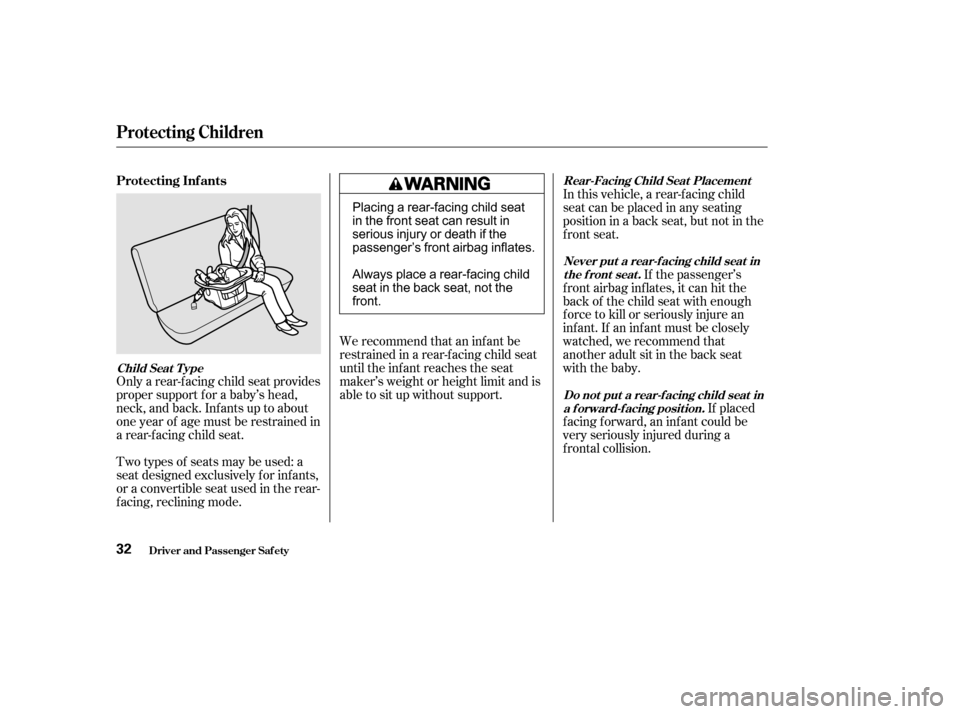
Only a rear-f acing child seat provides
proper support f or a baby’s head,
neck, and back. Inf ants up to about
one year of age must be restrained in
a rear-f acing child seat.We recommend that an inf ant be
restrained in a rear-f acing child seat
until the inf ant reaches the seat
maker’s weight or height limit and is
able to sit up without support.
Two types of seats may be used: a
seat designed exclusively f or inf ants,
or a convertible seat used in the rear-
f acing, reclining mode. In this vehicle, a rear-f acing child
seatcanbeplacedinanyseating
positioninabackseat,butnotinthe
front seat.
If the passenger’s
f ront airbag inf lates, it can hit the
back of the child seat with enough
f orce to kill or seriously injure an
inf ant. If an inf ant must be closely
watched, we recommend that
another adult sit in the back seat
with the baby.
If placed
f acing f orward, an inf ant could be
very seriously injured during a
f rontal collision.
Protecting Inf ants
Child Seat T ype
Rear-Facing Child Seat Placement
Never put a rear-f acing child seat inthe front seat.
Do not put a rear-f acing child seat ina f orward-f acing position.
Protecting Children
Driver and Passenger Saf ety32
Placing a rear-facing child seat
in the front seat can result in
serious injury or death if the
passenger’s front airbag inflates.
Always place a rear-facing child
seat in the back seat, not the
front.