ect HONDA ODYSSEY 2003 RB1-RB2 / 3.G Workshop Manual
[x] Cancel search | Manufacturer: HONDA, Model Year: 2003, Model line: ODYSSEY, Model: HONDA ODYSSEY 2003 RB1-RB2 / 3.GPages: 415, PDF Size: 5.28 MB
Page 56 of 415

For saf ety, you should check the
condition of your seat belts regularly.
Pull each belt out f ully and look f or
f rays, cuts, burns, and wear. Check
that the latches work smoothly and
that the lap/shoulder belts retract
easily. Any belt not in good condition
or not working properly will not
provide good protection and should
be replaced as soon as possible.For inf ormation on how to clean your
seat belts, see page . Automatic seat belt tensioners that
deployed during a crash must be
replaced.
If a seat belt is worn during a crash,
it must be replaced by the dealer. A
belt that has been worn during a
crash may not provide the same level
of protection in a subsequent crash.
The dealer should also inspect the
anchors f or damage and replace
them if needed.
Honda provides a lif etime warranty
on seat belts. Honda will repair or
replace any seat belt component that
f ails to f unction properly during
normal use. Please see your
booklet f or
details. 347
Honda
Warranty Inf ormation
Seat Belt Maintenance
Additional Inf ormation About Your Seat Belts
Driver and Passenger Saf ety
U.S. Models
53
Not checking or maintaining
seat belts can result in serious
injury or death if the seat belts
do not work properly when
needed.
Check your seat belts regularly
and have any problem
corrected as soon as possible.
Page 57 of 415
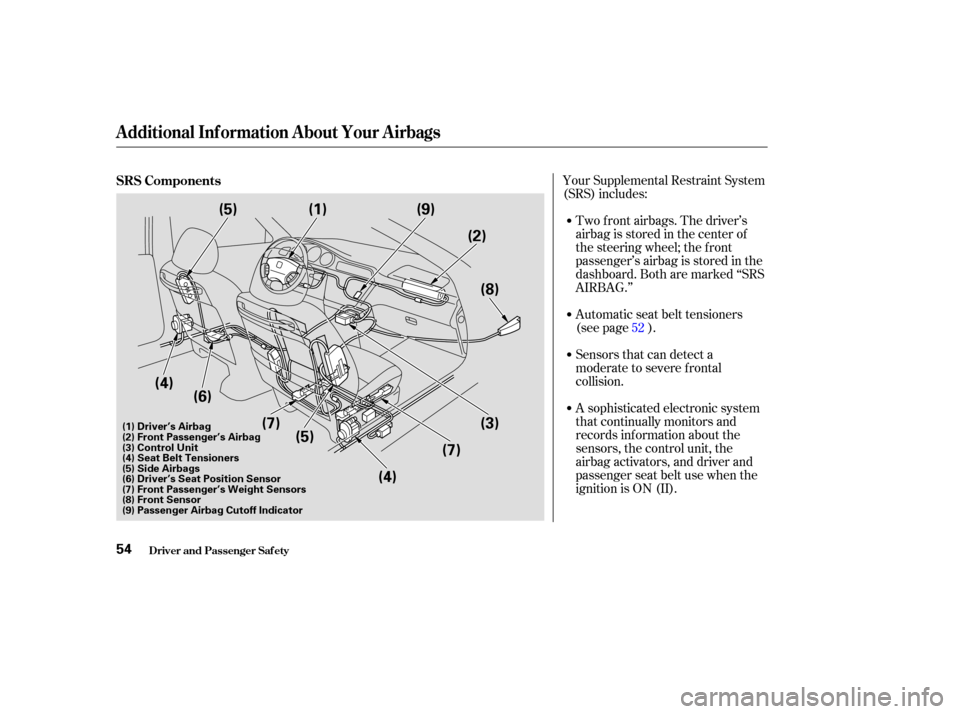
Your Supplemental Restraint System
(SRS) includes:Automatic seat belt tensioners
(see page ). Two f ront airbags. The driver’s
airbag is stored in the center of
the steering wheel; the f ront
passenger’sairbagisstoredinthe
dashboard. Both are marked ‘‘SRS
AIRBAG.’’
Sensors that can detect a
moderate to severe frontal
collision.
A sophisticated electronic system
that continually monitors and
records inf ormation about the
sensors, the control unit, the
airbag activators, and driver and
passenger seat belt use when the
ignition is ON (II). 52
SRS Components
Additional Inf ormation About Your Airbags
Driver and Passenger Saf ety54
(1) Driver’s Airbag
(2) Front Passenger’s Airbag
(3) Control Unit
(4) Seat Belt Tensioners
(5) Side Airbags
(6) Driver’s Seat Position Sensor
(7) Front Passenger’s Weight Sensors
(8) Front Sensor
(9) Passenger Airbag Cutoff Indicator
(5)
(9)
(2)
(8)
(3)
(7)
(4)
(4) (1)
(5)
(6)
(7)
Page 58 of 415
CONT INUED
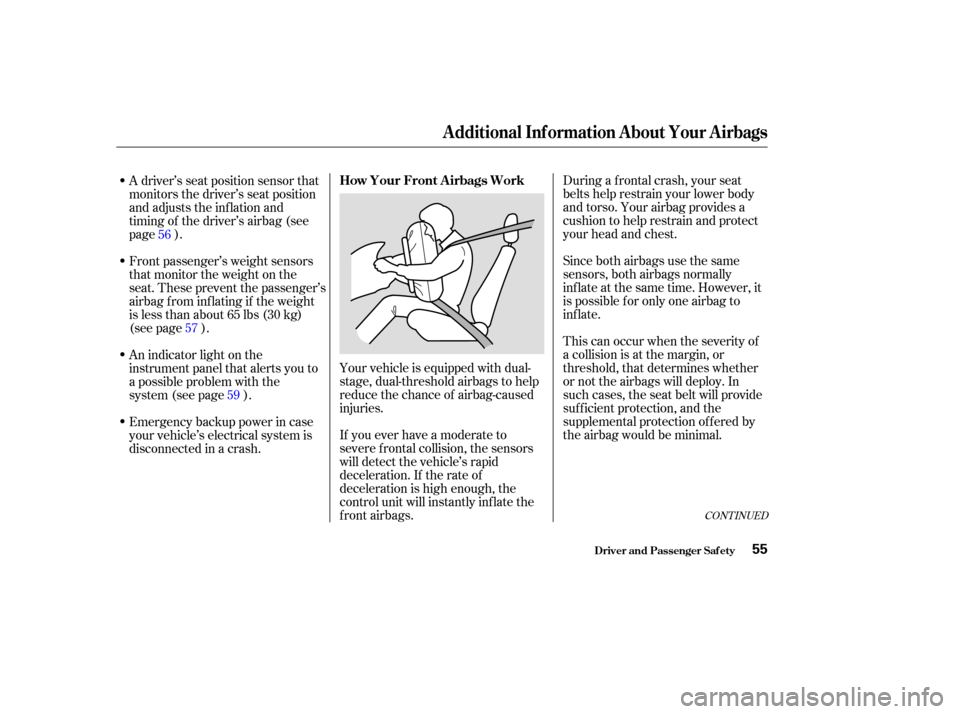
During a frontal crash, your seat
belts help restrain your lower body
and torso. Your airbag provides a
cushion to help restrain and protect
your head and chest.
Since both airbags use the same
sensors, both airbags normally
inf late at the same time. However, it
is possible f or only one airbag to
inf late.
This can occur when the severity of
a collision is at the margin, or
threshold, that determines whether
or not the airbags will deploy. In
such cases, the seat belt will provide
suf f icient protection, and the
supplemental protection of f ered by
the airbag would be minimal.
If you ever have a moderate to
severe f rontal collision, the sensors
will detect the vehicle’s rapid
deceleration. If the rate of
deceleration is high enough, the
control unit will instantly inf late the
f ront airbags. Your vehicle is equipped with dual-
stage, dual-threshold airbags to help
reduce the chance of airbag-caused
injuries.
A driver’s seat position sensor that
monitors the driver’s seat position
and adjusts the inf lation and
timing of the driver’s airbag (see
page ).
Front passenger’s weight sensors
that monitor the weight on the
seat. These prevent the passenger’s
airbag from inflating if the weight
is less than about 65 lbs (30 kg)
(see page ).
An indicator light on the
instrument panel that alerts you to
a possible problem with the
system (see page ).
Emergency backup power in case
your vehicle’s electrical system is
disconnected in a crash.
56
57 59
Additional Inf ormation About Your Airbags
Driver and Passenger Saf ety
How Your Front A irbags Work
55
Page 59 of 415
The total time for inflation and
def lation is approximately one-tenth
of a second, so f ast that most
occupants are not aware that the
airbags deployed until they see them
lying in their laps.
After a crash, you may see what
looks like smoke. This is actually
powder f rom the airbag’s surf ace.
Although the powder is not harmf ul,
people with respiratory problems
mayexperiencesometemporary
discomf ort. If this occurs, get out of
the vehicle as soon as it is saf e to do
so.
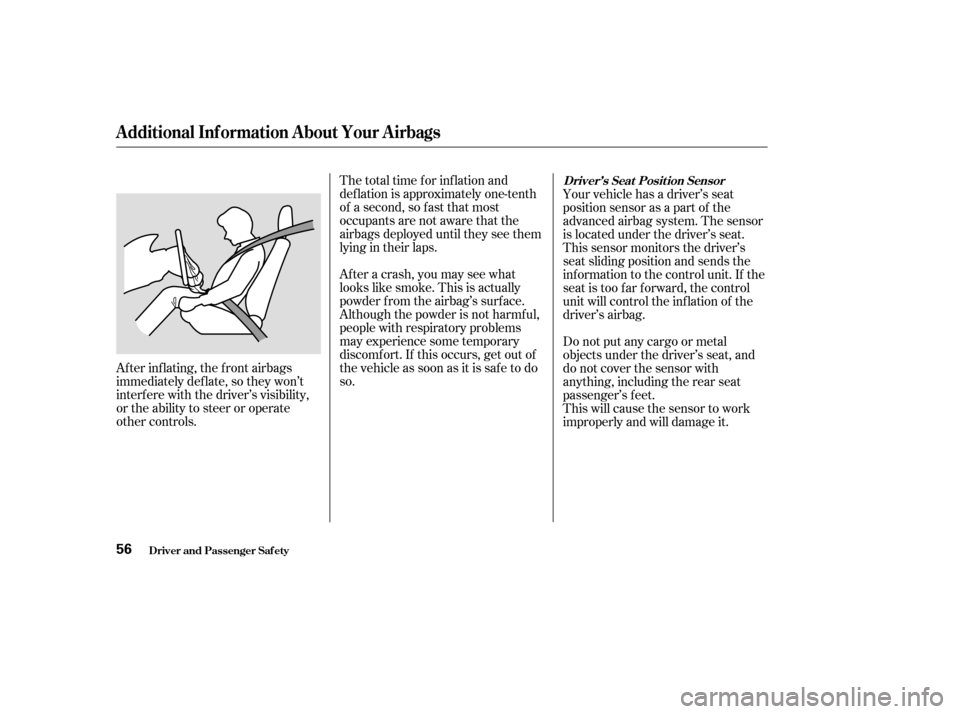
Af ter inf lating, the f ront airbags
immediately def late, so they won’t
interf ere with the driver’s visibility,
or the ability to steer or operate
other controls. Your vehicle has a driver’s seat
position sensor as a part of the
advanced airbag system. The sensor
is located under the driver’s seat.
This sensor monitors the driver’s
seat sliding position and sends the
inf ormation to the control unit. If the
seat is too far forward, the control
unit will control the inf lation of the
driver’s airbag.
Do not put any cargo or metal
objects under the driver’s seat, and
do not cover the sensor with
anything, including the rear seat
passenger’s f eet.
This will cause the sensor to work
improperly and will damage it.
Driver and Passenger Saf ety
Additional Inf ormation About Your Airbags
Driver’s Seat Posit ion Sensor
56
Page 61 of 415

The driver’s and f ront passenger’s
seat sensors may not work properly
if :Be caref ul not to spill any liquids.
Spilled liquids could damage the
sensors under the f ront seats.
If your vehicle sustains a severe
impact, have the driver’s seat
position sensor and the f ront
passenger’s weight sensors
inspected by your Honda dealer.
You do not wear your seat belt
properly.
You do not sit upright and as f ar
back as possible f rom the steering
wheel or the dashboard (see page
).
You do not secure the child seat
properly, and move the f ront seat
as far back as possible. For additional information on how
your airbags work, see the booklet
titled
that came with your
owner’s manual.
For additional information on how
your airbags work, ask your dealer
f or a copy of the booklet titled
20
SRS: What You Need to Know
About Airbags
SRS:
What You Need to Know About Airbags
.
Driver and Passenger Saf ety
Additional Inf ormation About Your Airbags
U.S.Owners
Canadian Owners
58
Page 62 of 415
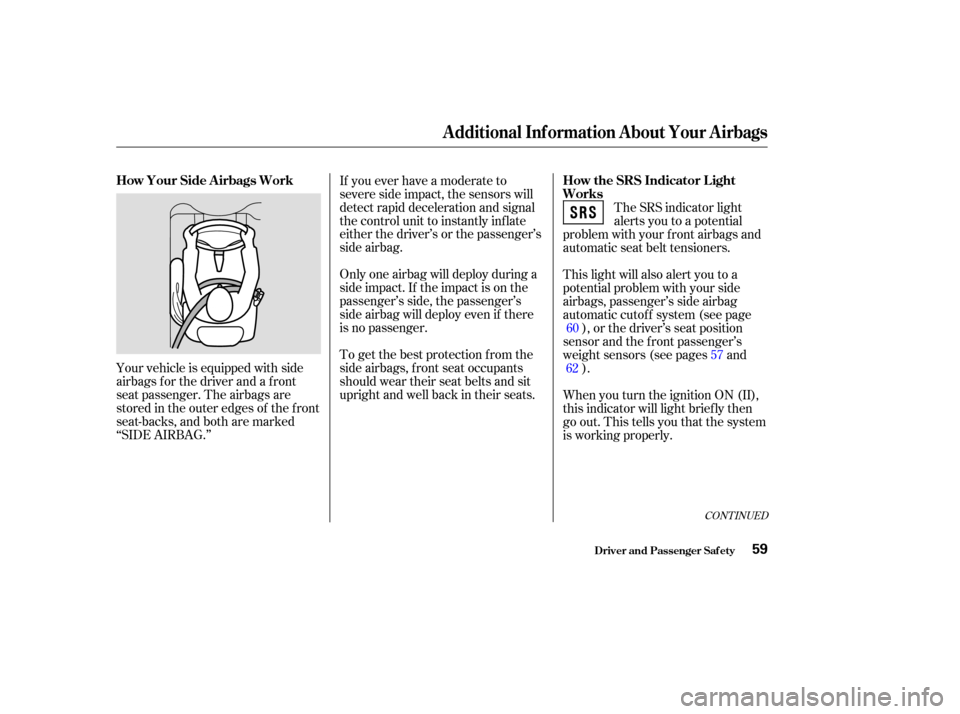
Your vehicle is equipped with side
airbags f or the driver and a f ront
seat passenger. The airbags are
stored in the outer edges of the f ront
seat-backs, and both are marked
‘‘SIDE AIRBAG.’’If you ever have a moderate to
severe side impact, the sensors will
detect rapid deceleration and signal
the control unit to instantly inf late
either the driver’s or the passenger’s
side airbag.
Only one airbag will deploy during a
side impact. If the impact is on the
passenger’s side, the passenger’s
side airbag will deploy even if there
is no passenger.
To get the best protection f rom the
side airbags, front seat occupants
should wear their seat belts and sit
upright and well back in their seats.
The SRS indicator light
alerts you to a potential
problem with your f ront airbags and
automatic seat belt tensioners.
This light will also alert you to a
potential problem with your side
airbags, passenger’s side airbag
automatic cutoff system (see page ), or the driver’s seat position
sensor and the f ront passenger’s
weight sensors (see pages and ).
When you turn the ignition ON (II),
this indicator will light brief ly then
go out. This tells you that the system
is working properly. 60
57
62
CONT INUED
Driver and Passenger Saf ety
How Your Side A irbags Work How the SRS Indicator L ight
Works
Additional Inf ormation About Your Airbags
59
Page 64 of 415

If a small-statured adult leans
sideways, or larger adult slouches
and leans sideways into the
deployment path of the side airbag,
the system may also shut of f the side
airbag.A f ront seat passenger should not
use a cushion or other object as a
backrest. It may prevent the cutof f
system f rom working properly.
When you turn the ignition switch to
ON (II), the indicator should light
brief ly and go out (see page ). If it
doesn’t light, stays on, or comes on
while driving without a passenger in
the front seat, have the system
checked.
If the side airbag cutof f indicator
light comes on, you should have the
passenger sit upright. Once the
passenger is out of the deployment
path of the side airbag, the system
will turn the airbag back on and the
light will go out. 73
Additional Inf ormation About Your Airbags
Driver and Passenger Saf ety61
Page 65 of 415
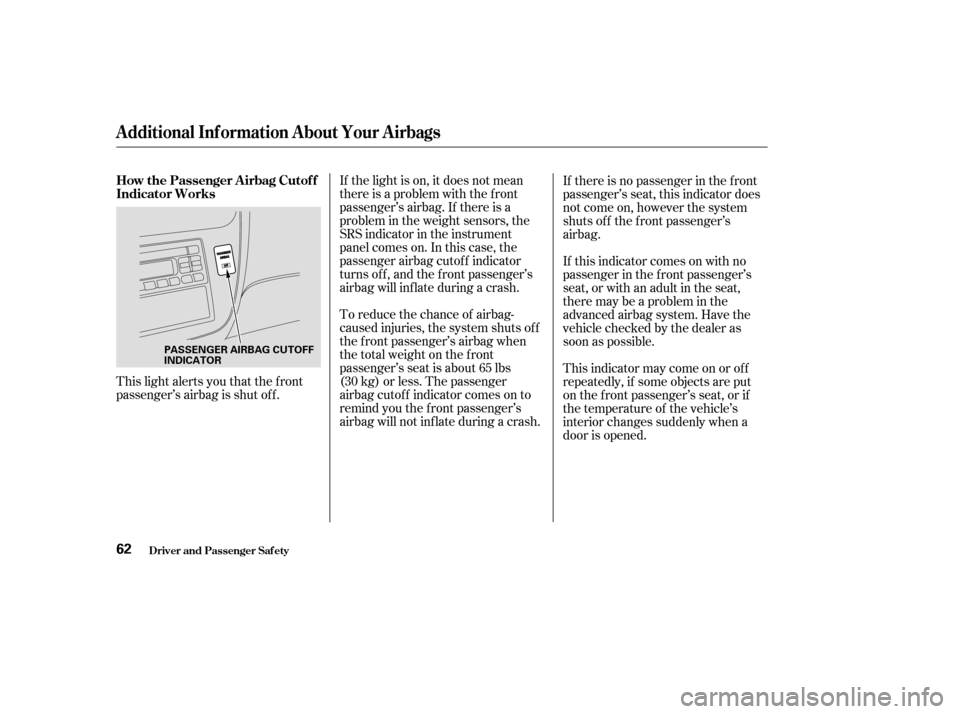
This light alerts you that the f ront
passenger’s airbag is shut of f .If the light is on, it does not mean
there is a problem with the f ront
passenger’s airbag. If there is a
problem in the weight sensors, the
SRS indicator in the instrument
panel comes on. In this case, the
passenger airbag cutof f indicator
turns of f , and the f ront passenger’s
airbag will inflate during a crash.
To reduce the chance of airbag-
caused injuries, the system shuts of f
the f ront passenger’s airbag when
the total weight on the f ront
passenger’s seat is about 65 lbs
(30 kg) or less. The passenger
airbag cutoff indicator comes on to
remind you the f ront passenger’s
airbag will not inf late during a crash.If there is no passenger in the f ront
passenger’s seat, this indicator does
not come on, however the system
shuts of f the f ront passenger’s
airbag.
If this indicator comes on with no
passenger in the f ront passenger’s
seat,orwithanadultintheseat,
there may be a problem in the
advanced airbag system. Have the
vehicle checked by the dealer as
soon as possible.
This indicator may come on or of f
repeatedly, if some objects are put
on the f ront passenger’s seat, or if
the temperature of the vehicle’s
interior changes suddenly when a
door is opened.
Additional Inf ormation About Your Airbags
Driver and Passenger Saf ety
How the Passenger Airbag Cutof f
Indicator Works
62
PASSENGER AIRBAG CUTOFF
INDICATOR
Page 68 of 415

Together, airbags and
seat belts provide the best
protection.
Tampering could cause
the airbags to deploy, possibly
causing very serious injury.
If rain or spilled water
soaks into a seat-back, it can
prevent the side airbag system
f rom working properly.
This could make the
driver’s seat position sensor and
the f ront passenger’s weight
sensors inef f ective. Improperly
replacing or covering f ront seat-
back covers can prevent your side
airbags f rom inf lating during a
collision.
This could make the driver’s seat
position sensor and the f ront
passenger’s weight sensors
inef f ective. See page f or f urther inf ormation
and precautions relating to your
airbags.
first contact American
Honda at 800-999-1009. 252
Additional Saf ety Precautions
Donotattempttodeactivateyour
airbags.
Do not t amper wit h airbagcomponent s or wiring f or anyreason.
Do not expose t he f ront seat -backsto water.
Do not place any it ems under t hefront seats. Do not cover or replace f ront seat -
back covers wit hout consult ing aHonda dealer.
Do not modif y t he f ront seat s.If it is necessary t o modif y anadvanced f ront airbag syst em t oaccommodat e a person wit hdisabilities,
Additional Inf ormation About Your Airbags
Driver and Passenger Saf ety65
Page 69 of 415

Your vehicle’s exhaust contains
carbon monoxide gas. You should
have no problem with carbon
monoxide entering the vehicle in
normal driving if you maintain your
vehicle properly.
Have the exhaust system inspected
f or leaks whenever:The vehicle is raised f or an oil
change.
You notice a change in the sound
of the exhaust.
The vehicle was in an accident
that may have damaged the under-
side. High levels of carbon monoxide can
collect rapidly in enclosed areas,
such as a garage. Do not run the
engine with the garage door closed.
Even with the door open, run the
engine only long enough to move the
vehicle out of the garage. With the tailgate open, air flow can
pull exhaust gas into your vehicle’s
interior and create a hazardous
condition. If you must drive with the
tailgate open, open all the windows
and set the heating and cooling
system/climate control system as
shown below.
Select the Fresh Air mode.
Select the mode.
Turn the f an on high speed.
Set the temperature control to a
comfortable setting.
If you must sit in your parked vehicle,
even in an unconf ined area, with the
engine running, adjust the heating
and cooling system/climate control
system as f ollows:
1.
2.
3.
4.
Carbon Monoxide Hazard
Driver and Passenger Saf ety66
Carbon monoxide gas is toxic.
Breathing it can cause
unconsciousness and even kill
you.
Avoid any enclosed areas or
activities that expose you to
carbon monoxide.