Air fan HONDA ODYSSEY 2018 Owner's Manual (in English)
[x] Cancel search | Manufacturer: HONDA, Model Year: 2018, Model line: ODYSSEY, Model: HONDA ODYSSEY 2018Pages: 763, PDF Size: 47.02 MB
Page 14 of 763
12
Quick Reference Guide
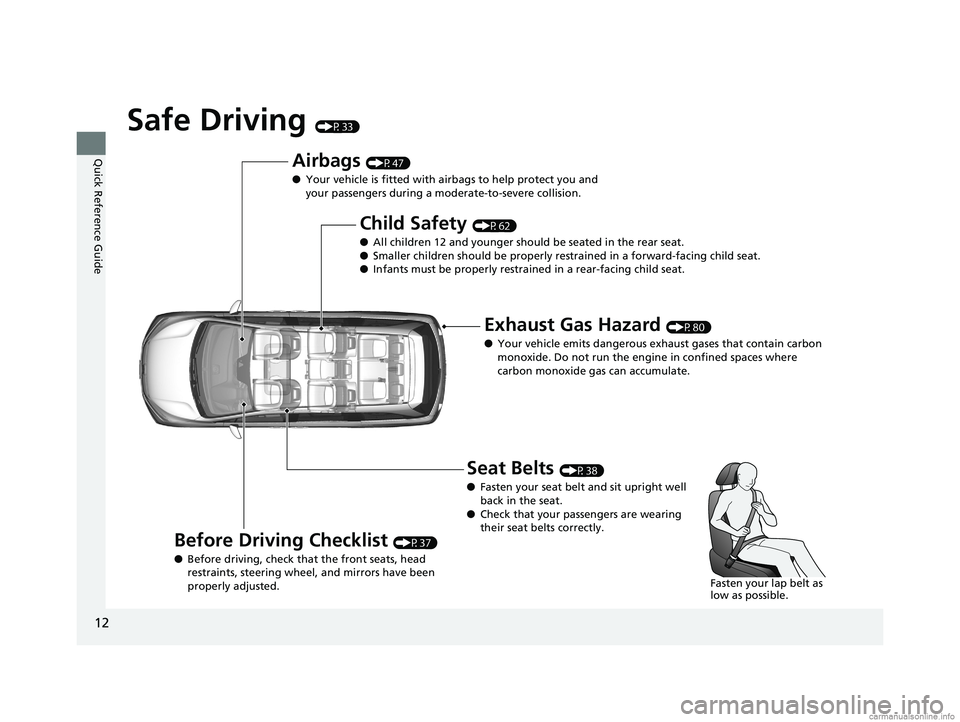
Safe Driving (P33)
Airbags (P47)
● Your vehicle is fitted with ai rbags to help protect you and
your passengers during a moderate-to-severe collision.
Child Safety (P62)
● All children 12 and younger should be seated in the rear seat.
● Smaller children should be properly restra ined in a forward-facing child seat.
● Infants must be properly restraine d in a rear-facing child seat.
Exhaust Gas Hazard (P80)
● Your vehicle emits dangerous exha ust gases that contain carbon
monoxide. Do not run the engine in confined spaces where
carbon monoxide gas can accumulate.
Before Driving Checklist (P37)
● Before driving, check that the front seats, head
restraints, steering wheel, and mirrors have been
properly adjusted.
Seat Belts (P38)
● Fasten your seat belt and sit upright well
back in the seat.
● Check that your passengers are wearing
their seat belts correctly.
Fasten your lap belt as
low as possible.
18 US ODYSSEY-31THR6010.book 12 ページ 2018年12月6日 木曜日 午後4時18分
Page 20 of 763
18
Quick Reference Guide
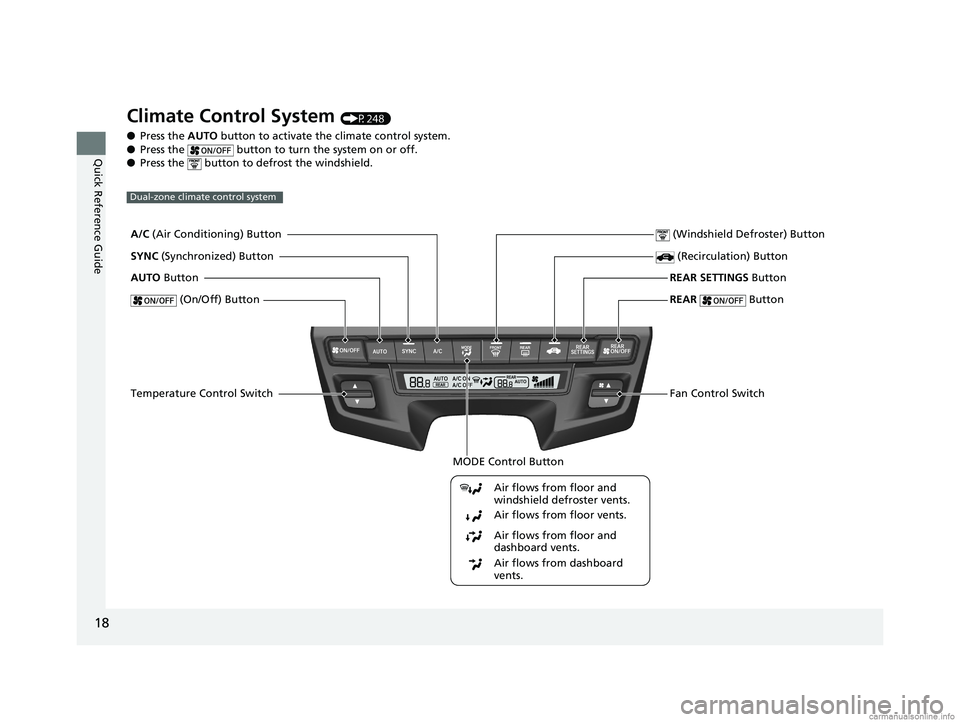
Climate Control System (P248)
● Press the AUTO button to activate the climate control system.
● Press the button to turn the system on or off.
● Press the button to defrost the windshield.
Dual-zone climate control system
Air flows from floor and
windshield defroster vents.
Air flows from floor vents.
Air flows from floor and
dashboard vents.
Air flows from dashboard
vents.
A/C (Air Conditioning) Button
MODE Control Button
SYNC (Synchronized) Button
AUTO Button
(On/Off) Button
Temperature Control Switch (Windshield Defroster) Button
(Recirculation) Button
REAR SETTINGS Button
REAR
Button
Fan Control Switch
18 US ODYSSEY-31THR6010.book 18 ページ 2018年12月6日 木曜日 午後4時18分
Page 21 of 763
19
Quick Reference Guide
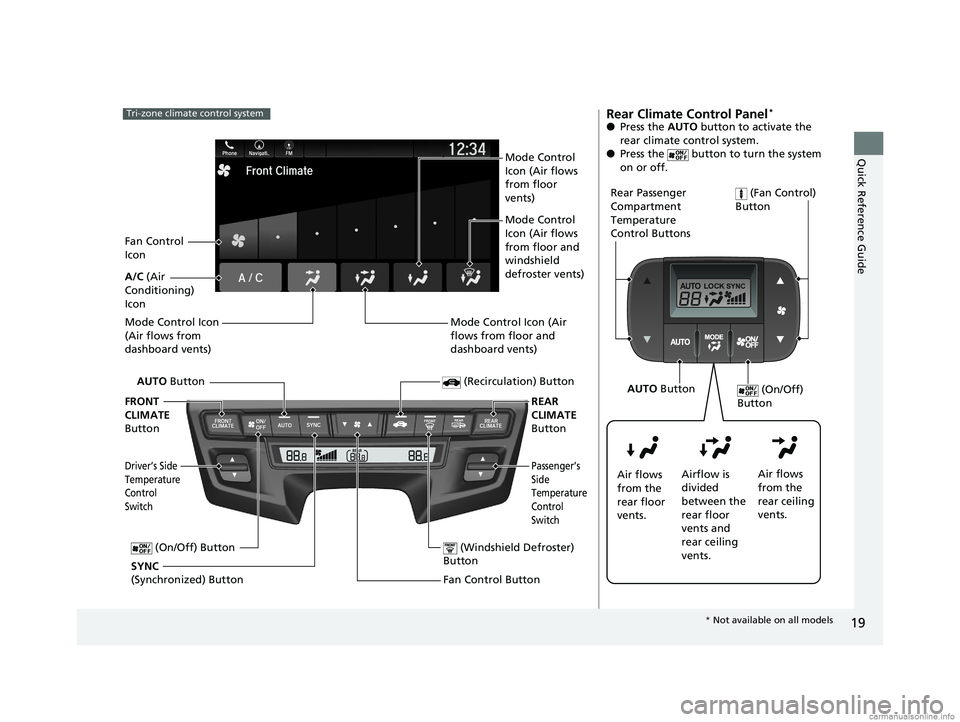
Tri-zone climate control system
Fan Control Button (Windshield Defroster)
Button
A/C (Air
Conditioning)
Icon
(Recirculation) Button
Passenger’s
Side
Temperature
Control
Switch
AUTO Button
Driver’s Side
Temperature
Control
Switch
Mode Control Icon
(Air flows from
dashboard vents)
SYNC
(Synchronized) Button (On/Off) Button
FRONT
CLIMATE
Button REAR
CLIMATE
Button
Fan Control
Icon Mode Control
Icon (Air flows
from floor
vents)
Mode Control
Icon (Air flows
from floor and
windshield
defroster vents)
Mode Control Icon (Air
flows from floor and
dashboard vents)
Rear Climate Control Panel*
● Press the AUTO button to activate the
rear climate control system.
● Press the button to turn the system
on or off.
Rear Passenger
Compartment
Temperature
Control Buttons (Fan Control)
Button
Air flows
from the
rear floor
vents. Airflow is
divided
between the
rear floor
vents and
rear ceiling
vents. Air flows
from the
rear ceiling
vents. (On/Off)
Button
AUTO Button
* Not available on all models
18 US ODYSSEY-31THR6010.book 19 ページ 2018年12月6日 木曜日 午後4時18分
Page 35 of 763
33
Safe Driving
You can find many safety recommendations throughout this chapter, and throughout this manual.
For Safe Driving
Important Safety Precautions.............. 34
Your Vehicle’s Safety Features ............ 36
Safety CheckList................................. 37
Seat Belts About Your Seat Belts ........................ 38
Fastening a Seat Belt .......................... 41
Seat Belt Inspection ............................ 46
Airbags Airbag System Components ............... 47
Types of Airbags ................................ 50
Front Airbags (SRS) ............................ 50 Front Knee Airbags ............................ 54
Side Airbags....................................... 56
Side Curtain Airbags .......................... 58
Airbag System Indicators .................... 59
Airbag Care ....................................... 61
Child Safety Protecting Child Passengers ............... 62
Safety of Infants a nd Small Children... 64
Safety of Larger Children ................... 78
Exhaust Gas Hazard Carbon Monoxide Gas ....................... 80 Safety Labels
Label Locations .................................. 81
18 US ODYSSEY-31THR6010.book 33 ページ 2018年12月6日 木曜日 午後4時18分
Page 36 of 763
34
Safe Driving
For Safe Driving
The following pages explain your vehicle’s safety features and how to use them
properly. The safety precautions below are ones that we consider to be among the
most important.
Important Safety Precautions
■Always wear your seat belt
A seat belt is your best protection in all types of collisions. Airbags are designed to
supplement seat belts, not replace them. So even though your vehicle is equipped
with airbags, make sure you and your passengers always wear your seat belts, and
wear them properly.
■Restrain all children
Children ages 12 and under should ride prop erly restrained in a back seat, not the
front seat. Infants and small children should be restrained in a child seat. Larger
children should use a booster seat and a lap/shoulder seat belt until they can use the
belt properly without a booster seat.
■Be aware of airbag hazards
While airbags can save lives, they can cause serious or fatal injuries to occupants
who sit too close to them, or are not prop erly restrained. Infants, young children,
and short adults are at the greatest risk. Be sure to follow all instructions and
warnings in this manual.
■Don’t drink and drive
Alcohol and driving don’t mix. Even one dr ink can reduce your ability to respond to
changing conditions, and your reaction time gets worse with every additional drink.
So don’t drink and drive, and don’t let your friends drink and drive, either.
1Important Safety Precautions
Some states, provinces and territories prohibit the use
of cell phones other than hands-free devices by the
driver while driving.
18 US ODYSSEY-31THR6010.book 34 ページ 2018年12月6日 木曜日 午後4時18分
Page 41 of 763
Continued39
uuSeat Belts uAbout Your Seat Belts
Safe Driving
■Proper use of seat belts
Follow these guidelines for proper use:
• All occupants should sit upright, well back in the seat, and remain in that position
for the duration of the trip. Slouching and leaning reduc e the effectiveness of the
belt and can increase the chance of serious injury in a crash.
• Never place the shoulder part of a lap/shoulder seat belt under your arm or
behind your back. This could cause very serious injuries in a crash.
• Two people should never use the same seat belt. If they do, they could be very
seriously injured in a crash.
• Do not put any accessories on the seat belt s. Devices intended to improve comfort
or reposition the shoulder part of a seat belt can reduce the protective capability
and increase the chance of serious injury in a crash.
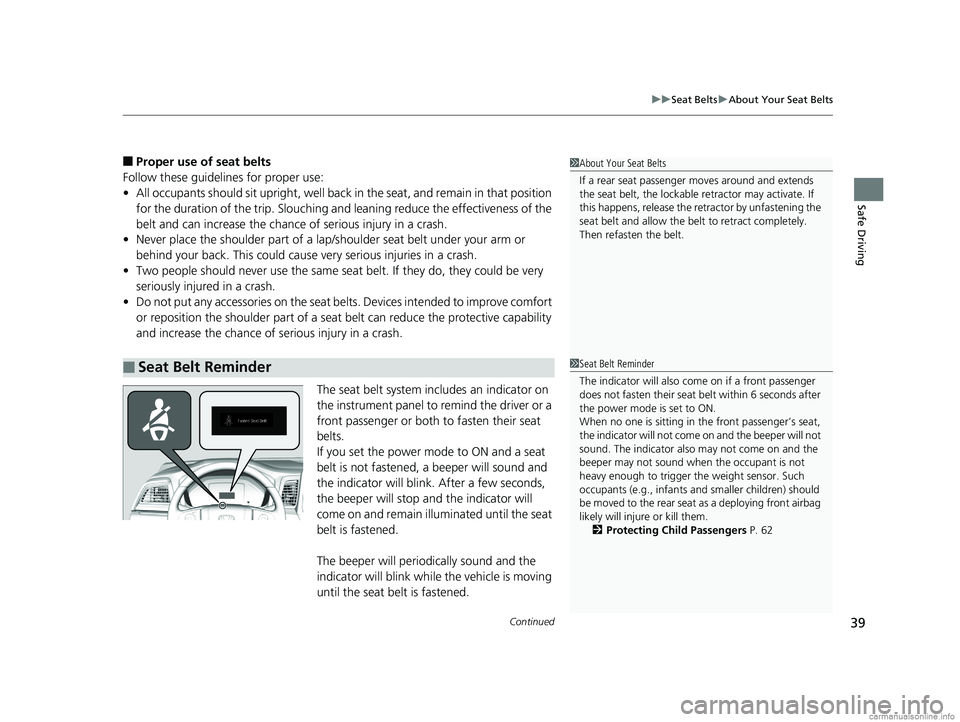
The seat belt system includes an indicator on
the instrument panel to remind the driver or a
front passenger or both to fasten their seat
belts.
If you set the power mode to ON and a seat
belt is not fastened, a beeper will sound and
the indicator will blink. After a few seconds,
the beeper will stop and the indicator will
come on and remain illuminated until the seat
belt is fastened.
The beeper will periodically sound and the
indicator will blink while the vehicle is moving
until the seat belt is fastened.
■Seat Belt Reminder
1About Your Seat Belts
If a rear seat passenger moves around and extends
the seat belt, the lockable retractor may activate. If
this happens, release the retractor by unfastening the
seat belt and allow the belt to retract completely.
Then refasten the belt.
1 Seat Belt Reminder
The indicator will also co me on if a front passenger
does not fasten their seat be lt within 6 seconds after
the power mode is set to ON.
When no one is sitting in th e front passenger’s seat,
the indicator will not come on and the beeper will not
sound. The indicator also may not come on and the
beeper may not sound when the occupant is not
heavy enough to trigger th e weight sensor. Such
occupants (e.g., infants and smaller children) should
be moved to the rear seat as a deploying front airbag
likely will injure or kill them. 2 Protecting Child Passengers P. 62
18 US ODYSSEY-31THR6010.book 39 ページ 2018年12月6日 木曜日 午後4時18分
Page 50 of 763
48
uuAirbags uAirbag System Components
Safe Driving
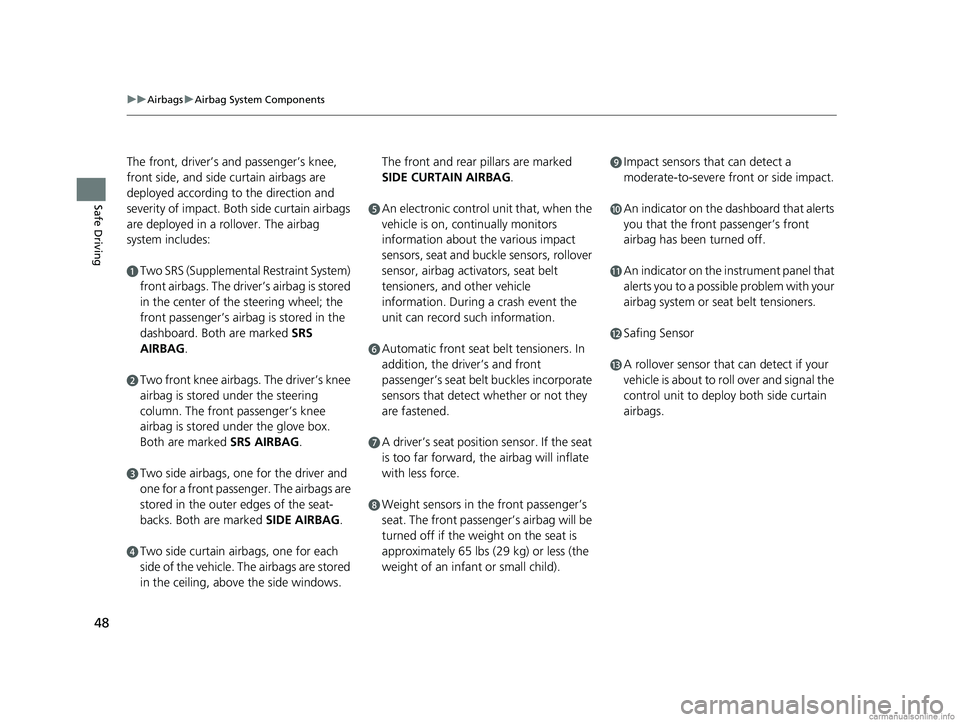
The front, driver’s and passenger’s knee,
front side, and side curtain airbags are
deployed according to the direction and
severity of impact. Both side curtain airbags
are deployed in a ro llover. The airbag
system includes:
aTwo SRS (Supplemental Restraint System)
front airbags. The driver’s airbag is stored
in the center of the steering wheel; the
front passenger’s airbag is stored in the
dashboard. Both are marked SRS
AIRBAG.
bTwo front knee airbags. The driver’s knee
airbag is stored under the steering
column. The front passenger’s knee
airbag is stored under the glove box.
Both are marked SRS AIRBAG.
cTwo side airbags, one for the driver and
one for a front passenger. The airbags are
stored in the outer edges of the seat-
backs. Both are marked SIDE AIRBAG .
dTwo side curtain airbags, one for each
side of the vehicle. The airbags are stored
in the ceiling, above the side windows. The front and rear pillars are marked
SIDE CURTAIN AIRBAG
.
eAn electronic control unit that, when the
vehicle is on, continually monitors
information about the various impact
sensors, seat and buckle sensors, rollover
sensor, airbag activators, seat belt
tensioners, and other vehicle
information. During a crash event the
unit can record such information.
fAutomatic front seat belt tensioners. In
addition, the driver’s and front
passenger’s seat belt buckles incorporate
sensors that detect whether or not they
are fastened.
gA driver’s seat position sensor. If the seat
is too far forward, the airbag will inflate
with less force.
hWeight sensors in the front passenger’s
seat. The front passenger’s airbag will be
turned off if the weight on the seat is
approximately 65 lbs (29 kg) or less (the
weight of an infant or small child).
iImpact sensors that can detect a
moderate-to-severe front or side impact.
jAn indicator on the dashboard that alerts
you that the front passenger’s front
airbag has been turned off.
kAn indicator on the instrument panel that
alerts you to a possible problem with your
airbag system or seat belt tensioners.
lSafing Sensor
mA rollover sensor that can detect if your
vehicle is about to roll over and signal the
control unit to deploy both side curtain
airbags.
18 US ODYSSEY-31THR6010.book 48 ページ 2018年12月6日 木曜日 午後4時18分
Page 62 of 763
uuAirbags uAirbag System Indicators
60
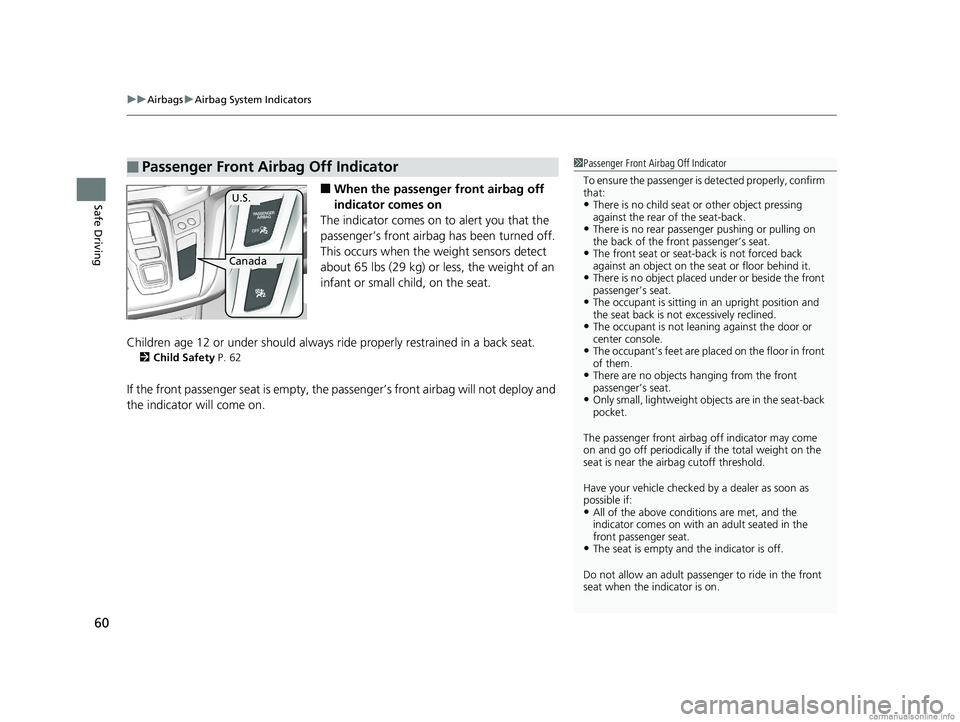
Safe Driving■When the passenger front airbag off
indicator comes on
The indicator comes on to alert you that the
passenger’s front airbag has been turned off.
This occurs when the weight sensors detect
about 65 lbs (29 kg) or less, the weight of an
infant or small child, on the seat.
Children age 12 or under should always ri de properly restrained in a back seat.
2Child Safety P. 62
If the front passenger seat is empty, the pa ssenger’s front airbag will not deploy and
the indicator will come on.
■Passenger Front Airbag Off Indicator1 Passenger Front Airbag Off Indicator
To ensure the passenger is detected properly, confirm
that:
•There is no child seat or other object pressing
against the rear of the seat-back.
•There is no rear passenger pushing or pulling on
the back of the front passenger’s seat.
•The front seat or seat-b ack is not forced back
against an object on the s eat or floor behind it.
•There is no object placed under or beside the front
passenger’s seat.
•The occupant is sitting in an upright position and
the seat back is not excessively reclined.
•The occupant is not leaning against the door or
center console.
•The occupant’s feet are plac ed on the floor in front
of them.
•There are no objects ha nging from the front
passenger’s seat.
•Only small, lightweight objects are in the seat-back
pocket.
The passenger front airbag off indicator may come
on and go off periodically if the total weight on the
seat is near the airbag cutoff threshold.
Have your vehicle checked by a dealer as soon as
possible if:
•All of the above conditions are met, and the
indicator comes on with an adult seated in the
front passenger seat.
•The seat is empty and the indicator is off.
Do not allow an adult passe nger to ride in the front
seat when the indicator is on.
U.S.
Canada
18 US ODYSSEY-31THR6010.book 60 ページ 2018年12月6日 木曜日 午後4時18分
Page 64 of 763
62
Safe Driving
Child Safety
Protecting Child Passengers
Each year, many children are injured or killed in vehicle crashes because they are
either unrestrained or not properly res trained. In fact, vehicle crashes are the
number one cause of death of children ages 12 and under.
To reduce the number of child deaths and in juries, every state, Canadian province
and territory requires that infants and childre n be properly restrained when they ride
in a vehicle.
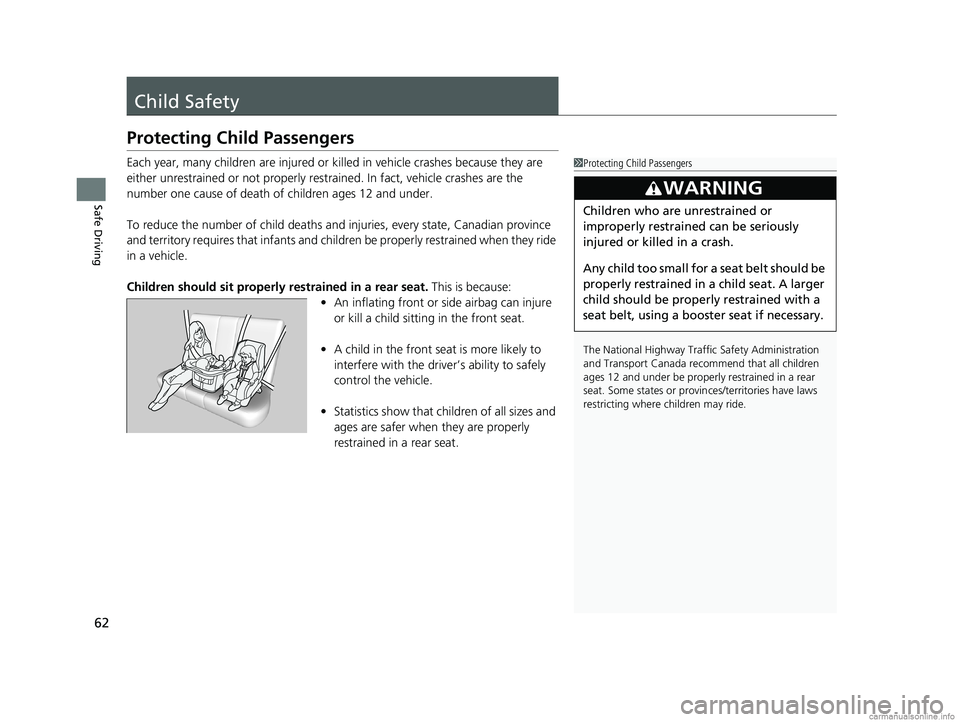
Children should sit properly restrained in a rear seat. This is because:
• An inflating front or side airbag can injure
or kill a child sitting in the front seat.
• A child in the front seat is more likely to
interfere with the driver ’s ability to safely
control the vehicle.
• Statistics show that ch ildren of all sizes and
ages are safer when they are properly
restrained in a rear seat.1 Protecting Child Passengers
The National Highway Traffic Safety Administration
and Transport Canada recommend that all children
ages 12 and under be properl y restrained in a rear
seat. Some states or provin ces/territories have laws
restricting where ch ildren may ride.
3WARNING
Children who are unrestrained or
improperly restrained can be seriously
injured or killed in a crash.
Any child too small for a seat belt should be
properly restrained in a child seat. A larger
child should be properly restrained with a
seat belt, using a booster seat if necessary.
18 US ODYSSEY-31THR6010.book 62 ページ 2018年12月6日 木曜日 午後4時18分
Page 66 of 763
64
uuChild Safety uSafety of Infants and Small Children
Safe Driving
Safety of Infants and Small Children
An infant must be properly restrained in a rear-facing, reclining child seat until the
infant reaches the seat manufacturer’s weig ht or height limit for the seat, and the
infant is at least one year old.
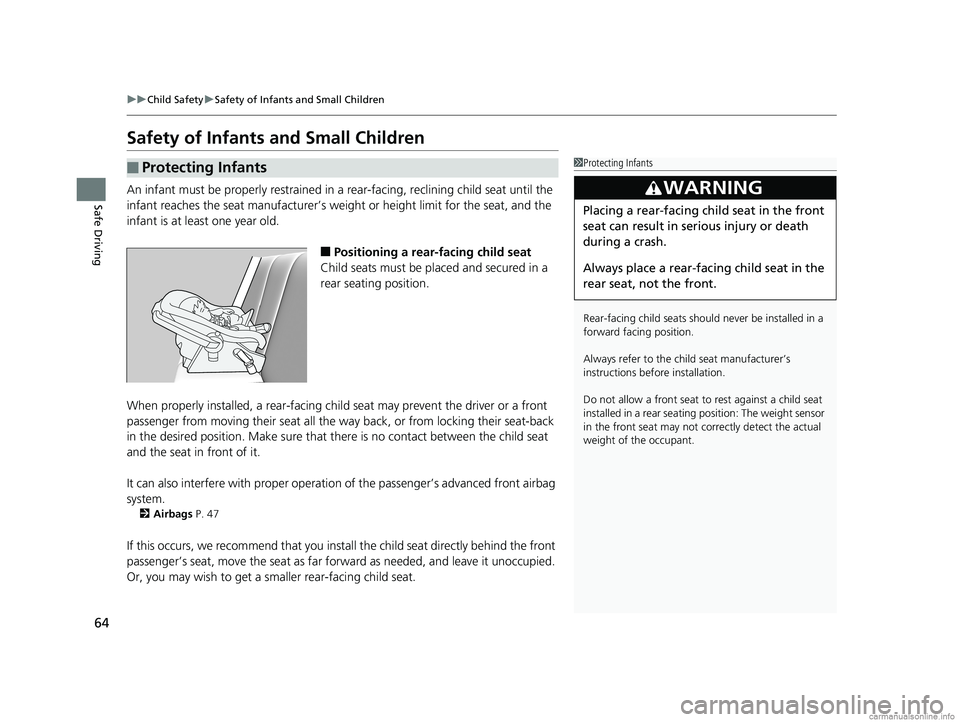
■Positioning a rear-facing child seat
Child seats must be placed and secured in a
rear seating position.
When properly installed, a rear-facing child seat may prevent the driver or a front
passenger from moving their seat all the way back, or from locking their seat-back
in the desired position. Make sure that th ere is no contact between the child seat
and the seat in front of it.
It can also interfere with pr oper operation of the passenger’s advanced front airbag
system.
2 Airbags P. 47
If this occurs, we recommend that you install the child seat directly behind the front
passenger’s seat, move the seat as far fo rward as needed, and leave it unoccupied.
Or, you may wish to get a sm aller rear-facing child seat.
■Protecting Infants1Protecting Infants
Rear-facing child seats should never be installed in a
forward facing position.
Always refer to the child seat manufacturer’s
instructions before installation.
Do not allow a front seat to rest against a child seat
installed in a rear seating position: The weight sensor
in the front seat may not co rrectly detect the actual
weight of the occupant.
3WARNING
Placing a rear-facing child seat in the front
seat can result in serious injury or death
during a crash.
Always place a rear-fac ing child seat in the
rear seat, not the front.
18 US ODYSSEY-31THR6010.book 64 ページ 2018年12月6日 木曜日 午後4時18分