4WD HONDA PASSPORT 2000 2.G User Guide
[x] Cancel search | Manufacturer: HONDA, Model Year: 2000, Model line: PASSPORT, Model: HONDA PASSPORT 2000 2.GPages: 267, PDF Size: 3.03 MB
Page 175 of 267
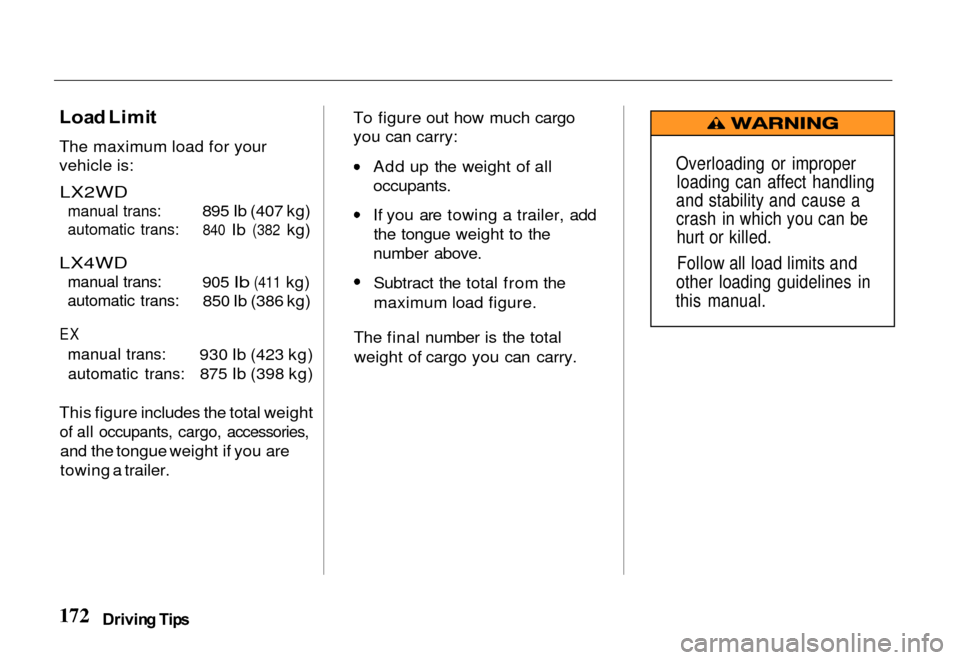
Loa
d Limi t
The maximum load for your
vehicle is:
LX2WD
manual trans:
automatic trans:
LX4WD
manual trans:
automatic trans:
EX
manual trans:automatic trans:
895 Ib (407 kg)
840
Ib
(382
kg)
905
Ib
(411
kg) 850 Ib (386 kg)
930 Ib (423 kg) 875 Ib (398 kg)
This figure includes the total weight
of all occupants, cargo, accessories,
and the tongue weight if you are
towing a trailer. To figure out how much cargo
you can carry: Add up the weight of all
occupants.
If you are towing a trailer, add
the tongue weight to the
number above. Subtract the total from the
maximum load figure.
The final number is the total weight of cargo you can carry.
Drivin g Tip s
Overloading o
r improper
loading can affect handling
and stability and cause a
crash in which you can be hurt or killed.
Follow all load limits and
other loading guidelines in
this manual.
Page 178 of 267
Follow the recommendations in
this manual and ask your Honda
dealer for further details before
you tow a trailer with your
Passport.
Towing a trailer affects vehicle
maintenance requirements due
to the additional load. More
frequent maintenance intervals
will be required to assure
continued satisfaction with
your vehicle. Consult yourHonda dealer for recommended
maintenance and service.
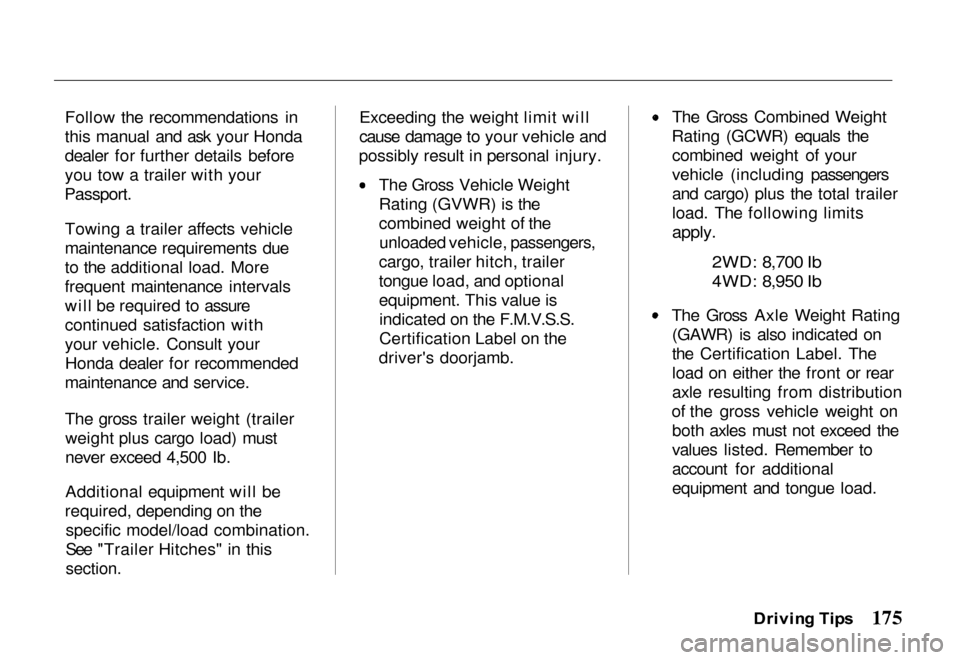
The gross trailer weight (trailer weight plus cargo load) must
never exceed 4,500 Ib.
Additional equipment will be
required, depending on the specific model/load combination.
See "Trailer Hitches" in this
section.
Exceeding the weight limit will
cause damage to your vehicle and
possibly result in personal injury. The Gross Vehicle Weight
Rating (GVWR) is the
combined weight of the
unloaded vehicle, passengers,
cargo, trailer hitch, trailer
tongue load, and optional
equipment. This value is indicated on the F.M.V.S.S.
Certification Label on the
driver's doorjamb. The Gross Combined Weight
Rating (GCWR) equals the combined weight of your
vehicle (including passengers
and cargo) plus the total trailer
load. The following limits
apply.
2WD: 8,700 Ib
4WD: 8,950 Ib
The Gross Axle Weight Rating
(GAWR) is also indicated on
the Certification Label. The
load on either the front or rear
axle resulting from distribution
of the gross vehicle weight on both axles must not exceed the
values listed. Remember to
account for additional
equipment and tongue load.
Driving Tip s
Page 181 of 267
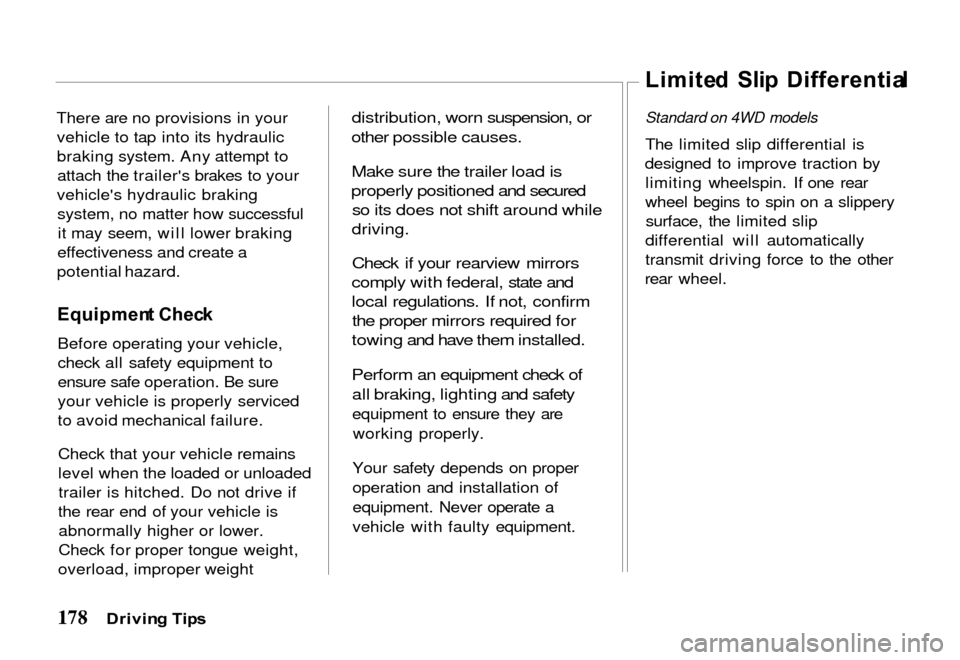
There are no provisions in your
vehicle to tap into its hydraulic
braking system. Any attempt toattach the trailer's brakes to your
vehicle's hydraulic braking system, no matter how successfulit may seem, will lower braking
effectiveness and create a
potential hazard.
Equipmen t Chec k
Before operating your vehicle,
check all safety equipment to
ensure safe operation. Be sure
your vehicle is properly serviced
to avoid mechanical failure.
Check that your vehicle remains
level when the loaded or unloadedtrailer is hitched. Do not drive if
the rear end of your vehicle is abnormally higher or lower.
Check for proper tongue weight,
overload, improper weight
distribution, worn suspension, or
other possible causes.
Make sure the trailer load is
properly positione
d and secured
so its does not shift around whil
e
driving.
Chec k
if your rearview mirrors
comply with federal, state and
local regulations. If not, confirm
the proper mirrors required for
towing and have them installed.
Perform an equipment check of
all braking, lighting and safety
equipment to ensure they are working properly.
Your safety depends on proper
operation and installation of
equipment. Never operate a
vehicle with faulty equipment.
Limite
d Sli p Differentia l
Standard on 4WD models
The limited slip differential is
designed to improve traction by limiting wheelspin. If one rear
wheel begins to spin on a slipperysurface, the limited slip
differential will automatically
transmit driving force to the other
rear wheel.
Drivin g Tip s
Page 191 of 267
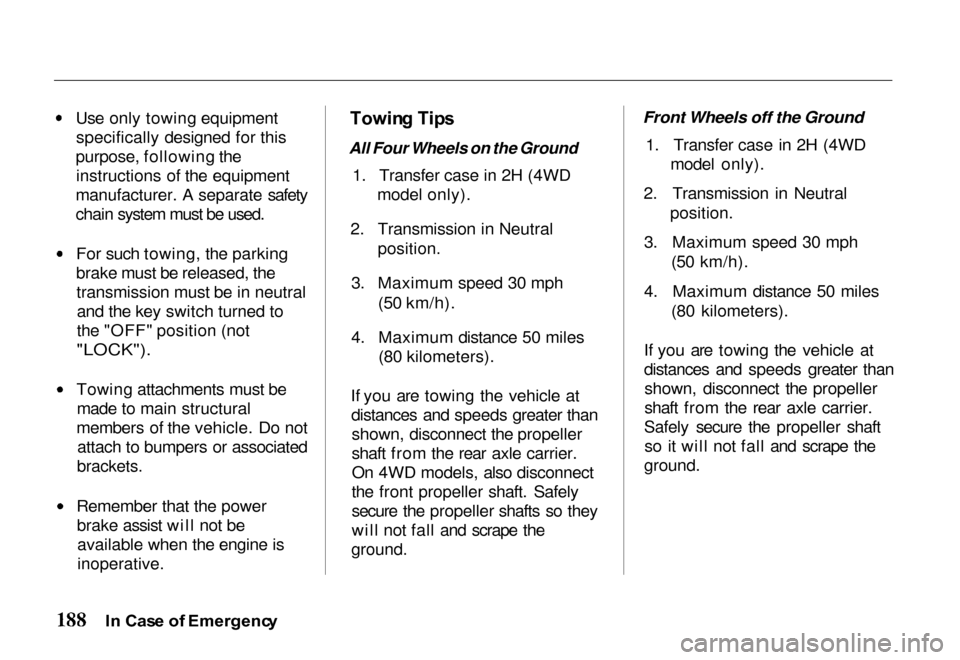
Use only towing equipment
specifically designed for this
purpose, following the instructions of the equipment
manufacturer. A separate safety
chain system must be used.
For such towing, the parking
brake must be released, thetransmission must be in neutraland the key switch turned to
the "OFF" position (not
"LOCK").
Towing attachments must be made to main structural
members of the vehicle. Do not attach to bumpers or associated
brackets.
Remember that the power brake assist will not beavailable when the engine is
inoperative.
Towin
g Tip s
All Four Wheels on the Ground
1. Transfer case in 2H (4WD model only).
2. Transmission in Neutral
position.
3. Maximum speed 30 mph (50 km/h).
4. Maximum distance 50 miles (80 kilometers).
If you are towing the vehicle at distances and speeds greater thanshown, disconnect the propeller
shaft from the rear axle carrier.
On 4WD models, also disconnect
the front propeller shaft. Safely
secure the propeller shafts so they
will not fall and scrape the
ground.
Front Wheels off the Ground
1. Transfer case in 2H (4WD model only).
2. Transmission in Neutral position.
3. Maximum speed 30 mph (50 km/h).
4. Maximum distance 50 miles (80 kilometers).
If you are towing the vehicle at
distances and speeds greater than shown, disconnect the propeller
shaft from the rear axle carrier.
Safely secure the propeller shaft so it will not fall and scrape the
ground.
I n Cas e o f Emergenc y
Page 192 of 267
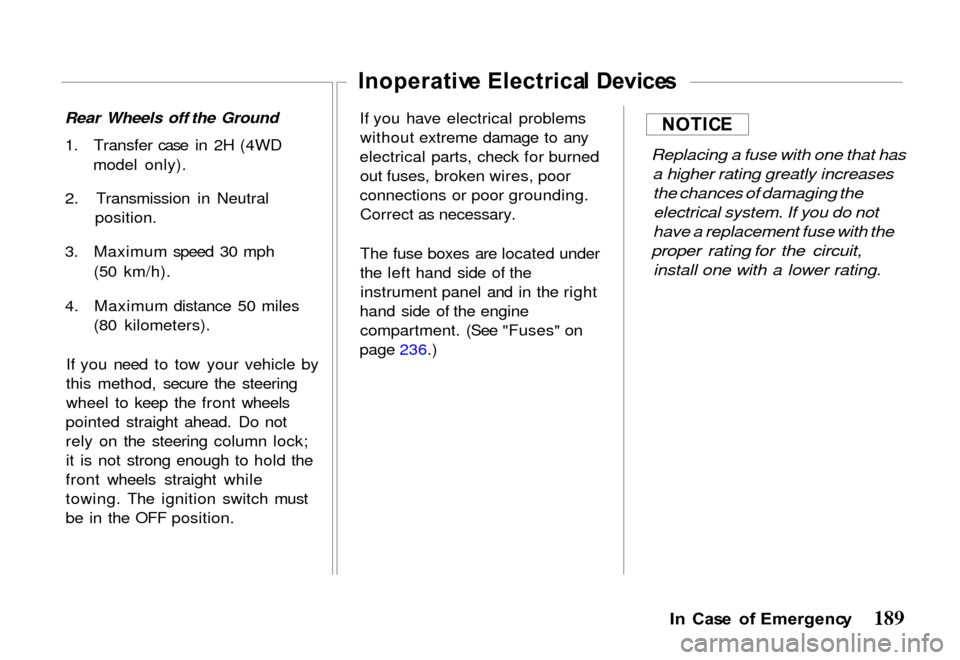
Rear Wheels off the Ground
1. Transfer case in 2H (4WD model only).
2. Transmission in Neutral position.
3. Maximum speed 30 mph (50 km/h).
4. Maximum distance 50 miles (80 kilometers).
If you need to tow your vehicle by
this method, secure the steering
wheel to keep the front wheels
pointed straight ahead. Do not
rely on the steering column lock; it is not strong enough to hold the
front wheels straight while
towing. The ignition switch must
be in the OFF position.
Inoperativ
e Electrica l Device s
If you have electrical problems without extreme damage to any
electrical parts, check for burned out fuses, broken wires, poor
connections or poor grounding. Correct as necessary.
The fuse boxes are located under
the left hand side of theinstrument panel and in the right
hand side of the engine compartment. (See "Fuses" on
page 236.)
Replacing a fuse with one that has
a higher rating greatly increases
the chances of damaging the
electrical system. If you do not
have a replacement fuse with the
proper rating for the circuit,
install one with a lower rating.
In Cas e o f Emergenc y
NOTIC
E
Page 194 of 267
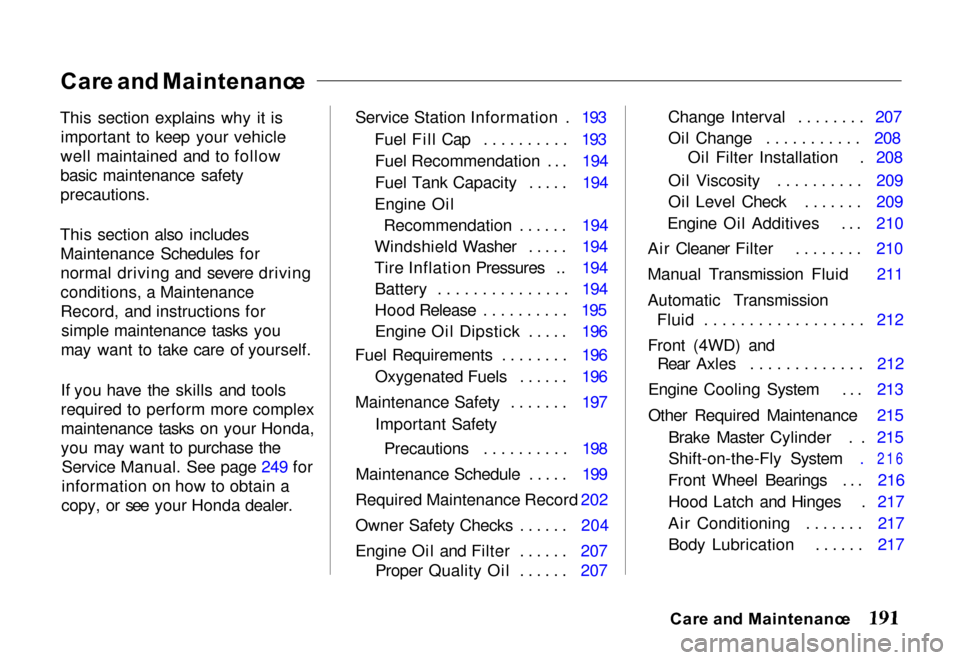
Car
e an d Maintenanc e
This section explains why it is important to keep your vehicle
well maintained and to follow
basic maintenance safety
precautions.
This section also includes Maintenance Schedules for
normal driving and severe driving
conditions, a Maintenance
Record, and instructions for simple maintenance tasks you
may want to take care of yourself.
If you have the skills and tools
required to perform more complex
maintenance tasks on your Honda,
you may want to purchase the Service Manual. See page 249 for
information on how to obtain a
copy, or see your Honda dealer. Service Station Information . 193
Fuel Fill Cap .......... 193Fuel Recommendation ... 194
Fuel Tank Capacity ..... 194
Engine Oil Recommendation ...... 194
Windshield Washer ..... 194
Tire Inflation Pressures .. 194 Battery ............... 194
Hood Release .......... 195
Engine Oil Dipstick ..... 196
Fuel Requirements ........ 196 Oxygenated Fuels ...... 196
Maintenance Safety ....... 197 Important Safety
Precautions .......... 198
Maintenance Schedule ..... 199
Required Maintenance Record 202
Owner Safety Checks ...... 204
Engine Oil and Filter ...... 207 Proper Quality Oil ...... 207 Change Interval ........ 207
Oil
Change ........... 208
Oil Filter Installation . 208
Oil Viscosity .......... 209
Oil Level Check ....... 209
Engine Oil Additives ... 210
Air Cleaner Filter ........ 210
Manual Transmission Fluid 211
Automatic Transmission Fluid .................. 212
Front (4WD) and Rear Axles ............. 212
Engine Cooling System ... 213
Other Required Maintenance 215 Brake Master Cylinder . . 215
Shift-on-the-Fly System
. 216
Front Whee
l Bearings ... 216
Hood Latch and Hinges . 217
Air Conditioning ....... 217 Body Lubrication ...... 217
Car e an d Maintenanc e
Page 195 of 267
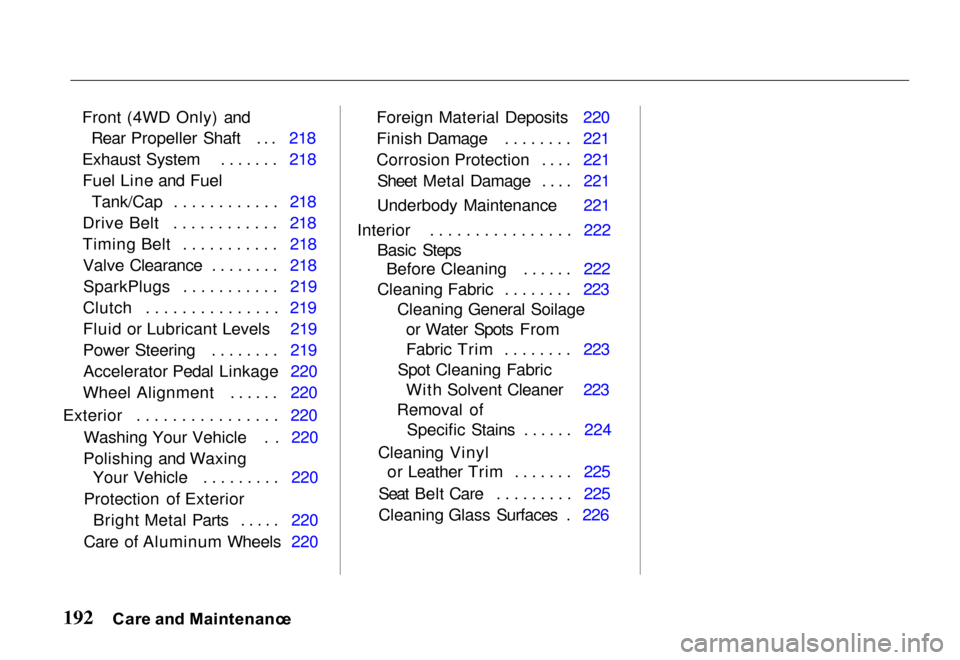
Front (4WD Only) and
Rear Propeller Shaft ... 218
Exhaust System ....... 218 Fuel Line and Fuel Tank/Cap ............ 218
Drive Belt ............ 218
Timing Belt ........... 218 Valve Clearance ........ 218SparkPlugs ........... 219
Clutch ............... 219
Fluid or Lubricant Levels 219
Power Steering ........ 219 Accelerator Pedal Linkage 220
Wheel Alignment ...... 220
Exterior ................ 220 Washing Your Vehicle . . 220
Polishing and Waxing Your Vehicle ......... 220
Protection of Exterior Bright Metal Parts ..... 220
Care of Aluminum Wheels 220 Foreign Material Deposits 220
Finish Damage ........ 221
Corrosion Protection .... 221
Sheet Metal Damage .... 221
Underbody Maintenance 221
Interior ................ 222 Basic StepsBefore Cleaning ...... 222
Cleaning Fabric ........ 223 Cleaning General Soilageor Water Spots From
Fabric Trim ........ 223
Spot Cleaning Fabric With Solvent Cleaner 223
Removal of Specific Stains ...... 224
Cleaning Vinyl or Leather Trim ....... 225
Seat Belt Care ......... 225
Cleaning Glass Surfaces . 226
Car e an d Maintenanc e
Page 214 of 267
Never run the engine with the air
cleaner filter removed. If the
engine should backfire, it could
possibly cause an engine
compartment fire.
Be sure to reinstall the air cleaner
filter and assembly correctly. If it is installed incorrectly, engine
damage could result. Manua
l Transmissio n Flui d
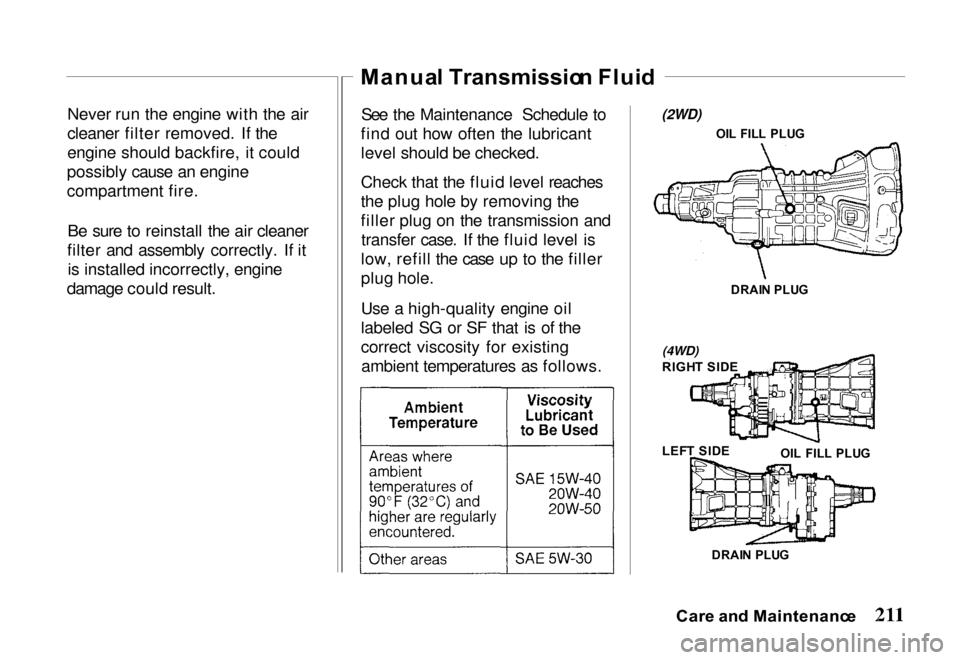
See the Maintenance Schedule to
find out how often the lubricant
level should be checked.
Check that the fluid level reaches
the plug hole by removing the
filler plug on the transmission and transfer case. If the fluid level is
low, refill the case up to the filler
plug hole.
Use a high-quality engine oil
labeled SG or SF that is of the
correct viscosity for existing ambient temperatures as follows.
(2WD)
OIL FIL L PLU G
DRAI N PLU G
DRAI N PLU G
Car e an d Maintenanc e
(4WD)
RIGH
T SID E
LEF T SID E
OIL FIL L PLU G
Page 215 of 267
Automati
c Transmissio n Flui d
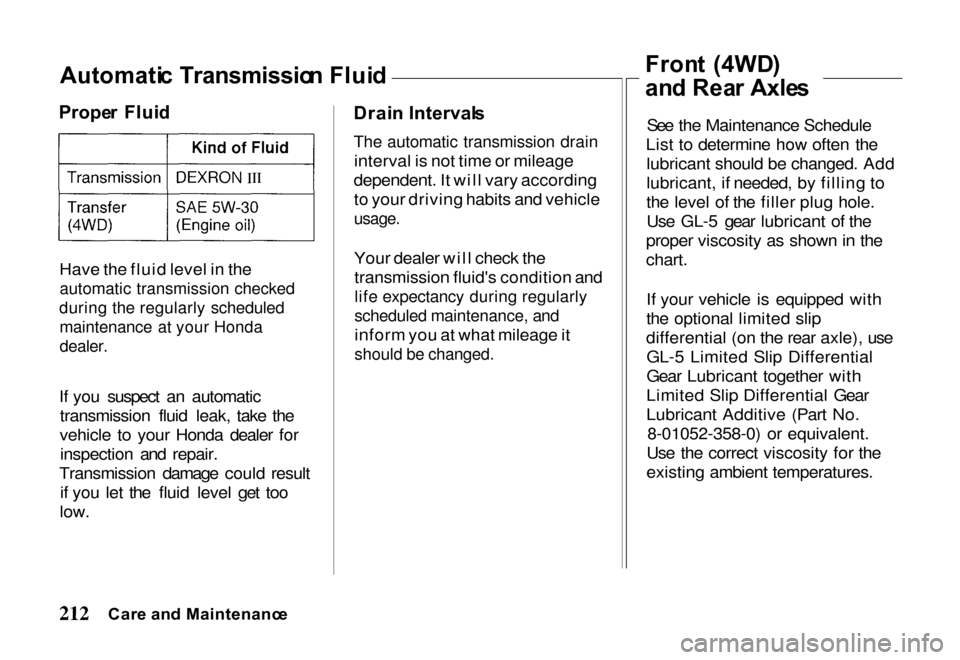
Prope r Flui d
Have the fluid level in the
automatic transmission checked
during the regularly scheduled maintenance at your Honda
dealer.
If you suspect an automatic transmission fluid leak, take the
vehicle to your Honda dealer for inspection and repair.
Transmission damage could result if you let the fluid level get too
low.
Drai
n Interval s
The automatic transmission drain
interval is not time or mileage
dependent. It will vary according to your driving habits and vehicle
usage.
Your dealer will check thetransmission fluid's condition and
life expectancy during regularly
scheduled maintenance, and
inform you at what mileage it
should be changed.
Fron
t (4WD )
an d Rea r Axle s
See the Maintenance Schedule
List to determine how often the lubricant should be changed. Add
lubricant, if needed, by filling to
the level of the filler plug hole.
Use GL-5 gear lubricant of the
proper viscosity as shown in the
chart.
If your vehicle is equipped with
the optional limited slip
differential (on the rear axle), use GL-5 Limited Slip Differential
Gear Lubricant together with
Limited Slip Differential Gear
Lubricant Additive (Part No. 8-01052-358-0) or equivalent.
Use the correct viscosity for the
existing ambient temperatures.
Car e an d Maintenanc e
Page 237 of 267
Fron
t Suspensio n
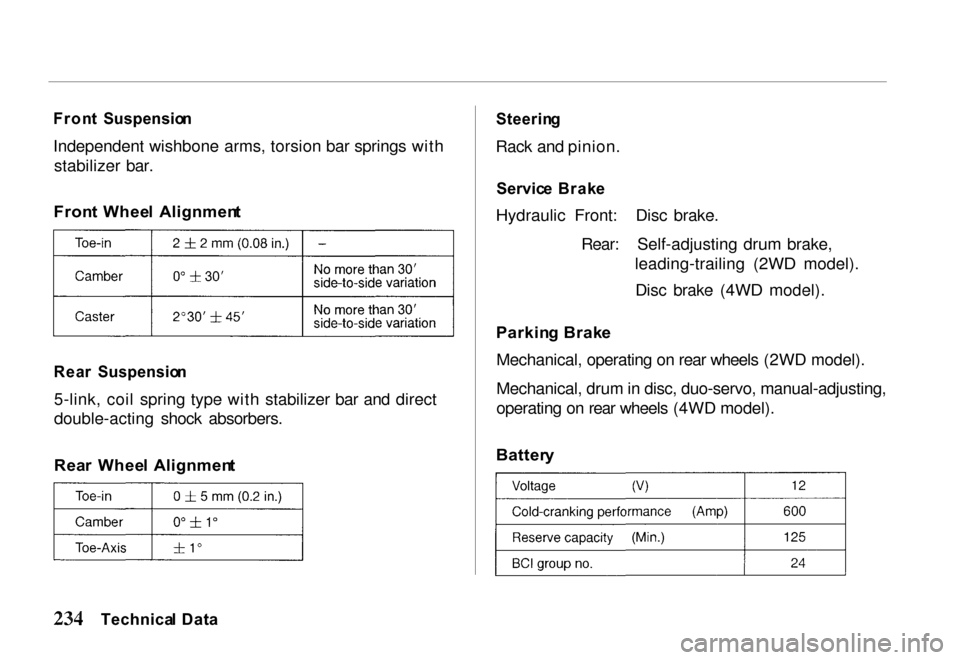
Independent wishbone arms, torsion bar springs with stabilizer bar.
Fron t Whee l Alignmen t
Rea r Suspensio n
5-link, coil spring type with stabilizer bar and direct
double-acting shock absorbers.
Rea r Whee l Alignmen t
Steerin
g
Rack and pinion.
Servic e Brak e
Hydraulic Front: Disc brake.
Rear: Self-adjusting drum brake,leading-trailing (2WD model).
Disc brake (4WD model).
Parkin g Brak e
Mechanical, operating on rear wheels (2WD model).
Mechanical, drum in disc, duo-servo, manual-adjusting,
operating on rear wheels (4WD model).
Batter y
Technical Dat a