brakes HONDA PASSPORT 2000 2.G User Guide
[x] Cancel search | Manufacturer: HONDA, Model Year: 2000, Model line: PASSPORT, Model: HONDA PASSPORT 2000 2.GPages: 267, PDF Size: 3.03 MB
Page 173 of 267
systems, such as the SRS and
anti-lock brake system.
However, if electronic accessories
are improperly installed, or
exceed your vehicle's electrical
system capacity, they can interfere with the operation of your vehicle,
or even cause the airbags to
deploy.
Before installing any accessory: Make sure the accessory does
not obscure any lights, or interfere with proper vehicle
operation or performance. Be sure electronic accessories
do not overload electrical
circuits (see page 236). Have the installer contact your
Honda dealer for assistance
before installing any electronic
accessory.
If possible, have your dealer
inspect the final installation.
Modification s
Do not remove any original
equipment or modify your vehicle in any way that would alter its
design or operation. This could
make your vehicle unsafe and illegal to drive.
For example, do not make any modifications that would change
the ride height of your vehicle, or
install wheels and tires with a
different overall diameter.
Such modifications can adversely
affect handling, and interfere with
the operation of the vehicle's
anti-lock brakes and other
systems.
In addition, any modifications that
decrease ground clearance increase the chance of
undercarriage parts striking a
curb, speed bump, or other raised object, which could cause your
airbags to deploy.
Do not modify your steering wheel or any other part of your
Supplemental Restraint System.Modifications could make the
system ineffective.
Additiona l Safet y Precautio n
Do not attach or place objects on
the airbag covers. Any object
attached to, or placed on, the
covers marked "SRS," in the
center of the steering wheel and on top of the dashboard, could
interfere with the proper operation
of the airbags. Or, if the airbags
inflate, the objects could be
propelled inside the vehicle and hurt someone.
Drivin g Tip s
Page 179 of 267
Tongue load should be between
9 percent and 11 percent of the
total trailer weight. However, itshould never exceed 450 pounds. Never load a trailer with more
weight in the rear than in the
front. The front should be
loaded with approximately
60 percent and the rear with
approximately 40 percent of
the total trailer load. Never exceed the maximum
weight limits of the trailer
or trailer towing equipment.
Improper loading can result in damage to your vehicle and
possible personal injury. Check the vehicle and trailer
loading and the weights on
each axle at a commercial scale
or a highway patrol office
equipped with a scale.
Traile
r Hitche s
A Class 3 hitch kit (up to 4,500 Ib) is available from your
Honda dealer.
Use a trailer equipped with
electric brakes and a "Weight
Distributing Hitch Attachment" when the gross trailer weight
exceeds 3,500 pounds.
A special attachment that replaces the draw bar/ball assembly is used
to distribute the proper weight to
the front axle. It uses a pair ofspring bars that are adjusted to
accomplish the distribution of the weight.
Consult your trailer's
manufacturer for assistance withselecting the proper weight
distributing hitch attachment. Check with a recreational vehicle
dealer for additional required
equipment. Have this equipment installed by a trained mechanic.
Improper equipment or installation
can damage your vehicle and cause
personal injury.
Do not use axle-mounted hitches
or equipment not designed for
your vehicle.
Do not make any modifications to
the vehicle's exhaust, braking, or
electrical system other than those
that are shown in the instructions
for the Honda Trailer Hitch Kit.
Improper modifications can affect
vehicle durability.
Periodic inspection of all added-on trailer towing equipment is
necessary to assure continued safe
operation.
Drivin g Tip s
Page 180 of 267

Safet
y Chai n
Always use a suitable safety chain
between your vehicle and the
trailer.
Check with your trailer
manufacturer for the required
equipment. Cross the safety
chains under the hitch and attach
them to the trailer hitch hardware.
This will prevent the trailer from
dropping to the ground in the
event the hitch disengages. For
proper use and installation,
consult your trailer manufacturer.
Traile r Light s
Trailer lights and equipment must
comply with federal, state and local regulations. Check with your
local recreational vehicle dealer
for the requirements in your area. Use only equipment designed for
your vehicle.
Improper equipment or installation can cause damage to
your vehicle's electrical system and affect your vehicle warranty.
Consult your Honda dealer for installation.
Tire s
Always check the condition of
your vehicle's tires and trailer's
tires before operation. Replace
worn or damaged tires before
operation.
Inflate tire pressure to the
recommended cold tire pressure indicated in the tire
manufacturer's warranty booklet in the glove box packet.
Check the tire manufacturer's
requirements when replacement
tires are installed on your vehicle.
Trailer tire condition, size, load
rating, and proper inflation
pressure should be in accordance
with the tire manufacturer's
specifications. Improper tire size
and inflation can cause tire
failure, possibly resulting in
vehicle damage and personal
injury.
Traile r Brake s
Trailers with a total weight of
1,000 pounds or more require trailer brakes. If your trailer is
equipped with a braking system,
make sure it conforms to federal,state, and local equipment
regulations.
Driving Tip s
Page 181 of 267
There are no provisions in your
vehicle to tap into its hydraulic
braking system. Any attempt toattach the trailer's brakes to your
vehicle's hydraulic braking system, no matter how successfulit may seem, will lower braking
effectiveness and create a
potential hazard.
Equipmen t Chec k
Before operating your vehicle,
check all safety equipment to
ensure safe operation. Be sure
your vehicle is properly serviced
to avoid mechanical failure.
Check that your vehicle remains
level when the loaded or unloadedtrailer is hitched. Do not drive if
the rear end of your vehicle is abnormally higher or lower.
Check for proper tongue weight,
overload, improper weight
distribution, worn suspension, or
other possible causes.
Make sure the trailer load is
properly positione
d and secured
so its does not shift around whil
e
driving.
Chec k
if your rearview mirrors
comply with federal, state and
local regulations. If not, confirm
the proper mirrors required for
towing and have them installed.
Perform an equipment check of
all braking, lighting and safety
equipment to ensure they are working properly.
Your safety depends on proper
operation and installation of
equipment. Never operate a
vehicle with faulty equipment.
Limite
d Sli p Differentia l
Standard on 4WD models
The limited slip differential is
designed to improve traction by limiting wheelspin. If one rear
wheel begins to spin on a slipperysurface, the limited slip
differential will automatically
transmit driving force to the other
rear wheel.
Drivin g Tip s
Page 202 of 267
Maintenanc
e Schedul e
The Maintenance Schedule specifies how often you should
have your vehicle serviced and what things need attention. It is
essential that you have your vehicle serviced as scheduled to
retain its high level of safety, dependability, and emission
control performance.
The services and time or distanceintervals shown in the
maintenance schedule assume you will use your vehicle as normal
transportation. You should: Avoid exceeding your vehicle's
load limit. This puts excess
stress on the engine, brakes, and
many other parts of your vehicle.
The load limit is shown on the label on the driver's doorjamb. Operate your vehicle on
reasonable roads within the
legal speed limit. Drive your vehicle regularly over
a distance of several miles
(kilometers).
Always use unleaded gasoline
with the proper octane rating
(see page 196).
Your authorized Honda dealer
knows your vehicle best and can
provide competent, efficient service. However, service at a
dealer is not mandatory to keep
your warranties in effect.
Maintenance may be done by any
qualified service facility or person
who is skilled in this type of automotive service. Keep all the
receipts as proof of completion, and have the person who does the
work fill out the Maintenance Record. Check your warranty
booklet for more information.
We recommend the use of Genuine Honda parts and fluids
whenever you have maintenance
done. These are manufactured to
the same high-quality standards as
the original components, so you
can be confident of their
performance and durability.
U.S . Vehicles :
Maintenance , replacemen t o r repai r
o f emissio n contro l device s an d
system s ma y b e don e b y an y
automotiv e repai r establishmen t o r
individua l usin g part s tha t ar e
"certified " t o EP A standards .
Car e an d Maintenanc e
Page 208 of 267

Sit in the driver's seat and
perform these checks:
1. With the engine stopped, depress the brake pedal severaltimes; the travel distance and
effective pedal stroke should
remain unchanged.
2. Start the engine with the brake pedal fully depressed.
The brake pedal should go downa little as the engine starts.
3. Depress the brake pedal, stop the engine and hold the pedal
depressed for about 30
seconds; the brake pedal
should remain in position
without rising or going down.
4. Restart the engine and run it for about a minute, then turn it
off and depress the brake
pedal firmly several times; the
brake pedal travel should decrease each time the brake
pedal is depressed.
If the brakes do not operate
normally, have them checked and
corrected by your Honda dealer.
Exhaus t syste m — Be alert to any
changes in the sound of the exhaust system or any smell of fumes.
These are signs the system may be leaking or overheating. Have the
system checked and/or repaired at
once if these conditions exist. (Also see "Carbon Monoxide Hazard" in
the "Driver and Passenger Safety"
section and "Three-Way Catalytic
Converter" in the "Driving Tips"
section.)
Windshiel d wiper s an d
washer s — Check the operation
and condition of the wiper blades.
Check the flow and aim of the
washer spray.
Defroster
s — Check performance
by moving the controls to the
defrost setting and noting the amount of air directed against the
windshield.
Rea r vie w mirror s an d su n
visor s — Check that the friction
joints hold the mirrors and sun visors firmly in place.
Hor n — Blow the horn now and
then to be sure it works.
La p an d shoulde r belt s — Check
the belt system, including
webbing, buckles, latch plates,
retractors, guide loops and anchors for proper operation and
damage.
Sea t adjuster s — When adjusting
a seat, be sure the seat adjusters
latch securely by pushing the seat
forward and backward.
Car e an d Maintenanc e
Page 255 of 267
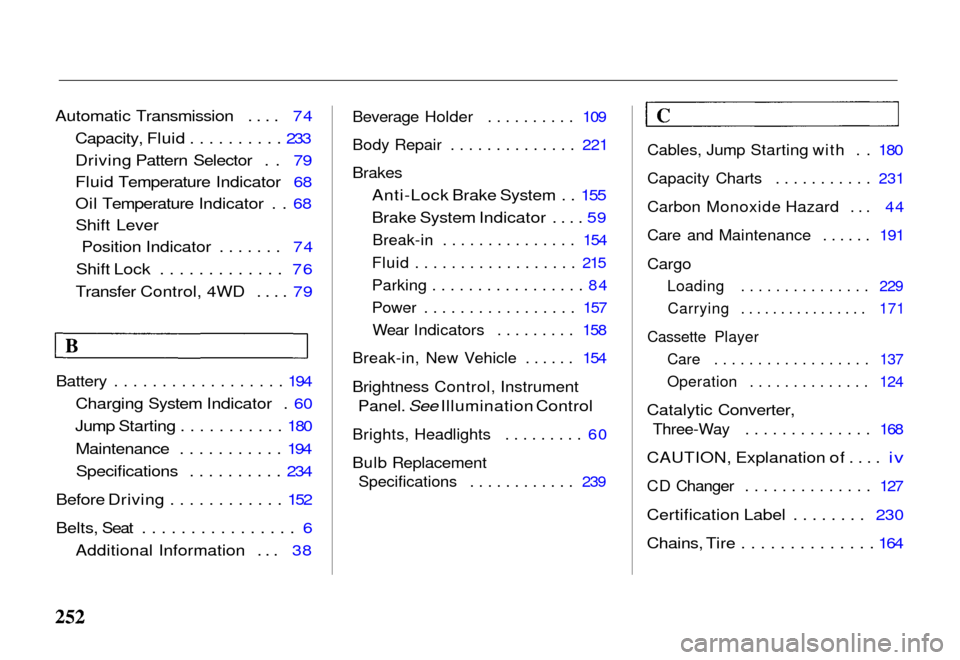
Automatic Transmission .... 74
Capacity, Fluid .......... 233
Driving Pattern Selector . . 79
Fluid Temperature Indicator 68
Oil Temperature Indicator . . 68Shift Lever Position Indicator ....... 74
Shift Lock ............. 76
Transfer Control, 4WD .... 79
Beverage Holder .......... 109
Body Repair .............. 221
Brakes
Anti-Lock Brake System . . 155
Brake System Indicator .... 59
Break-in ............... 154
Fluid .................. 215
Parking ................. 84
Power ................. 157
Wear Indicators ......... 158
Break-in, New Vehicle ...... 154
Brightness Control, Instrument
Panel. See Illumination Control
Brights, Headlights ......... 60
Bulb Replacement
Specifications ............ 239
Cables, Jump Starting with . . 180
Capacity Charts ........... 231
Carbon Monoxide Hazard ... 44
Care and Maintenance ...... 191
Cargo
Loading ............... 229
Carrying ................ 171
Cassette Player Care .................. 137
Operation .............. 124
Catalytic Converter,
Three-Way .............. 168
CAUTION, Explanation of .... iv
CD Change
r .............. 127
Certification Label ........ 230
Chains, Tire .............. 164
Battery .................. 194
Charging System Indicator . 60
Jump Starting ........... 180
Maintenance ........... 194Specifications .......... 234
Before Driving ............ 152
Belts, Seat ................ 6 Additional Information ... 38
Page 262 of 267
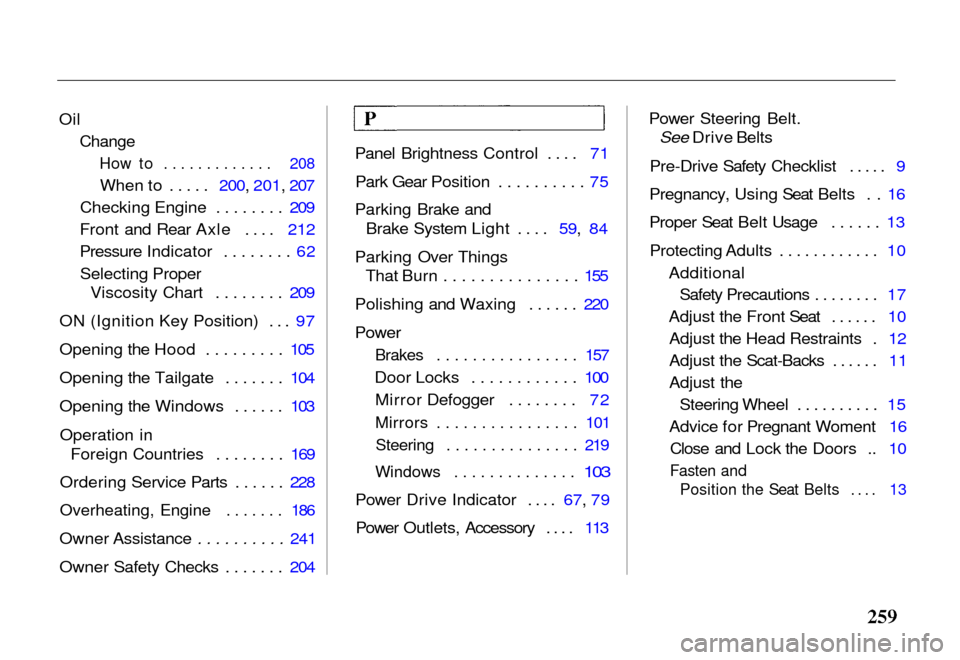
Oil
Change
How to ............. 208
When to ..... 200, 201, 207
Checking Engine ........ 209
Front and Rear Axle .... 212
Pressure Indicator ........ 62
Selecting Proper Viscosity Chart ........ 209
ON (Ignition Key Position) ... 97
Opening the Hood ......... 105
Opening the Tailgate ....... 104
Opening the Windows ...... 103
Operation in Foreign Countries ........ 169
Ordering Service Parts ...... 228
Overheating, Engine ....... 186
Owner Assistance .......... 241
Owner Safety Checks ....... 204 Panel Brightness Control .... 71
Park Gear Position .......... 75
Parking Brake and Brake System Light .... 59, 84
Parking Over Things That Burn ............... 155
Polishing and Waxing ...... 220
Power
Brakes ................ 157
Door Locks ............ 100 Mirror Defogger ........ 72
Mirrors ................ 101Steering ............... 219
Windows .............. 103
Power Drive Indicator .... 67, 79
Power Outlets, Accessory .... 113 Power Steering Belt.
See Drive Belts
Pre-Drive Safety Checklist ..... 9
Pregnancy, Using Seat Belts . . 16
Proper Seat Belt Usage ...... 13
Protecting Adults ............ 10 AdditionalSafety Precautions ........ 17
Adjust the Front Seat ...... 10 Adjust the Head Restraints . 12
Adjust the Scat-Backs ...... 11
Adjust the Steering Wheel .......... 15
Advice for Pregnant Woment 16 Close and Lock the Doors .. 10
Fasten and Position the Seat Belts .... 13
Page 264 of 267
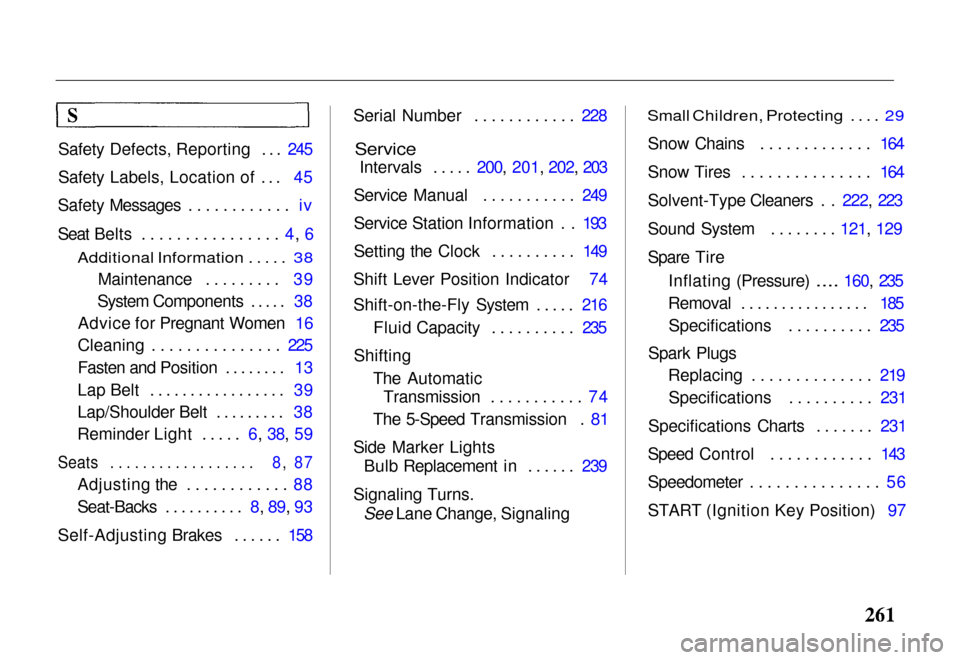
Safety Defects, Reporting ... 245
Safety Labels, Location of ... 45
Safety Messages ............ iv
Seat Belt
s ................ 4, 6
Additional Information ..... 38
Maintenance ......... 39
System Components ..... 38
Advice for Pregnant Women 16
Cleaning ............... 225
Fasten and Position ........ 13
Lap Belt ................. 39
Lap/Shoulder Belt ......... 38
Reminder Light ..... 6, 38, 59
Seats .................. 8, 87
Adjusting the ............ 88
Seat-Backs .......... 8, 89, 93
Self-Adjusting Brakes ...... 158 Serial Number ............ 228
Service
Intervals ..... 200, 201, 202, 203
Service Manual ........... 249
Service Station Information . . 193
Setting the Clock .......... 149
Shift Lever Position Indicator 74
Shift-on-the-Fly System ..... 216 Fluid Capacity .......... 235
Shifting The AutomaticTransmission ........... 74
The 5-Speed Transmission . 81
Side Marker Lights Bulb Replacement in ...... 239
Signaling Turns. See Lane Change, Signaling
Small Children, Protecting .... 29
Snow Chains ............. 164
Snow Tires ............... 164
Solvent-Type Cleaners . .
222, 223
Sound System ........ 121, 129
Spare Tire Inflating (Pressure)
.... 160, 235
Removal ................ 185 Specifications .......... 235
Spark Plugs Replacing .............. 219
Specifications .......... 231
Specifications Charts ....... 231
Speed Control ............ 143
Speedometer ............... 56
START (Ignition Key Position) 97