brake HONDA PASSPORT 2000 2.G Owners Manual
[x] Cancel search | Manufacturer: HONDA, Model Year: 2000, Model line: PASSPORT, Model: HONDA PASSPORT 2000 2.GPages: 267, PDF Size: 3.03 MB
Page 53 of 267
Interio
r
D IGNITION SWITCH
See page 97.
E STARTING THE ENGINE
See page 153.
F GAUGES
See page 56.
G ADJUSTING REAR AND
SIDE VIEW MIRRORS
See page 101.
H SHIFTING
For automatic, see page 74.
For manual, see page 81.
For four-wheel drive, see pages
78 and 82.
I
PARKING BRAKE
See page 84.
J HEADLIGHTS
See page 70.
K WINDSHIELD WIPERS
See page 68.
L TURN SIGNALS
See page 73.
M HEATER CONTROLS
See page 116.
N MAP LIGHT AND
MOONROOF
See pages 108. O
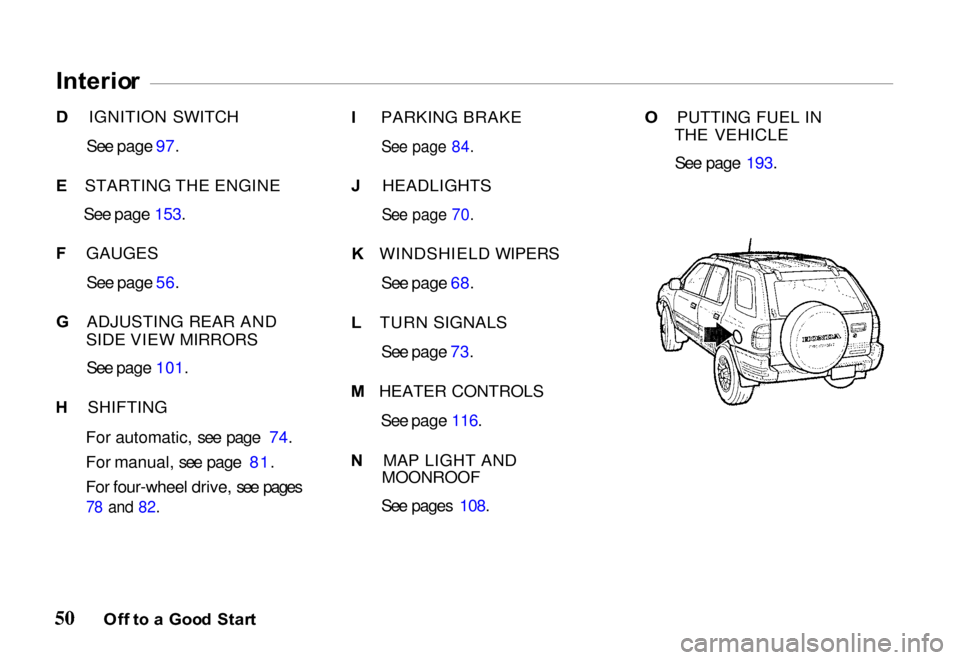
PUTTING FUEL IN
THE VEHICLE
See page 193.
Of f t o a Goo d Star t
Page 54 of 267
Engin
e Compartmen t
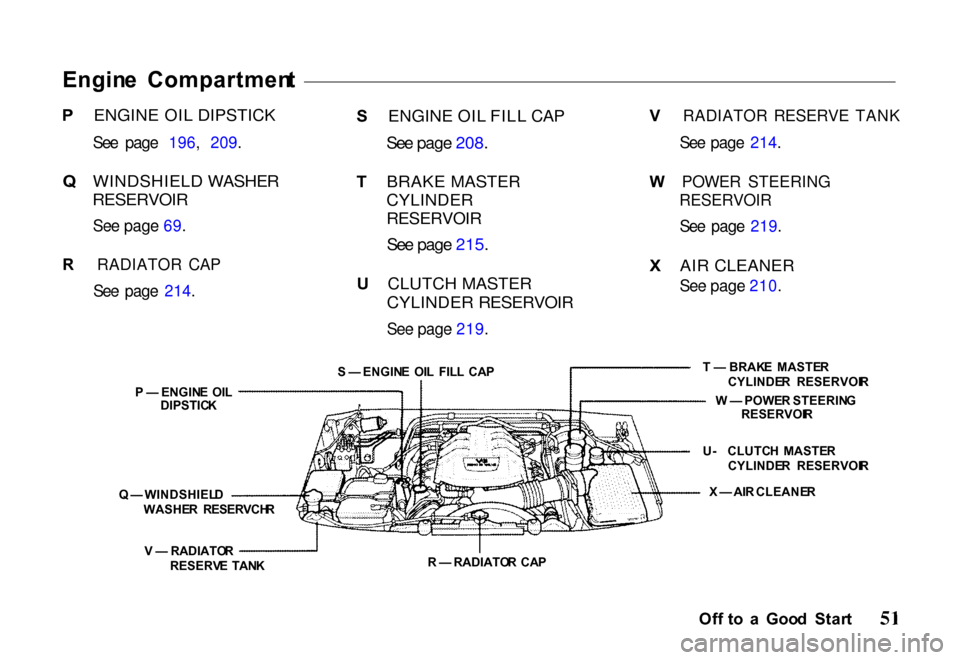
P ENGINE OIL DIPSTICK
See page 196, 209.
Q WINDSHIELD WASHER
RESERVOIR
See page 69.
R RADIATOR CAP
See page 214.
P — ENGIN E OI L
DIPSTIC K
Q — WINDSHIEL D
WASHE R RESERVCH R
V — RADIATO R
RESERV E TAN K
S
ENGINE OIL FILL CAP
See page 208.
T BRAKE MASTER
CYLINDER
RESERVOIR
See page 215.
U CLUTCH MASTER
CYLINDER RESERVOIR
See page 219. V
RADIATOR RESERVE TANK
See page 214.
W POWER STEERING
RESERVOIR
See page 219.
X AIR CLEANER
See page 210.
T — BRAK E MASTE R
CYLINDE R RESERVOI R
U - CLUTC H MASTE R
CYLINDE R RESERVOI R
R — RADIATO R CA P
Off t o a Goo d Star t
S
— ENGIN E OI L FIL L CA P
W — POWE R STEERIN G
RESERVOI R
X — AIR CLEANE R
Page 56 of 267
Instrument
s an d Control s
This section explains the controls
and displays that contribute to the
daily operation of your Honda.
All the essential controls are
within easy reach. Control Locations ......... 54
Indicators an
d Gauges ...... 55
Gauges .................. 56 Tachometer ............ 56Speedometer ........... 56
Odometer ............. 56
Trip Odometer/ Reset Knob ........... 56
Fuel Gauge ............ 57
Engine Coolant Temperature Gauge .... 58
Indicator Lights ........... 59
Switches ................. 68 Windshield Wiper/Washer 68Headlights ............. 70
Illumination Control ..... 71
Rear Window Defogger . . 72
Rear Window Wiper/ Washer .............. 72
Turn Signals ............ 73 Hazard Warning Flasher . .
74
Automatic Transmissio
n .... 74
Transfer Control (4WD Models) ......... 78
5-Speed Manual Transmission 81 Transfer Control(4WD Models) ......... 82
Parking Brake ............ 84
Accelerator Pedal .......... 85
Clutch Pedal ............. 85
Instrument s an d Control s
Page 62 of 267
Indicato
r Light s
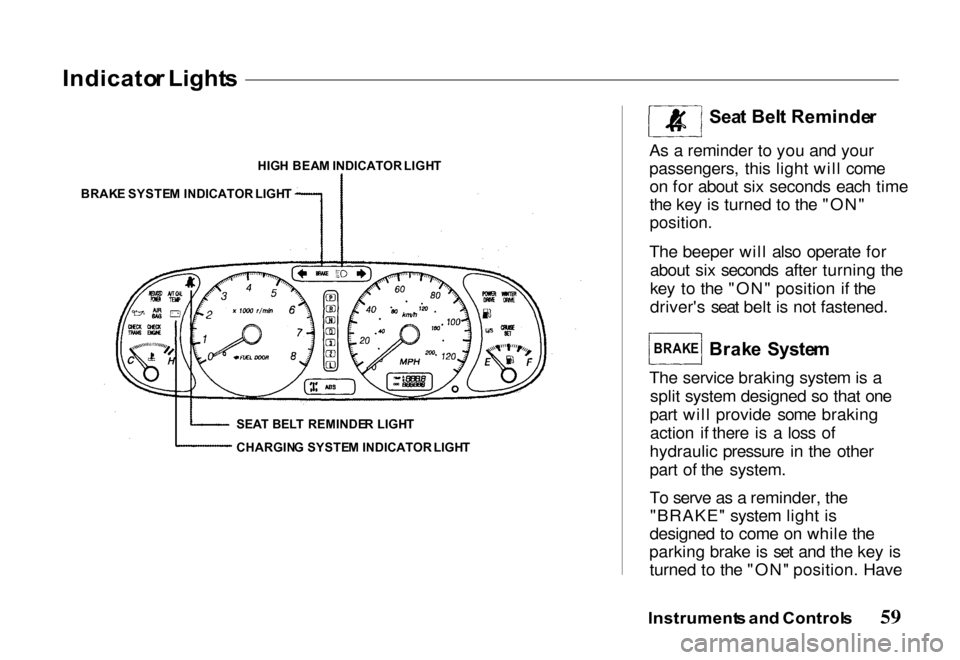
SEA T BEL T REMINDE R LIGH T Sea
t Bel t Reminde r
As a reminder to you and your
passengers, this light will come on for about six seconds each time
the key is turned to the "ON"
position.
The beeper will also operate for about six seconds after turning the
key to the "ON" position if the
driver's seat belt is not fastened.
Brake Syste m
The service braking system is a split system designed so that one
part will provide some braking action if there is a loss of
hydraulic pressure in the other
part of the system.
To serve as a reminder, the "BRAKE" system light is
designed to come on while the
parking brake is set and the key is turned to the "ON" position. Have
Instrument s an d Control s
BRAK
E
HIG
H BEA M INDICATOR LIGHT
BRAK E SYSTE M INDICATOR LIGHT
CHARGIN G SYSTE M INDICATOR LIGHT
Page 63 of 267
the system repaired if the light
does not come on when the key is
turned to the "ON" position
without the engine running or
when the parking brake is set.
This light does not eliminate the need for brake inspection and
maintenance. The brake fluid
level must be checked regularly.See the maintenance section of
this manual for other brake
checks.
If the light remains on after
engine start up with the parking
brake released, or comes on during operation of the vehicle, it
may mean that there is something
wrong with the brake system.
What to do?1. Check to see if the parking
brake has been fully released.
2. If it has, pull off the road and
stop carefully. Remember that: Stopping distances may be
longer.
You may have to push
harder on the pedal. The pedal may go down
farther than normal.
3. Have the vehicle towed to the nearest Honda dealer for
repair.
Do not continue to drive with the
brake system light on. There may
be a serious problem with the braking system. Driving under
this condition is hazardous and
could lead to an accident.
The brake system light does not indicate that the parking brake is
fully set. When applying the
parking brake, always pull it up as
far as possible. Hig
h Bea m
The headlight high beam indicator
lights up when the headlights are
on high beam.
Chargin g Syste m
This light should come on when
the key is turned to the "ON"
position and the alternator is not
charging. The light may stay on at
engine idle; however, it should go off and stay off above the normal
engine idle speed. If the light
comes on while driving, the
charging system should be
checked at once so the battery will
not completely discharge. Stop the engine, and check for a broken
drive belt. If it is broken, or if the
drive belt is not responsible for the trouble, have your Honda
dealer inspect and correct the
fault. If the drive belt is broken,
Instrument s an d Control s
Page 68 of 267
as indicated by the "U/S" (upshift)
light on the instrument panel.
If vehicle speed drops below
20 mph (30 km/h), or if the
engine is not running smoothly,
you should downshift to the next lower gear. You may need to
downshift two or more gears to
keep the engine running smoothly or for satisfactory performance.
This indicator comes on for a fewseconds when you turn the
ignition switch to the "ON"
position. 4-Whee
l Driv e
(4WD ) Indicato r
4WD models only
This indicator lights when the 4-Wheel Drive system is engaged.
With the 4WD-2WD switch in the "OFF" or 2WD position, this light
will come on to provide a "bulb
check" when the key is turned to the "ON" position, but should go
out after the engine is started.
If the 4WD-2WD switch is in the "ON" or 4WD position, this light
will come on when the key is
turned to the "ON" position and
remain on after the engine is
started.
Anti-Loc
k Indicato r
This light will come on and go out when the ignition switch is turned
to the "ON" position. (If the light
does not come on, see your Honda
dealer to have the system
repaired.)
If the light remains on after
engine start-up or comes on
during operation of the vehicle, stop as soon as possible and turn
the key off. Then start the engine
to reset the system. If the light stays on, or it comes on again
while you're driving, the anti-lock
brake system should be checked at your Honda dealer.
Until you get it fixed, you'll have
normal brakes, but you won't
have anti-lock.
Instrument s an d Control s
AB
S
Page 78 of 267
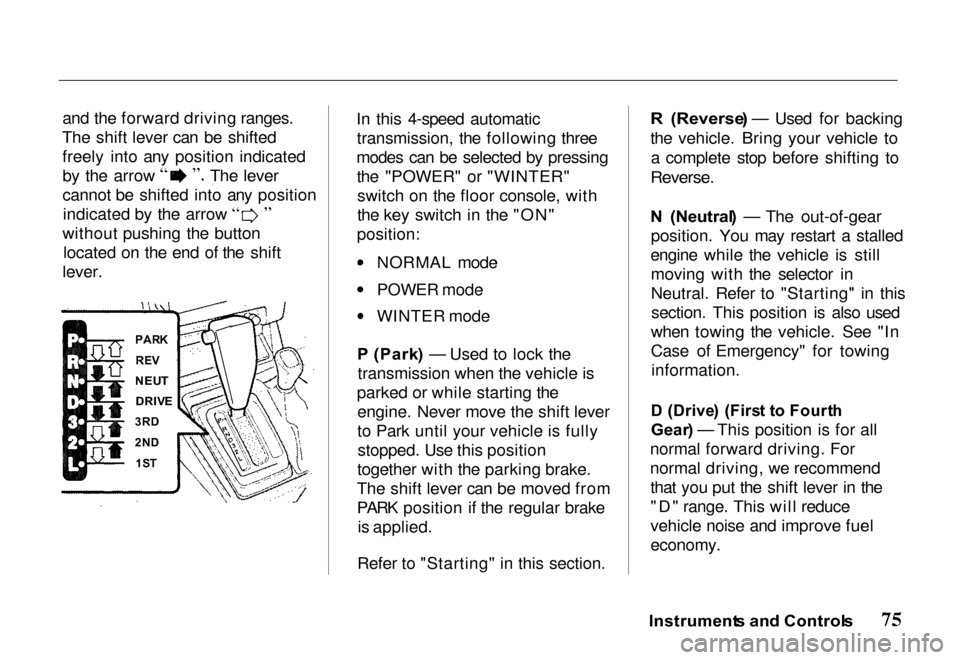
and the forward driving ranges.
The shift lever can be shifted freely into any position indicated by the arrow The lever
cannot be shifted into any position
indicated by the arrow
without pushing the button located on the end of the shift
lever. In this 4-speed automatic
transmission, the following three
modes can be selected by pressing the "POWER" or "WINTER"switch on the floor console, with
the key switch in the "ON"
position: NORMAL mode
POWER mode
WINTER mode
P (Park ) — Used to lock the
transmission when the vehicle is
parked or while starting the engine. Never move the shift lever
to Park until your vehicle is fullystopped. Use this position
together with the parking brake.
The shift lever can be moved from
PARK position if the regular brake is applied.
Refer to "Starting" in this section.R (Reverse ) — Used for backing
the vehicle. Bring your vehicle to a complete stop before shifting to
Reverse.
N (Neutral ) — The out-of-gear
position. You may restart a stalled
engine while the vehicle is still moving with the selector in
Neutral. Refer to "Starting" in thissection. This position is also used
when towing the vehicle. See "In
Case of Emergency" for towing information.
D (Drive ) (Firs t t o Fourt h
Gear ) — This position is for all
normal forward driving. For
normal driving, we recommend that you put the shift lever in the
"D" range. This will reduce
vehicle noise and improve fuel
economy.
Instrument s an d Control s
PAR
K
RE V
NEU T
DRIV E
3R D
2N D
1S T
Page 79 of 267
3
(Third ) — When operating your
vehicle on slippery roads, on a
long descending slope, or on a
road with many sharp curves, you
will want to use engine braking. At this time, put the shift lever into this range.
2 (Second ) — You may choose this
position when traveling down a
moderate grade where you want to slow down a little without using
the brake itself. Change back to the
"D" position to return to normal
driving. With the shift lever in "2," the vehicle will start in first gear
and automatically shift to second
gear.
L (First ) — This position may be
selected for maximum braking
down severe grades. Return the
selector lever to the "D" position
to resume normal driving. It is
possible to move the lever into first gear at any speed. However,
the transmission will not actually
shift to first gear until vehicle
speed is below 35 mph (Power
Mode) or 25 mph (Normal Mode).
When starting out in "L," the transmission will not upshift.
Startin g — Start the engine with
the lever in the "P" or "N"
position. It will not start in any other position. If it does, have
your vehicle checked by your
Honda dealer.
Always apply the foot brake
before shifting into any driving
position. This prevents the vehicle from creeping.
Do not press the accelerator pedal
while shifting from "P" or "N" to
any driving position. Shif
t Loc k — As a safety measure
for vehicles with an automatic
transmission, you cannot shift
from "P" (Park) position into any
other position unless the brake
pedal is depressed when the key switch is in the "ON" position or
the engine is running.
The shift lever may not move if
the pushbutton on the shift lever is
pressed before the brake pedal is
depressed. In this case, release the pushbutton, press the brake
pedal and try again.
If the shift lever won't move from
the "P" position even when theseinstructions are followed, perform
the following steps:
Instrument s an d Control s
Page 80 of 267
1. Check that the parking brake
is fully applied.
2. Turn the key switch to "ACC" position.
3. Move the shift lever from "P" to "N" position, depress the
brake pedal, and start the
engine again.
4. Operate the shift lever.
Have the transmission checked by
your Honda dealer as soon as
possible. Drivin
g Tip s
Before going down a steep or long
grade, reduce speed and shift the
transmission into a lower gear or
range to control the vehicle's speed. This will provide engine
braking to help slow the vehicle.
Try not to hold the brake pedal
down too long or too often. This
could cause the brakes to get hot
and not work properly.
Downshifting to a lower gear is
especially important when towing a trailer in mountainous terrain.
Do not hold the vehicle on a hill
by pressing on the accelerator. Do
not press on the accelerator pedal and brake pedal at the same time.
Either of these actions can
overheat the automatic
transmission and cause damage. Always keep your foot off the
accelerator pedal when shifting
from "P" or "N" to another gear.
Do not shift to "P" (Park) when
the vehicle is moving; you could
damage the automatic
transmission. Always come to a
complete stop.
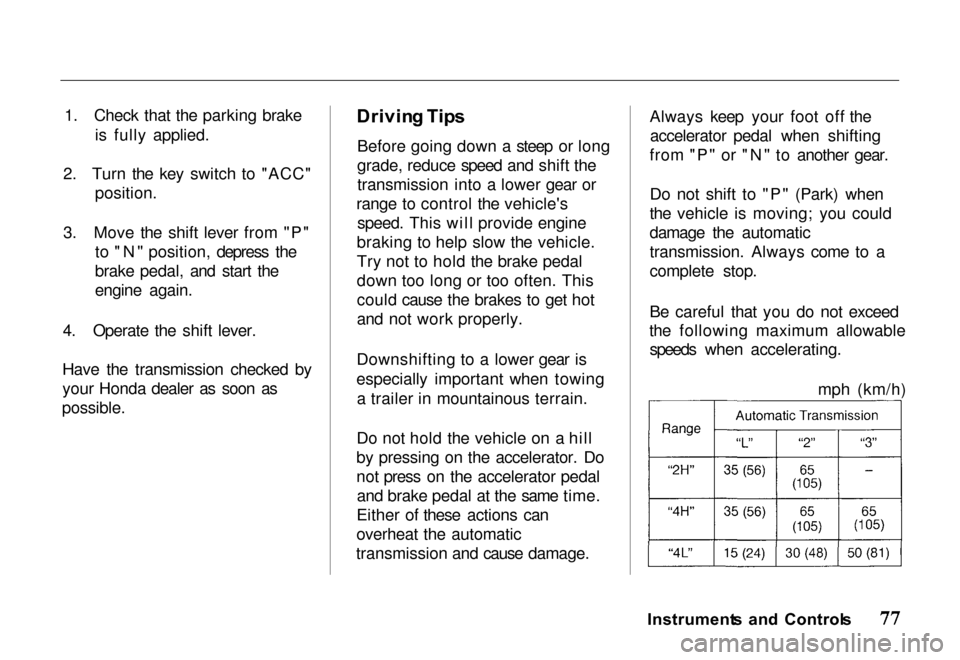
Be careful that you do not exceed
the following maximum allowable speeds when accelerating.
Instrument s an d Control s
mph (km/h)
Page 84 of 267
5-Spee
d Manua l Transmissio n
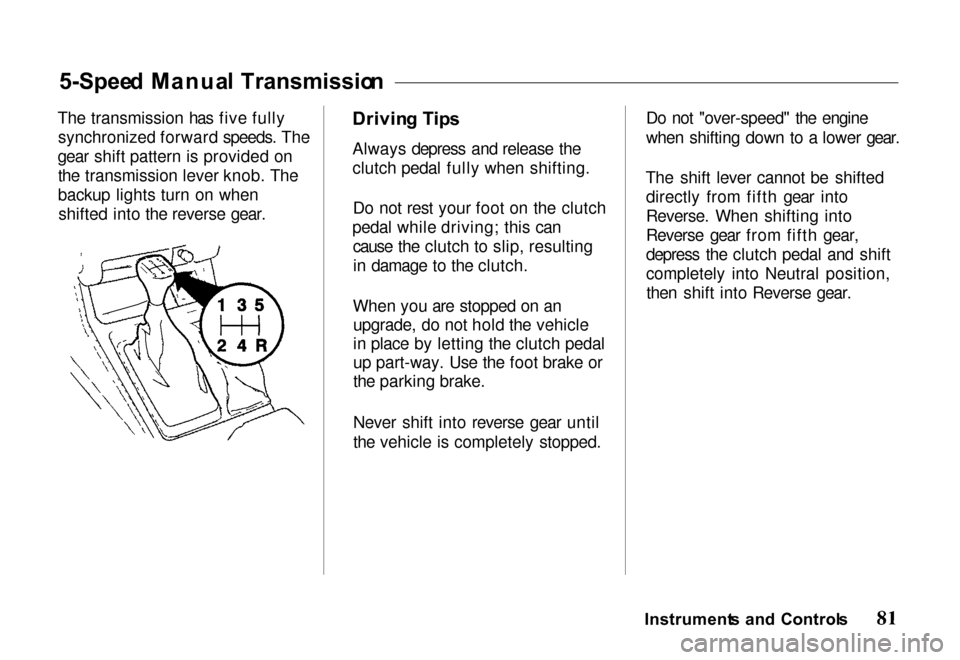
The transmission has five fully synchronized forward speeds. The
gear shift pattern is provided on the transmission lever knob. The
backup lights turn on whenshifted into the reverse gear. Drivin
g Tip s
Always depress and release the
clutch pedal fully when shifting.
Do not rest your foot on the clutch
pedal while driving; this can cause the clutch to slip, resultingin damage to the clutch.
When you are stopped on an upgrade, do not hold the vehicle
in place by letting the clutch pedal
up part-way. Use the foot brake or
the parking brake.
Never shift into reverse gear until
the vehicle is completely stopped. Do not "over-speed" the engine
when shifting down to a lower gear.
The shift lever cannot be shifted directly from fifth gear into
Reverse. When shifting into
Reverse gear from fifth gear,
depress the clutch pedal and shift
completely into Neutral position,then shift into Reverse gear.Instrument s an d Control s