engine oil HONDA PASSPORT 2000 2.G User Guide
[x] Cancel search | Manufacturer: HONDA, Model Year: 2000, Model line: PASSPORT, Model: HONDA PASSPORT 2000 2.GPages: 267, PDF Size: 3.03 MB
Page 204 of 267
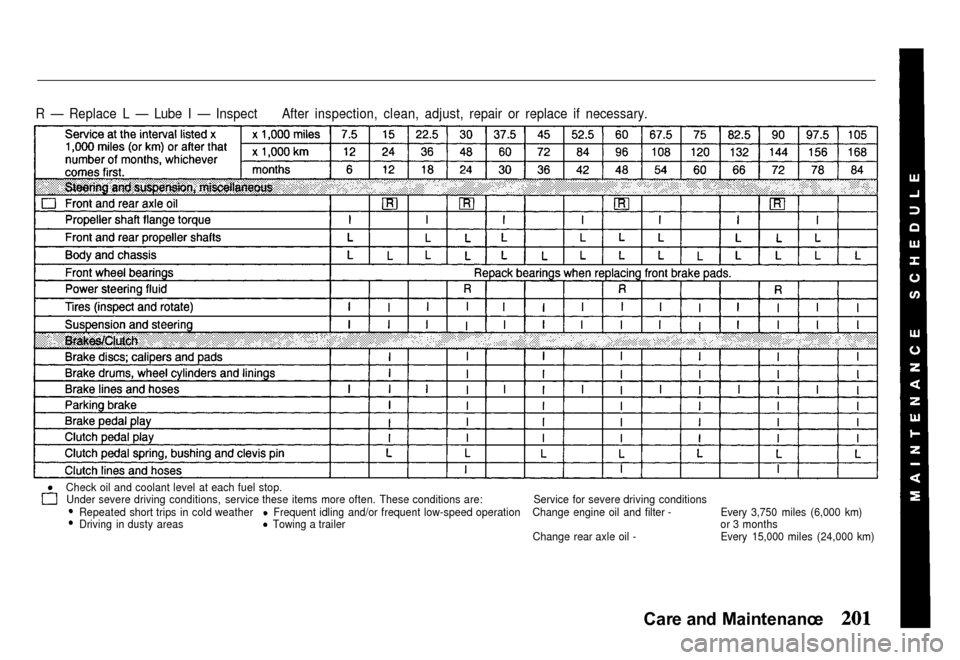
R — Replace L — Lube I — Inspect After inspection, clean, adjust, repair or replace if necessary.
Check oi
l and coolant level at each fuel stop.
Under severe driving conditions, service these items more often. These conditions are: Service for severe driving conditions
Repeated short trips in cold weather Frequent idling and/or frequent low-speed operation Change engine oil and filter - Every 3,750 miles (6,000 km) Driving in dusty areas Towing a trailer or 3 months
Change rear axle oil - Every 15,000 miles (24,000 km)
Care an d Maintenanc e
Page 210 of 267
Underbod
y — Corrosive
materials used for road-ice, snow
removal and dust control can collect on the underbody. If these
materials are not removed,
accelerated corrosion (rust) can
occur on underbody parts such as
the fuel line, frame, floor pan and
exhaust system. At least once a
year, in the spring, flush these
materials from the underbodywith plain water.
Take care to thoroughly clean any areas where mud and other debris
can collect. Sediment trapped in
closed areas of the frame should
be loosened before being flushed. Prope
r Qualit y Oi l
Engine oils are labeled on the
containers with various API (American Petroleum Institute)
designations of quality.
Use Only SJ Quality Oil
Additional designations of quality may also be present, but SJ must
be included.
The "SJ" designation may be shown alone, or in combination
with other designations, such as
"SJ/CC," "SJ/CD," or "SJ, CC"
etc.
As long as the letters "SJ" appearsomewhere in the designation of
oil quality indicated on the
container, the oil is of suitable
quality. Chang
e Interva l
The oil and filter change intervals for your engine are based on the
use of the recommended oil
quality and viscosity, as well as
high-quality filters. Using oils other than recommended, or
extending oil change intervals longer than those recommended,
could reduce engine life.
Your engine was filled with a
high-quality engine oil when it left the factory. You do not have
to change this oil before the
suggested change period.
If your normal driving does not include one or more of the "severe
driving" conditions listed below,
change the oil every 7,500 miles(12,000 kilometers) or 6 months,
whichever comes first.
Car e an d Maintenanc e
Engin
e Oi l an d Filte r
Page 211 of 267
Change the oil and oil filter every
3,750 miles (6,000 kilometers) or
every three months if you drive under one or more of these
"severe driving" conditions: Driving in dusty areas
Towing a trailer
Frequent idling or idling for
long periods Frequent short trips (4 miles [6
kilometers] or less) in cold or
freezing weather, where the
engine does not thoroughly
warm up. Change the oil and oil filter as
soon as possible after driving in
a dust storm.
Oi
l Chang e
Changing the oil and filter requires
special tools and access from underneath the vehicle. The vehicle
should be raised on a service station-type hydraulic lift for this
service. Unless you have the
knowledge and proper equipment,
you should have this maintenance
done by a skilled mechanic.
1. Warm up the engine. This makes the oil drain faster and
more thoroughly.
2. Remove the oil filler cap.
3. Remove the drain plug and drain oil fully.
4. Install the drain plug, with a new gasket, and tighten it.
5. Fill the engine with the proper amount of new oil (see
"Specifications"). Oil Filter Installation
1. Remove the old oil filter with the filter wrench.
2. Apply a light coat of engine oil to the oil filter gasket.
3. Hand-tighten the filter until the gasket contacts the sealing
face.
4. Using the filter wrench, tighten the filter one full turn.
5. Run the engine and inspect for
leaks.
6. Shut off the engine. After a couple of minutes, check the
oil level. If necessary, add oilto bring it to the FULL mark.
An improperly installed oil filter can result in severe engine
damage.
Car e an d Maintenanc e
NOTIC
E
Page 212 of 267
Oi
l Viscosit y
Engine oil viscosity (thickness) has an effect on fuel economy. Lower
viscosity engine oils can provideincreased fuel economy; however,
higher temperature weather
conditions require higher viscosity
engine oils for satisfactory lubrication. To get the best fuel
economy with your vehicle, you should use a fuel-saving engine oil
of the proper viscosity. These oils
can be found in service stations and other retail stores. They are
identified by words such as
"Energy Saving," "Conserves
Gasoline," "Gas Saving,"
"Gasoline Saving," "Friction
Reducing," "Improved Gasoline Mileage" or "Fuel Saving."
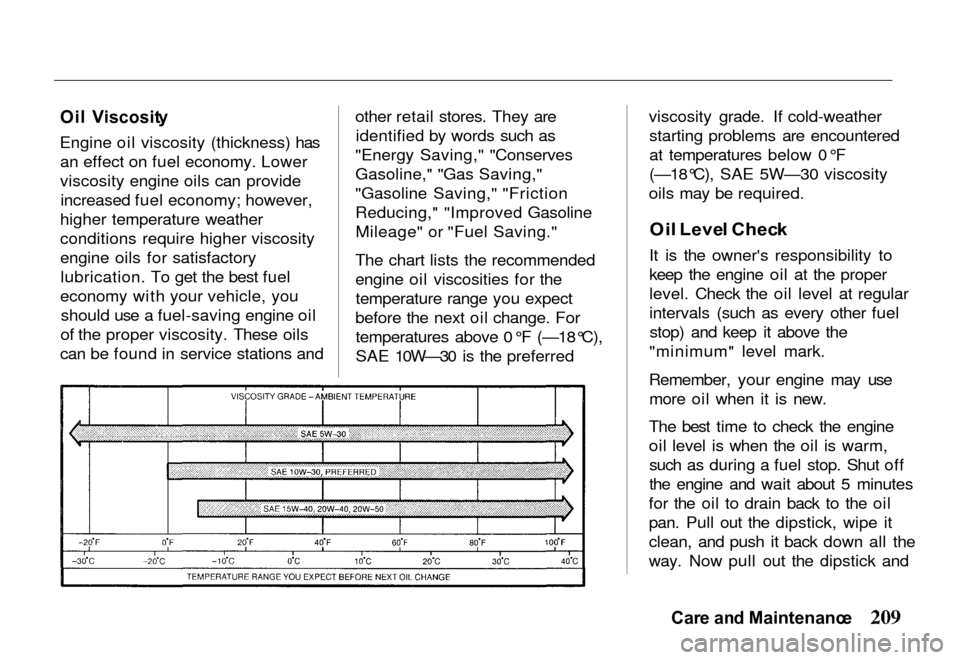
The chart lists the recommended
engine oil viscosities for the temperature range you expect
before the next oil change. For temperatures above 0°F (—18°C),
SAE 10W—30 is the preferred viscosity grade. If cold-weather
starting problems are encountered
at temperatures below 0°F
(—18°C), SAE 5W—30 viscosity
oils may be required.
Oi l Leve l Chec k
It is the owner's responsibility to
keep the engine oil at the proper
level. Check the oil level at regular
intervals (such as every other fuel stop) and keep it above the
"minimum" level mark.
Remember, your engine may use more oil when it is new.
The best time to check the engine
oil level is when the oil is warm, such as during a fuel stop. Shut off
the engine and wait about 5 minutes
for the oil to drain back to the oil
pan. Pull out the dipstick, wipe it
clean, and push it back down all the
way. Now pull out the dipstick and
Car e an d Maintenanc e
Page 213 of 267
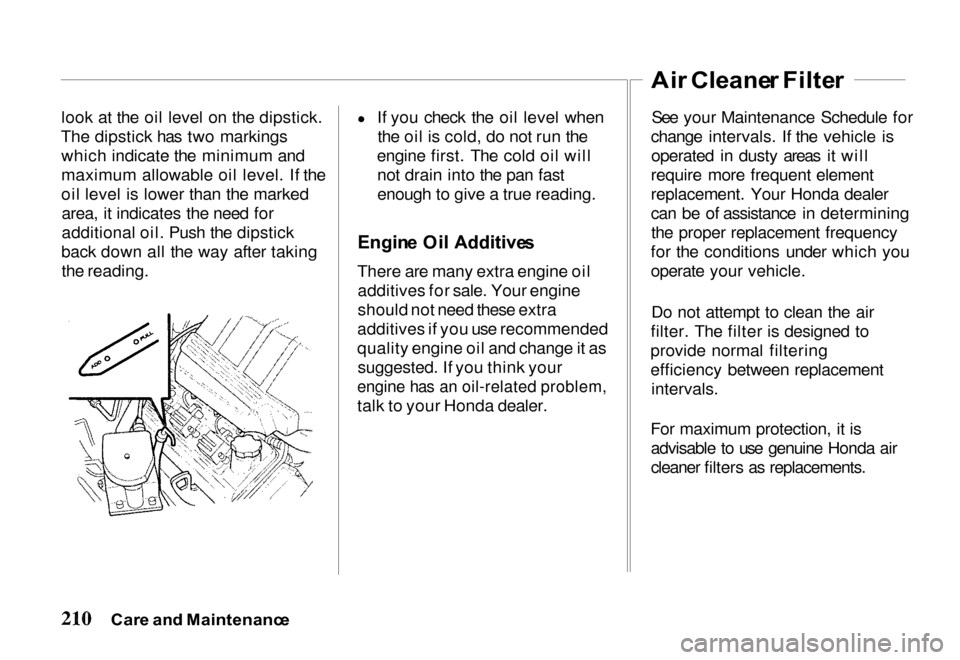
look at the oil level on the dipstick.
The dipstick has two markings which indicate the minimum and
maximum allowable oil level. If the
oil level is lower than the markedarea, it indicates the need for
additional oil. Push the dipstick
back down all the way after taking the reading. If you check the oil level when
the oil is cold, do not run the
engine first. The cold oil will not drain into the pan fast
enough to give a true reading.
Engin e Oi l Additive s
There are many extra engine oil additives for sale. Your engine
should not need these extra
additives if you use recommended
quality engine oil and change it as suggested. If you think your
engine has an oil-related problem,
talk to your Honda dealer. Ai
r Cleane r Filte r
See your Maintenance Schedule for
change intervals. If the vehicle is operated in dusty areas it will
require more frequent element
replacement. Your Honda dealer
can be of assistance in determining the proper replacement frequency
for the conditions under which you
operate your vehicle.
Do not attempt to clean the air
filter. The filter is designed to
provide normal filtering
efficiency between replacement intervals.
For maximum protection, it is advisable to use genuine Honda air
cleaner filters as replacements.
Car e an d Maintenanc e
Page 214 of 267
Never run the engine with the air
cleaner filter removed. If the
engine should backfire, it could
possibly cause an engine
compartment fire.
Be sure to reinstall the air cleaner
filter and assembly correctly. If it is installed incorrectly, engine
damage could result. Manua
l Transmissio n Flui d
See the Maintenance Schedule to
find out how often the lubricant
level should be checked.
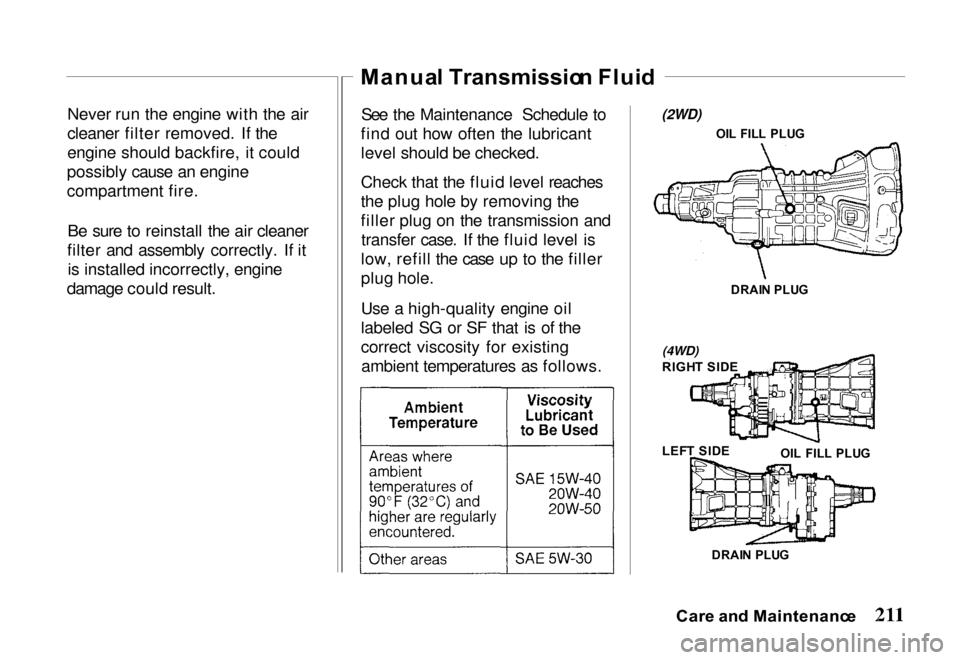
Check that the fluid level reaches
the plug hole by removing the
filler plug on the transmission and transfer case. If the fluid level is
low, refill the case up to the filler
plug hole.
Use a high-quality engine oil
labeled SG or SF that is of the
correct viscosity for existing ambient temperatures as follows.
(2WD)
OIL FIL L PLU G
DRAI N PLU G
DRAI N PLU G
Car e an d Maintenanc e
(4WD)
RIGH
T SID E
LEF T SID E
OIL FIL L PLU G
Page 216 of 267
The engine cooling system is
designed to maintain the engine at
the proper operating temperatures.
The cooling system was filled at the factory with a quality engine
coolant. The engine cooling system is designed to use coolant (a
mixture of water and ethylene glycol antifreeze) rather than plain
water. The engine coolant solutionshould be used year-round. It has
many advantages such as: provides freezing protection as
lowas — 33°F( — 36°C)
provides boiling protection up
to262°F(128°C)
protects against rust and
corrosion in the cooling system maintains the proper engine
temperature for efficient
operation and emission control
allows proper operation of the
engine coolant temperature gaugeSee the Maintenance Schedule in
this section to find out when the
engine coolant must be replaced.
Checkin g th e Coolan t Leve l
Check the engine coolant level at the interval shown in the
Maintenance Schedule unless there
is evidence of leaking or
overheating. The engine coolant
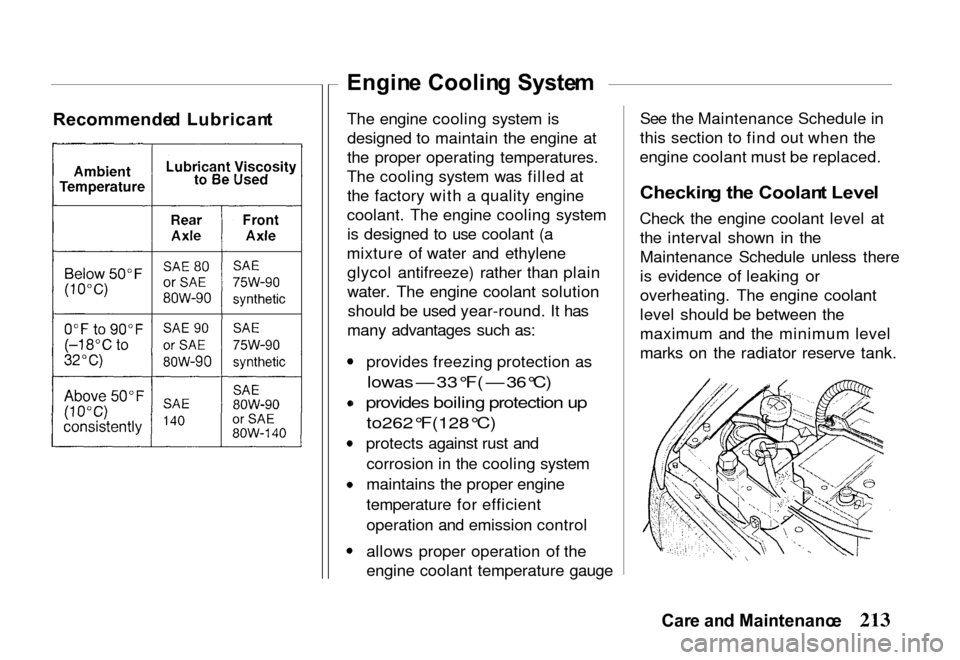
level should be between the
maximum and the minimum level
marks on the radiator reserve tank.
Car e an d Maintenanc e
Recommende
d Lubrican t
Engin
e Coolin g Syste m
Page 218 of 267
(—36°C) to ensure protection
against corrosion and loss of
engine coolant from boiling.
This should be done even if freezing temperatures are not
expected.
Add ethylene glycol-basedantifreeze when antifreeze has
to be added because of engine
coolant loss or if more
protection against freezing at
temperatures lower than —33 °F
(—36°C) is needed. Do not use
an alcohol-based or
methanol-based antifreeze, or
plain water. They boil at a
lower point, and do not provide corrosion protection.
Thermosta
t
The engine coolant temperature is
controlled by a thermostat, which stops engine coolant flow through
the radiator until a preset
temperature is reached. This
thermostat is installed in the
engine coolant inlet on the front of the engine block. The same
thermostat is used in both winter
and summer. Othe
r Require d
Maintenanc e
Brak e Maste r Cylinde r
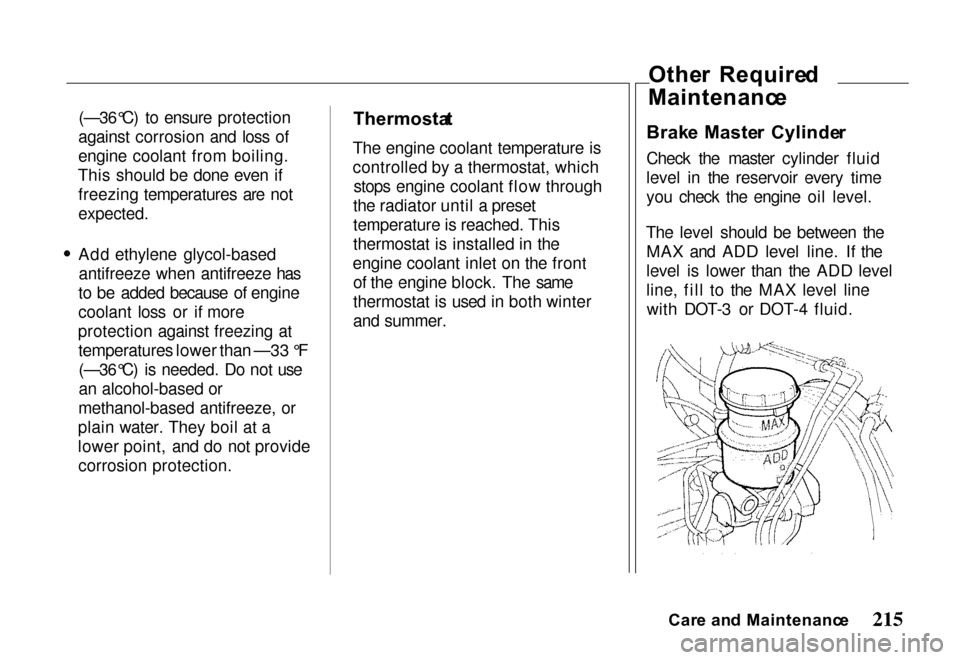
Check the master cylinder fluid
level in the reservoir every time
you check the engine oil level.
The level should be between the MAX and ADD level line. If the
level is lower than the ADD level
line, fill to the MAX level linewith DOT-3 or DOT-4 fluid.
Car e an d Maintenanc e
Page 220 of 267
Hoo
d Latc h an d Hinge s
Lubricate the hood latch assembly
and hood hinge assembly as
follows:
1. Wipe off any accumulatio n of
dirt o
r contamination on the
latch parts.
2. Apply multipurpose-type grease (NLGI No. 1 or 2) to
the hood latch pin cam.
3. Apply light engine oil to all pivot points in the release
mechanism.
4. Lubricate hood hinges with multipurpose-type grease
(NLGI No. 1 or 2).
5. Check the hood hinges and
latch mechanism to assure
they are working correctly.
Ai
r Conditionin g
Periodically have your Honda dealer check your air conditioning
system to be sure there has been
no loss in cooling output. See
your Honda dealer if you suspect
that the system is not performing
as it should.
Bod y Lubricatio n
Normal use of a vehicle causes
metal-to-metal movement at certain
points in the body. Noise, wear and improper operation at these points
will result when a protective film of lubricant is not provided.
For exposed surfaces such as door
checks, door lock bolts, lock striker plates, etc., apply a thin
film of light engine oil.
Any lubricant should be used
sparingly. After application, all excess lubricant should be
carefully wiped off.
The seat adjusters and seat track should be lubricated with water-
resistant EP chassis lubricant.
There are other points on the
vehicle body which may occasionally require lubrication.
Window regulators and controls are confined in the space between
the upholstery and the outside
door panel. Easy access to the
working parts may be made by
removing the trim. Door weatherstrips and rubber hood
bumpers should be lightly coatedwith a rubber lubricant.
Car e an d Maintenanc e
Page 254 of 267
Inde
x
ABS. See Anti-Lock Brake
System
Accessories, Installation .... 169
ACCESSORY
(Ignition Key Position) ...... 97
Accessory Power Outlets ..... 113
Adding AutomaticTransmission Fluid .... 212
Brake Fluid ............ 215
Clutch Fluid ............ 219
Engine Oil ............ 208
Manual Transmission Fluid .... 211
Power Steering Fluid ..... 219
Radiator Coolant ........ 214
Windshield Washer Fluid ..
194
Adjustments
Head
Restraints .......... 12
Mirrors
Exterior ............ 101Interior ............. 101
Power. ............. 101
Seat-Backs .......... 11,
89
Reclining the Rear ...... 93
Seats, Front ......... 10,
89
Steering Wheel ..... 15,
111
Adults, Protecting ........... 10
Airbags (SRS) ............. 7
Serious Risk to Children .... 19
Air Cleaner Filter ......
166, 210
Air Conditioning
Maintenance ........... 217
Usage ................. 116
Air Filter. See Air Cleaner Filter
Air Outlets (Vents) ......... 120
Air Pressure, Tires ......... 235
Alcohol and Driving ........ 4
Alcohol in Gasoline ........ 196
Alternator Belt. See Drive Belts
Antifreeze ................ 213
Anti-Lock Brake System
Indicator Lights .......... 65
Operation .............. 155
Anti-Theft Steering Column Lock ..... 98
System .................
..... 148
Appearance Care. See Cleaning
Ashtray .................. 112
Assist Grip ..............
111
Audio System ............. 121