tires HONDA PASSPORT 2000 2.G User Guide
[x] Cancel search | Manufacturer: HONDA, Model Year: 2000, Model line: PASSPORT, Model: HONDA PASSPORT 2000 2.GPages: 267, PDF Size: 3.03 MB
Page 168 of 267

Whee
l Replacemen t
Consideration s
Damaged wheels must be
replaced. For example, replace
wheels if they are bent, cracked or
heavily rusted, or if wheel nuts
often become loose. Also replace
wheels that leak air (except some
aluminum wheels that can be
repaired). See your Honda dealer.
Do not use bent wheels that have
been straightened, and do not use
tubes in leaking wheels designed
for tubeless tires. Such wheels
may have structural damage and
could fail without warning.
Maximum loads, maximum
inflation pressures, wheel
identification codes, and wheel
sizes are stamped on each wheel.
Service-tested and approved
wheels are available from your
Honda dealer.
When obtaining wheels for any
reason from any other source, the
replacement wheels should be
equal in load capacity, inflation
pressure capacity, diameter, width, offset and mounting configuration
to those originally installed on
your vehicle. A wheel of the
wrong size or type may adversely
affect load carrying capacity, wheel
and bearing life, brake cooling,
speedometer/odometer calibration,
stopping ability, headlight aim,
bumper height, vehicle ground clearance, and tire or tire chain
clearance to the body and chassis.
Replacement with used wheels is
not advised: They may have been subjected to harsh treatment or very high mileage and could fail
without warning.
Installing wheels and/or tires that
have a higher load carrying limit
than those that originally came on
your vehicle does not increase the
GAWR or GVWR of the vehicle.
Driving Tip s
Page 170 of 267

air cleaner, so it's important to
replace the air cleaner filter at
required intervals. See "Care and Maintenance." A dirty air cleaner
filter reduces engine performance
and can waste fuel.
Air Conditioning
Turn off the air conditioning whenit is not needed. The air
conditioning compressor is not on
in this position and the reduced
engine load can improve fuel
economy.
Tuned Engine
An engine that is properly
maintained will provide better
fuel economy than one that is not.
One misfiring spark plug will cut
fuel economy significantly, and
will make a difference in the
amount of pollution emitted from
your vehicle.
Excessive Weight
Fuel economy is related to thework the engine must do. The
heavier the load, the more fuel it takes to run your vehicle. Keep
weight to a minimum by removing
unnecessary luggage or cargo.
Tire Inflation
Underinflation not only causes
needless tire wear but can also
waste fuel. It's a good idea to
check tire pressure often and keep your tires inflated to the pressures
shown on the tire placard located
on the driver's doorjamb.
Wheel Alignment
Improper alignment will cause the
front tires to roll at an angle that
will result in faster tire wear. It takes power to overcome this
improper alignment, which, inturn, wastes fuel.
Use of 4-Wheel Drive
In normal driving, put the 4WD-2WD switch in the 2WD
position.
Driving Tip s
Page 173 of 267
systems, such as the SRS and
anti-lock brake system.
However, if electronic accessories
are improperly installed, or
exceed your vehicle's electrical
system capacity, they can interfere with the operation of your vehicle,
or even cause the airbags to
deploy.
Before installing any accessory: Make sure the accessory does
not obscure any lights, or interfere with proper vehicle
operation or performance. Be sure electronic accessories
do not overload electrical
circuits (see page 236). Have the installer contact your
Honda dealer for assistance
before installing any electronic
accessory.
If possible, have your dealer
inspect the final installation.
Modification s
Do not remove any original
equipment or modify your vehicle in any way that would alter its
design or operation. This could
make your vehicle unsafe and illegal to drive.
For example, do not make any modifications that would change
the ride height of your vehicle, or
install wheels and tires with a
different overall diameter.
Such modifications can adversely
affect handling, and interfere with
the operation of the vehicle's
anti-lock brakes and other
systems.
In addition, any modifications that
decrease ground clearance increase the chance of
undercarriage parts striking a
curb, speed bump, or other raised object, which could cause your
airbags to deploy.
Do not modify your steering wheel or any other part of your
Supplemental Restraint System.Modifications could make the
system ineffective.
Additiona l Safet y Precautio n
Do not attach or place objects on
the airbag covers. Any object
attached to, or placed on, the
covers marked "SRS," in the
center of the steering wheel and on top of the dashboard, could
interfere with the proper operation
of the airbags. Or, if the airbags
inflate, the objects could be
propelled inside the vehicle and hurt someone.
Drivin g Tip s
Page 180 of 267

Safet
y Chai n
Always use a suitable safety chain
between your vehicle and the
trailer.
Check with your trailer
manufacturer for the required
equipment. Cross the safety
chains under the hitch and attach
them to the trailer hitch hardware.
This will prevent the trailer from
dropping to the ground in the
event the hitch disengages. For
proper use and installation,
consult your trailer manufacturer.
Traile r Light s
Trailer lights and equipment must
comply with federal, state and local regulations. Check with your
local recreational vehicle dealer
for the requirements in your area. Use only equipment designed for
your vehicle.
Improper equipment or installation can cause damage to
your vehicle's electrical system and affect your vehicle warranty.
Consult your Honda dealer for installation.
Tire s
Always check the condition of
your vehicle's tires and trailer's
tires before operation. Replace
worn or damaged tires before
operation.
Inflate tire pressure to the
recommended cold tire pressure indicated in the tire
manufacturer's warranty booklet in the glove box packet.
Check the tire manufacturer's
requirements when replacement
tires are installed on your vehicle.
Trailer tire condition, size, load
rating, and proper inflation
pressure should be in accordance
with the tire manufacturer's
specifications. Improper tire size
and inflation can cause tire
failure, possibly resulting in
vehicle damage and personal
injury.
Traile r Brake s
Trailers with a total weight of
1,000 pounds or more require trailer brakes. If your trailer is
equipped with a braking system,
make sure it conforms to federal,state, and local equipment
regulations.
Driving Tip s
Page 223 of 267
Accelerato
r Peda l Linkag e
Lubricate the accelerator pedal
fulcrum pin with multipurpose
Whee l Alignmen t
Proper wheel alignment improves tire mileage. Your vehicle's
suspension parts should be
inspected often and aligned when
needed (see the "Technical Data" section). Improper alignment will
cause the front tires to roll at an angle that will result in faster tire
wear.
Proper tire balancing provides the
best riding comfort and helps
reduce tire tread wear. Out-of-balance tires can cause
annoying vibration and uneven
tire wear such as cupping and flat
spots.
Exterio
r
Washin g You r Vehicl e
The best way to preserve your vehicle's finish is to keep it clean by
frequent washings. Wash the vehicle
with lukewarm or cold water.
Do not use hot water or wash in direct sunlight. Do not use strong
soap or chemical detergents. All
cleaning agents should be promptly
flushed from the surface and not
allowed to dry on the finish.
Polishin g an d Waxin g
You r Vehicl e
Polishing is recommended to
remove accumulated residue and eliminate any "weathered"
appearance.
Your Honda dealer offers several
polishes and cleaners that have
proven to maintain the original finish appearance and durability. Protectio
n o f Exterio r
Brigh t Meta l Part s
Bright metal parts should be cleaned
regularly to keep their luster.
Washing with water is all that is
usually needed. However, chrome
polish may be used on chrome or stainless steel trim, if necessary. A
coating of wax, rubbed to a high
polish, is recommended for all bright metal parts.
Car e o f Aluminu m Wheel s
Aluminum wheels have a clear-coat finish similar to paint.
Use a chamois skin, sponge or
other soft material when washing
the wheels.
Foreig n Materia l Deposit s
Calcium chloride and other salts, ice melting agents, road oil and
tar, tree sap, bird droppings,
Car e an d Maintenanc e
Page 247 of 267
Warrant
y Coverage s
Your new Honda is covered by
these warranties:
New Vehicle Limited Warranty —
Covers your new vehicle, except
for the battery, emissions control systems and accessories, against
defects in materials and
workmanship.
Emission Control Systems
Defects Warranty and Emissions
Performance Warranty — These
two warranties cover your
vehicle's emission control systems. Time, mileage, and
coverage are conditional. Please
read the warranty manual forexact information.
Original Equipment Battery
Limited Warranty — This warranty gives up to 100% credit
toward a replacement battery.
Seat Belt Limited Warranty —
A seat belt that fails to function
properly is covered for the useful
life of the vehicle.
Rust Perforation Limited Warranty — All exterior body
panels are covered for rust-through from the inside for the specified
time period with no mileage limit.
Accessory Limited Warranty —
Genuine Honda Accessories are
covered under this warranty. Timeand mileage limits depend on the
type of accessory and other
factors. Please read your warranty
manual for details.
Replacement Parts Limited
Warranty — Covers all Genuine
Honda replacement parts against
defects in materials and
workmanship.
Replacement Battery Limited
Warranty — Provides prorated
coverage for a replacement
battery purchased from a Honda
dealer.
Replacement Muffler Lifetime
Limited Warranty — Provides
coverage for as long as the
purchaser of the muffler ownsthe vehicle.
Restrictions and exclusions apply to all these warranties. Please read
the 2000 Honda Warranty booklet
that came with your vehicle for
precise information on warranty coverages. Your Honda's original
tires are covered by theirmanufacturer. Tire warranty
information is in a separate
booklet.
Owne r Assistanc e
Page 250 of 267
Exhaust Gas Recirculation (EGR)
System
The Exhaust Gas Recirculation(EGR) system takes some of the
exhaust gas and routes it back into
the intake manifold. Adding
exhaust gas to the air/fuel mixture
reduces the amount of NOx
produced when the fuel is burned.
Three-Way Catalytic Converter
The Three-Way Catalytic
Converter is in the exhaust system. Through chemical
reactions, it converts HC, CO, and
NOx in the engine's exhaust to
carbon dioxide (CO 2), dinitrogen
(N 2), and water vapor.
Replacement Parts
The emissions control systems aredesigned and certified to work
together in reducing emissions to
levels that comply with the Clean Air Act. To make sure the
emissions remain low, you should use only new Genuine Honda
replacement parts or their
equivalent for repairs. Using lower quality parts may increasethe emissions from your vehicle.
The emissions control systems are
covered by warranties separate
from the rest of your vehicle.
Read your warranty manual for more information.
DO
T Tir e
Qualit y Gradin g
The tires on your vehicle meet all U.S. Federal Safety
Requirements. All tires are also
graded for treadwear, traction, and
temperature performanceaccording to Department of
Transportation (DOT) standards.
The following explains these
gradings.
Unifor m Tir e Qualit y
Gradin g
Quality grades can be found
where applicable on the tire
sidewall between the tread
shoulder and the maximum
section width. For example:
Treadwea r 20 0
Tractio n A A
Temperatur e A
Owne r Assistanc e
Page 251 of 267
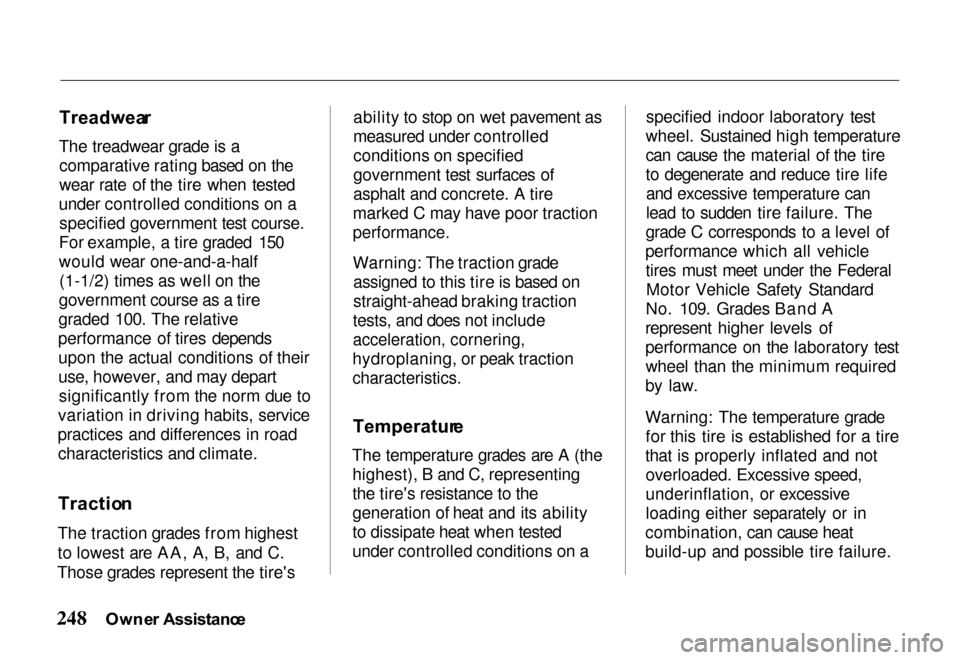
Treadwea
r
The treadwear grade is a comparative rating based on the
wear rate of the tire when tested
under controlled conditions on a specified government test course.
For example, a tire graded 150
would wear one-and-a-half (1-1/2) times as well on the
government course as a tire
graded 100. The relative
performance of tires depends upon the actual conditions of their
use, however, and may departsignificantly from the norm due to
variation in driving habits, service
practices and differences in road characteristics and climate.
Tractio n
The traction grades from highest
to lowest are AA, A, B, and C.
Those grades represent the tire's ability to stop on wet pavement as
measured under controlled
conditions on specified
government test surfaces of
asphalt and concrete. A tire
marked C may have poor traction
performance.
Warning: The traction grade assigned to this tire is based on
straight-ahead braking traction
tests, and does not include
acceleration, cornering,
hydroplaning, or peak traction
characteristics.
Temperatur e
The temperature grades are A (the highest), B and C, representing
the tire's resistance to the
generation of heat and its ability
to dissipate heat when tested
under controlled conditions on a specified indoor laboratory test
wheel. Sustained high temperature
can cause the material of the tire
to degenerate and reduce tire life and excessive temperature can
lead to sudden tire failure. The
grade C corresponds to a level of
performance which all vehicle tires must meet under the FederalMotor Vehicle Safety Standard
No. 109. Grades Band A
represent higher levels of
performance on the laboratory test wheel than the minimum required
by law.
Warning: The temperature grade for this tire is established for a tire
that is properly inflated and not overloaded. Excessive speed,
underinflation, or excessive
loading either separately or in
combination, can cause heat
build-up and possible tire failure.
Owne r Assistanc e
Page 254 of 267
Inde
x
ABS. See Anti-Lock Brake
System
Accessories, Installation .... 169
ACCESSORY
(Ignition Key Position) ...... 97
Accessory Power Outlets ..... 113
Adding AutomaticTransmission Fluid .... 212
Brake Fluid ............ 215
Clutch Fluid ............ 219
Engine Oil ............ 208
Manual Transmission Fluid .... 211
Power Steering Fluid ..... 219
Radiator Coolant ........ 214
Windshield Washer Fluid ..
194
Adjustments
Head
Restraints .......... 12
Mirrors
Exterior ............ 101Interior ............. 101
Power. ............. 101
Seat-Backs .......... 11,
89
Reclining the Rear ...... 93
Seats, Front ......... 10,
89
Steering Wheel ..... 15,
111
Adults, Protecting ........... 10
Airbags (SRS) ............. 7
Serious Risk to Children .... 19
Air Cleaner Filter ......
166, 210
Air Conditioning
Maintenance ........... 217
Usage ................. 116
Air Filter. See Air Cleaner Filter
Air Outlets (Vents) ......... 120
Air Pressure, Tires ......... 235
Alcohol and Driving ........ 4
Alcohol in Gasoline ........ 196
Alternator Belt. See Drive Belts
Antifreeze ................ 213
Anti-Lock Brake System
Indicator Lights .......... 65
Operation .............. 155
Anti-Theft Steering Column Lock ..... 98
System .................
..... 148
Appearance Care. See Cleaning
Ashtray .................. 112
Assist Grip ..............
111
Audio System ............. 121
Page 263 of 267
Protecting Children .......... 18
AdditionalSafety Precautions ........ 21
All Children Must Be Restrained ...... 18
Children Should Sit in the Back Seat ....... 19
General Guidelines for Using Child Seats ........ 21
If a Child Requires Close Attention .......... 20
If You Must Drive With Several Children .... 20
Passenger's Airbag Poses
Serious Risks to Children .. 19
Protecting Infants ......... 25
Protecting Larger Children . 33
Protecting Small Children . . 29
Using Child Seats With Tethers ............ 36 Radiator Overheating ....... 186
Radio/Cassette Sound System ........... 121
Radio/Cassette/CD Sound System ........... 129
Rear End Towing .......... 189
Rear Lights, Bulb Replacement ........ 239
Rear Seat, Folding .......... 91
Rear View Mirror .......... 101 Rear Window Defogger ...... 72
Rear Window Wiper and Washer ............... 72
Reclining the Seat-Backs Front .............. 11, 89
Rear .................. 93
Recommended Shift Speeds . . 82 Reduced Power Indicator .... 62
Replacement Information Air Cleaner Element ..... 210
Coolant .......... 200, 214
Engine Oi
l and Filter ..... 207
Fuses ................. 236
Light Bulbs ............ 239 Schedule .............. 200
Spark Plugs ............ 231
Tires .................. 162
Replacing Seat Belts After a Crash ............ 40
Reporting Safety Defects .... 245
Reserve Tank, Coolant ...... 213
Restraint, Child ............ 18
Reverse Gear Position ...... 75
Rotation, Tire ............. 162
Rust Protection ............ 221