tow HONDA PASSPORT 2000 2.G User Guide
[x] Cancel search | Manufacturer: HONDA, Model Year: 2000, Model line: PASSPORT, Model: HONDA PASSPORT 2000 2.GPages: 267, PDF Size: 3.03 MB
Page 171 of 267
Three-Wa
y Catalyti c Converte r
The three-way catalytic converter is an emissions control device
added to the exhaust system to
reduce exhaust gas pollutants. The
converter contains a ceramic material coated with noble metal
catalysts. To prevent contamination
of the catalysts, unleaded gasoline must be used. Unleaded gasoline
also reduces combustion chamber
deposits and exhaust system
corrosion.
The three-way catalytic converter requires the use of unleaded
gasoline. Use of leaded gasolinewill cause the converter to lose its
effectiveness.
T o Hel p Preven t Damag e
1. Keep your engine properly maintained. Engine
malfunctions involving the electrical, electronic fuel
injection or ignition systems
may result in unusually high
converter and exhaust system
temperatures. Do not keep
driving your vehicle if you
detect engine misfire,
noticeable loss of performance, or other unusual operating
conditions. Have it serviced
promptly. A properly
maintained engine willminimize malfunctions that
could damage the converter. It
will also help provide good
emissions control and fuel economy. (See theMaintenance Schedule on page
200 for information on inspecting and maintaining the
engine, exhaust system and
other components.) 2. Do not push or tow your
vehicle to start it. This could
damage the converter.
3. Do not park your vehicle over high grass, dry leaves or othercombustible materials. The
catalytic converter gets very
hot and could set fire to these materials.
Drivin g Tip s
Page 174 of 267
Carryin
g Carg o
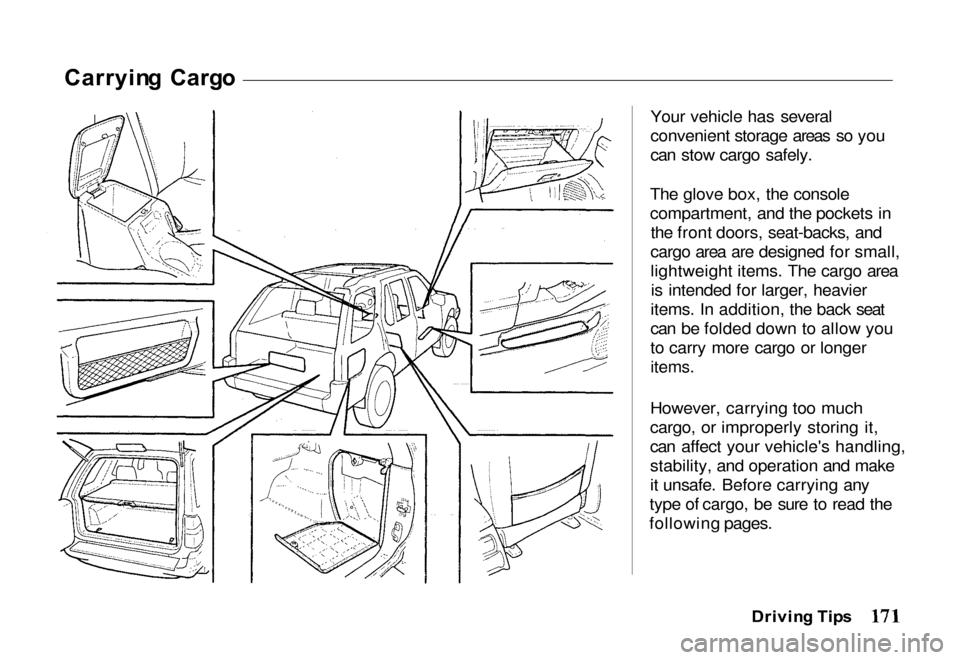
Your vehicle has several
convenient storage areas so you
can stow cargo safely.
The glove box, the console
compartment, and the pockets in the front doors, seat-backs, and
cargo area are designed for small,
lightweight items. The cargo area is intended for larger, heavier
items. In addition, the back seat
can be folded down to allow you
to carry more cargo or longer
items.
However, carrying too much
cargo, or improperly storing it,
can affect your vehicle's handling,
stability, and operation and make
it unsafe. Before carrying any
type of cargo, be sure to read the
following pages.
Drivin g Tip s
Page 175 of 267
Loa
d Limi t
The maximum load for your
vehicle is:
LX2WD
manual trans:
automatic trans:
LX4WD
manual trans:
automatic trans:
EX
manual trans:automatic trans:
895 Ib (407 kg)
840
Ib
(382
kg)
905
Ib
(411
kg) 850 Ib (386 kg)
930 Ib (423 kg) 875 Ib (398 kg)
This figure includes the total weight
of all occupants, cargo, accessories,
and the tongue weight if you are
towing a trailer. To figure out how much cargo
you can carry: Add up the weight of all
occupants.
If you are towing a trailer, add
the tongue weight to the
number above. Subtract the total from the
maximum load figure.
The final number is the total weight of cargo you can carry.
Drivin g Tip s
Overloading o
r improper
loading can affect handling
and stability and cause a
crash in which you can be hurt or killed.
Follow all load limits and
other loading guidelines in
this manual.
Page 177 of 267
Traile
r Towin g
Your Honda vehicle is designed
for passenger and cargo transportation. With the proper
equipment installed, your vehicle
can also tow a trailer under certain
conditions, as detailed in this section. Be sure to read this entire
section and follow all
requirements.
Towing a trailer will have an
effect on handling, performance,
braking, durability and fuel
consumption.
Honda recommends that you do
not tow a trailer with a new Honda vehicle or one with a new
powertrain component (engine, transmission, differential) for the
first 500 miles. For your safety and the safety
of others, use equipment
specifically designed for your
vehicle. Improper towing
equipment and improper installation of same can cause
damage to your vehicle and may also result in personal injury.
Additional care and cautious
driving habits are essential to trailer towing.
Do not exceed 45 mph or the
posted towing speed limit, whichever is lower. Higher speed
may cause loss of vehicle control.
Drivin g Tip s
Improperly loading your
vehicle and trailer can seriously affect the steering
and braking performance,
causing a crash in which you
can be seriously injured.
Check the loading of your
vehicle and trailer carefully before starting to drive.
Page 178 of 267
Follow the recommendations in
this manual and ask your Honda
dealer for further details before
you tow a trailer with your
Passport.
Towing a trailer affects vehicle
maintenance requirements due
to the additional load. More
frequent maintenance intervals
will be required to assure
continued satisfaction with
your vehicle. Consult yourHonda dealer for recommended
maintenance and service.
The gross trailer weight (trailer weight plus cargo load) must
never exceed 4,500 Ib.
Additional equipment will be
required, depending on the specific model/load combination.
See "Trailer Hitches" in this
section.
Exceeding the weight limit will
cause damage to your vehicle and
possibly result in personal injury. The Gross Vehicle Weight
Rating (GVWR) is the
combined weight of the
unloaded vehicle, passengers,
cargo, trailer hitch, trailer
tongue load, and optional
equipment. This value is indicated on the F.M.V.S.S.
Certification Label on the
driver's doorjamb. The Gross Combined Weight
Rating (GCWR) equals the combined weight of your
vehicle (including passengers
and cargo) plus the total trailer
load. The following limits
apply.
2WD: 8,700 Ib
4WD: 8,950 Ib
The Gross Axle Weight Rating
(GAWR) is also indicated on
the Certification Label. The
load on either the front or rear
axle resulting from distribution
of the gross vehicle weight on both axles must not exceed the
values listed. Remember to
account for additional
equipment and tongue load.
Driving Tip s
Page 179 of 267
Tongue load should be between
9 percent and 11 percent of the
total trailer weight. However, itshould never exceed 450 pounds. Never load a trailer with more
weight in the rear than in the
front. The front should be
loaded with approximately
60 percent and the rear with
approximately 40 percent of
the total trailer load. Never exceed the maximum
weight limits of the trailer
or trailer towing equipment.
Improper loading can result in damage to your vehicle and
possible personal injury. Check the vehicle and trailer
loading and the weights on
each axle at a commercial scale
or a highway patrol office
equipped with a scale.
Traile
r Hitche s
A Class 3 hitch kit (up to 4,500 Ib) is available from your
Honda dealer.
Use a trailer equipped with
electric brakes and a "Weight
Distributing Hitch Attachment" when the gross trailer weight
exceeds 3,500 pounds.
A special attachment that replaces the draw bar/ball assembly is used
to distribute the proper weight to
the front axle. It uses a pair ofspring bars that are adjusted to
accomplish the distribution of the weight.
Consult your trailer's
manufacturer for assistance withselecting the proper weight
distributing hitch attachment. Check with a recreational vehicle
dealer for additional required
equipment. Have this equipment installed by a trained mechanic.
Improper equipment or installation
can damage your vehicle and cause
personal injury.
Do not use axle-mounted hitches
or equipment not designed for
your vehicle.
Do not make any modifications to
the vehicle's exhaust, braking, or
electrical system other than those
that are shown in the instructions
for the Honda Trailer Hitch Kit.
Improper modifications can affect
vehicle durability.
Periodic inspection of all added-on trailer towing equipment is
necessary to assure continued safe
operation.
Drivin g Tip s
Page 181 of 267
There are no provisions in your
vehicle to tap into its hydraulic
braking system. Any attempt toattach the trailer's brakes to your
vehicle's hydraulic braking system, no matter how successfulit may seem, will lower braking
effectiveness and create a
potential hazard.
Equipmen t Chec k
Before operating your vehicle,
check all safety equipment to
ensure safe operation. Be sure
your vehicle is properly serviced
to avoid mechanical failure.
Check that your vehicle remains
level when the loaded or unloadedtrailer is hitched. Do not drive if
the rear end of your vehicle is abnormally higher or lower.
Check for proper tongue weight,
overload, improper weight
distribution, worn suspension, or
other possible causes.
Make sure the trailer load is
properly positione
d and secured
so its does not shift around whil
e
driving.
Chec k
if your rearview mirrors
comply with federal, state and
local regulations. If not, confirm
the proper mirrors required for
towing and have them installed.
Perform an equipment check of
all braking, lighting and safety
equipment to ensure they are working properly.
Your safety depends on proper
operation and installation of
equipment. Never operate a
vehicle with faulty equipment.
Limite
d Sli p Differentia l
Standard on 4WD models
The limited slip differential is
designed to improve traction by limiting wheelspin. If one rear
wheel begins to spin on a slipperysurface, the limited slip
differential will automatically
transmit driving force to the other
rear wheel.
Drivin g Tip s
Page 182 of 267
I
n Cas e o f Emergenc y
This section covers the most
common problems that motorists
experience with their vehicles. It
gives you information on how tosafely evaluate those problems,
with tips to help get you going
again. Lastly, it tells you how to
have your vehicle towed. Jump Starting ............ 180
Changing a Tire .......... 182 Lifting Points .......... 183
Tool Locations ........... 184
Engine Overheating ....... 186
Towing ................ 187 Precautions ........... 187
Towing Tips ........... 188
All Four Wheelson the Ground ...... 188
Front Wheels off the Ground ...... 188
Rear Wheels off the Ground ...... 189
Inoperative Electrical Devices. ............... 189
In Cas e o f Emergenc y
Page 183 of 267
Jum
p Startin g
Do not push or tow your vehicle to start it. Under some conditions
this may damage the three-way catalytic converter or other parts
of the vehicle.
If your vehicle has a discharged
battery, it can be started by using the battery in another vehicle; a
procedure called "jump starting." To jump start your vehicle:
1. Position the vehicle with the good (charged) battery so that
the jump-starting cables will
reach. Do not allow the vehiclesto touch. Check to see that the
bumpers do not touch.
2. Turn off all electric motors and accessories in both
vehicles. Turn off all lights
except hazard flashers and
lights needed to light up the
work area. Turn off theignition, apply the parking
brake firmly, and shift an automatic transmission to
"P" (Park) and a manual
transmission to "N" (Neutral)
in both vehicles.
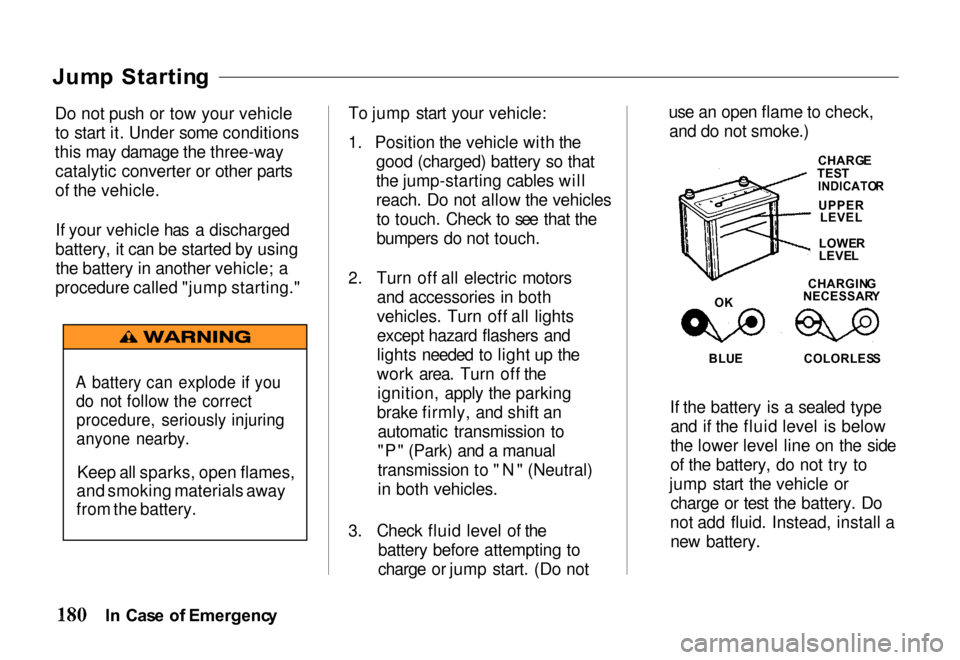
3. Check fluid level of the battery before attempting to
charge or jump start. (Do not use an open flame to check,
and do not smoke.)CHARG ETEST
INDICATO R
BLUE
COLORLES S
If the battery is a sealed type
and if the fluid level is below
the lower level line on the side
of the battery, do not try to
jump start the vehicle or charge or test the battery. Do
not add fluid. Instead, install a new battery.
I n Cas e o f Emergenc y
A battery can explode if you
do not follow the correct
procedure, seriously injuring
anyone nearby.
Keep all sparks, open flames,
and smoking materials away
from the battery.
CHARGIN G
NECESSAR Y
LOWE
R
LEVE L
O K
UPPERLEVEL
Page 185 of 267
6. Start the engine of the vehicle
that has the discharged battery.
7. Remove the battery cables by reversing the above sequence
exactly. Start by removing thelast clamp first; that is,
remove the jumper cable from
the engine of the vehicle with
the discharged battery as the first step. Changin
g a Tir e
If you have a flat tire while driving, stop in a safe place to
change it. Stopping in traffic or on
the shoulder of a busy road is
dangerous. Drive slowly along the shoulder until you get to an exit or
an area to stop that is far away
from the traffic lanes. 1. Park on a level surface and set
the parking brake firmly. Turn
on the hazard warning flasher, and turn the ignition switch to
LOCK.
2. Set the automatic transmission in "Park" (the manual
transmission in "Reverse")
and transfer case in gear if it is a four-wheel drive vehicle.
3. Have your passengers get out
of th
e vehicle.
4. Remove the jacking tools (see page 184) and spare tire from
their stowage areas.
I n Cas e o f Emergenc y
The vehicle can easily roll off
the jack, seriously injuring
anyone underneath.
Follow the directions for
changing a tire exactly, and never get under the vehicle
when it is supported only by
the jack.