transmission HONDA PASSPORT 2000 2.G Owner's Manual
[x] Cancel search | Manufacturer: HONDA, Model Year: 2000, Model line: PASSPORT, Model: HONDA PASSPORT 2000 2.GPages: 267, PDF Size: 3.03 MB
Page 156 of 267

switch is turned to the "ON"
or "START" position.
5. Check all gauges (including
the fuel gauge).
6. Release the parking brake
(and make sure the "BRAKE"
light turns off).
See related topics in this manual if
you find any problems.
Startin g th e Engin e
1. Apply the parking brake.
2. Manual Transmission: Press
the clutc
h pedal to the floor
and shift the transmission to
the Neutral position. Hold the
clutch pedal to the floor while
you are starting the engine. A starter safety switch keeps the
starter from operating if the
clutch pedal is not fully
depressed.
Automatic Transmission:
Place the shift lever in "P"
or "N" position ("P" is
preferred). A starter safety switch prevents the starter
from operating if the shift lever is in any drive position.
If it is necessary to restart the
engine with the vehicle
moving, place the shift lever in "N" (never in "P").
3. Do not touch the accelerator pedal. Start the engine byturning the ignition switch to
"START."
If the engine does not start in 10 seconds, wait 15 seconds to let
the starter cool down. Then crank
the engine at wide open throttle
for a maximum of 10 seconds. If
the engine still does not start, wait
another 15 seconds and repeat the
entire procedure. Do not crank the engine for more
than 10 seconds at a time. Wait 15
seconds before trying again.
4. Return the ignition switch to
the "ON" position as soon as
the engine starts.
5. Apply the regular brakes and shift into the proper gear.
Release the parking brake and
brake pedal and drive off.
In models with an automatic
transmission, you cannot shift
from "P" (Park) position to any other position unless the
brake pedal is applied.
Driving Tip s
Page 157 of 267
Ne
w Vehicl e Break-I n
You may drive your new vehicle
from its very first mile/kilometer without following a formal
"break-in" schedule. However,
there are things you can do during
the first few hundred miles/
kilometers of driving that will add
to the future performance and
economy of your vehicle.
It is recommended that your speed
during the first 500 miles (800
kilometers) be limited to a
maximum of 55 mph (90 km/h) and that you do not drive for long
periods at any one constant speed, either fast or slow. During this
period, avoid full-throttle starts and, if possible, avoid hard stops;
especially during the first 200
miles (320 kilometers) of driving.
Always drive at moderate speed
until the engine has completely warmed up.
Parkin
g
When leaving your vehicle
unattended:
Set the parking brake.
Place the shift lever in "P" (Park) position for automatic
transmission.
When parking a vehicle equipped
with a manual transmission on an
upward slope, or on a level surface, place the shift lever in
the "1st" position.
When parking a vehicle
equipped with a manual
transmission on a downward slope, place the shift lever in
the "R" (Reverse) position. Turn the key to the "LOCK"
position.
Remove the key. The beeper
will remind you. Close all windows and lock all
doors.
Check to make certain the
lights are turned off. The
beeper will remind you. If your vehicle is equipped with
a transfer case (4WD), make
sure the shift lever is in 4H or
4L.
Parkin g Tip s
Never drive the vehicle with
the parking brake set. This can
overheat the rear brakes,
reducing their effectiveness and
causing excessive wear or
damage.
Always apply the parking brake
whenever you leave the vehicle,
whether it is equipped with a
manual or automatic transmission.
Drivin g Tip s
Page 158 of 267
If your vehicle is equipped with
an automatic transmission, set
the parking brake before you
leave the driver's seat. If the
vehicle is parked on a grade and the transmission shift leveris placed in "P" (Park) position
before you set the parking
brake, the weight of the vehicle may exert so much force on the
transmission that you may have
difficulty moving the shift
lever out of "P" (Park)
position. To prevent this, apply the parking brake BEFORE
moving the shift lever to "P" (Park). When you want to drive
away, move the shift lever out
of the "P" (Park) position
BEFORE releasing the parking
brake. It is good driving
practice to set the parking
brake first, then place the
transmission in "PARK"
position, even on level
surfaces.
If the parking brake does not
seem to hold the vehicle as
well as before, have the vehicle
serviced by your Honda dealer.
Do not park your vehicle over
high grass, dry leaves or other
combustible materials. The
catalytic converter gets very
hot and could set fire to these
materials.
Anti-Loc
k Brake s
Your vehicle has an Anti-lock
Brake System (ABS) as standard
equipment. ABS helps to prevent
the wheels from locking up and skidding during hard braking,
allowing you to retain steering
control.
When the front tires skid, you lose steering control; the vehicle
continues straight ahead even
though you turn the steering
wheel. The ABS helps to prevent
lock-up and retain steering control
by pumping the brakes rapidly;
much faster than a person can do it.
Yo u shoul d neve r pum p th e
brak e pedal , this defeats the
purpose of the ABS. Let the ABS work for you by always keeping
firm, steady pressure on the brake
pedal as you steer away from the
Driving Tip s
Brake
s
Page 161 of 267
Self-Adjustin
g Brake s
The brakes on this vehicle are self-adjusting. They have been
designed so that periodic brake
adjustment is not needed.
The brakes adjust themselves each time you firmly apply them.
Thus, if the brake pedal goes down
farther than normal due to a lack of adjustment, drive backward and
forward a few times. Apply the
brakes intermittently.
See your Honda dealer if the
brake pedal height does not return
to normal or if there is a rapidincrease in pedal travel. Either is a
sign of other brake trouble. Also,
see your Honda dealer if the
parking brake needs adjustment.
Brakin
g Tip s
Control your vehicle's speed on a steep or long downhill grade by
shifting the transmission to a
lower gear. Constantly using the
brakes can cause them to overheat
and lose effectiveness.
Resting your foot on the brake
pedal when you are not intending to brake ("riding the brakes") can
cause them to overheat. This
reduces their effectiveness, wears them out faster, and can reduce
fuel mileage. It also causes your
brake lights to stay on all the time, confusing drivers behind you.
Brak e Wea r Indicator s
The front and rear brakes have built-in wear indicators. These make a high-pitched squealing or
cricket-like warning sound when the brake pads or linings are worn
to the point of replacement. Thesound may come and go or be
heard all the time when the vehicle is moving, but may stop when the
brake pedal is pushed down firmly.
Expensive damage can result if
pads or linings are not replaced immediately when needed.
Drivin g o n Slipper y Surface s
Driving, steering, and braking
traction are reduced when the
road is coated with water, snow, ice, gravel, or other materials.
Slow down and adjust your
driving to such conditions. It is important to slow down when it is
slippery because stopping
Drivin g Tip s
Page 177 of 267
Traile
r Towin g
Your Honda vehicle is designed
for passenger and cargo transportation. With the proper
equipment installed, your vehicle
can also tow a trailer under certain
conditions, as detailed in this section. Be sure to read this entire
section and follow all
requirements.
Towing a trailer will have an
effect on handling, performance,
braking, durability and fuel
consumption.
Honda recommends that you do
not tow a trailer with a new Honda vehicle or one with a new
powertrain component (engine, transmission, differential) for the
first 500 miles. For your safety and the safety
of others, use equipment
specifically designed for your
vehicle. Improper towing
equipment and improper installation of same can cause
damage to your vehicle and may also result in personal injury.
Additional care and cautious
driving habits are essential to trailer towing.
Do not exceed 45 mph or the
posted towing speed limit, whichever is lower. Higher speed
may cause loss of vehicle control.
Drivin g Tip s
Improperly loading your
vehicle and trailer can seriously affect the steering
and braking performance,
causing a crash in which you
can be seriously injured.
Check the loading of your
vehicle and trailer carefully before starting to drive.
Page 183 of 267
Jum
p Startin g
Do not push or tow your vehicle to start it. Under some conditions
this may damage the three-way catalytic converter or other parts
of the vehicle.
If your vehicle has a discharged
battery, it can be started by using the battery in another vehicle; a
procedure called "jump starting." To jump start your vehicle:
1. Position the vehicle with the good (charged) battery so that
the jump-starting cables will
reach. Do not allow the vehiclesto touch. Check to see that the
bumpers do not touch.
2. Turn off all electric motors and accessories in both
vehicles. Turn off all lights
except hazard flashers and
lights needed to light up the
work area. Turn off theignition, apply the parking
brake firmly, and shift an automatic transmission to
"P" (Park) and a manual
transmission to "N" (Neutral)
in both vehicles.
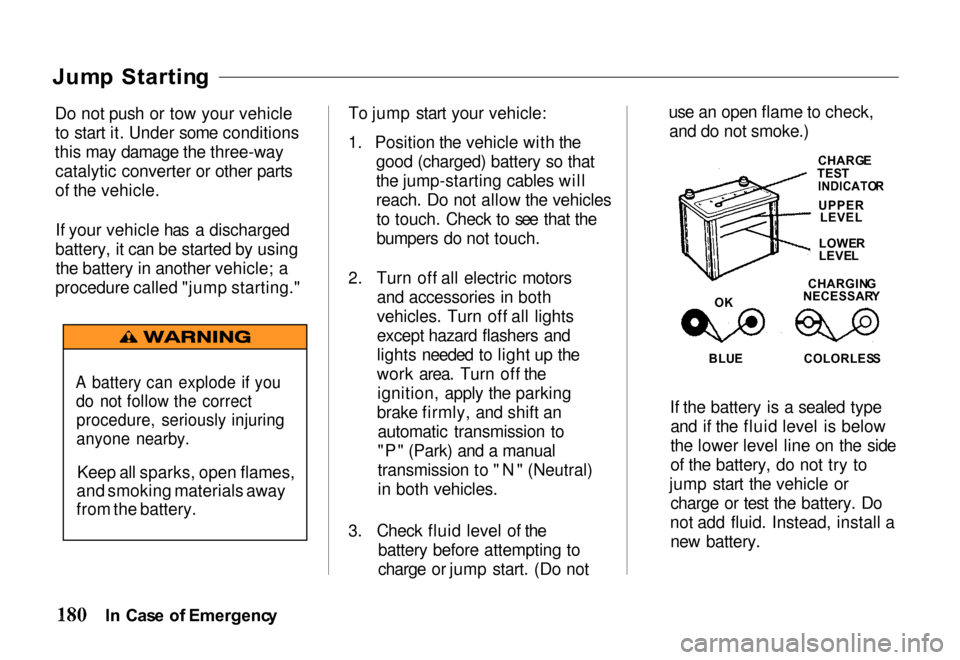
3. Check fluid level of the battery before attempting to
charge or jump start. (Do not use an open flame to check,
and do not smoke.)CHARG ETEST
INDICATO R
BLUE
COLORLES S
If the battery is a sealed type
and if the fluid level is below
the lower level line on the side
of the battery, do not try to
jump start the vehicle or charge or test the battery. Do
not add fluid. Instead, install a new battery.
I n Cas e o f Emergenc y
A battery can explode if you
do not follow the correct
procedure, seriously injuring
anyone nearby.
Keep all sparks, open flames,
and smoking materials away
from the battery.
CHARGIN G
NECESSAR Y
LOWE
R
LEVE L
O K
UPPERLEVEL
Page 185 of 267
6. Start the engine of the vehicle
that has the discharged battery.
7. Remove the battery cables by reversing the above sequence
exactly. Start by removing thelast clamp first; that is,
remove the jumper cable from
the engine of the vehicle with
the discharged battery as the first step. Changin
g a Tir e
If you have a flat tire while driving, stop in a safe place to
change it. Stopping in traffic or on
the shoulder of a busy road is
dangerous. Drive slowly along the shoulder until you get to an exit or
an area to stop that is far away
from the traffic lanes. 1. Park on a level surface and set
the parking brake firmly. Turn
on the hazard warning flasher, and turn the ignition switch to
LOCK.
2. Set the automatic transmission in "Park" (the manual
transmission in "Reverse")
and transfer case in gear if it is a four-wheel drive vehicle.
3. Have your passengers get out
of th
e vehicle.
4. Remove the jacking tools (see page 184) and spare tire from
their stowage areas.
I n Cas e o f Emergenc y
The vehicle can easily roll off
the jack, seriously injuring
anyone underneath.
Follow the directions for
changing a tire exactly, and never get under the vehicle
when it is supported only by
the jack.
Page 190 of 267
find a leak, it must be repaired
before you can continue
driving. (See
Towing on page
187.)
If you don't find an obvious leak, check the coolant level inthe radiator reserve tank. If the
level is below the MIN mark, add
coolant to halfway between the
MIN and MAX marks.
If there was no coolant in the
reserve tank, you may also
have to add coolant to the
radiator.
Let the engine cool down until
the pointer reaches the middle
of the temperature gauge, orlower, before checking the
radiator. If needed, add coolant to the
radiator to bring the level up to the filler neck, and to the
reservoir up to the level indicated on the reservoir tank. Proper equipment must be used to
prevent damage to vehicles during
any towing. State and local laws
that apply to vehicles in tow must
be followed. Get detailed towing
instructions from your Honda
dealer.
Should it become necessary to
tow your vehicle, follow these
directions.
Precaution s
Before towing, make sure that
the power train, axle,
transmission, wheels and steering system are in good
condition.
If any of these items are
damaged, a flatbed trailer must
be used.
In Cas e o f Emergenc y
Towin
g
Removing the radiator cap
while the engine is hot can
cause the coolant to spray out, seriously scalding you.
Always let the engine andradiator cool down before
removing the radiator cap.
Page 191 of 267
Use only towing equipment
specifically designed for this
purpose, following the instructions of the equipment
manufacturer. A separate safety
chain system must be used.
For such towing, the parking
brake must be released, thetransmission must be in neutraland the key switch turned to
the "OFF" position (not
"LOCK").
Towing attachments must be made to main structural
members of the vehicle. Do not attach to bumpers or associated
brackets.
Remember that the power brake assist will not beavailable when the engine is
inoperative.
Towin
g Tip s
All Four Wheels on the Ground
1. Transfer case in 2H (4WD model only).
2. Transmission in Neutral
position.
3. Maximum speed 30 mph (50 km/h).
4. Maximum distance 50 miles (80 kilometers).
If you are towing the vehicle at distances and speeds greater thanshown, disconnect the propeller
shaft from the rear axle carrier.
On 4WD models, also disconnect
the front propeller shaft. Safely
secure the propeller shafts so they
will not fall and scrape the
ground.
Front Wheels off the Ground
1. Transfer case in 2H (4WD model only).
2. Transmission in Neutral position.
3. Maximum speed 30 mph (50 km/h).
4. Maximum distance 50 miles (80 kilometers).
If you are towing the vehicle at
distances and speeds greater than shown, disconnect the propeller
shaft from the rear axle carrier.
Safely secure the propeller shaft so it will not fall and scrape the
ground.
I n Cas e o f Emergenc y
Page 192 of 267
Rear Wheels off the Ground
1. Transfer case in 2H (4WD model only).
2. Transmission in Neutral position.
3. Maximum speed 30 mph (50 km/h).
4. Maximum distance 50 miles (80 kilometers).
If you need to tow your vehicle by
this method, secure the steering
wheel to keep the front wheels
pointed straight ahead. Do not
rely on the steering column lock; it is not strong enough to hold the
front wheels straight while
towing. The ignition switch must
be in the OFF position.
Inoperativ
e Electrica l Device s
If you have electrical problems without extreme damage to any
electrical parts, check for burned out fuses, broken wires, poor
connections or poor grounding. Correct as necessary.
The fuse boxes are located under
the left hand side of theinstrument panel and in the right
hand side of the engine compartment. (See "Fuses" on
page 236.)
Replacing a fuse with one that has
a higher rating greatly increases
the chances of damaging the
electrical system. If you do not
have a replacement fuse with the
proper rating for the circuit,
install one with a lower rating.
In Cas e o f Emergenc y
NOTIC
E