clutch HONDA PASSPORT 2000 2.G Owners Manual
[x] Cancel search | Manufacturer: HONDA, Model Year: 2000, Model line: PASSPORT, Model: HONDA PASSPORT 2000 2.GPages: 267, PDF Size: 3.03 MB
Page 54 of 267
Engin
e Compartmen t
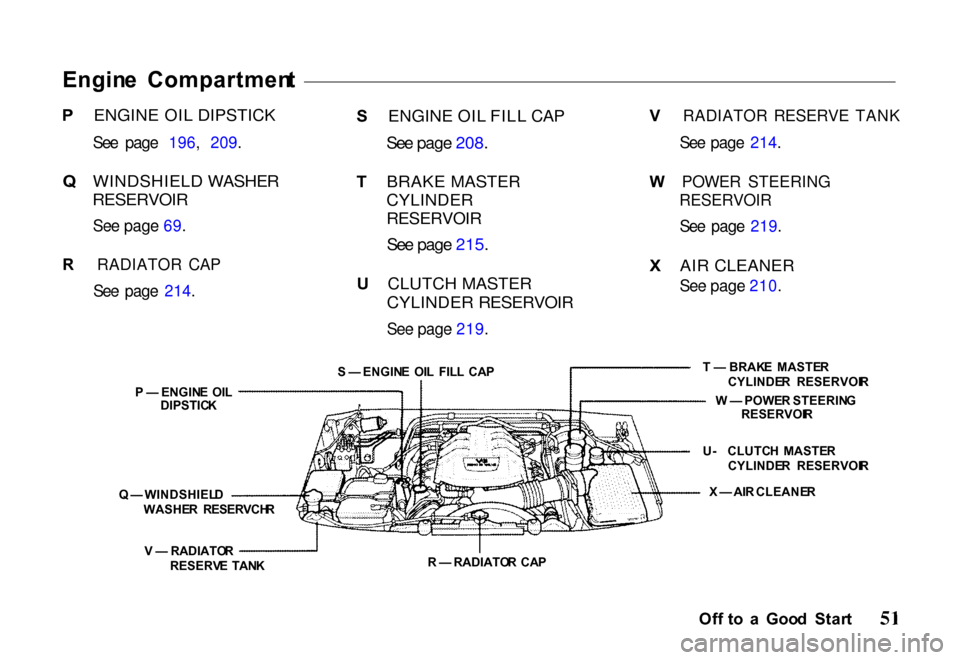
P ENGINE OIL DIPSTICK
See page 196, 209.
Q WINDSHIELD WASHER
RESERVOIR
See page 69.
R RADIATOR CAP
See page 214.
P — ENGIN E OI L
DIPSTIC K
Q — WINDSHIEL D
WASHE R RESERVCH R
V — RADIATO R
RESERV E TAN K
S
ENGINE OIL FILL CAP
See page 208.
T BRAKE MASTER
CYLINDER
RESERVOIR
See page 215.
U CLUTCH MASTER
CYLINDER RESERVOIR
See page 219. V
RADIATOR RESERVE TANK
See page 214.
W POWER STEERING
RESERVOIR
See page 219.
X AIR CLEANER
See page 210.
T — BRAK E MASTE R
CYLINDE R RESERVOI R
U - CLUTC H MASTE R
CYLINDE R RESERVOI R
R — RADIATO R CA P
Off t o a Goo d Star t
S
— ENGIN E OI L FIL L CA P
W — POWE R STEERIN G
RESERVOI R
X — AIR CLEANE R
Page 56 of 267
Instrument
s an d Control s
This section explains the controls
and displays that contribute to the
daily operation of your Honda.
All the essential controls are
within easy reach. Control Locations ......... 54
Indicators an
d Gauges ...... 55
Gauges .................. 56 Tachometer ............ 56Speedometer ........... 56
Odometer ............. 56
Trip Odometer/ Reset Knob ........... 56
Fuel Gauge ............ 57
Engine Coolant Temperature Gauge .... 58
Indicator Lights ........... 59
Switches ................. 68 Windshield Wiper/Washer 68Headlights ............. 70
Illumination Control ..... 71
Rear Window Defogger . . 72
Rear Window Wiper/ Washer .............. 72
Turn Signals ............ 73 Hazard Warning Flasher . .
74
Automatic Transmissio
n .... 74
Transfer Control (4WD Models) ......... 78
5-Speed Manual Transmission 81 Transfer Control(4WD Models) ......... 82
Parking Brake ............ 84
Accelerator Pedal .......... 85
Clutch Pedal ............. 85
Instrument s an d Control s
Page 84 of 267
5-Spee
d Manua l Transmissio n
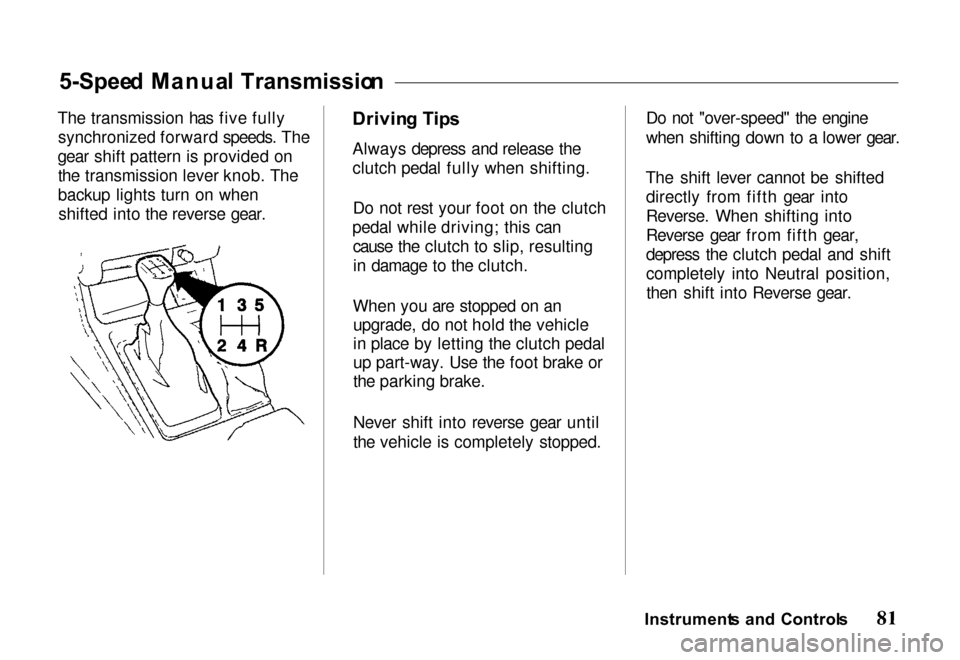
The transmission has five fully synchronized forward speeds. The
gear shift pattern is provided on the transmission lever knob. The
backup lights turn on whenshifted into the reverse gear. Drivin
g Tip s
Always depress and release the
clutch pedal fully when shifting.
Do not rest your foot on the clutch
pedal while driving; this can cause the clutch to slip, resultingin damage to the clutch.
When you are stopped on an upgrade, do not hold the vehicle
in place by letting the clutch pedal
up part-way. Use the foot brake or
the parking brake.
Never shift into reverse gear until
the vehicle is completely stopped. Do not "over-speed" the engine
when shifting down to a lower gear.
The shift lever cannot be shifted directly from fifth gear into
Reverse. When shifting into
Reverse gear from fifth gear,
depress the clutch pedal and shift
completely into Neutral position,then shift into Reverse gear.Instrument s an d Control s
Page 86 of 267
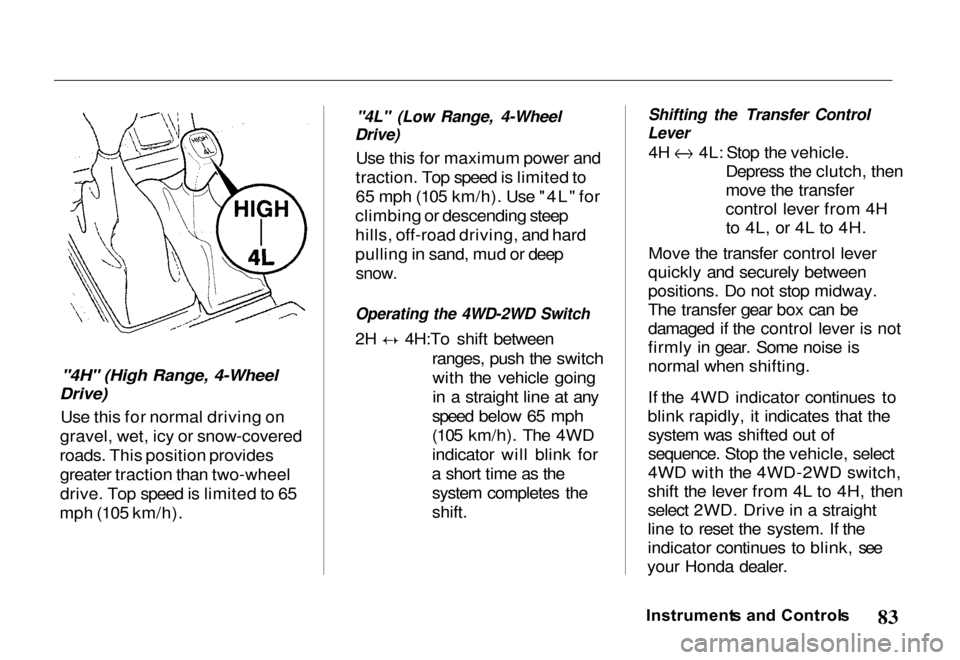
"4H" (High Range, 4-Wheel
Drive)
Use this for normal driving on
gravel, wet, icy or snow-covered
roads. This position provides greater traction than two-wheel
drive. Top speed is limited to 65
mph (105 km/h).
"4L" (Low Range, 4-Wheel
Drive)
Use this for maximum power and
traction. Top speed is limited to
65 mph (105 km/h). Use "4L" for
climbing or descending steep
hills, off-road driving, and hard
pulling in sand, mud or deep
snow.
Operating the 4WD-2WD Switch
2H 4H:To shift between
ranges, push the switchwith the vehicle going
in a straight line at any
speed below 65 mph
(105 km/h). The 4WD
indicator will blink for
a short time as the system completes the
shift.
Shifting the Transfer Control
Lever
4H 4L: Stop the vehicle.
Depress the clutch, then
move the transfer
control lever from 4Hto 4L, or 4L to 4H.
Move the transfer control lever
quickly and securely between
positions. Do not stop midway.
The transfer gear box can be
damaged if the control lever is not
firmly in gear. Some noise is
normal when shifting.
If the 4WD indicator continues to
blink rapidly, it indicates that the system was shifted out of
sequence. Stop the vehicle, select
4WD with the 4WD-2WD switch,
shift the lever from 4L to 4H, then
select 2WD. Drive in a straight
line to reset the system. If the
indicator continues to blink, see
your Honda dealer.
Instrument s an d Control s
Page 88 of 267
parking brake first, then place the
transmission in "P" (Park)
position, even on level surfaces.
When parking a vehicle equippedwith a manual transmission on an
upward slope or on a levelsurface, place the shift lever in the
" 1" (first gear) position.
When parking a vehicle equipped
with a manual transmission on a
downward slope, place the shift lever in the "R" (Reverse)
position. Accelerato
r Peda l
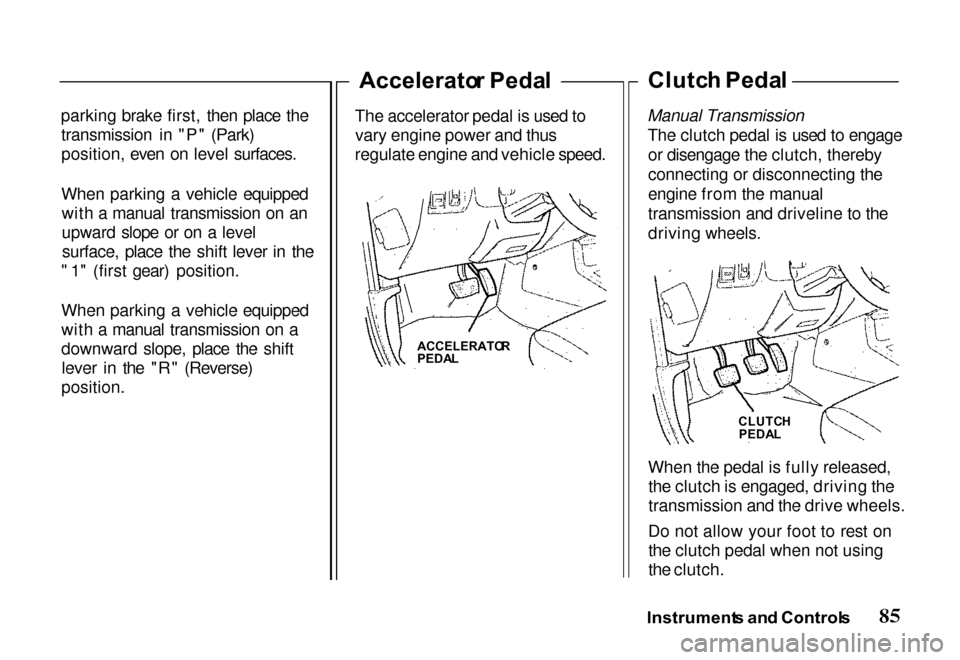
The accelerator pedal is used to vary engine power and thus
regulate engine and vehicle speed. Clutc
h Peda l
Manual Transmission The clutch pedal is used to engageor disengage the clutch, thereby
connecting or disconnecting the
engine from the manual
transmission and driveline to the
driving wheels.
When the pedal is fully released,the clutch is engaged, driving the
transmission and the drive wheels.
Do not allow your foot to rest on the clutch pedal when not using
the clutch.
Instrument s an d Control s
ACCELERATO
R
PEDA L
CLUTCH
PEDA L
Page 148 of 267
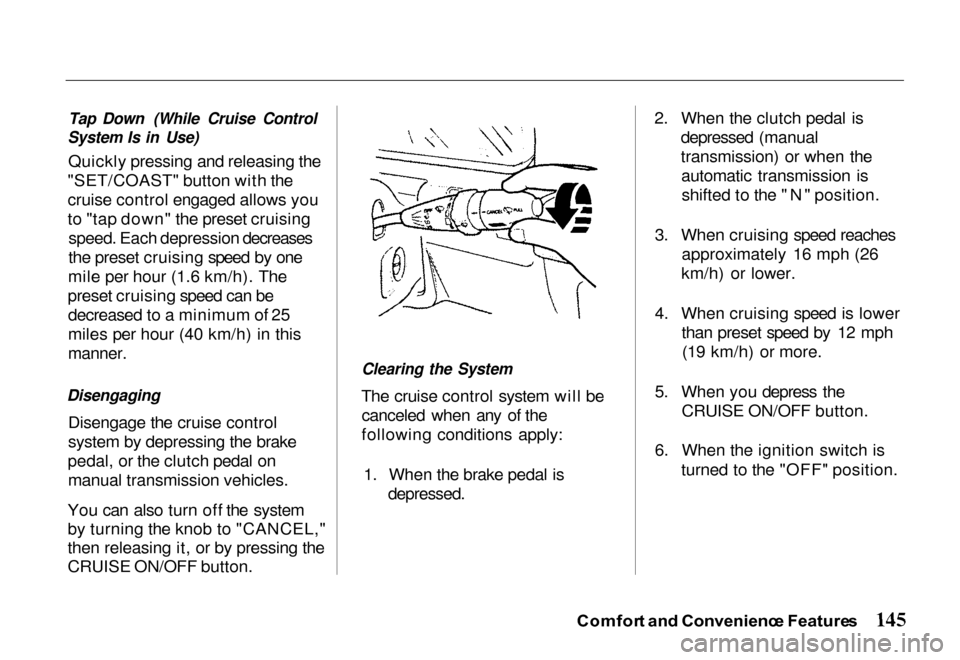
Tap Down (While Cruise Control
System Is in Use)
Quickly pressing and releasing the
"SET/COAST" button with the
cruise control engaged allows you
to "tap down" the preset cruising speed. Each depression decreases
the preset cruising speed by one
mile per hour (1.6 km/h). The
preset cruising speed can be decreased to a minimum of 25
miles per hour (40 km/h) in this
manner.
Disengaging
Disengage the cruise control
system by depressing the brake
pedal, or the clutch pedal on manual transmission vehicles.
You can also turn off the system
by turning the knob to "CANCEL,"
then releasing it, or by pressing the
CRUISE ON/OFF button.
Clearing the System
The cruise control system will be canceled when any of the
following conditions apply:
1. When the brake pedal is
depressed.
2. When the clutch pedal is
depressed (manual
transmission) or when theautomatic transmission isshifted to the "N" position.
3. When cruising speed reaches approximately 16 mph (26
km/h) or lower.
4. When cruising speed is lower than preset speed by 12 mph(19 km/h) or more.
5. When you depress the CRUISE ON/OFF button.
6. When the ignition switch is turned to the "OFF" position.
Comfor t an d Convenienc e Feature s
Page 156 of 267

switch is turned to the "ON"
or "START" position.
5. Check all gauges (including
the fuel gauge).
6. Release the parking brake
(and make sure the "BRAKE"
light turns off).
See related topics in this manual if
you find any problems.
Startin g th e Engin e
1. Apply the parking brake.
2. Manual Transmission: Press
the clutc
h pedal to the floor
and shift the transmission to
the Neutral position. Hold the
clutch pedal to the floor while
you are starting the engine. A starter safety switch keeps the
starter from operating if the
clutch pedal is not fully
depressed.
Automatic Transmission:
Place the shift lever in "P"
or "N" position ("P" is
preferred). A starter safety switch prevents the starter
from operating if the shift lever is in any drive position.
If it is necessary to restart the
engine with the vehicle
moving, place the shift lever in "N" (never in "P").
3. Do not touch the accelerator pedal. Start the engine byturning the ignition switch to
"START."
If the engine does not start in 10 seconds, wait 15 seconds to let
the starter cool down. Then crank
the engine at wide open throttle
for a maximum of 10 seconds. If
the engine still does not start, wait
another 15 seconds and repeat the
entire procedure. Do not crank the engine for more
than 10 seconds at a time. Wait 15
seconds before trying again.
4. Return the ignition switch to
the "ON" position as soon as
the engine starts.
5. Apply the regular brakes and shift into the proper gear.
Release the parking brake and
brake pedal and drive off.
In models with an automatic
transmission, you cannot shift
from "P" (Park) position to any other position unless the
brake pedal is applied.
Driving Tip s
Page 195 of 267
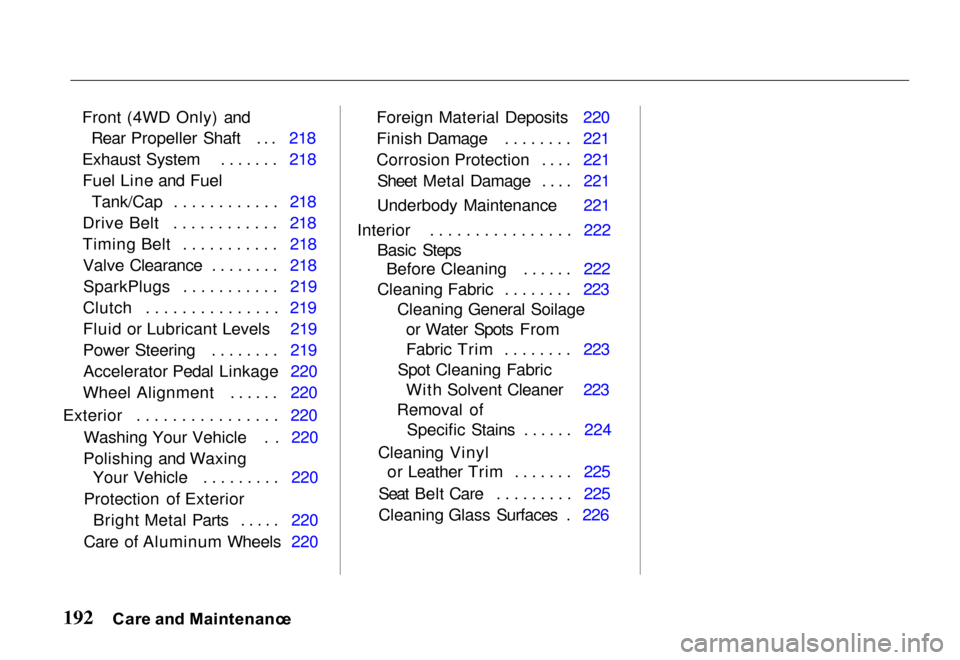
Front (4WD Only) and
Rear Propeller Shaft ... 218
Exhaust System ....... 218 Fuel Line and Fuel Tank/Cap ............ 218
Drive Belt ............ 218
Timing Belt ........... 218 Valve Clearance ........ 218SparkPlugs ........... 219
Clutch ............... 219
Fluid or Lubricant Levels 219
Power Steering ........ 219 Accelerator Pedal Linkage 220
Wheel Alignment ...... 220
Exterior ................ 220 Washing Your Vehicle . . 220
Polishing and Waxing Your Vehicle ......... 220
Protection of Exterior Bright Metal Parts ..... 220
Care of Aluminum Wheels 220 Foreign Material Deposits 220
Finish Damage ........ 221
Corrosion Protection .... 221
Sheet Metal Damage .... 221
Underbody Maintenance 221
Interior ................ 222 Basic StepsBefore Cleaning ...... 222
Cleaning Fabric ........ 223 Cleaning General Soilageor Water Spots From
Fabric Trim ........ 223
Spot Cleaning Fabric With Solvent Cleaner 223
Removal of Specific Stains ...... 224
Cleaning Vinyl or Leather Trim ....... 225
Seat Belt Care ......... 225
Cleaning Glass Surfaces . 226
Car e an d Maintenanc e
Page 203 of 267
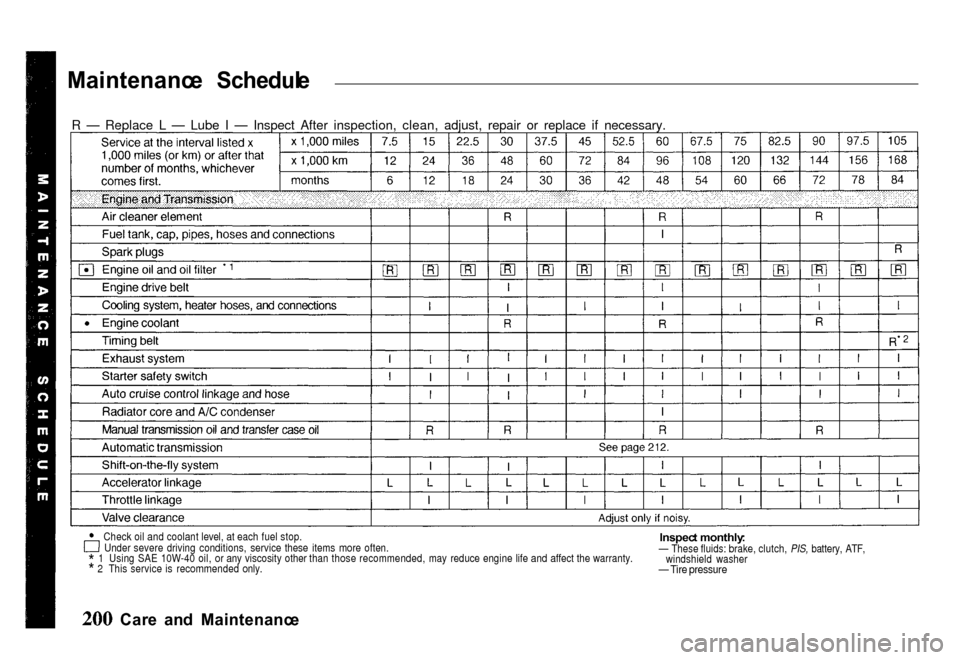
Maintenanc
e Schedul e
Check oil and coolant level, at each fuel stop. Under severe driving conditions, service these items more often.
* 1 Using SAE 10W-40 oil, or any viscosity other than those recommended, may reduce engine life and affect the warranty.
* 2 This service is recommended only.
Inspec
t monthly :
— These fluids: brake, clutch, PIS, battery, ATF, windshield washer
— Tire pressure
Car e an d Maintenanc e
R — Replace L — Lube I — Inspect After inspection, clean, adjust, repair or replace if necessary.
Page 207 of 267
Owne
r Safet y Check s
Promptly take any safety
problems to your Honda dealer for service advice.
Parkin g brak e — Park on a fairly
steep hill and hold the vehicle
with the parking brake only. This
checks its holding ability.
Starte r safet y switc h (automati c
transmission ) — Check the safety
switch by trying to start the
engine in each gear. The starter should work only with the shift
lever in the "P" (Park) or "N" (Neutral) position.
Starte r safet y switc h (manua l
transmission ) — To check the
safety switch, place the shift lever
in "Neutral," push the clutch
pedal halfway and try to start the engine. The starter should not
work. The starter should work only when the clutch pedal is fully
depressed.
Transmissio n shif t indicato r
(automati c transmission ) —
Check that the indicator points to
the gear chosen.
Steerin g — Be alert for any
changes in steering action. An inspection or service is needed
when the steering wheel is harder
to turn or has too much free play,
or if there are unusual sounds when turning or parking.
Whee l alignment , balanc e an d
tire s — Uneven or abnormal tire
wear, or pulling to the right or left
on a straight and level road may show the need for a wheel
alignment. A vibration of the
steering wheel or seat at normal
highway speeds means wheel balancing is needed. Check tire
pressures (including the spare) at
least monthly and whenever the
vehicle is serviced (see page 159).
Brake s — Watch for the
"BRAKE" light coming on. Other signs of possible brake trouble are
such things as repeated pulling to
one side when braking, unusual sounds when braking or between
brake applications, or increased
brake pedal travel. If you note one
of these conditions, have the system checked at once and
repaired if needed.
Car e an d Maintenanc e