engine HONDA PASSPORT 2000 2.G Owner's Guide
[x] Cancel search | Manufacturer: HONDA, Model Year: 2000, Model line: PASSPORT, Model: HONDA PASSPORT 2000 2.GPages: 267, PDF Size: 3.03 MB
Page 154 of 267
Drivin
g Tip s
Before Driving ........... 152Starting the Engine ..... 153
New Vehicle Break-In ..... 154
Parking ................ 154 Brakes ................. 155
Tires .................. 159 Inflation ............. 160
Inspection ............ 161
Maintenance .......... 162
Tire Rotation .......... 162
Replacing Tires and Wheels .......... 162
Wheels and Tires ...... 163
Traction .............. 164 Tire Chains ......... 164
Wheel Replacement
Considerations ....... 165
Fuel Economy ........... 166
Three-Way Catalytic Converter ............. 168 Operation in
Foreign Countries ....... 169
Accessories & Modifications 169
Carrying Cargo ........... 171
Trailer Towing ........... 174 Trailer Hitches ........ 176Safety Chain .......... 177
Trailer Lights .......... 177
Tires ................. 177 Trailer Brakes ......... 177
Equipment Check ...... 178
Limited Slip Differential ... 178
Driving Tip s
Page 156 of 267

switch is turned to the "ON"
or "START" position.
5. Check all gauges (including
the fuel gauge).
6. Release the parking brake
(and make sure the "BRAKE"
light turns off).
See related topics in this manual if
you find any problems.
Startin g th e Engin e
1. Apply the parking brake.
2. Manual Transmission: Press
the clutc
h pedal to the floor
and shift the transmission to
the Neutral position. Hold the
clutch pedal to the floor while
you are starting the engine. A starter safety switch keeps the
starter from operating if the
clutch pedal is not fully
depressed.
Automatic Transmission:
Place the shift lever in "P"
or "N" position ("P" is
preferred). A starter safety switch prevents the starter
from operating if the shift lever is in any drive position.
If it is necessary to restart the
engine with the vehicle
moving, place the shift lever in "N" (never in "P").
3. Do not touch the accelerator pedal. Start the engine byturning the ignition switch to
"START."
If the engine does not start in 10 seconds, wait 15 seconds to let
the starter cool down. Then crank
the engine at wide open throttle
for a maximum of 10 seconds. If
the engine still does not start, wait
another 15 seconds and repeat the
entire procedure. Do not crank the engine for more
than 10 seconds at a time. Wait 15
seconds before trying again.
4. Return the ignition switch to
the "ON" position as soon as
the engine starts.
5. Apply the regular brakes and shift into the proper gear.
Release the parking brake and
brake pedal and drive off.
In models with an automatic
transmission, you cannot shift
from "P" (Park) position to any other position unless the
brake pedal is applied.
Driving Tip s
Page 157 of 267
Ne
w Vehicl e Break-I n
You may drive your new vehicle
from its very first mile/kilometer without following a formal
"break-in" schedule. However,
there are things you can do during
the first few hundred miles/
kilometers of driving that will add
to the future performance and
economy of your vehicle.
It is recommended that your speed
during the first 500 miles (800
kilometers) be limited to a
maximum of 55 mph (90 km/h) and that you do not drive for long
periods at any one constant speed, either fast or slow. During this
period, avoid full-throttle starts and, if possible, avoid hard stops;
especially during the first 200
miles (320 kilometers) of driving.
Always drive at moderate speed
until the engine has completely warmed up.
Parkin
g
When leaving your vehicle
unattended:
Set the parking brake.
Place the shift lever in "P" (Park) position for automatic
transmission.
When parking a vehicle equipped
with a manual transmission on an
upward slope, or on a level surface, place the shift lever in
the "1st" position.
When parking a vehicle
equipped with a manual
transmission on a downward slope, place the shift lever in
the "R" (Reverse) position. Turn the key to the "LOCK"
position.
Remove the key. The beeper
will remind you. Close all windows and lock all
doors.
Check to make certain the
lights are turned off. The
beeper will remind you. If your vehicle is equipped with
a transfer case (4WD), make
sure the shift lever is in 4H or
4L.
Parkin g Tip s
Never drive the vehicle with
the parking brake set. This can
overheat the rear brakes,
reducing their effectiveness and
causing excessive wear or
damage.
Always apply the parking brake
whenever you leave the vehicle,
whether it is equipped with a
manual or automatic transmission.
Drivin g Tip s
Page 159 of 267
hazard. This is sometimes referred
to as "stomp and steer."
You will feel a pulsation in the
brake pedal when the ABS activates, and you may hear some
noise. This is normal, it is theABS rapidly pumping the brakes.
Activation varies with the amount
of traction your tires have. On dry
pavement, you will need to press on the brake pedal very hard
before you activate the ABS. However, you may feel the ABSactivate immediately if you are
trying to stop on snow or ice.
Important Safety Reminders AB S doe s no t reduc e th e tim e
o r distanc e it take s t o sto p th e
vehicle , it only helps with steering
control during braking. You
should always maintain a safe following distance from other
vehicles.
AB
S wil l no t preven t a ski d tha t
result s fro m changin g directio n
abruptly , such as trying to take a
corner too fast or making a sudden lane change. Always drive
at a safe, prudent speed for the
road and weather conditions.
AB S canno t preven t a los s o f
stability . Always steer moderately
when you are braking hard. Severe or sharp steering wheel
movement can still cause your
vehicle to veer into oncoming traffic or off the road.
A vehicl e wit h AB S ma y requir e
a longe r distanc e t o sto p o n
loose or uneven surfaces, such as
gravel or snow, than a vehicle
without anti-lock. Slow down and allow a greater distance between
vehicles under those conditions.
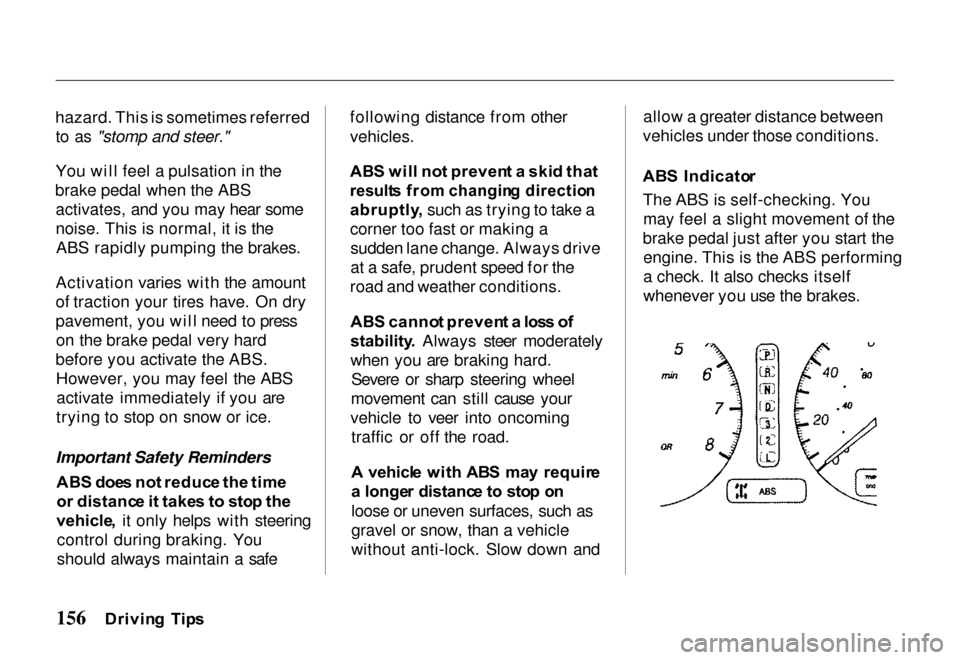
AB S Indicato r
The ABS is self-checking. You may feel a slight movement of the
brake pedal just after you start the engine. This is the ABS performing
a check. It also checks itself
whenever you use the brakes.
Drivin g Tip s
Page 160 of 267
If anything goes wrong, the ABS
indicator on the instrument panel
comes on (see page 65). This
means th
e anti-lock function of
the braking system has shut down.
The brakes still work like a conventional system without
anti-lock, providing normal stopping ability. You should have
the dealer inspect your vehicle as soon as possible if this light stays
on after you start the engine, or
comes on while driving. Drivin
g Wit h We t Brake s
Driving through deep water may get the brakes wet and reduce
their effectiveness. As a result, the
vehicle may not slow down
normally or may pull in one direction or the other.
If you drive through deep water,apply the brakes lightly to see if
the water has affected them. To
dry the brakes quickly, press
lightly on the brake pedal while
maintaining the same speed with the accelerator pedal. Continue
this until the brakes operate
normally.
Powe
r Brake s
The braking system uses engine vacuum to provide power assist. If
the power assist fails because of astalled engine or other reason, the
reserve vacuum in the system will usually allow you to apply the
brakes at least one time.
The reserve vacuum is partly used up each time the brake pedal isapplied and released. Do not
pump the brakes when the power assist has been lost, except when
needed to maintain steering
control on slippery surfaces.
You can still stop the vehicle
without the power assist by pushing
harder on the brake pedal.
However, the stopping distance
may be longer, even though the
brakes themselves remain fully
operational.
Driving Tip s
Page 162 of 267
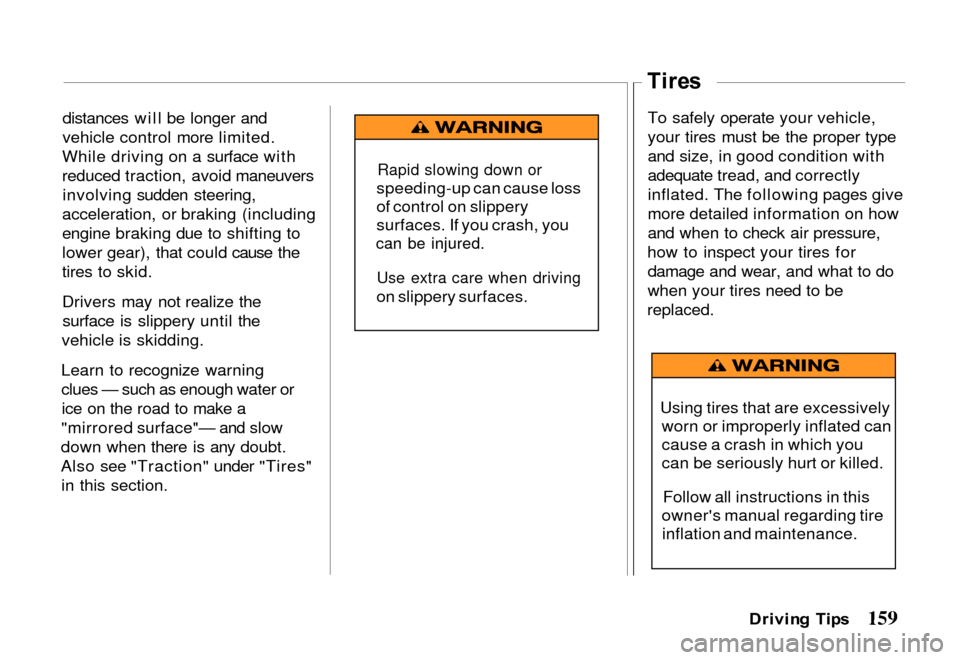
distances will be longer and
vehicle control more limited.
While driving on a surface with
reduced traction, avoid maneuvers involving sudden steering,
acceleration, or braking (including
engine braking due to shifting to
lower gear), that could cause the
tires to skid.
Drivers may not realize the surface is slippery until the
vehicle is skidding.
Learn to recognize warning
clues — such as enough water or ice on the road to make a
"mirrored surface"— and slow
down when there is any doubt.
Also see "Traction" under "Tires" in this section. To safely operate your vehicle,
your tires must be the proper type
and size, in good condition with
adequate tread, and correctly
inflated. The following pages give
more detailed information on how
and when to check air pressure,
how to inspect your tires for damage and wear, and what to do
when your tires need to be
replaced.
Driving Tip s
Rapid slowing down or
speeding-up can cause loss
of control on slippery
surfaces. If you crash, you
can be injured.
Use extra care when driving
on slippery surfaces.
Using tires that are excessivelyworn or improperly inflated can
cause a crash in which you
can be seriously hurt or killed.
Follow all instructions in this
owner's manual regarding tire inflation and maintenance.
Tire
s
Page 169 of 267
Drivin
g fo r Bes t Fue l
Econom y
How, where, and when you drive all affect how many miles/
kilometers you can get from a
gallon/liter of fuel. The careful attention you give your vehicle as
far as maintenance and repairs will also help fuel economy.
Fuel Selection Use only unleaded gasolinemeeting federal government
regulations. The federal
government specifies the
minimum octane rating number of
unleaded gasoline. Unleaded
gasoline must be used for proper
emissions control system
operation. It will also minimize spark plug fouling. The use of
leaded gasoline can damage the
emissions control system and could result in loss of warranty
coverage.
"Jackrabbit" Starts
You can save fuel (and prolong
engine and tire life) by avoiding fast starts away from lights andstop signs.
Stop-and-Go Driving Frequent stop-and-go driving
during a trip will cut down on
your miles per gallon (kilometers
per liter). Plan even your short shopping trips to take advantage
of through streets to avoid traffic
lights. Pace your driving to avoid
unplanned stops.
Excessive Idling
An idling engine uses fuel, too. If
you're faced with more than a few
minutes wait and you're not in traffic, it is better to turn off the
key and start the engine again
later.
Repetitive Harsh Stopping Harsh stops can also waste fuel;instead of moving the vehicle, the
energy is wasted as heat in
braking. Energy in the form of
fuel is also needed to accelerate
back to driving speed.
Lubricants A well-lubricated vehicle meansless friction between moving
parts. This manual lists the proper
lubrication intervals in the "Care
and Maintenance" section.
Air Cleaner Your vehicle gets its power from a
mixture of fuel and air. The air is
taken into the engine through the
Drivin g Tip s
Fue
l Econom y
Page 170 of 267

air cleaner, so it's important to
replace the air cleaner filter at
required intervals. See "Care and Maintenance." A dirty air cleaner
filter reduces engine performance
and can waste fuel.
Air Conditioning
Turn off the air conditioning whenit is not needed. The air
conditioning compressor is not on
in this position and the reduced
engine load can improve fuel
economy.
Tuned Engine
An engine that is properly
maintained will provide better
fuel economy than one that is not.
One misfiring spark plug will cut
fuel economy significantly, and
will make a difference in the
amount of pollution emitted from
your vehicle.
Excessive Weight
Fuel economy is related to thework the engine must do. The
heavier the load, the more fuel it takes to run your vehicle. Keep
weight to a minimum by removing
unnecessary luggage or cargo.
Tire Inflation
Underinflation not only causes
needless tire wear but can also
waste fuel. It's a good idea to
check tire pressure often and keep your tires inflated to the pressures
shown on the tire placard located
on the driver's doorjamb.
Wheel Alignment
Improper alignment will cause the
front tires to roll at an angle that
will result in faster tire wear. It takes power to overcome this
improper alignment, which, inturn, wastes fuel.
Use of 4-Wheel Drive
In normal driving, put the 4WD-2WD switch in the 2WD
position.
Driving Tip s
Page 171 of 267
Three-Wa
y Catalyti c Converte r
The three-way catalytic converter is an emissions control device
added to the exhaust system to
reduce exhaust gas pollutants. The
converter contains a ceramic material coated with noble metal
catalysts. To prevent contamination
of the catalysts, unleaded gasoline must be used. Unleaded gasoline
also reduces combustion chamber
deposits and exhaust system
corrosion.
The three-way catalytic converter requires the use of unleaded
gasoline. Use of leaded gasolinewill cause the converter to lose its
effectiveness.
T o Hel p Preven t Damag e
1. Keep your engine properly maintained. Engine
malfunctions involving the electrical, electronic fuel
injection or ignition systems
may result in unusually high
converter and exhaust system
temperatures. Do not keep
driving your vehicle if you
detect engine misfire,
noticeable loss of performance, or other unusual operating
conditions. Have it serviced
promptly. A properly
maintained engine willminimize malfunctions that
could damage the converter. It
will also help provide good
emissions control and fuel economy. (See theMaintenance Schedule on page
200 for information on inspecting and maintaining the
engine, exhaust system and
other components.) 2. Do not push or tow your
vehicle to start it. This could
damage the converter.
3. Do not park your vehicle over high grass, dry leaves or othercombustible materials. The
catalytic converter gets very
hot and could set fire to these materials.
Drivin g Tip s
Page 177 of 267
Traile
r Towin g
Your Honda vehicle is designed
for passenger and cargo transportation. With the proper
equipment installed, your vehicle
can also tow a trailer under certain
conditions, as detailed in this section. Be sure to read this entire
section and follow all
requirements.
Towing a trailer will have an
effect on handling, performance,
braking, durability and fuel
consumption.
Honda recommends that you do
not tow a trailer with a new Honda vehicle or one with a new
powertrain component (engine, transmission, differential) for the
first 500 miles. For your safety and the safety
of others, use equipment
specifically designed for your
vehicle. Improper towing
equipment and improper installation of same can cause
damage to your vehicle and may also result in personal injury.
Additional care and cautious
driving habits are essential to trailer towing.
Do not exceed 45 mph or the
posted towing speed limit, whichever is lower. Higher speed
may cause loss of vehicle control.
Drivin g Tip s
Improperly loading your
vehicle and trailer can seriously affect the steering
and braking performance,
causing a crash in which you
can be seriously injured.
Check the loading of your
vehicle and trailer carefully before starting to drive.