fuel HONDA PASSPORT 2000 2.G Owner's Guide
[x] Cancel search | Manufacturer: HONDA, Model Year: 2000, Model line: PASSPORT, Model: HONDA PASSPORT 2000 2.GPages: 267, PDF Size: 3.03 MB
Page 212 of 267
Oi
l Viscosit y
Engine oil viscosity (thickness) has an effect on fuel economy. Lower
viscosity engine oils can provideincreased fuel economy; however,
higher temperature weather
conditions require higher viscosity
engine oils for satisfactory lubrication. To get the best fuel
economy with your vehicle, you should use a fuel-saving engine oil
of the proper viscosity. These oils
can be found in service stations and other retail stores. They are
identified by words such as
"Energy Saving," "Conserves
Gasoline," "Gas Saving,"
"Gasoline Saving," "Friction
Reducing," "Improved Gasoline Mileage" or "Fuel Saving."
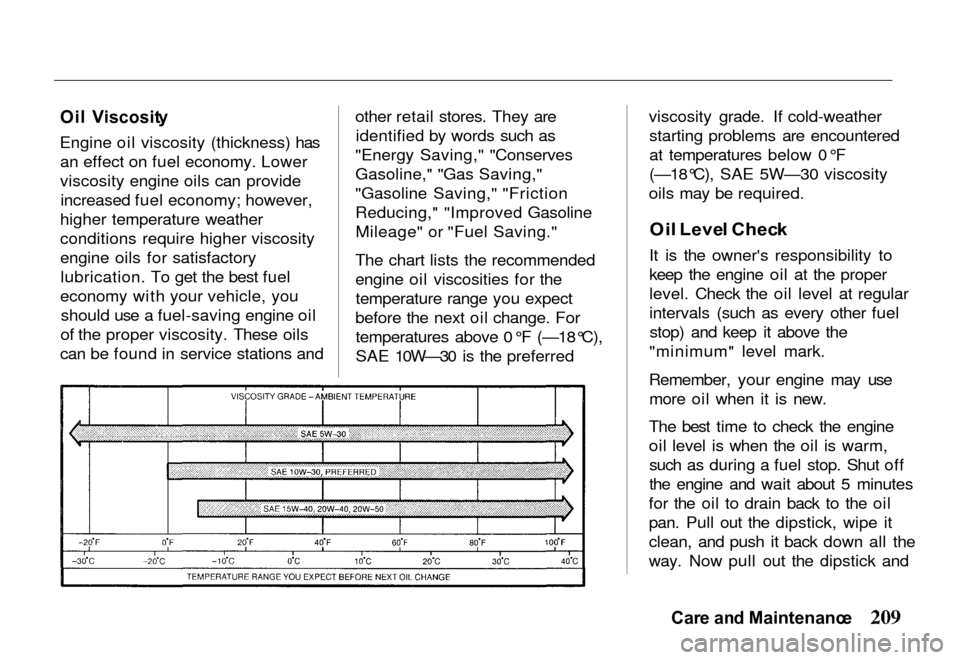
The chart lists the recommended
engine oil viscosities for the temperature range you expect
before the next oil change. For temperatures above 0°F (—18°C),
SAE 10W—30 is the preferred viscosity grade. If cold-weather
starting problems are encountered
at temperatures below 0°F
(—18°C), SAE 5W—30 viscosity
oils may be required.
Oi l Leve l Chec k
It is the owner's responsibility to
keep the engine oil at the proper
level. Check the oil level at regular
intervals (such as every other fuel stop) and keep it above the
"minimum" level mark.
Remember, your engine may use more oil when it is new.
The best time to check the engine
oil level is when the oil is warm, such as during a fuel stop. Shut off
the engine and wait about 5 minutes
for the oil to drain back to the oil
pan. Pull out the dipstick, wipe it
clean, and push it back down all the
way. Now pull out the dipstick and
Car e an d Maintenanc e
Page 221 of 267
Fron
t (4W D Only ) an d Rea r
Propelle r Shaf t
Lubricate the sliding yoke with
EP chassis grease. Lubricate
universal joints with grease
containing MoS 2 (molybdenum
disulfide-type grease) at the intervals shown in the
Maintenance Schedule. Also
check the propeller shaft
flange-to-pinion bolts for proper
torque of 64 N.m (46.3 Ib-ft).
Most lubrication recommendations
and procedures for four-wheel drive-
equipped vehicles are the same
for the corresponding components in conventional drive vehicles.
Exhaus t Syste m
Check the complete exhaust
system and nearby body areas for
damaged, missing, or
mispositioned parts, open seams, holes, loose connections, or other
deterioration that could allow
exhaust fumes to seep into the
passenger compartment or cause
heat build-up in the floor pan. Any
necessary corrections should be made immediately. For continuedsafety, exhaust system pipes and
resonators rearward of the muffler must be replaced whenever a new
muffler is installed.
Fue l Lin e an d Fue l Tank/Ca p
Inspect the fuel tank, cap and lines
for damage that could cause
leakage. Inspect the fuel cap and
gasket for correct sealing ability
and indications of physical
damage. Replace any damaged or
malfunctioning parts.
Driv
e Bel t
Check the belt driving the
alternator, power steering pump,
and air conditioning compressor.
Look for cracks, fraying, and wear. Replace as necessary.
Timin g Bel t
The timing belt should normally
be replaced at the intervals shown
in the Maintenance Schedule.
Valv e Clearanc e
Incorrect valve clearance will
result in increased engine noise and lower engine output, thereby
adversely affecting engine
performance.
Car e an d Maintenanc e
Page 224 of 267
chemicals from industrial
chimneys, and other foreign
matter may damage your vehicle's
finish if allowed to remain on
painted surfaces.
Prompt washing may not
completely remove all of these
deposits. Additional cleaners may
be needed. When using chemical
cleaners developed for this
purpose, be certain they are safe
for use on painted surfaces.
Finis h Damag e
Any stone chips, fractures or deep scratches in the finish should be
repaired promptly. Exposed metal will corrode quickly and may
develop into a major repair
expense. Minor chips and scratches
can be repaired using touch-up materials available from your
Honda dealer. Corrosio
n Protectio n
Your vehicle has been designed
and built to resist corrosion.
Special materials and protective
finishes were applied to most
parts of your vehicle when it was built to help maintain its good
looks, strength and reliable
operation. However, some parts
that are normally not visible (suchas certain parts under the vehicle
and under the hood) are strong
enough so that surface rust will
not affect their reliability. So
corrosion protection is not needed or used on these parts. By
omitting unneeded rust protection
on such parts and applying extra
protection where it is needed most, the best value is assured forthe vehicle buyer. Shee
t Meta l Damag e
If your vehicle is damaged and
requires sheet metal repair or
replacement, make sure the body
repair shop applies anti-corrosion material to the parts repaired or
replaced so that corrosion
protection is restored. (Also see "Finish Damage.")
Underbod y Maintenanc e
Corrosive materials used for ice and snow removal and dust
control can collect on the
underbody. If these materials are not removed, accelerated
corrosion (rust) can occur on
underbody parts such as fuel lines,
frame, floor pan, and exhaustsystem even though they have
Car e an d Maintenanc e
Page 249 of 267
maintain them. This section
summarizes how the emissions
controls work. Scheduled
maintenance is on page 200.
Crankcas e Emission s
Contro l Syste m
Your vehicle has a Positive
Crankcase Ventilation System.
This keeps gasses that build up in the engine's crankcase from goinginto the atmosphere. The Positive
Crankcase Ventilation valve
routes them from the crankcase
back to the intake manifold. They are then drawn into the engine and
burned.
Evaporativ e Emission s
Contro l Syste m
As gasoline evaporates in the fuel
tank, an evaporative emission
control canister filled with charcoal adsorbs the vapor. It is stored in this canister while the
engine is off. After the engine is
started and warmed up, the vapor
is drawn into the engine and
burned during driving.
Exhaus t Emission s Control s
The exhaust emission controls include four systems: Fuel
Injection, Ignition Timing Control, Exhaust Gas
Recirculation, and Three-Way Catalytic Converter. These four
systems work together to control
the engine's combustion and
minimize the amount of HC, CO,
and NOx that comes out the
tailpipe. The exhaust emission
control systems are separate fromthe crankcase and evaporative
emission control systems. Fuel Injection System
The Fuel Injection System uses sequential multiport fuel injection.
It has three subsystems: Air
Intake, Engine Control, and Fuel
Control. The Engine Control Module (ECM) uses various
sensors to determine how much
air is going into the engine. It then
controls how much fuel to inject
under all operating conditions.
Ignition Timing Control System This system constantly adjusts theignition timing, reducing the amount
of HC, CO and NOx produced.
Owne r Assistanc e
Page 250 of 267
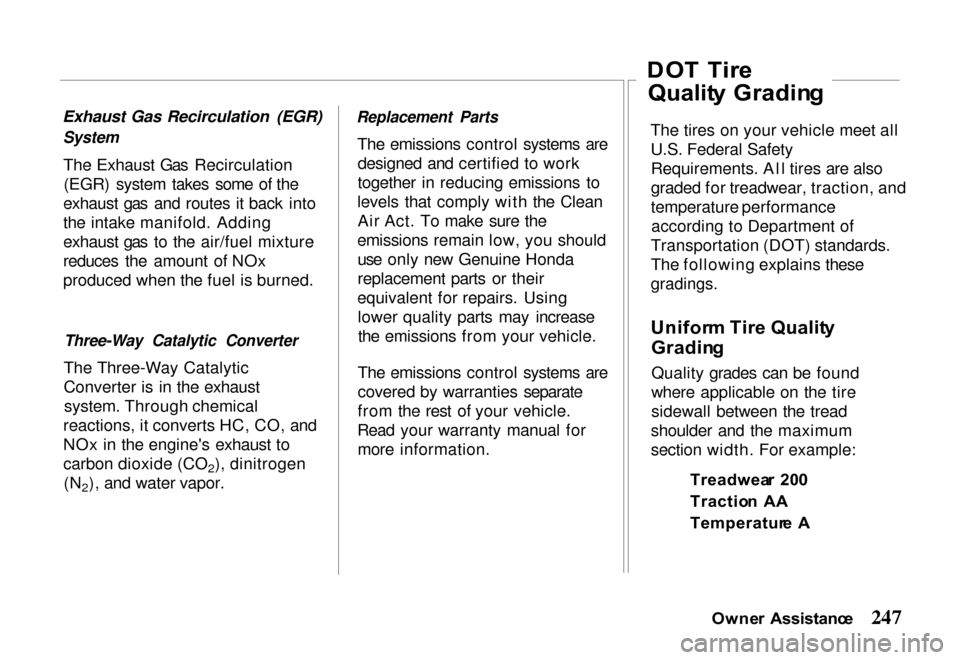
Exhaust Gas Recirculation (EGR)
System
The Exhaust Gas Recirculation(EGR) system takes some of the
exhaust gas and routes it back into
the intake manifold. Adding
exhaust gas to the air/fuel mixture
reduces the amount of NOx
produced when the fuel is burned.
Three-Way Catalytic Converter
The Three-Way Catalytic
Converter is in the exhaust system. Through chemical
reactions, it converts HC, CO, and
NOx in the engine's exhaust to
carbon dioxide (CO 2), dinitrogen
(N 2), and water vapor.
Replacement Parts
The emissions control systems aredesigned and certified to work
together in reducing emissions to
levels that comply with the Clean Air Act. To make sure the
emissions remain low, you should use only new Genuine Honda
replacement parts or their
equivalent for repairs. Using lower quality parts may increasethe emissions from your vehicle.
The emissions control systems are
covered by warranties separate
from the rest of your vehicle.
Read your warranty manual for more information.
DO
T Tir e
Qualit y Gradin g
The tires on your vehicle meet all U.S. Federal Safety
Requirements. All tires are also
graded for treadwear, traction, and
temperature performanceaccording to Department of
Transportation (DOT) standards.
The following explains these
gradings.
Unifor m Tir e Qualit y
Gradin g
Quality grades can be found
where applicable on the tire
sidewall between the tread
shoulder and the maximum
section width. For example:
Treadwea r 20 0
Tractio n A A
Temperatur e A
Owne r Assistanc e
Page 257 of 267
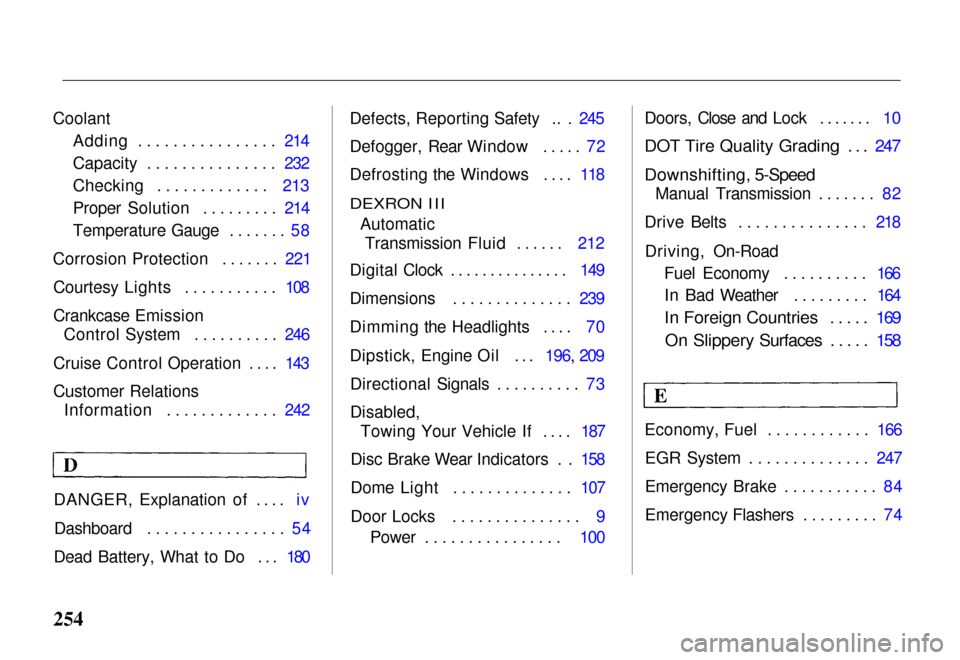
Coolant
Adding ................ 214
Capacity ............... 232
Checking ............. 213
Proper Solution ......... 214
Temperature Gauge ....... 58
Corrosion Protection ....... 221 Courtesy Lights ........... 108
Crankcase Emission Control System .......... 246
Cruise Control Operation .... 143
Customer Relations Information ............. 242
DANGER, Explanation of .... iv Dashboard ................ 54
Dead Battery, What to Do ... 180 Defects, Reporting Safety .. . 245
Defogger, Rear Window ..... 72
Defrosting the Windows .... 118
DEXRON III
AutomaticTransmission Fluid ...... 212
Digital Clock ............... 149
Dimensions .............. 239
Dimming the Headlights .... 70
Dipstick, Engine Oil ... 196, 209
Directional Signals .......... 73
Disabled, Towing Your Vehicle If .... 187
Disc Brake Wear Indicators . . 158
Dome Light .............. 107
Door Locks ............... 9 Power ................ 100 Doors, Close and Lock ....... 10
DOT Tire Quality Grading ... 247
Downshifting, 5-Speed
Manual Transmission ....... 82
Drive Belts ............... 218
Driving, On-Road Fuel Economy .......... 166In Bad Weather ......... 164
In Foreign Countries ..... 169
On Slippery Surfaces ..... 158
Economy, Fuel ............ 166 EGR System .............. 247
Emergency Brake ........... 84
Emergency Flashers ......... 74
Page 258 of 267
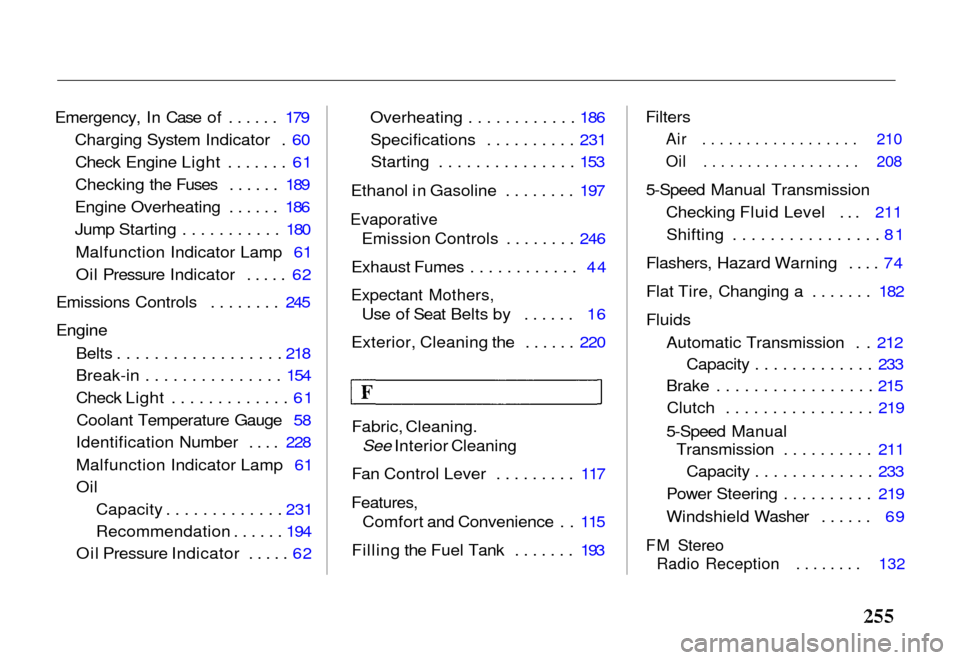
Emergency, In Case of ...... 179
Charging System Indicator . 60Check Engine Light ....... 61
Checking the Fuses ...... 189
Engine Overheating ...... 186 Jump Starting ........... 180
Malfunction Indicator Lamp 61Oil Pressure Indicator ..... 62
Emissions Controls ........ 245
Engine
Belts .................. 218
Break-in ............... 154
Check Light ............. 61Coolant Temperature Gauge 58
Identification Number .... 228
Malfunction Indicator Lamp 61 Oil
Capacity ............. 231
Recommendation ...... 194
Oil Pressure Indicator ..... 62 Overheating ............ 186
Specifications .......... 231
Starting ............... 153
Ethanol in Gasoline ........ 197
Evaporative
Emission Controls ........ 246
Exhaust Fumes ............ 44
Expectant Mothers,
Use of Seat Belts by ...... 16
Exterior, Cleaning the ...... 220
Fabric, Cleaning.
See Interior Cleaning
Fan Control Lever ......... 117
Features,
Comfort and Convenience . . 115
Filling the Fuel Tank ....... 193 Filters
Air .................. 210
Oil .................. 208
5-Speed Manual Transmission Checking Fluid Level ... 211Shifting ................ 81
Flashers, Hazard Warning ....
74
Flat Tire
, Changing a ....... 182
Fluids Automatic Transmission . .
212
Capacity ............
. 233
Brake ................. 215
Clutch ................ 219
5-Speed Manual Transmission .......... 211
Capacity ............. 233
Power Steering .......... 219
Windshield Washer ...... 69
FM Stereo
Radio Reception ........ 132
Page 259 of 267
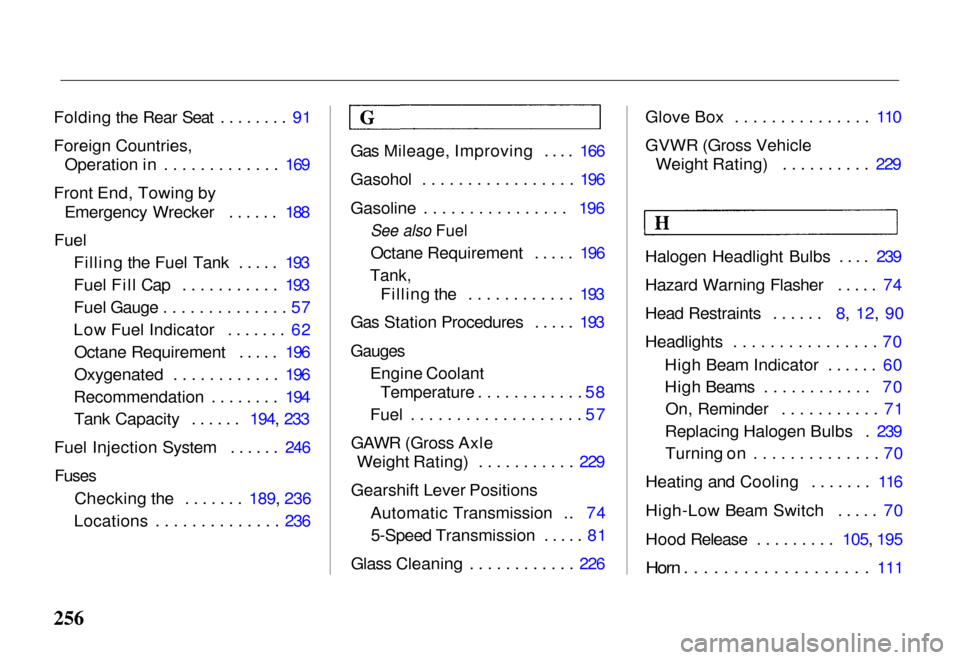
Folding the Rear Seat ........ 91
Foreign Countries,
Operation in ............. 169
Front End, Towing by Emergency Wrecker ...... 188
Fuel Filling the Fuel Tank ..... 193
Fuel Fill Cap ........... 193
Fuel Gauge .............. 57
Low Fuel Indicator ....... 62Octane Requirement ..... 196
Oxygenated ............ 196
Recommendation ........ 194 Tank Capacity ...... 194, 233
Fuel Injectio
n System ...... 246
Fuses
Checking the .......
189, 236
Locations .............
. 236Gas Mileage, Improving .... 166
Gasohol ................. 196
Gasoline ................ 196
See also Fuel
Octane Requirement ..... 196
Tank,
Filling the ............ 193
Gas Station Procedures ..... 193
Gauges
Engine CoolantTemperature ............ 58
Fuel ................... 57
GAWR (Gross Axle Weight Rating) ........... 229
Gearshift Lever Positions Automatic Transmission .. 745-Speed Transmission ..... 81
Glass Cleaning ............ 226 Glove Box ............... 110
GVWR (Gross Vehicle
Weight Rating) .......... 229
Halogen Headlight Bulbs .... 239
Hazard Warning Flasher ..... 74
Head Restraints ...... 8, 12, 90
Headlights ................ 70 High Beam Indicator ...... 60
High Beams ............ 70On, Reminder ........... 71
Replacing Halogen Bulbs . 239 Turning on .............. 70
Heating and Cooling ....... 116
High-Low Beam Switch ..... 70
Hood Release ......... 105, 195
Horn ...................
111