wheel HONDA PASSPORT 2000 2.G Owner's Guide
[x] Cancel search | Manufacturer: HONDA, Model Year: 2000, Model line: PASSPORT, Model: HONDA PASSPORT 2000 2.GPages: 267, PDF Size: 3.03 MB
Page 170 of 267
air cleaner, so it's important to
replace the air cleaner filter at
required intervals. See "Care and Maintenance." A dirty air cleaner
filter reduces engine performance
and can waste fuel.
Air Conditioning
Turn off the air conditioning whenit is not needed. The air
conditioning compressor is not on
in this position and the reduced
engine load can improve fuel
economy.
Tuned Engine
An engine that is properly
maintained will provide better
fuel economy than one that is not.
One misfiring spark plug will cut
fuel economy significantly, and
will make a difference in the
amount of pollution emitted from
your vehicle.
Excessive Weight
Fuel economy is related to thework the engine must do. The
heavier the load, the more fuel it takes to run your vehicle. Keep
weight to a minimum by removing
unnecessary luggage or cargo.
Tire Inflation
Underinflation not only causes
needless tire wear but can also
waste fuel. It's a good idea to
check tire pressure often and keep your tires inflated to the pressures
shown on the tire placard located
on the driver's doorjamb.
Wheel Alignment
Improper alignment will cause the
front tires to roll at an angle that
will result in faster tire wear. It takes power to overcome this
improper alignment, which, inturn, wastes fuel.
Use of 4-Wheel Drive
In normal driving, put the 4WD-2WD switch in the 2WD
position.
Driving Tip s
Page 173 of 267
systems, such as the SRS and
anti-lock brake system.
However, if electronic accessories
are improperly installed, or
exceed your vehicle's electrical
system capacity, they can interfere with the operation of your vehicle,
or even cause the airbags to
deploy.
Before installing any accessory: Make sure the accessory does
not obscure any lights, or interfere with proper vehicle
operation or performance. Be sure electronic accessories
do not overload electrical
circuits (see page 236). Have the installer contact your
Honda dealer for assistance
before installing any electronic
accessory.
If possible, have your dealer
inspect the final installation.
Modification s
Do not remove any original
equipment or modify your vehicle in any way that would alter its
design or operation. This could
make your vehicle unsafe and illegal to drive.
For example, do not make any modifications that would change
the ride height of your vehicle, or
install wheels and tires with a
different overall diameter.
Such modifications can adversely
affect handling, and interfere with
the operation of the vehicle's
anti-lock brakes and other
systems.
In addition, any modifications that
decrease ground clearance increase the chance of
undercarriage parts striking a
curb, speed bump, or other raised object, which could cause your
airbags to deploy.
Do not modify your steering wheel or any other part of your
Supplemental Restraint System.Modifications could make the
system ineffective.
Additiona l Safet y Precautio n
Do not attach or place objects on
the airbag covers. Any object
attached to, or placed on, the
covers marked "SRS," in the
center of the steering wheel and on top of the dashboard, could
interfere with the proper operation
of the airbags. Or, if the airbags
inflate, the objects could be
propelled inside the vehicle and hurt someone.
Drivin g Tip s
Page 181 of 267
There are no provisions in your
vehicle to tap into its hydraulic
braking system. Any attempt toattach the trailer's brakes to your
vehicle's hydraulic braking system, no matter how successfulit may seem, will lower braking
effectiveness and create a
potential hazard.
Equipmen t Chec k
Before operating your vehicle,
check all safety equipment to
ensure safe operation. Be sure
your vehicle is properly serviced
to avoid mechanical failure.
Check that your vehicle remains
level when the loaded or unloadedtrailer is hitched. Do not drive if
the rear end of your vehicle is abnormally higher or lower.
Check for proper tongue weight,
overload, improper weight
distribution, worn suspension, or
other possible causes.
Make sure the trailer load is
properly positione
d and secured
so its does not shift around whil
e
driving.
Chec k
if your rearview mirrors
comply with federal, state and
local regulations. If not, confirm
the proper mirrors required for
towing and have them installed.
Perform an equipment check of
all braking, lighting and safety
equipment to ensure they are working properly.
Your safety depends on proper
operation and installation of
equipment. Never operate a
vehicle with faulty equipment.
Limite
d Sli p Differentia l
Standard on 4WD models
The limited slip differential is
designed to improve traction by limiting wheelspin. If one rear
wheel begins to spin on a slipperysurface, the limited slip
differential will automatically
transmit driving force to the other
rear wheel.
Drivin g Tip s
Page 182 of 267
I
n Cas e o f Emergenc y
This section covers the most
common problems that motorists
experience with their vehicles. It
gives you information on how tosafely evaluate those problems,
with tips to help get you going
again. Lastly, it tells you how to
have your vehicle towed. Jump Starting ............ 180
Changing a Tire .......... 182 Lifting Points .......... 183
Tool Locations ........... 184
Engine Overheating ....... 186
Towing ................ 187 Precautions ........... 187
Towing Tips ........... 188
All Four Wheelson the Ground ...... 188
Front Wheels off the Ground ...... 188
Rear Wheels off the Ground ...... 189
Inoperative Electrical Devices. ............... 189
In Cas e o f Emergenc y
Page 185 of 267
6. Start the engine of the vehicle
that has the discharged battery.
7. Remove the battery cables by reversing the above sequence
exactly. Start by removing thelast clamp first; that is,
remove the jumper cable from
the engine of the vehicle with
the discharged battery as the first step. Changin
g a Tir e
If you have a flat tire while driving, stop in a safe place to
change it. Stopping in traffic or on
the shoulder of a busy road is
dangerous. Drive slowly along the shoulder until you get to an exit or
an area to stop that is far away
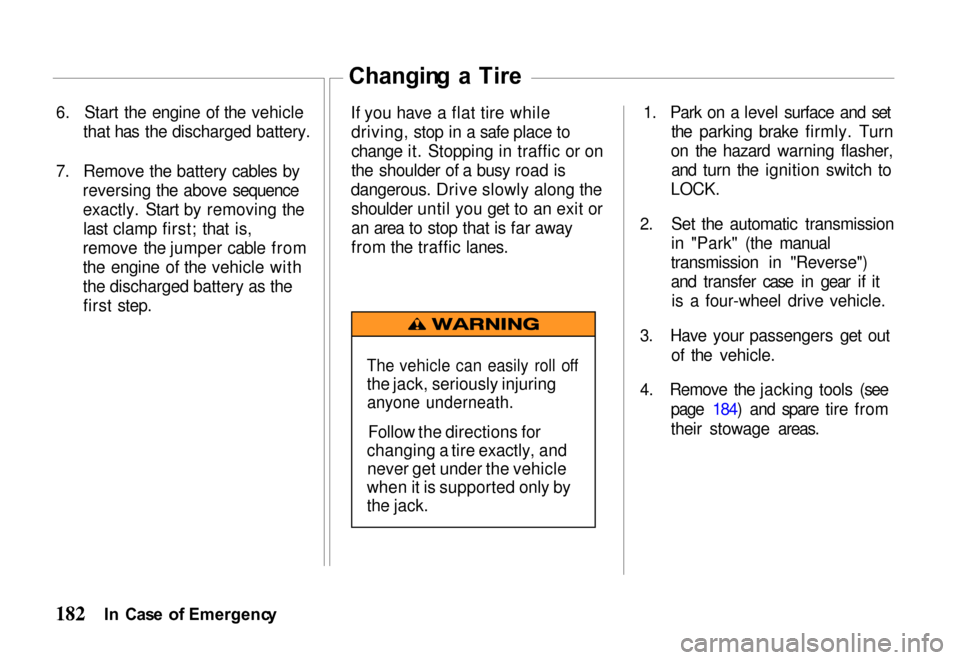
from the traffic lanes. 1. Park on a level surface and set
the parking brake firmly. Turn
on the hazard warning flasher, and turn the ignition switch to
LOCK.
2. Set the automatic transmission in "Park" (the manual
transmission in "Reverse")
and transfer case in gear if it is a four-wheel drive vehicle.
3. Have your passengers get out
of th
e vehicle.
4. Remove the jacking tools (see page 184) and spare tire from
their stowage areas.
I n Cas e o f Emergenc y
The vehicle can easily roll off
the jack, seriously injuring
anyone underneath.
Follow the directions for
changing a tire exactly, and never get under the vehicle
when it is supported only by
the jack.
Page 186 of 267
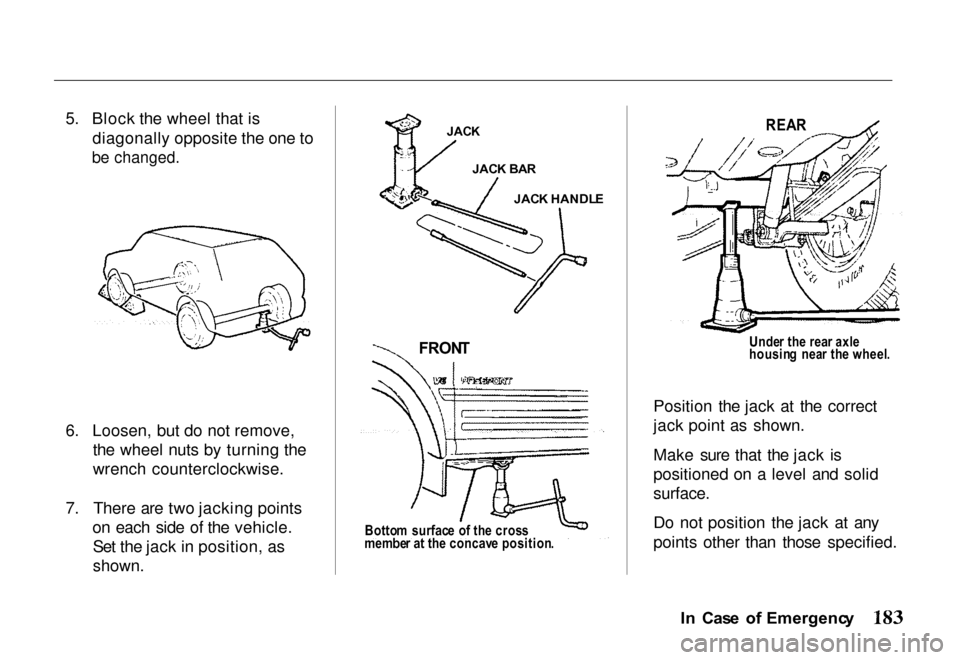
5. Block the wheel that is
diagonally opposite the one to
be changed.
6. Loosen, but do not remove, the wheel nuts by turning the
wrench counterclockwise.
7. There are two jacking points on each side of the vehicle.Set the jack in position, as
shown.
REA
R
Unde r th e rea r axl e
housin g nea r th e wheel .
Position the jack at the correct
jack point as shown.
Make sure that the jack is
positioned on a level and solid
surface.
Do not position the jack at any
points other than those specified.
In Cas e o f Emergenc y
JAC K
JAC K BA R
JAC K
HANDL
E
FRON T
Bottom surfac e o f th e cros s
membe r a t th e concav e position .
Page 187 of 267
8. Turn the jack handle
clockwise with a slow, smooth
motion to raise the vehicle sothe inflated spare tire will
clear the surface.
9. Remove the wheel nuts and the wheel.
10. Install the wheel and replace the whee
l nuts with the
cone-shaped end toward the
wheel, then hand-tighten each
nut. The wheel must be seated on the hub.
11.
Lower the vehicle by turning
the jac
k handle counter-
clockwise, then fully tighten the wheel nuts in a crisscrosssequence by turning the
wrench clockwise. Have the
wheel nut torque checked at
the nearest automotive service
facility.
87 lb-ft ( 118 N.m)
12.
Stow the jacking tools and flat
tire i
n their proper locations.
Too
l Location s
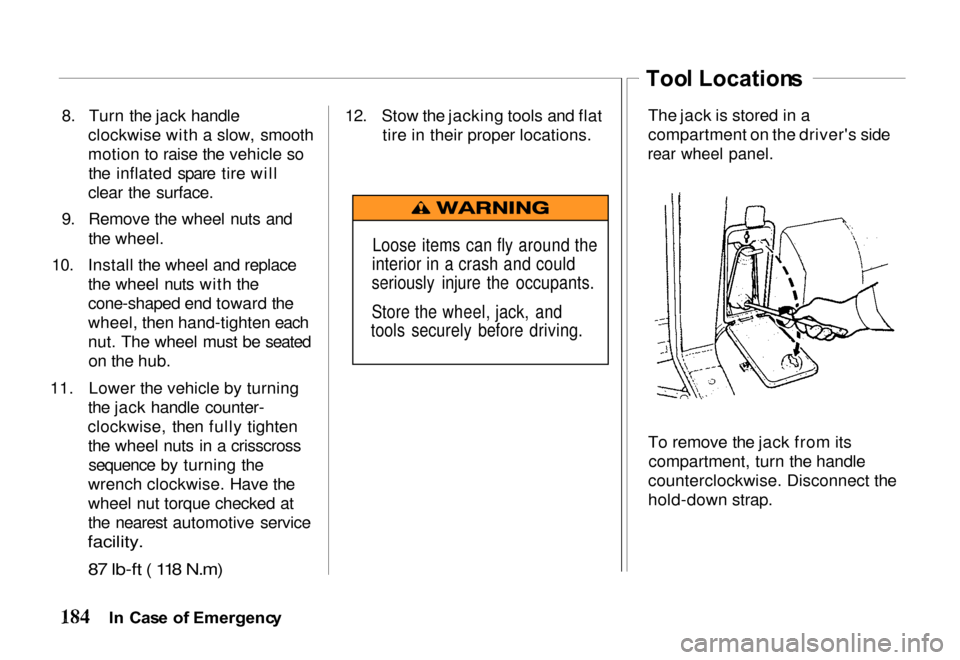
The jack is stored in a
compartment on the driver's side
rear wheel panel.
To remove the jack from itscompartment, turn the handle
counterclockwise. Disconnect the
hold-down strap.
I n Cas e o f Emergenc y
Loose items can fly around the
interior in a crash and could
seriously injure the occupants.
Store the wheel, jack, and
tools securely before driving.
Page 188 of 267
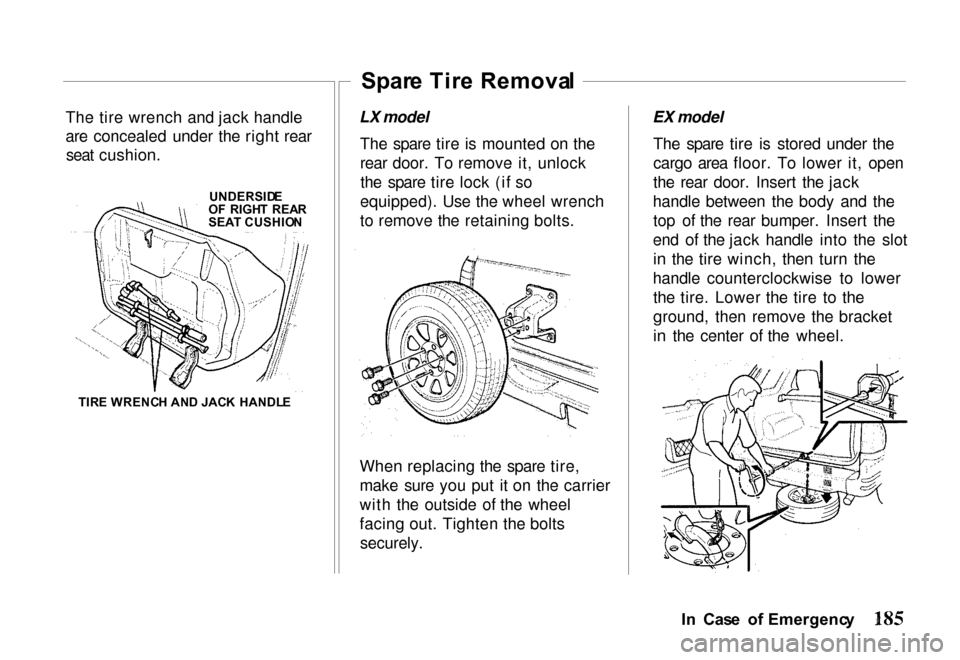
The tire wrench and jack handle
are concealed under the right rear
seat cushion.
UNDERSIDE
O F RIGH T REA R
SEA T CUSHIO N
TIR E WRENC H AN D JAC K HANDL E Spar
e Tir e Remova l
LX model The spare tire is mounted on the
rear door. To remove it, unlockthe spare tire lock (if so
equipped). Use the wheel wrench
to remove the retaining bolts.
When replacing the spare tire,
make sure you put it on the carrier
with the outside of the wheel
facing out. Tighten the bolts securely. EX model
The spare tire is stored under the
cargo area floor. To lower it, open
the rear door. Insert the jack
handle between the body and the top of the rear bumper. Insert the
end of the jack handle into the slot in the tire winch, then turn the
handle counterclockwise to lower the tire. Lower the tire to the
ground, then remove the bracket
in the center of the wheel.
In Cas e o f Emergenc y
Page 189 of 267
Reverse this procedure to store
the spare tire. Connect the spare
tire to the bracket with the outside
of the wheel facing up. Make sure
the tire does not catch on any part
of the underbody of the vehicle as
you are raising it, and that the spare tire is stored securely before
driving.
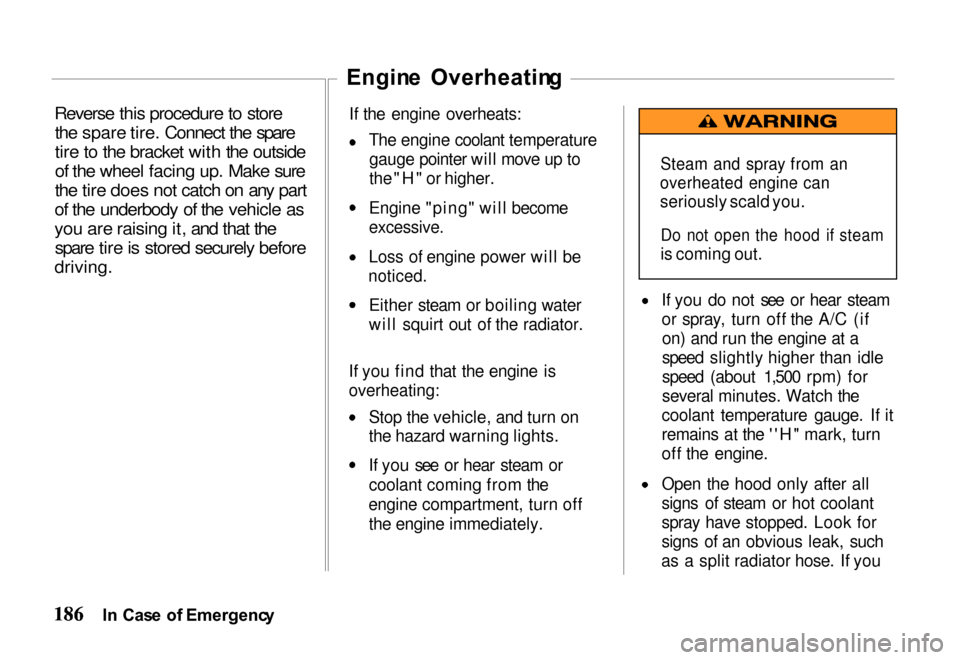
If the engine overheats:
The engine coolant temperaturegauge pointer will move up to
the "H" or higher. Engine "ping" will become
excessive.
Loss of engine power will be
noticed.
Either steam or boiling water
will squirt out of the radiator.
If you find that the engine is
overheating:
Stop the vehicle, and turn on
the hazard warning lights.
If you see or hear steam or
coolant coming from the
engine compartment, turn off the engine immediately. If you do not see or hear steam
or spray, turn off the A/C (if
on) and run the engine at a
speed slightly higher than idle
speed (about 1,500 rpm) for
several minutes. Watch the
coolant temperature gauge. If it
remains at the ''H" mark, turn
off the engine.
Open the hood only after all
signs of steam or hot coolant
spray have stopped. Look for
signs of an obvious leak, such
as a split radiator hose. If you
I n Cas e o f Emergenc y
Steam and spray from an
overheated engine can
seriously scald you.
Do not open the hood if steam
is coming out.
Engin
e Overheatin g
Page 190 of 267
find a leak, it must be repaired
before you can continue
driving. (See
Towing on page
187.)
If you don't find an obvious leak, check the coolant level inthe radiator reserve tank. If the
level is below the MIN mark, add
coolant to halfway between the
MIN and MAX marks.
If there was no coolant in the
reserve tank, you may also
have to add coolant to the
radiator.
Let the engine cool down until
the pointer reaches the middle
of the temperature gauge, orlower, before checking the
radiator. If needed, add coolant to the
radiator to bring the level up to the filler neck, and to the
reservoir up to the level indicated on the reservoir tank. Proper equipment must be used to
prevent damage to vehicles during
any towing. State and local laws
that apply to vehicles in tow must
be followed. Get detailed towing
instructions from your Honda
dealer.
Should it become necessary to
tow your vehicle, follow these
directions.
Precaution s
Before towing, make sure that
the power train, axle,
transmission, wheels and steering system are in good
condition.
If any of these items are
damaged, a flatbed trailer must
be used.
In Cas e o f Emergenc y
Towin
g
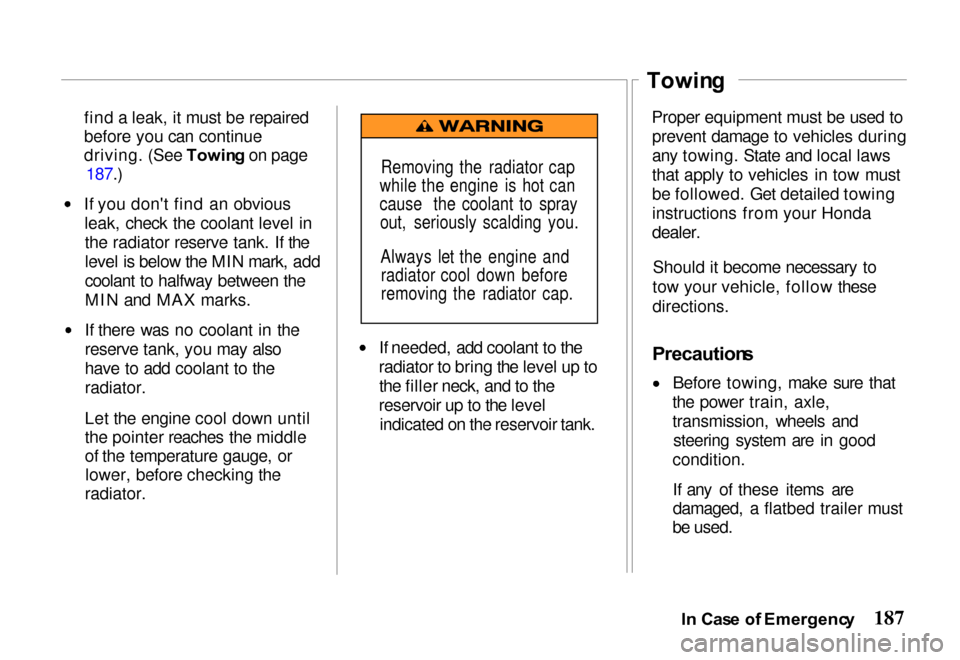
Removing the radiator cap
while the engine is hot can
cause the coolant to spray out, seriously scalding you.
Always let the engine andradiator cool down before
removing the radiator cap.