belt HONDA PASSPORT 2001 2.G Owner's Guide
[x] Cancel search | Manufacturer: HONDA, Model Year: 2001, Model line: PASSPORT, Model: HONDA PASSPORT 2001 2.GPages: 317, PDF Size: 4.85 MB
Page 45 of 317
To fasten the belt, insert the latch
plate into the buckle, then tug on
the belt
to make sure the buckle is
latched.
To unloc
k the belt, push the red
PRESS button
on the buckle.
Guide the
belt across your body to
the door
pillar. After exiting the
vehicle, be
sure the belt is out of
the way and will not get closed in
the door.
Al
l lap/shoulder
belts have an
emergency locking
retractor. In
normal driving, the retractor lets
you move freely in your seat
while it keeps some tension on the belt. During a collision or sudden
stop, the
retractor automatically
locks the
belt to help restrain your
body.
Driver and
Passenger Safety
Additional Information About Your Seat Belts
Lap/Shoulder Belt
Sea
t Belt System
Components
Your seat belt system includes lap/shoulder belts in the front
seats and the outer back seats, and a lap bel
t in the center back seat.
The system
also includes
a light on the instrument
panel to remind you and your
passengers to
fasten your belts. If
the driver's
seat belt is not
fastened before
the ignition is
turned ON(II), the light will come
on and a beeper will also sound.
The beeper will stop
after a few
seconds, bu
t the light will stay on
until the
driver's seat belt is
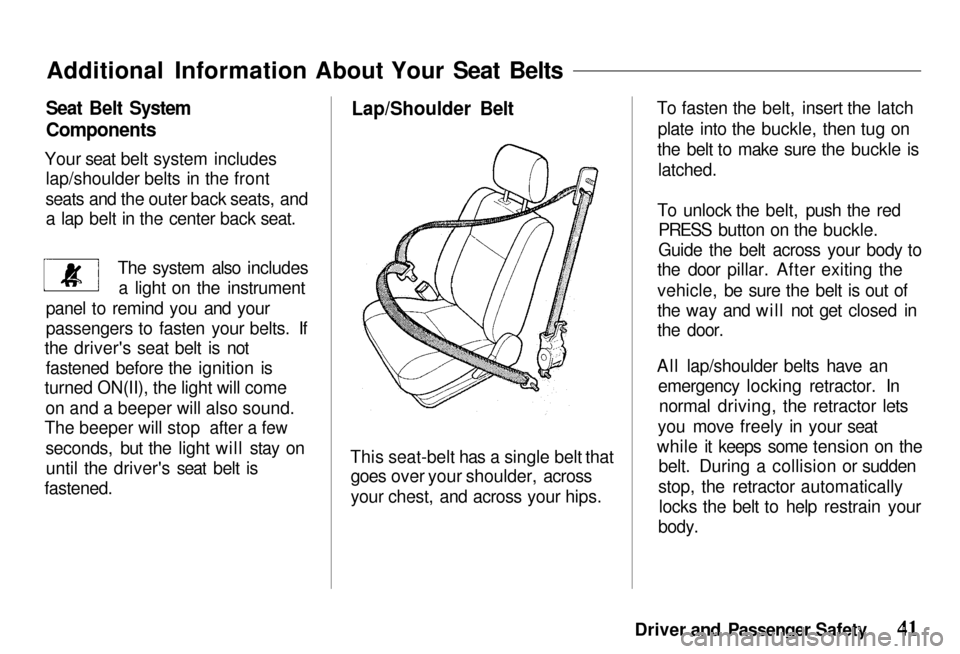
fastened. This seat-belt has a single belt that
goes over
your shoulder, across
your chest,
and across your hips.
Page 46 of 317
Al
l th e lap/shoulde r belt s excep t
th e driver' s hav e a n additiona l
lockin g mechanis m tha t mus t b e
activate d to secur e a chil d seat .
(Se e page s 2 7 an d 3 2 fo r
instruction s o n ho w to secur e
chil d seat s wit h thi s typ e o f sea t
belt. )
I f th e shoulde r par t o f th e bel t i s
pulle d al l th e wa y out , th e lockin g
mechanis m wil l activate . Th e bel t
wil l retract , bu t i t wil l no t allo w a
passenger to mov e freely .
T o deactivat e th e lockin g
mechanism , unlatc h th e buckl e
an d le t th e sea t bel t full y retract .
T o refaste n th e belt , pul l i t ou t
onl y a s fa r a s needed .
Se e pag e 1 3 fo r instruction s o n
ho w to wea r th e lap/shoulde r bel t
properly . La
p Bel t
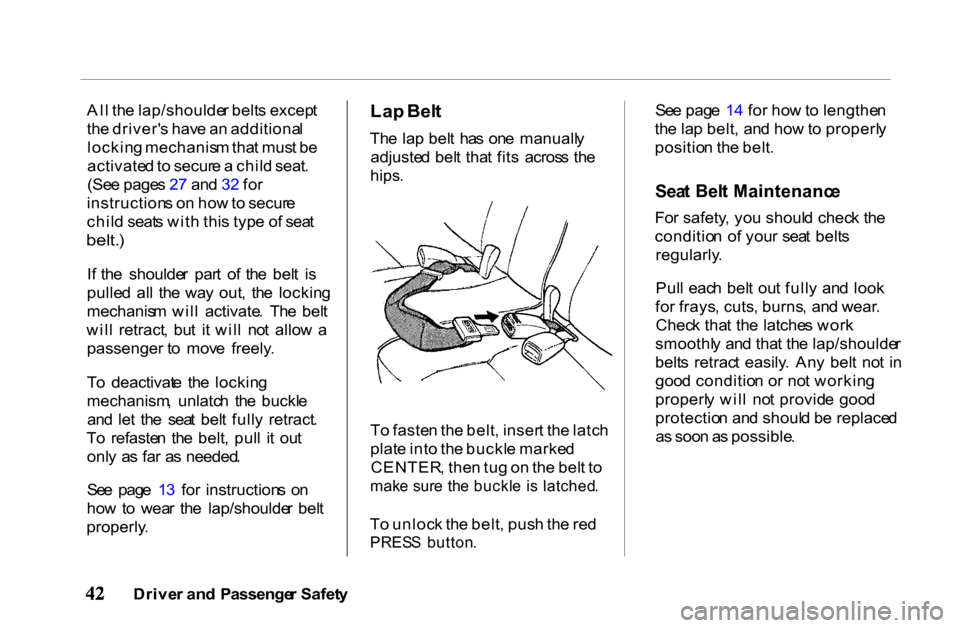
Th e la p bel t ha s on e manuall y
adjuste d bel t tha t fit s acros s th e
hips .
T o faste n th e belt , inser t th e latc h
plat e int o th e buckl e marke d
CENTER , the n tu g o n th e bel t t o
mak e sur e th e buckl e i s latched .
T o unloc k th e belt , pus h th e re d
PRES S button .
Se
e pag e 1 4 fo r ho w to lengthe n
th e la p belt , an d ho w to properl y
positio n th e belt .
Sea t Bel t Maintenanc e
Fo r safety , yo u shoul d chec k th e
conditio n o f you r sea t belt s
regularly .
Pul l eac h bel t ou t full y an d loo k
fo r frays , cuts , burns , an d wear .
Chec k tha t th e latche s wor k
smoothl y an d tha t th e lap/shoulde r
belt s retrac t easily . An y bel t no t i n
goo d conditio n o r no t workin g
properl y wil l no t provid e goo d
protectio n an d shoul d b e replace d
a s soo n a s possible .
Drive r an d Passenge r Safet y
Page 47 of 317
Hond
a provide s a lifetim e
warrant y o n sea t belts . Hond a wil l
repai r o r replac e an y sea t bel t
componen t tha t fail s t o functio n
properl y durin g norma l use .
Pleas e se e you r Honda Warranty
Information booklet fo r details .
I f a sea t bel t i s wor n durin g a
crash , yo u shoul d hav e you r
deale r inspec t th e belt , an d replac e
i t i f necessary. A bel t tha t ha s
bee n wor n durin g a cras h ma y no t
provid e th e sam e leve l o f
protectio n in a subsequen t crash .
Th e deale r shoul d als o inspec t th e
anchor s fo r damag e an d replac e
the m if needed . Fo
r informatio n o n ho w to clea n
you r sea t belts , se e pag e 229 . Th
e SR S is designe d t o provid e
protectio n unde r a wid e rang e o f
drivin g conditions , includin g
off-roa d driving . Whe n drivin g
off-road , i t i s importan t tha t
everyon e wea r thei r sea t belt s
properly , an d tha t yo u driv e a t
speeds that ar e saf e fo r th e terrai n
an d conditions . Refe r t o th e
Off-Road Driving Information
bookle t fo r tip s o n prope r
operation .
SR S Component s
You r Supplementa l Restrain t
Syste m (SRS ) includes :
Tw o fronta l airbags . Th e
driver' s airba g is store d in th e
cente r o f th e steerin g wheel ;
th e fron t passenger' s airba g is
store d in th e dashboard . Bot h
ar e marke d "SR S AIRBAG. "
Drive r an d Passenge r Safet y
Additiona
l Informatio n
Abou t You r SR S
No t checkin g o r maintainin g
sea t belt s ca n resul t i n seriou s
injur y o r deat h i f th e sea t belt s
d o no t wor k properl y whe n
needed .
Chec k you r sea t belt s regularl y
an d hav e an y proble m
correcte d a s soo n a s possible .
Page 48 of 317
Sensor
s tha t ca n detec t a
moderat e to sever e fronta l
collision .
A sophisticate d electroni c
syste m tha t continuall y
monitor s th e sensors , contro l
unit , th e airbag activators and
al l related wiring when the
ignitio n is O N (II) .
A n indicato r ligh t o n th e
instrumen t pane l t o aler t yo u t o
a possibl e proble m wit h th e
syste m (se e pag e 45 ).
Emergenc y backu p powe r i n
cas e you r vehicle' s electrica l
syste m is disconnecte d in a
crash .
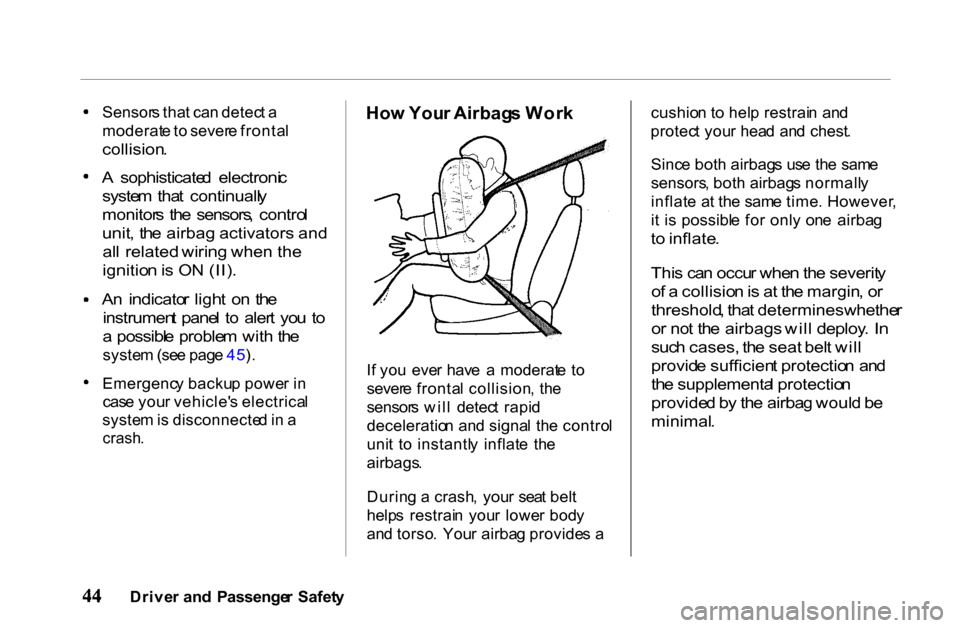
Ho
w You r Airbag s Wor k
I f yo u eve r hav e a moderat e t o
sever e fronta l collision , th e
sensor s wil l detec t rapi d
deceleratio n an d signa l th e contro l
uni t t o instantl y inflat e th e
airbags .
Durin g a crash , you r sea t bel t
help s restrai n you r lowe r bod y
an d torso . You r airba g provide s a cushio
n t o hel p restrai n an d
protec t you r hea d an d chest .
Sinc e bot h airbag s us e th e sam e
sensors , bot h airbag s normall y
inflat e a t th e sam e time . However ,
i t i s possibl e fo r onl y on e airba g
t o inflate .
Thi s ca n occu r whe n th e severit y
o f a collisio n is a t th e margin , o r
threshold , tha t determines whether
o r no t th e airbags will deploy . I n
suc h cases, the seat belt wil l
provid e sufficien t protectio n an d
th e supplementa l protectio n
provide d b y th e airba g woul d b e
minimal .
Drive r an d Passenge r Safet y
Page 50 of 317
I
f th e ligh t stay s o n afte r th e
engin e starts .
I f th e ligh t come s o n o r flashe s
o n an d of f whil e yo u drive .
I f yo u see any o f thes e
indications , you r airbag s ma y no t
deplo y whe n yo u nee d them . See
you r Hond a deale r a s soo n a s
possible .
SR
S Servic e
You r Supplementa l Restrain t
Syste m is virtuall y maintenance -
free , an d ther e ar e n o parts you
ca n safel y service . However , yo u
mus t hav e you r vehicl e service d
if :
Your airbags ever inflate. The
airbag s an d contro l uni t mus t
b e replaced . D o no t tr y t o
remov e o r replac e th e airbag s
yourself . Thi s mus t b e don e b y
a Hond a deale r o r a
knowledgeabl e bod y shop .
The SRS indicator light alerts
you to a problem. Take you r
vehicl e t o a n authorize d Hond a
deale r a s soo n a s possible . I f
yo u ignor e thi s indication , th e
airbag s migh t no t inflat e whe n
yo u nee d them .
Additiona
l Safet y
Precaution s
D o no t attemp t t o deactivat e
you r airbags . Together , airbag s
an d sea t belt s provid e th e bes t
protectio n in a moderat e t o
sever e fronta l collision .
D o no t tampe r wit h SR S
component s o r wirin g fo r an y
reason . Tamperin g coul d caus e
th e airbag s t o deploy , possibl y
causin g ver y seriou s injury .
See pag e 17 4 fo r furthe r
informatio n an d precaution s
relatin g t o you r SRS .
Drive r an d Passenge r Safet y
Ignorin
g th e SR S indicato r ligh t
ca n resul t i n seriou s injur y o r
deat h if th e airbag s d o no t
inflat e whe n needed .
Hav e you r vehicl e checke d b y a
deale r a s soo n a s possibl e if
th e SR S ligh t alert s yo u t o a
potentia l problem .
Page 66 of 317

th
e syste m repaire d if th e ligh t
doe s no t com e o n whe n th e ke y i s
turne d t o th e "ON " positio n
withou t th e engin e runnin g o r
whe n th e parkin g brak e is set .
Thi s ligh t doe s no t eliminat e th e
nee d fo r brak e inspectio n an d
maintenance . Th e brak e flui d
leve l mus t b e checke d regularly .
Se e th e maintenanc e sectio n o f
thi s manua l fo r othe r brak e
checks .
I f th e ligh t remain s o n afte r
engin e star t u p wit h th e parkin g
brak e released , o r come s o n
durin g operatio n o f th e vehicle , i t
ma y mea n tha t ther e is somethin g
wron g wit h th e brak e system .
What to do?
1 . Chec k t o se e if th e parkin g
brak e ha s bee n full y released .
2
. I f i t has , pul l of f th e roa d an d
sto p carefully . Remembe r that :
Stoppin g distance s ma y b e
longer . Yo
u ma y hav e t o pus h
harde r o n th e pedal .
Th e peda l ma y g o dow n
farthe r tha n normal .
3 . Hav e th e vehicl e towe d t o th e
neares t Hond a deale r fo r
repair .
D o no t continu e t o driv e wit h th e
brak e syste m ligh t on . Ther e ma y
b e a seriou s proble m wit h th e
brakin g system . Drivin g unde r
thi s conditio n is hazardou s an d
coul d lea d t o a n accident .
Th e brak e syste m ligh t doe s no t
indicat e tha t th e parkin g brak e i s
full y set . Whe n applyin g th e
parkin g brake , alway s pul l i t u p a s
fa r a s possible .
Hig
h Bea m
Th e headligh t hig h bea m indicato r
light s u p whe n th e headlight s ar e
o n hig h beam .
Chargin g Syste m
Thi s ligh t shoul d com e o n whe n
th e ke y i s turne d t o th e "ON "
positio n an d th e alternato r i s no t
charging . Th e ligh t ma y sta y o n a t
engin e idle ; however , i t shoul d g o
of f an d sta y of f abov e th e norma l
engin e idl e speed . I f th e ligh t
come s o n whil e driving , th e
chargin g syste m shoul d b e
checke d a t onc e s o th e batter y wil l
no t completel y discharge . Sto p th e
engine , an d chec k fo r a broke n
driv e belt . I f i t i s broken , o r i f th e
driv e bel t i s no t responsibl e fo r
th e trouble , hav e you r Hond a
deale r inspec t an d correc t th e
fault . I f th e driv e bel t i s broken ,
Instrument s an d Control s
Page 96 of 317

Th
e fron t seat-back s ca n b e tilte d
backwar d if s o desired , usin g th e
leve r o n th e doo r sid e o f eac h
fron t seat .
Rais e th e leve r an d us e bod y
pressur e to mov e th e seat-bac k to
th e desire d position . Le t g o o f th e
leve r an d th e seat-bac k wil l loc k
int o th e desire d position .
Kee
p th e sea t belt' s webbin g an d
latc h clea r o f th e sea t part s whe n
yo u til t th e foldin g seat s forwar d
o r backward . Thi s help s t o
preven t damag e t o th e sea t bel t
system .
Adjus t th e seat-bac k befor e yo u
star t driving . Tryin g to adjus t th e
seat-bac k wit h th e vehicl e i n
motio n coul d caus e yo u t o los e
control .
Driver'
s Sea t Ful l Powe r
Adjustment s
See pages 10 -11 for important
safety information and warnings
about how to properly position
seats and seat-backs.
Th e tw o powe r sea t adjustmen t
switche s ar e o n th e outsid e o f th e
sea t bottom . Th e horizonta l
switc h adjust s th e sea t botto m
forwar d an d backward . Th e shor t
vertica l switc h adjust s th e
seat-bac k angle .
Yo u ca n adjus t th e sea t wit h th e
ignitio n switc h in an y position .
Mak e al l adjustment s befor e yo u
star t driving .
Seat s
Page 100 of 317

5
. Inser t th e hea d restraint s
betwee n th e seat-bac k an d sea t
cushion .
Mak e sur e th e hea d restraint s ar e
secure d properl y betwee n th e
seat-bac k an d sea t cushion .
Neve
r le t passenger s rid e in th e
carg o are a o r o n to p o f th e
folded-dow n seat . Carr y
passenger s i n th e rea r onl y whe n
the y ar e sittin g o n th e locked ,
uprigh t sea t an d properl y
restraine d b y sea t belts .
Unfoldin g
1 . T o rais e th e seat-back , pul l i t
u p t o th e locke d uprigh t
position . Pul l o n th e seat-bac k
t o verif y bot h latche s ar e
locked .
2 . Whe n latchin g th e rea r sea t
cushio n t o th e floor , pus h th e
cushio n wit h enoug h forc e t o
loc k it .
Afte r this , confir m it i s locke d
b y pullin g th e sea t bel t buckl e
upward .
3
. Mak e sur e tha t th e hea d
restraint s ar e properl y
reinstalle d o n th e to p o f th e
seat-backs .
4 . Verif y tha t th e sea t belt s ar e
route d properl y an d no t
twisted .
Seat s
Drivin
g you r vehicl e withou t
hea d restraint s ca n lea d t o
seriou s injur y t o yo u an d you r
passenge r i n a crash .
Mak e sur e th e hea d restraint s
ar e i n plac e an d adjuste d
properl y befor e driving .
Page 118 of 317

B
e carefu l whe n yo u ar e usin g th e
beverag e holder . A spille d liqui d
tha t i s ver y ho t ca n scal d yo u o r
you r passengers . Spille d liquid s
ca n als o damag e th e upholstery ,
carpeting , an d electrica l
component s i n th e interior .
Sun Visor
The su n viso r ca n b e pivote d t o
th e sid e whe n unhooked . Glov
e Bo x
Ope n th e glov e bo x b y pullin g th e
handle .
Th e glov e bo x ca n b e locke d an d
unlocke d wit h th e ignitio n key .
Interio r Feature s A
n ope n glov e bo x ca n
caus e seriou s injur y t o you r
passenge r i n a crash , eve n if
th e passenge r i s wearin g th e
sea t belt .
Alway s kee p th e glov e bo x
close d whil e driving .
Page 213 of 317
Si
t i n th e driver' s sea t an d
perfor m thes e checks :
1 . Wit h th e engin e stopped ,
depres s th e brak e peda l severa l
times ; th e trave l distanc e an d
effectiv e peda l strok e shoul d
remai n unchanged .
2 . Star t th e engin e wit h th e brak e
peda l full y depressed .
Th e brak e peda l shoul d g o dow n
a littl e a s th e engin e starts .
3 . Depres s th e brak e pedal , sto p
th e engin e an d hol d th e peda l
depresse d fo r abou t 3 0
seconds ; th e brak e peda l
shoul d remai n i n positio n
withou t risin g o r goin g down .
4 . Restar t th e engin e an d ru n i t
fo r abou t a minute , the n tur n i t
of f an d depres s th e brak e
peda l firml y severa l times ; th e
brak e peda l trave l shoul d decreas
e eac h tim e th e brak e
peda l i s depressed .
I f th e brake s d o no t operat e
normally , hav e the m checke d an d
correcte d b y you r Hond a dealer .
Exhaus t syste m — Be aler t t o an y
change s i n th e soun d o f th e exhaus t
syste m o r an y smel l o f fumes .
Thes e ar e sign s th e syste m ma y b e
leakin g o r overheating . Hav e th e
syste m checke d and/o r repaire d a t
onc e i f thes e condition s exist . (Als o
se e "Carbo n Monoxid e Hazard " i n
th e "Drive r an d Passenger Safety "
sectio n an d "Three-Wa y Catalyti c
Converter " i n th e "Drivin g Tips "
section. )
Windshiel d wiper s an d
washer s — Chec k th e operatio n
an d conditio n o f th e wipe r blades .
Chec k th e flo w an d ai m o f th e
washe r spray .
Defrosters
— Chec k performanc e
b y movin g th e control s t o th e
defros t settin g an d notin g th e
amoun t o f ai r directe d agains t th e
windshield .
Rea r vie w mirror s an d su n
visor s — Chec k tha t th e frictio n
joint s hol d th e mirror s an d su n
visor s firml y i n place .
Hor n — Blo w th e hor n no w an d
the n t o b e sur e i t works .
La p an d shoulde r belt s — Chec k
th e bel t system , includin g
webbing , buckles , latc h plates ,
retractors , guid e loop s an d
anchor s fo r prope r operatio n an d
damage .
Sea t adjuster s — Whe n adjustin g
a seat , b e sur e th e sea t adjuster s
latc h securel y b y pushin g th e sea t
forwar d an d backward .
Car e an d Maintenanc e