belt HONDA PASSPORT 2001 2.G Workshop Manual
[x] Cancel search | Manufacturer: HONDA, Model Year: 2001, Model line: PASSPORT, Model: HONDA PASSPORT 2001 2.GPages: 317, PDF Size: 4.85 MB
Page 298 of 317
Restrain
t Syste m (SRS) . Th e ke y wor d
her e is "supplemental, " becaus e airbag s
ar e designe d t o wor k with , no t replace ,
th e "primary " restrain t syste m — sea t belts .
S o eve n if you r ca r ha s airbags , b e sur e
yo u an d you r passenger s alway s buckl e up .
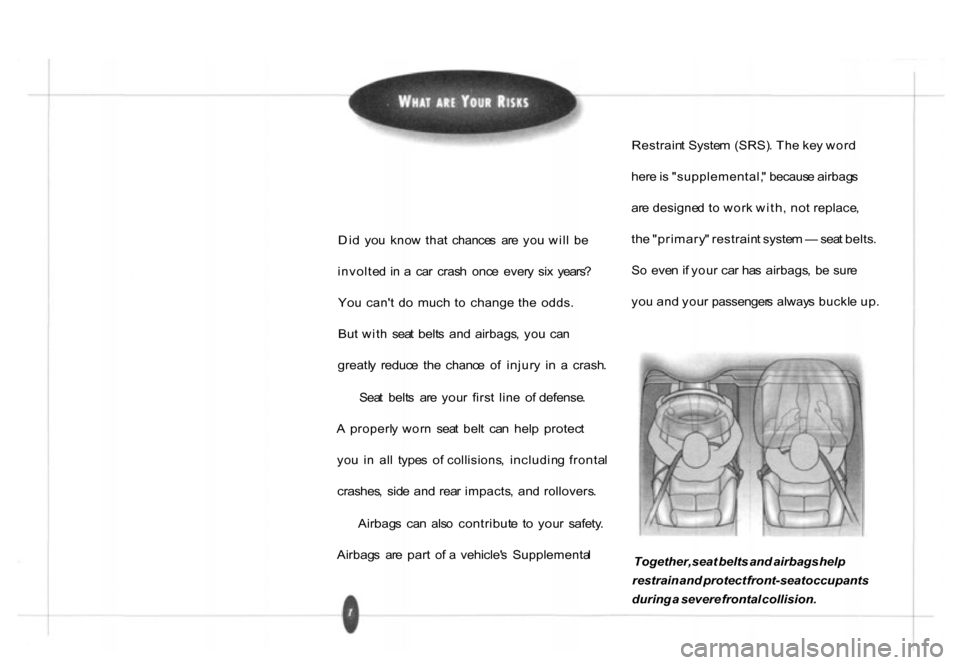
Together, seat belts and airbags help
restrain and protect front-seat occupants
during a severe frontal collision.
Di
d yo u kno w tha t chance s ar e yo u wil l b e
involte d in a ca r cras h onc e ever y si x years ?
You can't do much to change the odds.
Bu t wit h sea t belt s an d airbags , yo u ca n
greatl y reduc e th e chanc e o f injur y i n a crash .
Sea t belt s ar e you r firs t lin e o f defense .
A properl y wor n sea t bel t ca n hel p protec t
yo u i n al l type s o f collisions , includin g fronta l
crashes , sid e an d rea r impacts , an d rollovers .
Airbag s ca n als o contribut e t o you r safety .
Airbag s ar e par t o f a vehicle' s Supplementa l
Page 299 of 317
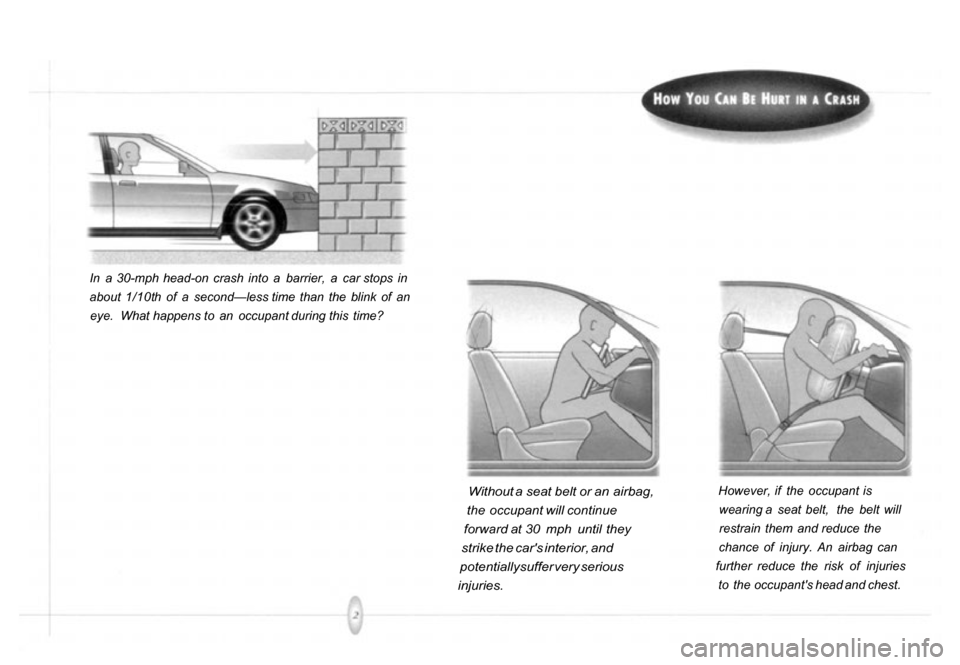
In
a 30-mph head-on crash into a barrier, a car stops in
about 1/10t h o f a second—less time than the blink of a n
eye. What happens to an occupant during this time?
However, if the occupant is
wearing a seat belt, the belt will
restrain them and reduce the
chance of injury. An airbag can
further reduce the risk of injuries
to the occupant's head and chest.
Without
a seat belt or an airbag,
the occupant will continue
forward at 30 mph until they
strike the car's interior, and
potentially suffer very serious
injuries.
Page 300 of 317
"Spee
d kills, " a sayin g goes . Whil e th e ris k
o f injur y generall y increase s wit h speed ,
no t al l aut o injurie s occu r a t hig h speeds ,
an d spee d alon e doe s no t caus e injuries . I n
fact , th e mai n caus e o f collisio n injurie s i s
a rapi d decreas e i n speed , o r rapi d
deceleration .
Fo r example, if a ca r collide s head-o n
wit h a soli d barrie r a t 3 0 mph , th e ca r wil l
decelerat e t o a sto p almos t instantly . Sinc e
a perso n insid e th e ca r travel s a s fas t a s th e car
, the y wil l continu e forwar d at 30 mp h
unti l the y ar e stoppe d b y something .
I f a perso n i s no t stoppe d b y a sea t bel t
o r airbag , the y wil l strik e th e interio r o f th e
ca r wit h a forc e equivalen t t o fallin g ou t o f a
third-stor y windo w an d landin g face-firs t o n
pavement . However , i f th e perso n i s wearin g
a sea t belt , th e bel t wil l allo w the m to
decelerat e a t a slowe r rate . An d th e airba g
wil l provid e additiona l protectio n for thei r
hea d an d chest .
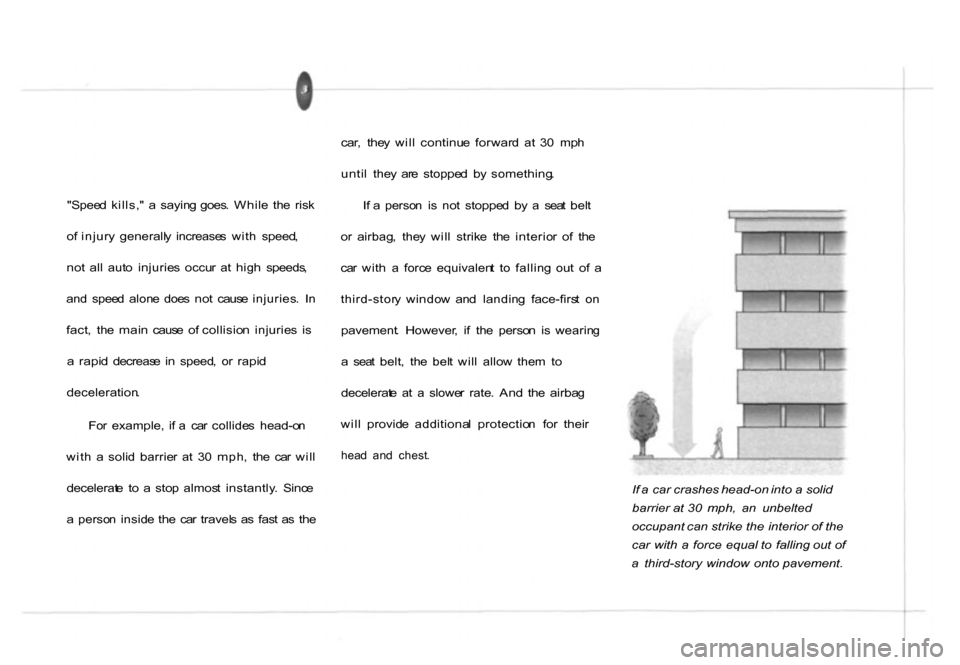
If a car crashes head-on into a solid
barrier at 30 mph, an unbelted
occupant can strike the interior of the
car with a force equal to falling out of
a third-story window onto pavement.
Page 301 of 317
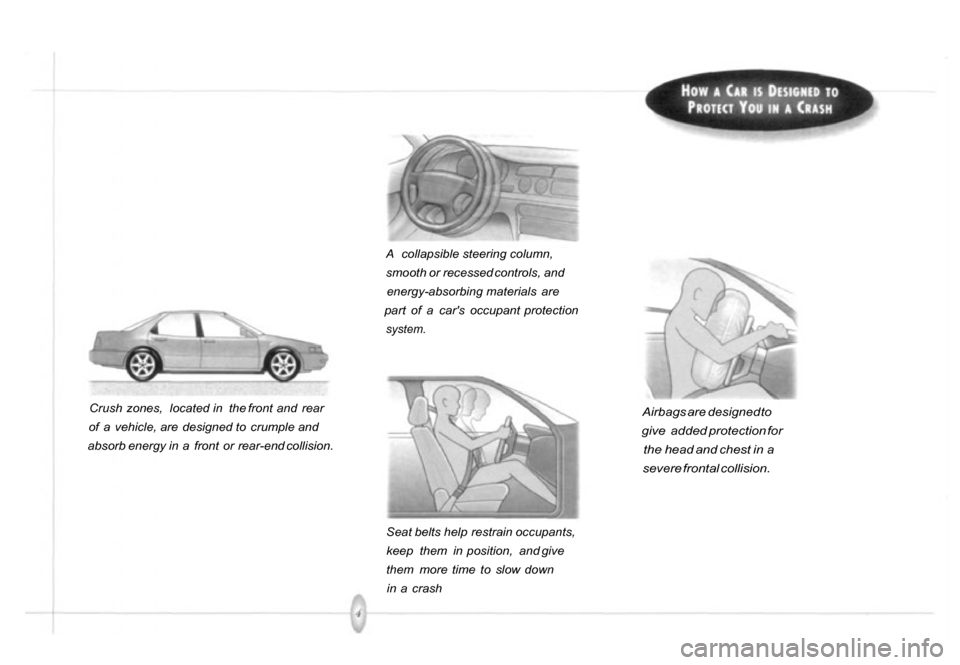
Crush
zones, located in the front and rear
of a vehicle, are designed to crumple and
absorb energy in a front or rear-end collision. A
collapsible steering column,
smooth or recessed controls, and
energy-absorbing materials are
part of a car's occupant protection
system.
Seat belts help restrain occupants,
keep them in position, and give
them more time to slow down
in a crash
Airbags
are designed to
give added protection for
the head and chest in a
severe frontal collision.
Page 302 of 317

T
o hel p automobil e occupant s surviv e th e
tremendo s force s o f a crash , vehicl e
designer s hav e develope d numerou s safet y
feature s an d systems .
Fo r example , moder n automobile s hav e
fron t an d rea r "crus h zones " tha t ar e
designe d t o defor m o r crumpl e i n a crash .
Th e crumplin g lengthen s th e duratio n o f th e
crash , an d help s absor b an d dissipat e cras h
energy , whic h lower s th e rat e o f deceleration
i n th e passenge r compartment .
Th e dashboard , seats , headrest s an d othe r
interio r part s o f automobile s als o us e energy -
absorbin
g material s t o hel p protec t th e
occupants . I n addition , th e steerin g colum n i s
designe d t o collaps e i f struc k durin g a
collision .
Sea t belt s hav e prove n t o b e th e singl e
mos t effectiv e devic e i n reducin g automobil e
fatalitie s an d injurie s i n al l type s o f accidents .
Whe n properl y worn , sea t belt s hel p restrai n
occupant s fro m strikin g interio r part s o f th e
car , the y kee p occupant s connecte d t o th e ca r
s o the y ca n tak e advantag e o f th e energ y
absorptio n buil t int o th e car , an d the y
allo w occupant s t o decelerat e mor e slowl y
durin g a crash . Airbag
s ar e a recen t additio n t o a
car' s occupan t protectio n system . Airbag s
hav e a n importan t bu t limite d role—t o
hel p protec t th e head s an d chest s o f
front-sea t occupant s durin g a sever e
fronta l collision .
However , yo u can' t ge t th e ful l
benefi t o f thes e life-savin g feature s
unles s yo u buckl e up . I n short , it' s bette r
t o le t th e ca r absor b th e energy . It' s buil t
t o tak e it .
Page 303 of 317
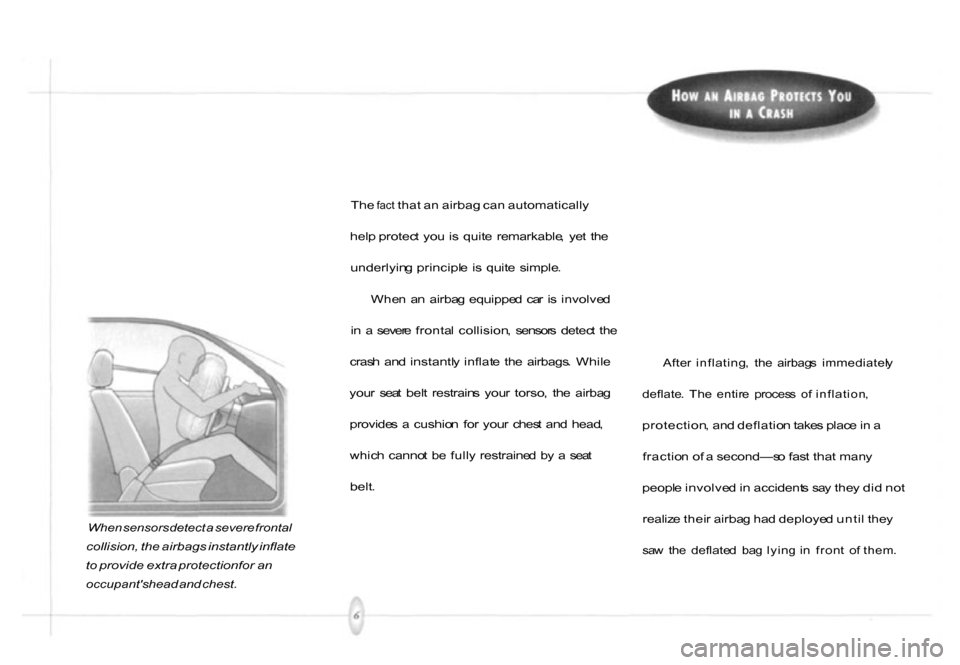
When
sensors detect a severe frontal
collision, the airbags instantly inflate
to provide extra protection for an
occupant's head and chest.
Afte
r inflating , th e airbag s immediatel y
deflate . Th e entir e proces s o f inflation ,
protection , an d deflatio n take s plac e in a
fractio n o f a second—s o fas t tha t man y
peopl e involve d in accident s sa y the y di d no t
realiz e thei r airba g ha d deploye d unti l the y
sa w th e deflate d ba g lyin g i n fron t o f them .
The
fact
that an airbag can automatically
hel p protec t yo u i s quit e remarkable , ye t th e
underlyin g principl e i s quit e simple .
Whe n a n airba g equippe d ca r i s involve d
i n a sever e fronta l collision , sensor s detec t th e
cras h an d instantl y inflat e th e airbags . Whil e
you r sea t bel t restrain s you r torso , th e airba g
provide s a cushio n fo r you r ches t an d head ,
whic h canno t b e full y restraine d b y a sea t
belt .
Page 305 of 317
Airbag
s ar e onl y on e par t o f a car' s tota l
occupant protectio n
system ,
an d the y hav e
on e simpl e bu t ver y importan t role—t o
supplemen t sea t belt s an d hel p protec t front -
seat occupants during a severe frontal
collision .
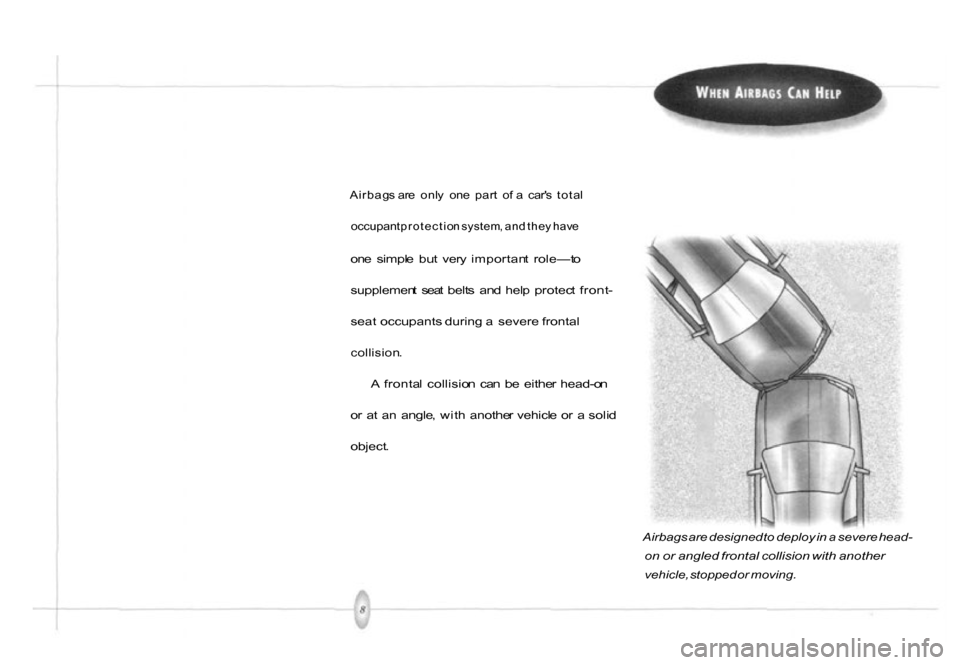
A fronta l collisio n ca n b e eithe r head-o n
o r a t a n angle , wit h anothe r vehicl e o r a soli d
object .
Airbags are designed to deploy in a severe head-
on or angled frontal collision with another
vehicle, stopped or moving.
Page 307 of 317
Airbag
s ca n povid e life-savin g protection ,
bu t onl y i n a sever e fronta l collision .
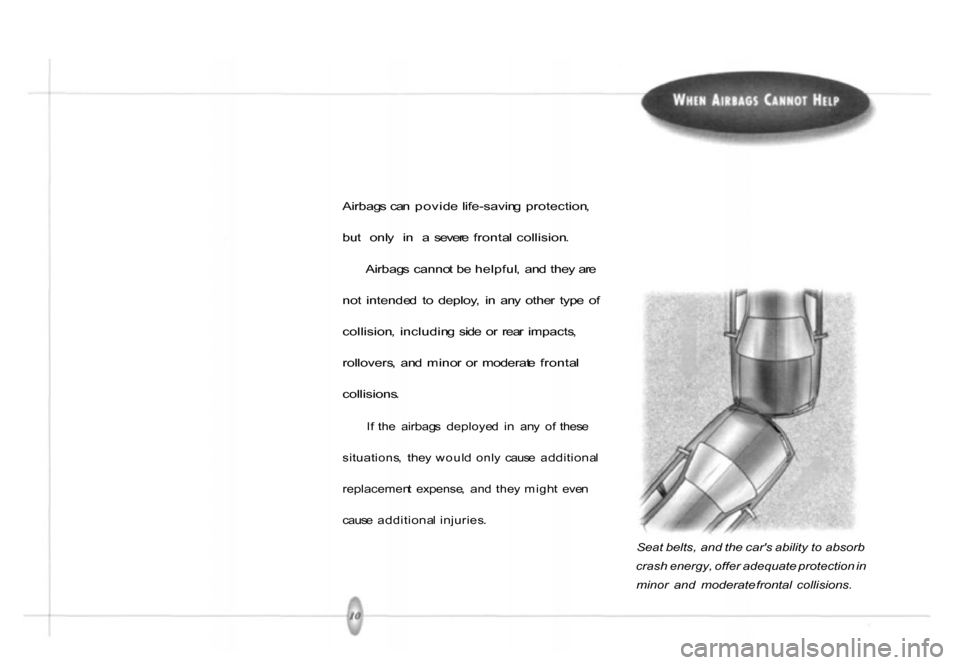
Airbag s canno t b e helpful , an d the y ar e
no t intende d t o deploy , i n an y othe r typ e o f
collision , includin g sid e o r rea r impacts ,
rollovers , an d mino r o r moderat e fronta l
collisions .
I f th e airbag s deploye d i n an y o f thes e
situations , the y woul d onl y caus e additiona l
replacemen t expense , an d the y migh t eve n
caus e additiona l injuries .
Seat belts, and the car's ability to absorb
crash energy, offer adequate protection in
minor and moderate frontal collisions.
Page 311 of 317
T
o wea r a sea t bel t properly , yo u shoul d
si t up , wel l bac k i n you r seat , wit h th e la p
portio n o f th e bel t pulle d snugl y acros s you r
hip s an d th e shoulde r portio n restin g agains t
you r ches t an d shoulder .
Befor e drivin g away , it' s ver y importan t t o
mov e th e driver' s sea t a s fa r bac k a s yo u ca n
whil e stil l allowin g goo d contro l o f th e vehicle .
I f yo u hav e a fron t passenger , hav e the m mov e
thei r sea t a s fa r bac k a s possible . Why ?
Yo
u ca n ge t th e maximu m protectio n offere d
b y airbage s b y followin g a fe w simpl e rules .
First , alway s wea r a sea t belt . A sea t bel t i s
you r bes t protectio n i n an y accident .
A properl y wor n sea t bel t wil l als o hel p kee p
yo u i n a goo d positio n shoul d you r airbag s
eve r deploy .
Page 312 of 317
T
o d o thei r job , airbag s inflat e wit h
tremendou s speed—ove r 10 0 mph . S o whil e
airbag s ca n sav e you r lif e an d reduc e th e
severit y o f injuries , the y ca n als o caus e
abrasion s an d bruises . An d i f yo u si t to o
close , or don' t wea r a sea t belt , or don' t si t in
a prope r position , a n inflatin g airba g ca n
caus e broke n bone s o r mor e seriou s injuries .
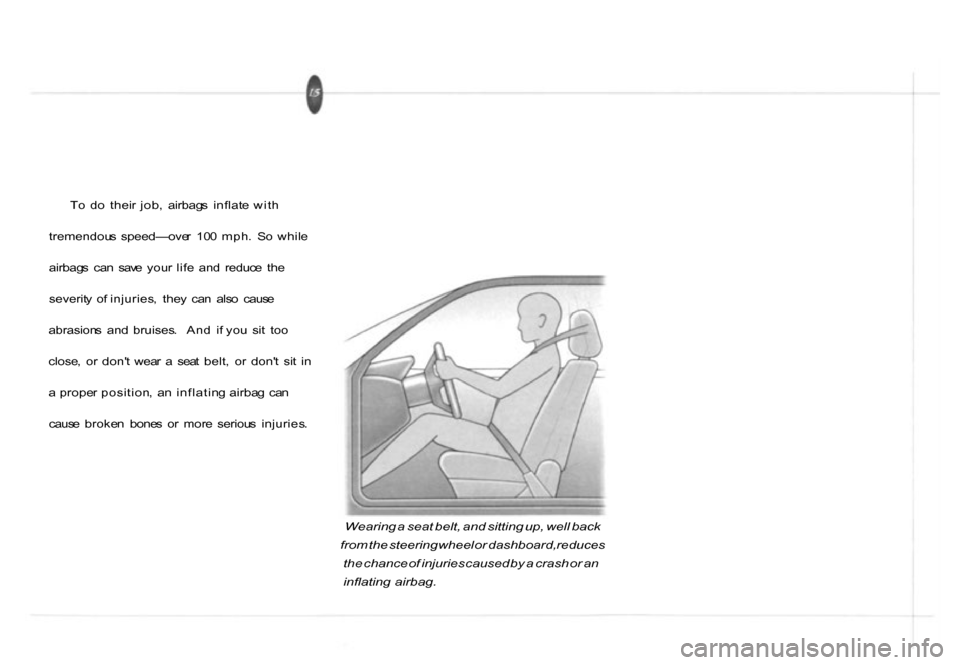
Wearing a seat belt, and sitting up, well back
from the steering wheel or dashboard, reduces
the chance of injuries caused by a crash or an
inflating airbag.