seats HONDA PASSPORT 2001 2.G Owners Manual
[x] Cancel search | Manufacturer: HONDA, Model Year: 2001, Model line: PASSPORT, Model: HONDA PASSPORT 2001 2.GPages: 317, PDF Size: 4.85 MB
Page 1 of 317
 to navigate through\
this reference.
For a printed owners manual, click on authorized manuals or go")
2001 Passport Online Reference Owner's Manual Use these links (and links throughout this manual) to navigate through\
this reference.
For a printed owner's manual, click on authorized manuals or go to www.h\
elminc.com. Contents
Owner's Identification Form
A Word to the Owner
........................................................................\
................................................... i
Important Handling Information ........................................................................\
.............................. ii
A Few Words About Safety
........................................................................\
........................................ iv
Driver and Passenger Safety ........................................................................\
...................................... 3
Proper use and care of your vehicle's seat belts, and Supplemental Restr\
aint System.
Off to a Good Start
........................................................................\
..................................................... 49
Instruments and Controls
........................................................................\
......................................... 55
Instrument panel indicator and gauge, and how to use dashboard and steering co\
lumn controls.
Seats
........................................................................\
........................................................................\
.... 89
Interior Features
........................................................................\
....................................................... 99
Comfort and Convenience Features
........................................................................\
...................... 119
How to operate the climate control system, the audio system, and other c\
onvenience features.
Driving Tips
........................................................................\
.............................................................. 155
The proper way to start the engine, shift the transmission, and park, wh\
at gasoline to use, how to
break -in your new vehicle, and how to load luggage and other cargo.
In Case of Emergency
........................................................................\
.............................................. 183
This section covers several problems motorists sometimes experience, and how to handle them.
Care and Maintenance
........................................................................\
............................................ 195
The Maintenance Schedule shows you when you need to take your vehicle to\
the dealer and
tips on cleaning and protecting your vehicle. Things to look for if your\
car ever needs body
repairs.
Technical Data
........................................................................\
......................................................... 231
ID numbers, dimensions, capacities, and technical information.
Owner Assistance
........................................................................\
..................................................... 245
A summary of the warranties covering your new Honda, and how to contact \
us.
Authorized Manuals
........................................................................\
................................................ 253
How to order manuals and other technical literature.
Index ........................................................................\
.......................................................................
.....
I
Supplemental Restraint System Off Road Driving Information
Page 10 of 317
som
e safet y feature s ca n
contribut e t o injurie s i f the y ar e
no t use d properly .
Sea t Belt s
Fo r you r safety , an d th e safet y o f
you r passengers , you r vehicl e i s
equippe d wit h sea t belt s i n al l
seatin g positions .
You r sea t bel t syste m
als o include s a ligh t o n
th e instrumen t pane l t o remin d
yo u an d you r passenger s t o faste n
you r sea t belts .
Why Wear Seat Belts
Sea t belt s ar e th e singl e mos t
effectiv e safet y devic e fo r adult s
an d large r children . (Infant s an d
smalle r childre n mus t b e
restraine d i n chil d seats. ) No
t wearin g a sea t bel t properl y
increase s th e chanc e o f seriou s
injur y o r deat h i n a crash , eve n
thoug h you r vehicl e ha s airbags .
I n addition , mos t state s an d
Canadia n province s requir e yo u t o
wea r sea t belts . Whe
n properl y worn , sea t belts : Kee
p yo u connecte d t o th e
vehicl e s o yo u ca n tak e
advantag e o f th e vehicle' s
built-i n safet y features . Hel
p protec t yo u i n almos t
ever y typ e o f crash , includin g
sid e an d rea r impact s an d
rollovers . I n a rollove r crash ,
a n unbelte d perso n i s mor e
likel y t o di e tha n a perso n
wearin g a sea t belt . You r airba g
ca n onl y b e helpfu l i n a
moderat e t o sever e fronta l
collision .
Hel
p kee p yo u fro m bein g
throw n agains t th e insid e o f th e
vehicl e an d agains t othe r
occupants .
Kee
p yo u fro m bein g throw n
ou t o f th e vehicle .
Drive r an d Passenge r Safet y No
t wearin g a sea t bel t
properl y increase s th e chanc e
o f seriou s injur y o r deat h i n a
crash , eve n i f yo u hav e
airbags .
B e sur e yo u an d you r
passenger s alway s wea r sea t
belt s an d wea r the m properly .
Page 12 of 317
onl
y durin g a moderat e to
sever e fronta l collision .
Airbags
can pose serious
hazards. To d o thei r job ,
airbag s mus t inflat e wit h
tremendou s forc e an d speed . S o
whil e airbag s sav e lives , the y
ca n caus e seriou s injurie s t o
adult s an d large r childre n wh o
ar e no t wearin g sea t belts , ar e
no t wearin g the m properly , ar e
sittin g to o clos e t o th e airbag ,
o r ar e no t sittin g in a prope r
position . Infant s an d smal l
childre n ar e a t a n eve n greate r
ris k o f injur y o r death .
What you should do: Always
wea r you r sea t bel t properly , an d
si t uprigh t an d a s fa r bac k a s
possibl e fro m th e steerin g whee l
o r dashboard .
Seat
s an d Seat-Back s
You r vehicle' s seat s ar e designe d
t o kee p yo u in a comfortable ,
uprigh t positio n s o yo u ca n tak e
ful l advantag e o f th e protectio n
offere d b y sea t belt s an d th e
energy-absorbin g material s i n th e
seats.
Ho w yo u adjus t you r seat s an d
seat-back s ca n als o affec t you r
safety . Fo r example , sittin g to o
clos e t o th e steerin g whee l o r
dashboar d increase s th e ris k o f
yo u o r you r passenge r bein g
injure d b y strikin g th e insid e o f
th e vehicle , o r b y a n inflatin g
airbag .
Reclinin
g a seat-bac k to o fa r
reduce s th e sea t belt' s
effectivenes s an d increase s th e
chanc e tha t th e seat' s occupan t
wil l slid e unde r th e sea t bel t i n a
cras h an d b e seriousl y injured .
What you should do: Mov e th e
fron t seat s a s fa r bac k a s possible ,
an d kee p adjustabl e seat-back s i n
a n uprigh t positio n wheneve r th e
vehicl e i s moving .
Hea d Restraint s
Hea d restraint s ca n hel p protec t
yo u fro m whiplas h an d othe r
injuries . Fo r maximu m protection ,
th e bac k o f you r hea d shoul d res t
agains t th e cente r o f th e hea d
restraint .
Drive r an d Passenge r Safet y
Page 13 of 317
Doo
r Lock s
Keepin g you r door s locke d
reduce s th e chanc e o f bein g
throw n ou t o f th e vehicl e durin g
a crash . I t als o help s preven t
occupants from accidentall y
openin g a doo r an d fallin g out ,
an d outsider s fro m unexpectedl y
openin g you r doors .
Pre-Driv e Safet y Checklis t
T o mak e sur e yo u an d you r
passenger s ge t th e maximu m
protectio n fro m you r vehicle' s
safet y features , chec k th e
followin g eac h tim e befor e yo u
driv e away .
Al l adults , an d childre n wh o
hav e outgrow n chil d safet y
seats , ar e wearin g thei r sea t
belt s an d wearin g the m
properl y (se e pag e 13 ). An
y infan t o r smal l chil d is
properl y restraine d in a chil d
sea t i n th e bac k sea t (se e pag e
18 ).
Fron t sea t occupant s ar e sittin g
uprigh t an d a s fa r bac k a s
possibl e fro m th e steerin g
whee l an d dashboar d (se e pag e
10 ).
Seat-back s ar e uprigh t (se e
pag e 11 ).
Hea d restraint s ar e properl y
adjuste d (se e pag e 12 ).
Al l door s an d th e tailgat e ar e
close d an d locke d (se e pag e
10 ).
Al l carg o i s properl y store d o r
secure d (se e pag e 175 ). Th
e res t o f thi s sectio n give s mor e
detaile d informatio n abou t ho w
yo u ca n maximiz e you r safety .
Remember , however , tha t n o
safet y syste m ca n preven t al l
injurie s o r death s tha t ca n occu r i n
sever e crashes , eve n whe n sea t
belt s ar e properl y wor n an d th e
airbag s deploy .
Drive r an d Passenge r Safet y
Page 15 of 317
T
o reduc e th e chanc e o f injury ,
wea r you r sea t bel t properly , si t
uprigh t wit h you r bac k agains t th e
seat , an d mov e th e sea t a s fa r bac k
a s possibl e fro m th e steerin g
whee l whil e stil l maintainin g ful l
contro l o f th e vehicle . Als o mak e
sur e you r fron t sea t passenge r
move s th e sea t a s fa r t o th e rea r a s
possible .
Most shorte r driver s ca n ge t fa r
enoug h awa y fro m th e steerin g
whee l an d stil l reac h th e pedals .
However , i f yo u ar e concerned
abou t sittin g to o close , w e
recommen d tha t yo u investigat e
whethe r som e typ e o f adaptiv e
equipmen t ma y help .
Onc e you r sea t i s adjuste d
correctly , roc k i t bac k an d fort h t o
mak e sur e th e sea t i s locke d in
position .
See pages 9 1 an d 9 2 fo r ho w to
adjus t th e fron t seats .
3
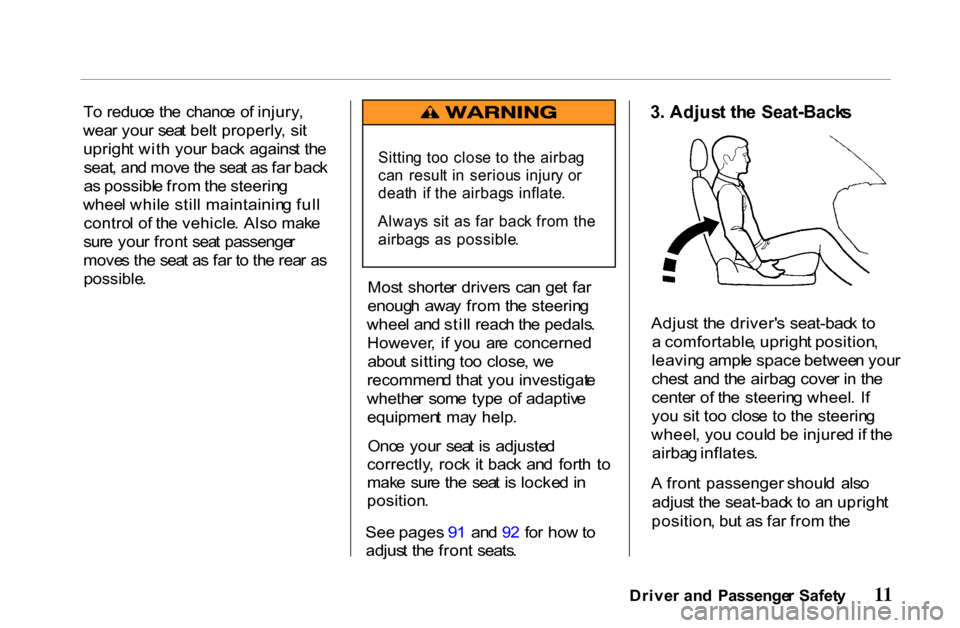
. Adjus t th e Seat-Back s
Adjus t th e driver' s seat-bac k t o
a comfortable , uprigh t position ,
leavin g ampl e space betwee n you r
ches t an d th e airba g cove r i n th e
cente r o f th e steerin g wheel . I f
yo u si t to o clos e t o th e steerin g
wheel , yo u coul d b e injure d if th e
airba g inflates .
A fron t passenger should als o
adjus t th e seat-bac k t o a n uprigh t
position , bu t a s fa r fro m th e
Drive r an d Passenge r Safet y
Sittin
g to o clos e t o th e airba g
ca n resul t i n seriou s injur y o r
deat h i f th e airbag s inflate .
Alway s si t a s fa r bac k fro m th e
airbag s a s possible .
Page 20 of 317
7
. Maintai n a Prope r Sittin g
Positio n
Afte r al l occupant s hav e adjuste d
thei r seat s an d pu t o n sea t belts , i t
i s ver y importan t tha t the y
continu e t o si t upright , wel l bac k
i n thei r seats , wit h thei r fee t o n
th e floor , unti l th e vehicl e i s
parke d an d th e engin e
i s off .
Sittin g improperl y ca n increas e
th e chanc e o f injur y durin g a
crash . Fo r example , i f a n occupan t
slouches , lie s down , turns
sideways , sit s forward , lean s
forwar d o r sideways , o r put s on e
o r bot h fee t up , th e chanc e o f
injur y durin g a cras h is greatl y
increased .
I n addition , a n occupan t wh o i s
ou t o f positio n i n th e fron t sea t
ca n b e seriousl y o r fatall y injure d
b y strikin g interio r part s o f th e
vehicle
, o r b y bein g struc k b y a n
inflatin g airbag .
Remember , t o ge t th e bes t
protectio n fro m you r vehicle' s
airbag s an d othe r safet y features ,
yo u mus t si t properl y an d wea r
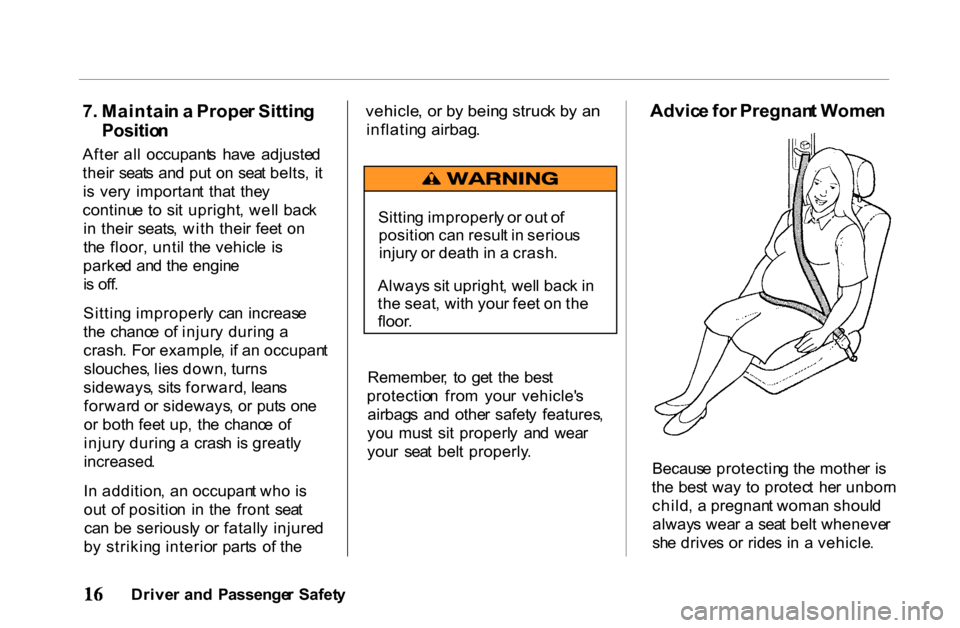
you r sea t bel t properly . Advic
e fo r Pregnan t Wome n
Becaus e protectin g th e mothe r i s
th e bes t wa y t o protec t he r unbor n
child , a pregnan t woma n shoul d
alway s wea r a sea t bel t wheneve r
sh e drive s o r ride s i n a vehicle .
Drive r an d Passenge r Safet ySittin
g improperl y o r ou t o f
positio n ca n resul t i n seriou s
injur y o r deat h in a crash .
Alway s si t upright , wel l bac k i n
th e seat , wit h you r fee t o n th e
floor .
Page 24 of 317
Small
Children
Placing a forward-facing child
seat in the front seat of a vehicle
equipped with a passenger's
airbag can be hazardous. If th e
vehicl e sea t i s to o fa r forward , o r
th e child' s hea d is throw n forwar d
durin g a collision , a n inflatin g
airba g ca n strik e th e chil d wit h
enoug h forc e t o kil l o r ver y
seriousl y injur e a smal l child .
Larger Children
Children who have outgrown
child seats are also at risk of
being injured or killed by an
inflating passenger's airbag.
Wheneve r possible , large r
childre n shoul d si t i n th e bac k
seat , properl y restraine d wit h a
sea t belt . (Se e pag e 3 4 fo r
importan t informatio n abou t
protectin g large r children. )
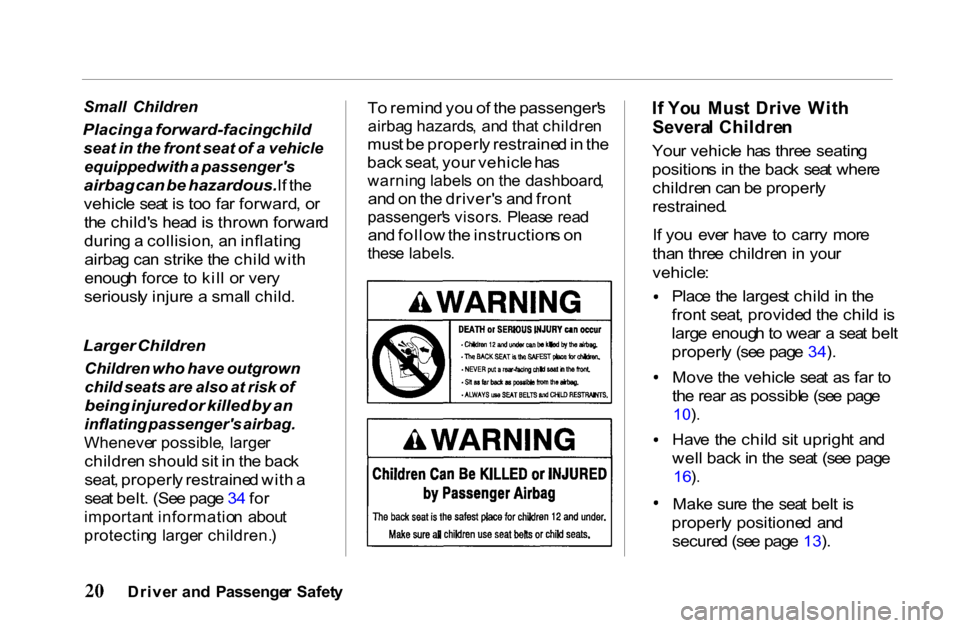
T
o remin d yo u o f th e passenger' s
airba g hazards , an d tha t childre n
mus t b e properl y restraine d in th e
bac k seat , you r vehicl e ha s
warnin g label s o n th e dashboard ,
an d o n th e driver' s an d fron t
passenger' s visors . Pleas e rea d
an d follo w th e instruction s o n
thes e labels .
I
f Yo u Mus t Driv e Wit h
Severa l Childre n
You r vehicl e ha s thre e seatin g
position s i n th e bac k sea t wher e
childre n ca n b e properl y
restrained .
I f yo u eve r hav e t o carr y mor e
tha n thre e childre n in you r
vehicle : Plac
e th e larges t chil d in th e
fron t seat , provide d th e chil d is
larg e enoug h to wea r a sea t bel t
properl y (se e pag e 34 ).
Mov e th e vehicl e sea t a s fa r t o
th e rea r a s possibl e (se e pag e
10 ).
Hav e th e chil d si t uprigh t an d
wel l bac k in th e sea t (se e pag e
16 ).
Mak e sur e th e sea t bel t i s
properl y positione d an d
secure d (se e pag e 13 ).
Drive r an d Passenge r Safet y
Page 27 of 317
Du
e t o variation s i n th e desig n o f
chil d seats , vehicl e seats , an d sea t
belts , al l chil d seat s will no t fi t al l
vehicl e seatin g positions .
However , Hond a is confiden t tha t
on e o r mor e chil d sea t model s ca n
fi t an d b e properl y installe d in al l
recommende d seatin g position s in
you r vehicle .
Befor e purchasin g a chil d seat , w e
recommen d tha t parent s tes t th e
chil d sea t i n th e specifi c vehicl e
seatin g positio n (o r positions )
wher e the y inten d t o us e th e seat .
I f a previousl y purchase d chil d
sea t doe s no t fit , yo u ma y nee d to
bu y a differen t on e tha t wil l fit .
You r vehicl e ha s lowe r
anchorage s installe d fo r us e wit h
Chil d Restrain t Anchorag e
System-compatibl e chil d seats .
Fo r mor e information , se e pag e 39 .
Driver an d Passenge r Safet y
Page 28 of 317
Placing
a Child Seat
Thi s pag e briefl y summarize s
Honda' s recommendation s o n wher e
t o plac e rear-facin g an d forward -
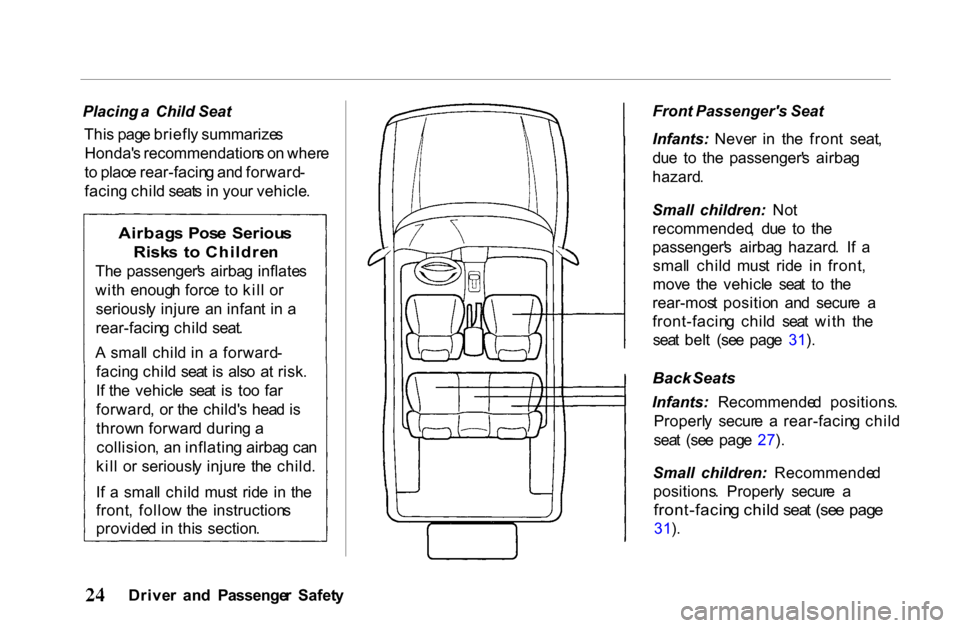
facin g chil d seat s i n you r vehicle . Front
Passenger's Seat
Infants: Never i n th e fron t seat ,
du e t o th e passenger' s airba g
hazard .
Small children: Not
recommended , du e t o th e
passenger' s airba g hazard . I f a
smal l chil d mus t rid e i n front ,
mov e th e vehicl e sea t t o th e
rear-mos t positio n an d secur e a
front-facin g chil d sea t wit h th e
sea t bel t (se e pag e 31 ).
Back Seats
Infants: Recommende d positions .
Properl y secur e a rear-facin g chil d
sea t (se e pag e 27 ).
Small children: Recommende d
positions . Properl y secur e a
front-facin g chil d sea t (se e pag e
31 ).
Drive r an d Passenge r Safet y
Airbag
s Pos e Seriou s
Risk s t o Childre n
Th e passenger' s airba g inflate s
wit h enoug h forc e t o kil l o r
seriousl y injur e a n infan t i n a
rear-facin g chil d seat .
A smal l chil d i n a forward -
facin g chil d sea t i s als o a t risk .
I f th e vehicl e sea t i s to o fa r
forward , o r th e child' s hea d is
throw n forwar d durin g a
collision , a n inflatin g airba g ca n
kil l o r seriousl y injur e th e child .
I f a smal l chil d mus t rid e i n th e
front , follo w th e instruction s
provide d i n thi s section .
Page 43 of 317
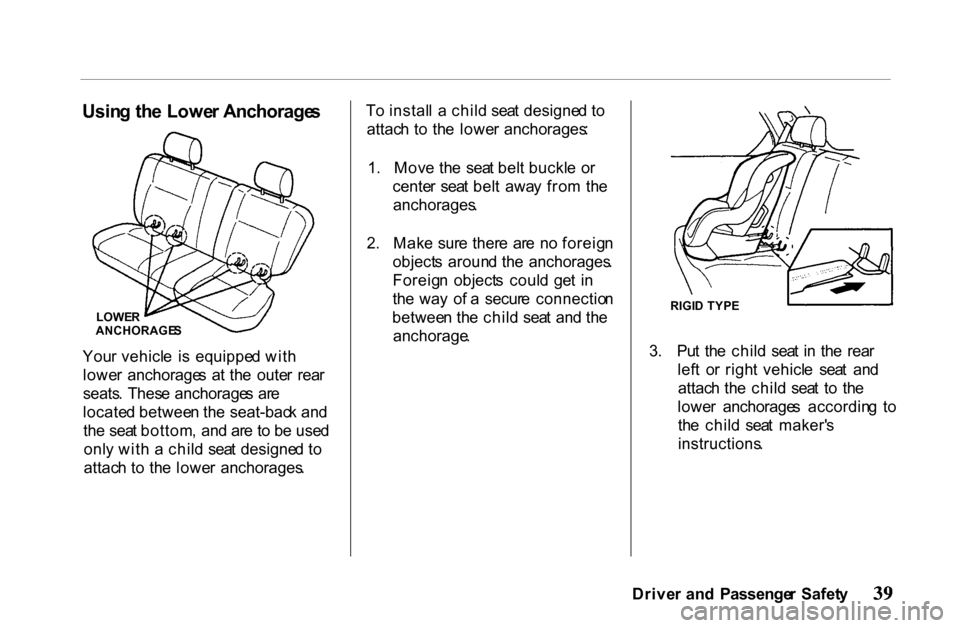
Usin
g th e Lowe r Anchorage s
You r vehicl e i s equippe d wit h
lowe r anchorage s a t th e oute r rea r
seats . Thes e anchorage s ar e
locate d betwee n th e seat-bac k an d
th e sea t bottom , an d ar e t o b e use d
onl y wit h a chil d sea t designe d t o
attac h t o th e lowe r anchorages .T
o instal l a chil d sea t designe d t o
attac h t o th e lowe r anchorages :
1 . Mov e th e sea t bel t buckl e o r
cente r sea t bel t awa y fro m th e
anchorages .
2 . Mak e sur e ther e ar e n o foreig n
object s aroun d th e anchorages .
Foreig n object s coul d ge t i n
th e wa y o f a secur e connectio n
betwee n th e chil d sea t an d th e
anchorage .
3. Pu t th e chil d sea t i n th e rea r
lef t or righ t vehicl e sea t an d
attac h th e chil d sea t t o th e
lowe r anchorage s accordin g t o
th e chil d sea t maker' s
instructions .
Drive r an d Passenge r Safet y
LOWE
R
ANCHORAGE S RIGI
D TYP E