Test your brakes from time to
time
to make sure they are
operating properly. This will also
give you a feel for how much
traction you have on a given surface. Controllin
g Steering
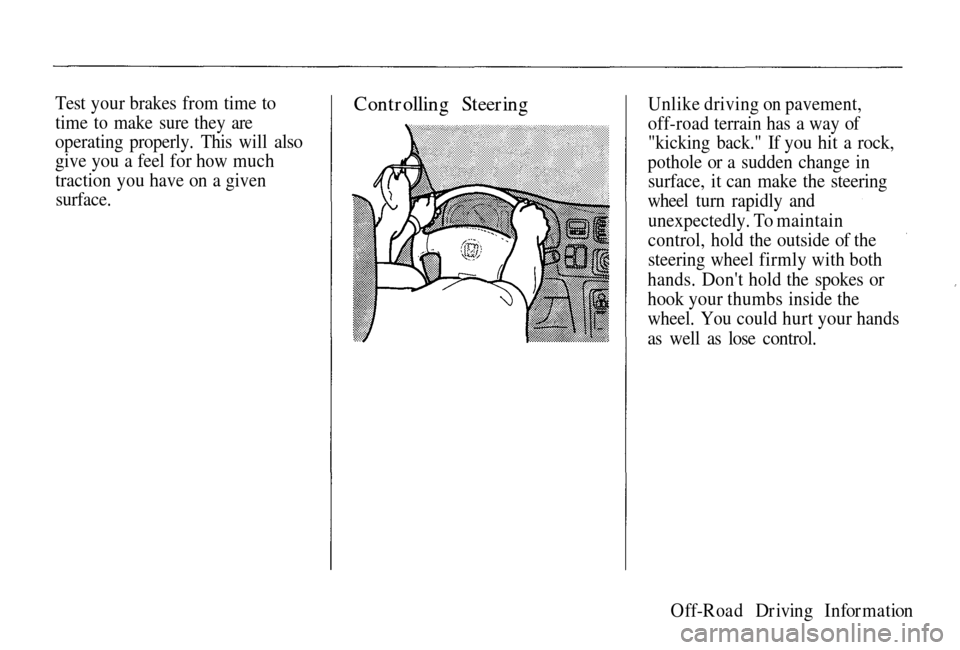
Unlike driving on pavement,
off-road
terrain has a way of
"kicking back." If you hit a rock,
pothole
or a sudden change in
surface
, it can make the steering
wheel
turn rapidly and
unexpectedly. To maintain
control, hold the outside of the
steering wheel firmly with both
hands.
Don't hold the spokes or
hook your thumbs inside the wheel.
You could hurt your hands
as well as lose control. Off-Road Driving Information
If you don't know the answers to
these questions before beginning
an ascent, stop, walk up the hill
and find out.
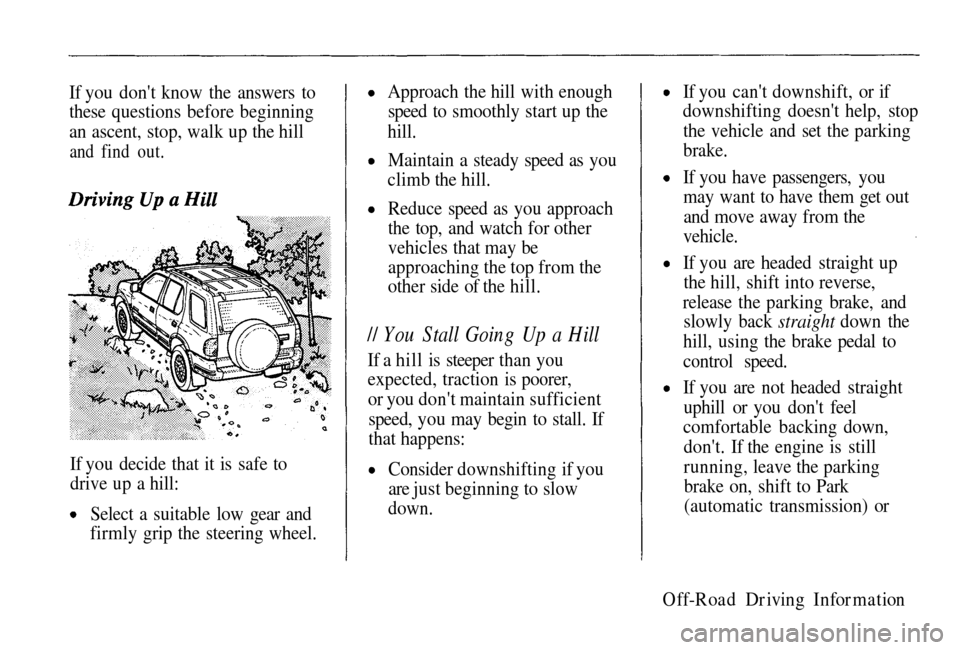
If you decide that it is safe to drive up a hill:
Selec
t a suitable low gear and
firmly grip the steering wheel. Approach
the hill with enough
speed to smoothly start up the
hill.
Maintain a steady speed as you
climb the hill.
Reduce
speed as you approach
the
top, and watch for other
vehicle
s that may be
approaching
the top from the
other
side of the hill.
// You Stall Going Up a Hill
If a hill is steeper than you
expected,
traction is poorer,
or you don't maintain sufficient speed,
you may begin to stall. If
that happens:
Consider downshifting if you
are just beginning to slow
down. If you can't downshift, or if
downshifting
doesn't help, stop
the vehicle and set the parking
brake.
I
f you have passengers, you
may want to have them get out
and
move away from the
vehicle.
I
f you are headed
straight up
the hill, shif
t into reverse,
release the parking brake, and slowly back straight down the
hill,
using the brake pedal to
control
speed.
If you
are not headed straight
uphill or you don't feel
comfortable backing down,
don't. If the engine is still
running,
leave the parking
brake
on, shift to Park
(automatic transmission) or Off-Road Driving Information