weight HONDA PASSPORT 2002 2.G User Guide
[x] Cancel search | Manufacturer: HONDA, Model Year: 2002, Model line: PASSPORT, Model: HONDA PASSPORT 2002 2.GPages: 294, PDF Size: 3.97 MB
Page 178 of 294
175Driving Tips
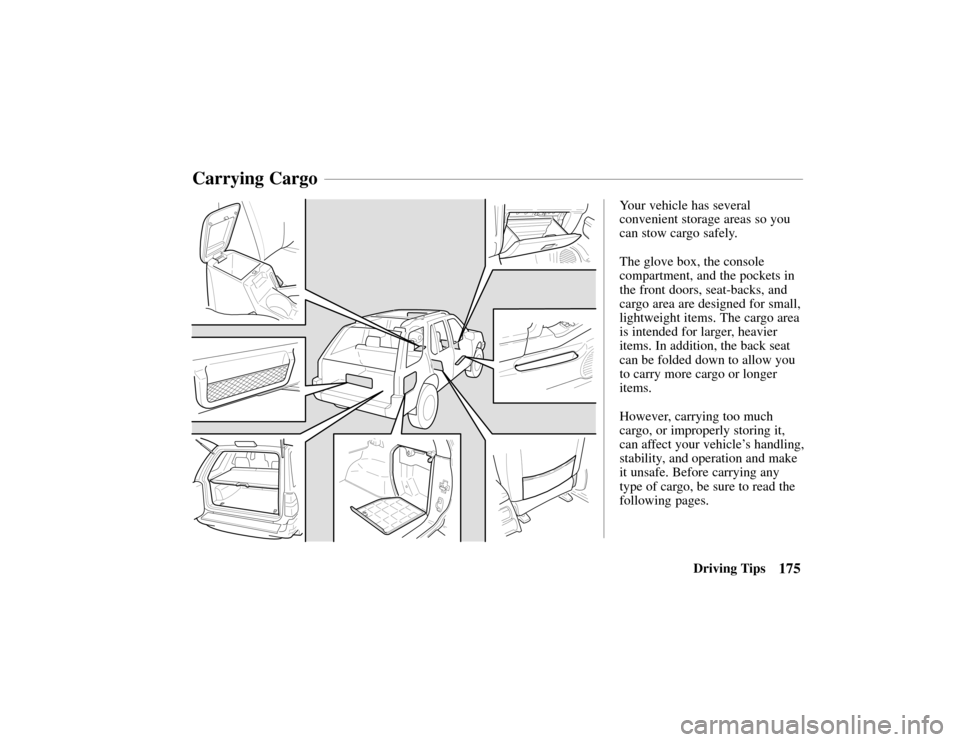
Your vehicle has several
convenient storage areas so you
can stow cargo safely.
The glove box, the console
compartment, and the pockets in
the front doors, seat-backs, and
cargo area are designed for small,
lightweight items. The cargo area
is intended for larger, heavier
items. In addition, the back seat
can be folded down to allow you
to carry more cargo or longer
items.
However, carrying too much
cargo, or improperly storing it,
can affect your vehicle
’s handling,
stability, and operation and make
it unsafe. Before carrying any
type of cargo, be sure to read the
following pages.
Carrying Cargo
Page 179 of 294

176Driving Tips
Load Limit
The maximum load for your
vehicle is:
LX 2WD
manual trans: 895 lb (407 kg)
automatic trans: 840 lb (382 kg)
LX 4WD
manual trans: 905 lb (411 kg)
automatic trans: 850 lb (386 kg)
EXmanual trans: 930 lb (423 kg)
automatic trans: 875 lb (398 kg)
This figure includes the total weight
of all occupants, cargo, accessories,
and the tongue weight if you are
towing a trailer. To figure out how much cargo
you can carry:
•Add up the weight of all
occupants.
•If you are towing a trailer, add
the tongue weight to the
number above.
•Subtract the total from the
maximum load figure.
The final number is the total
weight of cargo you can carry.
Overloading or improper
loading can affect handling
and stability and cause a
crash in which you can be
hurt or killed.
Follow all load limits and
other loading guidelines in
this manual.
Page 180 of 294

177Driving Tips
Carrying Items in the
Passenger Compartment
• Store or secure all items that
could be thrown around and
hurt someone during a crash.
• Be sure items placed on the
floor behind the front seats
cannot roll under the seats
and interfere with the driver’s
ability to operate the pedals,
or with the proper operation
of the seats.
• Keep the glove box closed
while driving. If the lid is open,
a passenger’s knees could be
injured during a crash or
sudden stop.
Carrying Cargo in the Cargo
Area or on a Roof Rack
• Distribute cargo evenly on the
floor of the cargo area, placing
the heaviest items on the
bottom and as far forward as
possible.
• If you fold down the back seat,
tie down items that could be
thrown about the vehicle
during a crash or sudden stop.
• If you carry large items that
prevent you from closing the
hatch glass or rear door,
exhaust gas can enter the
passenger area. To avoid the
possibility of carbon monoxide
poisoning, follow the
instructions on page 47.
•If you carry any items on a roof
rack, be sure the total weight of
the rack and the items does not
exceed 200 lb (90 kg).
Page 182 of 294

179Driving Tips
Follow the recommendations in
this manual and ask your Honda
dealer for further details before
you tow a trailer with your
Passport.
Towing a trailer affects vehicle
maintenance requirements due
to the additional load. More
frequent maintenance intervals
will be required to assure
continued satisfaction with
your vehicle. Consult your
Honda dealer for recommended
maintenance and service.
The gross trailer weight (trailer
weight plus cargo load) must
never exceed 4,500 lb.
Additional equipment will be
required, depending on the
specific model/load combination.
See “Trailer Hitches” in this
section.
Exceeding the weight limit will
cause damage to your vehicle and
possibly result in personal injury.
•The Gross Vehicle Weight
Rating (
GVWR) is the
combined weight of the
unloaded vehicle, passengers,
cargo, trailer hitch, trailer
tongue load, and optional
equipment. This value is
indicated on the
F.M.V.S.S.
Certification Label on the
driver ’ s doorjamb.
•The Gross Combined Weight
Rating (
GCWR) equals the
combined weight of your
vehicle (including passengers
and cargo) plus the total trailer
load. The following limits
apply.
2WD: 8,700 lb
4WD: 8,950 lb
•The Gross Axle Weight Rating
(
GAWR) is also indicated on
the Certification Label. The
load on either the front or rear
axle resulting from distribution
of the gross vehicle weight on
both axles must not exceed the
values listed. Remember to
account for additional
equipment and tongue load.
Page 183 of 294

180Driving Tips
•Tongue load should be between
9 percent and 11 percent of the
total trailer weight. However, it
should never exceed 450 pounds.
•Never load a trailer with more
weight in the rear than in the
front. The front should be
loaded with approximately
60 percent and the rear with
approximately 40 percent of
the total trailer load.
•Never exceed the maximum
weight limits of the trailer
or trailer towing equipment.
Improper loading can result in
damage to your vehicle and
possible personal injury.
•Check the vehicle and trailer
loading and the weights on
each axle at a commercial scale
or a highway patrol office
equipped with a scale.
Trailer Hitches
A Class 3 hitch kit (up to
4,500 lb) is available from your
Honda dealer.
Use a trailer equipped with
electric brakes and a “Weight
Distributing Hitch Attachment”
when the gross trailer weight
exceeds 3,500 pounds.
A special attachment that replaces
the draw bar/ball assembly is used
to distribute the proper weight to
the front axle. It uses a pair of
spring bars that are adjusted to
accomplish the distribution of the
weight.
Consult your trailer’s
manufacturer for assistance with
selecting the proper weight
distributing hitch attachment. Check with a recreational vehicle
dealer for additional required
equipment. Have this equipment
installed by a trained mechanic.
Improper equipment or installation
can damage your vehicle and
cause personal injury.
Do not use axle-mounted hitches
or equipment not designed for
your vehicle.
Do not make any modifications to
the vehicle’
s exhaust, braking, or
electrical system other than those
that are shown in the instructions
for the Honda Trailer Hitch Kit.
Improper modifications can affect
vehicle durability.
Periodic inspection of all added-
on trailer towing equipment is
necessary to assure continued safe
operation.
Page 184 of 294

181Driving Tips
Safety Chain
Always use suitable safety chains
between your vehicle and the
trailer.
Check with your trailer
manufacturer for the required
equipment. Cross the safety
chains under the hitch and attach
them to the trailer hitch hardware.
This will prevent the trailer from
dropping to the ground in the
event the hitch disengages. For
proper use and installation,
consult your trailer manufacturer.
Trailer Lights
Trailer lights and equipment must
comply with federal, state and
local regulations. Check with your
local recreational vehicle dealer
for the requirements in your area.Use only equipment designed for
your vehicle.
Improper equipment or
installation can cause damage to
your vehicle’
s electrical system
and affect your vehicle warranty.
Consult your Honda dealer for
installation.
Tires
Always check the condition of
your vehicle’ s tires and trailer ’s
tires before operation. Replace
worn or damaged tires before
operation.
Inflate tire pressure to the
recommended cold tire pressure
indicated in the tire
manufacturer ’ s warranty booklet
in the glove box packet. Check the tire manufacturer
’s
requirements when replacement
tires are installed on your vehicle.
Trailer tire condition, size, load
rating, and proper inflation
pressure should be in accordance
with the tire manufacturer ’s
specifications. Improper tire size
and inflation can cause tire
failure, possibly resulting in
vehicle damage and personal
injury.
Trailer Brakes
Trailers with a total weight of
1,000 pounds or more require
trailer brakes. If your trailer is
equipped with a braking system,
make sure it conforms to federal,
state, and local equipment
regulations.
Page 185 of 294

182Driving Tips
There are no provisions in your
vehicle to tap into its hydraulic
braking system. Any attempt to
attach the trailer
’s brakes to your
vehicle’ s hydraulic braking
system, no matter how successful
it may seem, will lower braking
effectiveness and create a
potential hazard.
Equipment Check
Before operating your vehicle,
check all safety equipment to
ensure safe operation. Be sure
your vehicle is properly serviced
to avoid mechanical failure.
Check that your vehicle remains
level when the loaded or unloaded
trailer is hitched. Do not drive if
the rear end of your vehicle is
abnormally higher or lower.
Check for proper tongue weight,
overload, improper weight distribution, worn suspension, or
other possible causes.
Make sure the trailer load is
properly positioned and secured
so its does not shift around while
driving.
Check if your rearview mirrors
comply with federal, state and
local regulations. If not, confirm
the proper mirrors required for
towing and have them installed.
Perform an equipment check of
all braking, lighting and safety
equipment to ensure they are
working properly.
Your safety depends on proper
operation and installation of
equipment. Never operate a
vehicle with faulty equipment.
Standard on 4WD models
The limited slip differential is
designed to improve traction by
limiting wheelspin. If one rear
wheel begins to spin on a slippery
surface, the limited slip
differential will automatically
transmit driving force to the other
rear wheel.
Limited Slip Differential
Page 223 of 294
220 Care and Maintenance
If the diaphragm inside the
reservoir cap is deformed, return
it to the original (collapsed)
condition, then tighten the cap.
It is normal for the brake fluid
level to go down slightly as the
front brake pads wear. So be sure
to keep the reservoir fluid at the
proper level.
If the reservoir needs frequent
refilling, it may indicate a serious
mechanical problem.
Brake fluid absorbs water from
the air. Never use brake fluid that
has been open to the air for an
extended period. Throw it away
and use new brake fluid from a
sealed container.
Brake fluid can damage your
vehicle’s paint. Thoroughly clean
up any brake fluid spills.
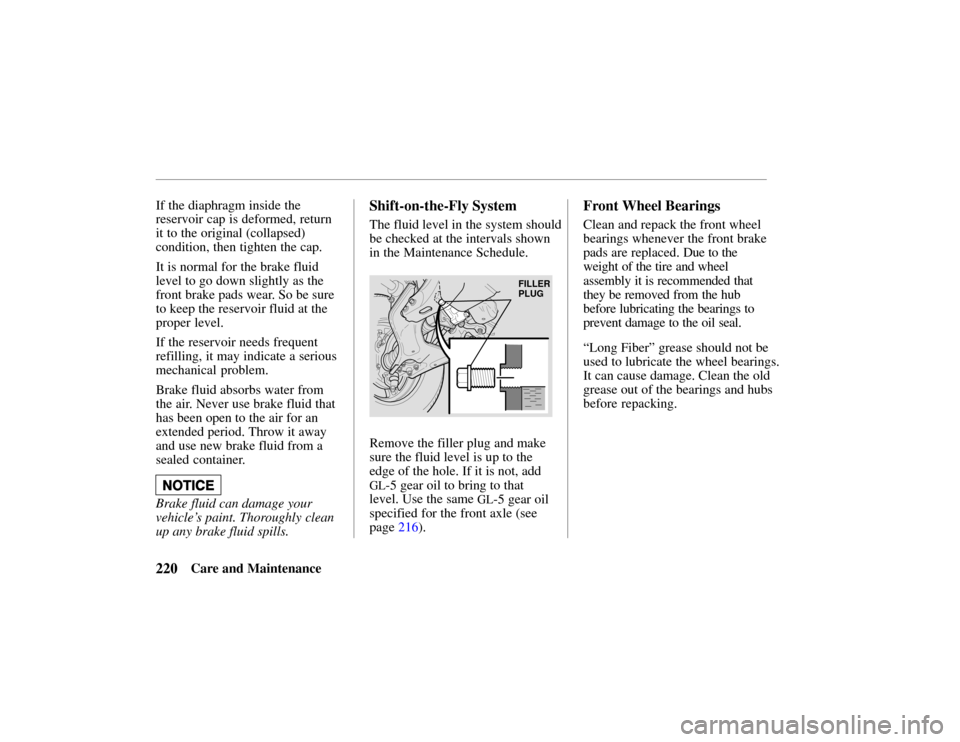
Shift-on-the-Fly System
The fluid level in the system should
be checked at the intervals shown
in the Maintenance Schedule.
FILLER
PLUG
Remove the filler plug and make
sure the fluid level is up to the
edge of the hole. If it is not, add
GL-5 gear oil to bring to that
level. Use the same
GL-5 gear oil
specified for the front axle (see
page 216).
Front Wheel Bearings
Clean and repack the front wheel
bearings whenever the front brake
pads are replaced. Due to the
weight of the tire and wheel
assembly it is recommended that
they be removed from the hub
before lubricating the bearings to
prevent damage to the oil seal.
“Long Fiber” grease should not be
used to lubricate the wheel bearings.
It can cause damage. Clean the old
grease out of the bearings and hubs
before repacking.
Page 236 of 294
233Technical Data
equipment on the vehicle when it
was shipped from the factory. Be
sure to provide this information to
your authorized Honda dealer
when it is necessary to order
parts.
Vehicle Loading Information
The components of your vehicle
are designed to provide
satisfactory service only if the
vehicle is not loaded in excess of
either the Gross Vehicle Weight
Rating (
GVWR) or the maximum
front and rear Gross Axle Weight
Ratings (
GAWRs). These ratings
are listed on the Vehicle
Certification Label located on the
left door lock pillar.
Your Honda dealer can advise you
of the proper loading conditions
for your vehicle. The use of
selected heavier suspension
components for added durability
purposes does not increase any of
the weight ratings printed on the
Vehicle Certification Label.
Maximum Front and Rear
Axle Weight
The weight of the cargo load must
be properly distributed over both
the front and rear axles. The
Certification Label shows the
maximum weight that the front
axle (front
GAWR) can carry. It
also shows the maximum weight
that the rear axle (rear
GAWR) can
carry. The
GVWR represents the
maximum permissible loaded
weight of the vehicle and takes
into account the engine,
transmission, frame, springs,
brake, axle, and tire capabilities.
Actual loads on the front and rear
axles can only be determined by
weighing the vehicle. This can be
done at highway weight stations
or other such commercial weigh
stations. Consult your Honda
dealer for assistance. The cargo
Vehicle Loading
Page 237 of 294

234Technical Data
load should be distributed on both
sides as equally as possible.
Effect on Warranty
Your Limited Warranty on your
new Honda vehicle does not apply
to any part of your vehicle that
has been subject to misuse. Any
part which fails because of
overloading is considered misuse.
Vehicle Certification Label
The Certification Label shows
the
GVWR and the front and rear
GAWRs for your vehicle.
Gross Vehicle Weight (
GVW) is
the weight of the originally
equipped vehicle and all items
added to it after it has left the
factory. This includes the driver
and all occupants, and the load the
vehicle is carrying. The
GVW
must not exceed the GVWR. Also,
the front and rear gross axle
weight must not exceed the front
and rear
GAWRs.